 |
|
 |
|
|
|
|
This page illustrates the various types of personal vehicle license plates currently or recently seen on the streets of Maryland, with the exception of organizational member plates and military service plates. Those plate types are addressed on a separate page. Latest noteworthy updates to this page
|
|
This page illustrates the various types of personal vehicle license plates currently or recently seen on the streets of Maryland. Not included on this page, however, are organizational member and military service plates, of which there are many hundreds of varieties. Though they're also issued to personal vehicles, their sheer numbers make them worthy of their own separate page.
The black-on-white reflective bases with the screened, script Maryland have been in continuous use since February 1986, and aside from a few graphic special interest plate types, were the only valid Maryland plates between October 1, 1987 and June 13, 2010. According to the state, these plates are considered to be permanent, and so there are apparently no plans for a replate in our lifetimes. Subsequently, other standard base plates have been issued to several personal vehicle types, including passenger cars and motorcycles, while the black-on-white base continues to be issued to new registrants of other vehicle types, including some personal vehicle types. In most instances, Maryland plates are issued in pairs, and month and year expiration stickers are applied only to the rear plate.
Please note that, although a good number of the plates shown on this page are from my personal collection, I've shown plates from a variety of sources. Several plates shown belong to other collectors; some of these I photographed and some were photographed by their owners. The plates shown with bolts attaching them to vehicles are photographs of plates in actual use. Primarily, these are photos I've taken; some have also been photographed by others. Any photograph that I didn't take, and any plate that isn't from my collection, is indicated with appropriate credits. All photographs taken by others are used with permission. Oh, and if you're wondering what that arc of light is on some of the candid shots, it's just a reflection from my camera. I get this when I have to shoot towards the sun due to the position of the vehicle. (Remember when cameras were black and didn't reflect light?)
I sincerely hope that you find this information useful. If you find an error or have additional information, or can provide a plate, or a photo of a plate that is not shown, please send me an e-mail. There's a link to my e-mail address at the bottom of every page.
Move your mouse over each image to see a description of that plate. Click on any image to see a larger version.
Standard-issue, black-on-white passenger car plates were issued to regular cars and station wagons only. They were not issued to mini-vans, SUVs, pickup trucks, motor homes, buses, or anything else that commonly receives passenger plates in other states. All mini-vans, SUVs, and motor homes getting standard-issue plates were instead issued multi-purpose vehicle (MPV) plates, which are addressed in the next section this page. Pickup trucks received the same standard-issue truck plates as do big commercial trucks; these are also covered further down on this page.
This all changed on June 14, 2010, when a new standard-issue base plate was introduced for serveral personal vehicle plate categories. Since then, sedans, station wagons, SUVs, mini-vans, motor homes, and regular trucks all share the same numbering format and sequence. Essentially, the MPV and regular truck plate types has been discontinued, and both MPVs and trucks are now issued passenger car plates.

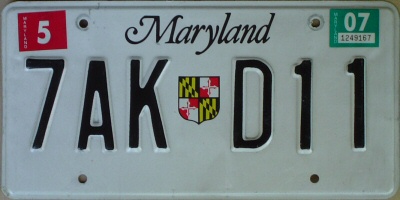

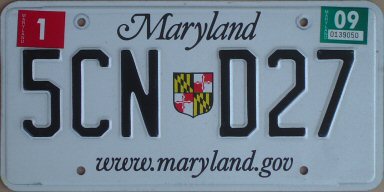
Three versions of standard passenger car plates: Numbering format xxx*000 without website issued
1986-2004; numbering format 0xx*x00 without website issued 2004-2005; numbering format
0xx*x00 with website issued 2005-2010.
Maryland passenger plates were issued with serial format xxx*000 from February 1986 until September 2004, when the format was finally used up. This format probably began at NAA*002 or thereabouts, and reached ZZZ*999 in the fall of 1992. The N series was chosen as the starting point so as not to conflict with the previous base that would still on the road through September 1987, which had been issued in the A through K series. Serial numbers NAA*000 and NAA*001 were used on sample plates; otherwise, triple-zero serial numbers are not issued. Letters I, O, Q, and U are avoided. In the fall of 1992, the serials rolled over to AAB*001, skipping the AAA series according to one report, and kept going until MZZ*999 was issued in September 2004. After the 1986-1987 replate was completed, this format went through about one letter series per year. All of these plates, even the oldest N-series plates issued in 1986, remain valid if continuously registered.
In September 2004, a second serial format 0xx*x00 was introduced; this format would have probably lasted a good 15 to 20 years before it ran out of combinations. In this format, the first digit before the letters is never a zero, and letters I, O, Q, and U are still avoided. This format began at approximately 1AA*A01; all numbers change before the first letter changes. For example, after plate 1AA*A99 came 2AA*A01, and after 9AA*A99 came 1AA*B01.
Starting at plate number 1AL*A01, the state government web site address, www.maryland.gov, was added to the bottom edge of the plate. These web site passenger car plates were first seen in use approximately February 2005. The last of the passenger car plates on this base were issued on Friday, June 11, 2010, in the early G series.
Standard Maryland passenger car plate made by New Jersey.
Maryland passenger car plates began to be seen with New Jersey-style serial characters in November 2006. Maryland arranged for the state of New Jersey to stamp out a total of nearly 35,000 pairs of plates for them, including nearly 20,000 passenger car plates, due to the Maryland plate manufacturing facility at the state prison in Jessup being shut down for three weeks due to inmate unrest. New Jersey serial character dies are much more squared-off than the rounded Maryland dies. Passenger car plates made with New Jersey serial characters have plate numbers between 1CN*A01 and 9CN*Z99. Maryland serial character plates resumed being issued in December 2006 at about plate number 1CP*A01, but New Jersey character plates continued to be issued into February 2007.
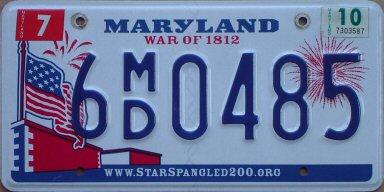
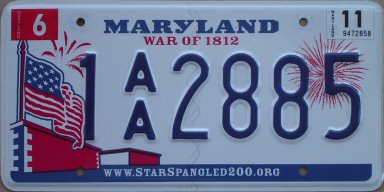

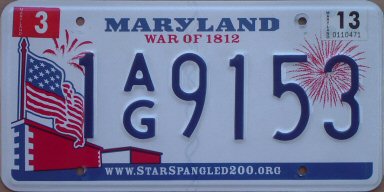
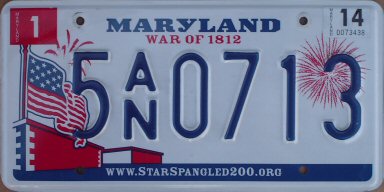
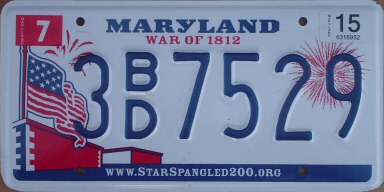
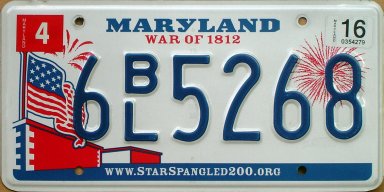
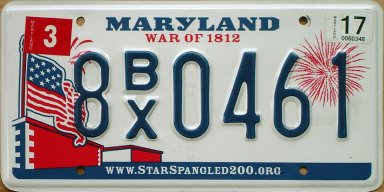
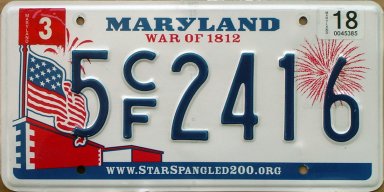
Standard War of 1812 base passenger car plates with natural 2010 through 2018
expirations.
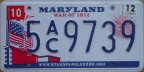
After over 24 years of essentially the same design, on Flag Day, Monday, June 14, 2010, Maryland introduced this graphic plate commemorating the War of 1812, and specifically the Battle of Baltimore, during which the words to the Star-Spangled Banner were written by Marylander Francis Scott Key. However, desipite the graphics, this plate was not another extra-cost, optional plate like the Treasure the Chesapeake and Our Farms, Our Future plates. Rather, it was the standard plate issued for all new registrations of passenger cars and several other personal vehicle types. Passenger cars, multi-purpose vehicles (MPVs; that is, SUVs, mini-vans, and motor homes, mostly), and regular trucks all shared this odd 0A/A0000 serial format. The full-sized, sequentially-numbered plate has a larger flag graphic than is used on some of the other plate types. Unfortunately, this large flag causes some legibility issues. The leftmost serial digit crowds the flag and is therefore difficult to read.
Initially, plates were issued in the M/D series as shown above; but then, plates were issued in the A/A series, and subsequent letter series have advanced sequentially. After plate number 9A/Z9999 was issued, the plate numbers continued into the B/A series. It's not hard to figure out that the significance of the M/D designation is that Md. is the abbreviation for Maryland, but why the Maryland MVA saw fit to issue these first is anyone's guess; they did not just go to VIPs or cost extra. Again, the first digit cannot be a zero, so the lowest number issued on this base was 1M/D0000. These plates were issued through Friday, September 23, 2016, and have been seen with plate numbers as high as the mid C/N series. I believe that these were manufactured with plate numbers as high as 7C/N9999, and that many thousands of plates from the mid C/N series up to that number were never issued and were destroyed.
The state did not autmatically replace older-design plates with War of 1812 plates, however. Black-and-white plates currently in use remain valid and continue to be renewed with updated year stickers. However, motorists who wanted to trade in their old plates for new ones could do so upon payment of a $20 plate replacement fee, either at registration renewal time, or earlier if they so chose. That's one of a few reasons why expiration stickers prior to June 2012 can be found on these plates, such as the 2010 and 2011 expirations shown above.
Standard motorcycles plates, and also vanity and/or handicapped plates in both standard-sized and motorcycle-sized versions, were also produced on the War of 1812 base; these are addressed in more detail in their respective sections on this page. Other vehicle classes have continued to be issued the old-design black-on-white plates.

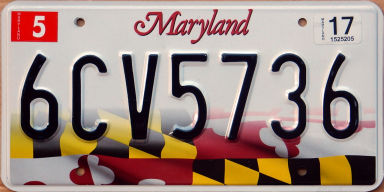
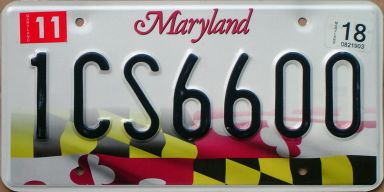

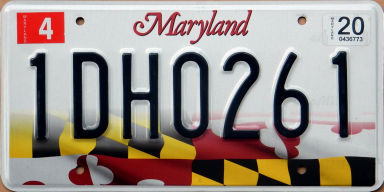
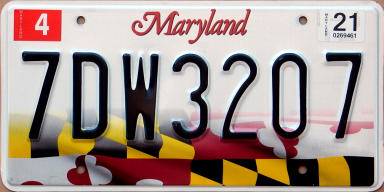
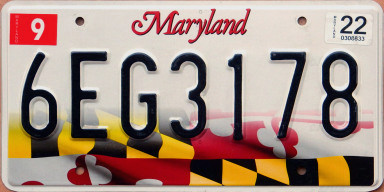
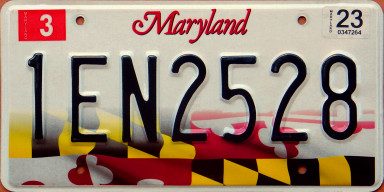
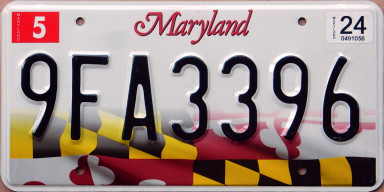

Standard "Maryland Proud" base passenger car plates with natural 2016 through 2025 expirations.
Beginning Monday, September 26, 2016, Maryland began issuing what they call the "Maryland Proud" plate design to new registrants of passenger cars and all other vehicle types and plate types that had been previously issued War of 1812 plates. "Maryland Proud" plates consist of black characters on a white background, with a graphic of the state flag along the bottom edge of the plates. The state name uses the same font as the previous black-on-white plates, but it's noticeably smaller, and is colored red and outlined in black, rather than being solid black.
Numbering for all plate types picked up from where it had ended on the previous plate design. In the case of passenger car plates, the numbering format is unchanged, but the serial letters are not stacked one above the other. Passenger car plate numbering on this base began at 8CN0000. As on the previous base, the letters advance after all numeric digits, including the first one, and the first digit cannot be a zero.
Agian, the state is not autmatically replacing older-design plates with "Maryland Proud" plates. Both black-on-white plates and War of 1812 plates currently in use remain valid and continue to be renewed with updated year stickers. Motorists who wanted to trade in their old plates for new ones may do so upon payment of a $20 plate replacement fee, either at registration renewal time, or earlier if they so choose.
Standard motorcycles plates, and also vanity and/or handicapped plates in both standard-sized and motorcycle-sized versions, are also produced on the "Maryland Proud" base; these are addressed in more detail in their respective sections on this page. Other vehicle classes continue to be issued the old-design black-on-white plates.

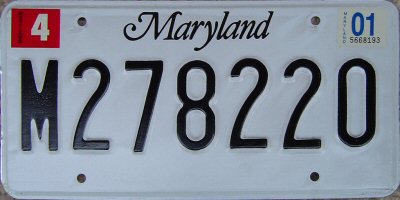
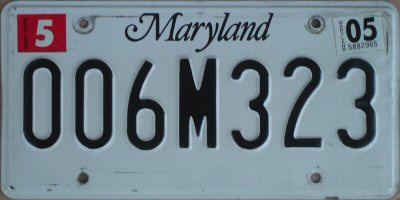
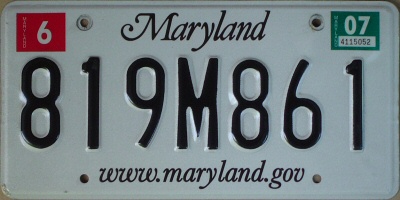
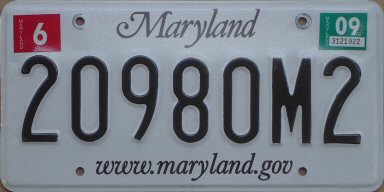
Standard multi-purpose passenger vehicle plates in various serial formats with 1993, 2001, 2005, 2007, and 2009
expirations
Multi-purpose passenger vehicle (MPV) plates were issued to a variety of vehicle types. They were issued to all SUVs and mini-vans, so these plates were nearly as common as passenger car plates and more common than truck plates. MPV plates were also issued to full-sized passenger vans, motor homes, and not-for-hire buses, regardless of whether the vehicle is driven for personal use or commercial use. Surprisingly, all three-wheeled vehicles also received MPV plates until a few years ago. Recently, I believe only enclosed-body three-wheeled vehicles got them; open three-wheeled vehicles are now classified as motorcycles.
Several serial formats were used, but they all involved six numeric digits and the letter M. The initial serial format issued from 1986 until about the late 1990s was 000000M; the second format, issued from about the late 1990s through about 2002, was M000000. The third format, issued from about 2002 until the spring of 2007, was 000M000. In January 2005, MPV plates were the first plate type to be issued with the www.maryland.gov web site address added to the bottom of the plate, beginning at about serial 480M000. The fourth and last serial format, first issued in April 2007, was 00000M0.
Effective June 14, 2010, multi-purpose passenger vehicles being issued new plates now get passenger car plates. MPV plates were in the early 60000M0 series when they stopped being issued. MPV plates issued prior to that date remain in use if continually registered.
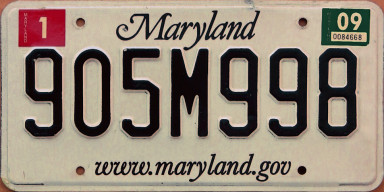
Standard Maryland MPV plate made by New Jersey.
MPV plates were also the first plate type to be seen with New Jersey-style serial dies in October 2006. 15,000 pairs of MPV plates were made in New Jersey, with serial numbers between 895M000 and 909M999. The Maryland serial dies resumed being issued in November 2006 at about serial 910M000, but New Jersey die MPV plates continued to be issued into January 2007.
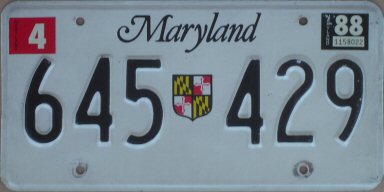

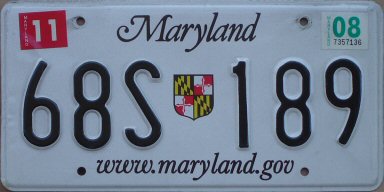
Standard regular truck plates with all-numeric format issued 1986-1992, one-letter format with no web address issued
1992-2005, and one-letter format with the web address issued 2005-2010.
Personal light trucks such as pickup trucks were issued these regular truck plates, along with most types and all sizes of commercial straight trucks and cargo vans. Other plate types issed only to specific kinds of commercial trucks are covered on a separate page.
Regular truck plates were first issued in February 1986 in serial format 000*000, beginning at about serial 300*000 to avoid conflicting with motorcycle serial numbers from the previous base still in use. Serial 999*999 was reached after only a couple of years, and the format rolled over to approximately serial 000*001 and continued until 299*999 was reached in the spring of 1992. A second format 00x*000 was then begun, and was used until this plate type stopped being issued in June 2010. With this format, all numbers change before the letter changes. Both of these formats are still in use, although the all-numeric plates are now seen infrequently. The web site address was added to the bottom of the plate in 2005 at about serial 23R*000.
Effective June 14, 2010, regular trucks of all weight classes being issued new plates now get passenger car plates. Regular truck plates on the shield base were in the upper "X" series when they stopped being issued.
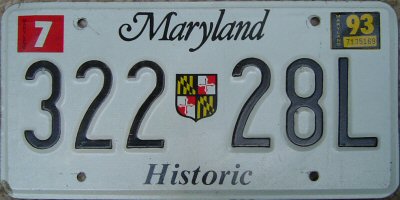
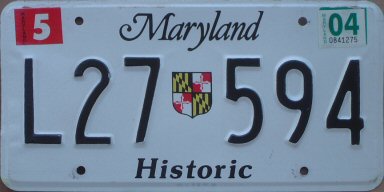
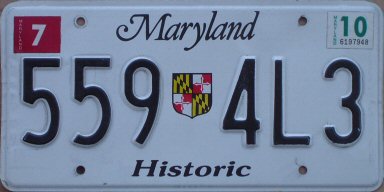

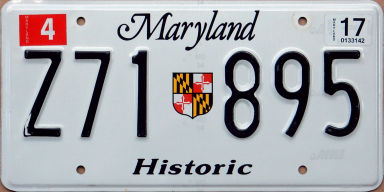
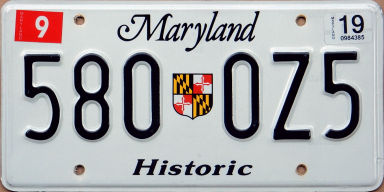

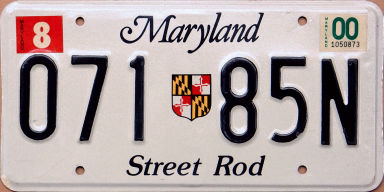


Regular historic vehicle formats 1 through 6;
regular historic vehicle format 7 (plate in actual use); regular street rod;
50 year historic vehicle and street rod (both plates in actual use).


Regular historic vehicle converted from biennial to permanent registration;
regular historic vehicle with natural permanent registration;
50 year historic vehicle with permanent registration
(all plates in actual use).
Standard historic vehicle plates and street rod plates continue to be issued on the black-on-white "shield" base. Both historic vehicles and street rods are eligibile for the commemorative 1910 Vintage specialty plates issued only during 2014, which are addressed in the next section below. Historic vehicles and street rods are not eligible for other types of specialty plates.
To qualify for historic plates, a vehicle must generally be over 20 years and in basically stock condition, and must be driven infrequently. Historic plates were initially assigned serial format 000*00L, with the "L" indicating the vehicle class code, and with the screened legend Historic at the bottom of the plate. This format was eventually used up, and this plate type progressed through second format L00*000 and third format 000*0L0. Then, in the spring of 2010, the fourth format hit the streets, but in a completely unexpected and head-scratching format 000*00Z, using a suffix letter that has nothing to do with the vehicle class. That format has been used up, too, as have fifth format Z00*000 and sixth format 000*0Z0. At this writing in 2019, a seventh format 000*Z00 is being issued.
|
Permanent registration sticker for historic vehicle 60 or more years old |
According the Maryland Motor Vehicle Administration, a historic vehicle 60 years or older may obtain a one-time, permanent, non-transferable registration. This option has only been in effect since January 1, 2007, and it's available only to historic vehicles, not street rods. These permanent registrations are indicated with a white-on-black sticker with the words Maryland Historic Permanent in place of an expiration year sticker. Such permanent regisrations are charged a one-time fee of $50, rather than the biennial (once every two years) $51 registration fee that non-permanent historic vehicles and street rods are charged.
Historic vehicle plates may be ordered with vanity registration numbers. Examples of these are shown in the "combination plates" section, below on this page. Motorcycles are also eligible for historic plates, available with either sequentially-issued or vanity registration numbers. These are addressed in the motorcycle plate section, further down this page.
Street rods are heavily modified or customized vehicles; vehicles receiving street rod plates must be over 25 years old and driven infrequently. Street rod plates have serial format 000*00N, with the "N" indicating the vehicle class, and with the screened legend Street Rod displayed along the bottom of the plate.
Street rod plates may also be ordered with vanity registration numbers; these are shown in the "combination plates" section, below. Motorcycles are eligible for street rod plates, available with either sequentially-issued or vanity registration numbers. These are addressed in the motorcycle plate section, further down this page.
Beginning in early 2016, Maryland began issuing specific plates for historic vehicles and street rods over 50 years old. These plates are black-on-white, have the text 50 Year Historic or 50 Year Street Rod at the bottom, and use serial formats L0000x or N0000x, without any shield graphic, respectively. Strangely, they're only issued as single (rear) plates. Otherwise, there seems to be no reason for these plate types to exist, and yet they do. The fees, restrictions, etc. are no different for vehicles 50 or more years old vs. those under 50 years old. Vehicles at least 60 years old can pay a one-time fee and get the permanent historic sticker described above, while those between 50 and 60 years still have normal two-year registration periods and get normal month and year expiration stickers.
It turns out that the reason for these 50 year plates is precisely because they're issued as single plates. A state law was passed that allowed vehicles over 50 years old to only display a single, rear plate. Law enforcement needed a way to distinguish between historic vehicles and street rods that were allowed to display one plate from those that were not, and the solution was to introduce these two 50 year plate types.
Maryland only offers two true special interest plates that are available to anyone, directly through the Motor Vehicle Administration - the well-known Chesapeake and Our Farms, Our Future plates. These plates have completely different designs than the standard-issue plates. While these plates are used to raise money for specific organizations, unlike organizational member plates, the MVA collects the money from the registrant and distributes it to the groups after the plates are issued. No actual affiliation with any organization is necessary.
Maryland also briefly offered the plain black-on-yellow 1910 Vintage special interest plate to the general public. These plates did not support any organization.
(All of these special interest plates are also available with vanity registration numbers, with a wheelchair symbol for use by handicapped motorists, or both. These are covered in the handicapped and vanity plate sections further down this page.)
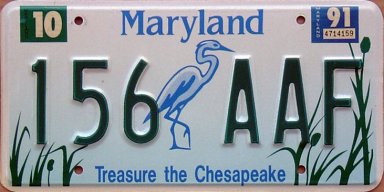
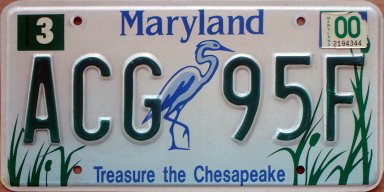
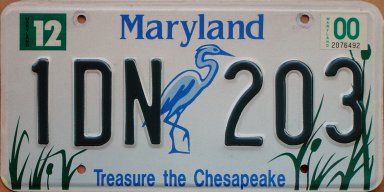
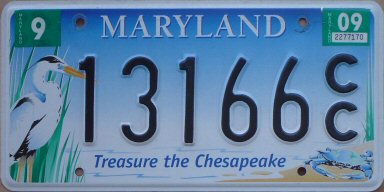
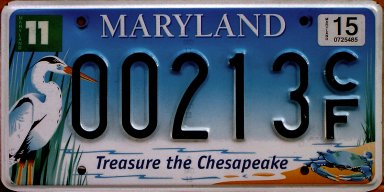
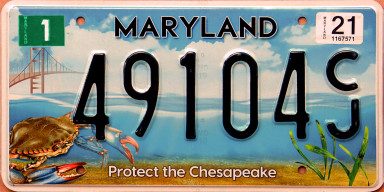
First-generation Treasure the Chesapeake passenger car, multi-purpose vehicle, and light truck
plates; two second-generation Treasure the Chesapeake motor vehicle plates;
third-generation Protect the Chesapeake motor vehicle plate.
For many years, the only alternative to the standard black-on-white plates was the green-on-white/blue fade Treasure the Chesapeake environmental plate with the blue heron in the middle of the plate. This plate was available to new registrants from 1991 through 2003. Cars, MPVs, light trucks, taxis, and trailers were all eligible for this plate, and different serial formats were issued for each vehicle type. Cars received plates in format 000*xxx, MPVs got plates in format xxx*00x, and light trucks up to 10,000 pounds gross vehicle weight got format 0xx*000. Taxis and trailers were issued plates in format x00*000. Although no longer issued, these plates remain valid if continuously registered.
In January 2004, a redesigned and more modern-looking Treasure the Chesapeake plate made its debut, with a black-on-blue/white fade color scheme, and a full-color blue heron at the left of the plate. On this plate, cars, MPVs, light trucks, taxis, and trailers all share a single serial format 00000x/x, with trailer plates restricted to a specific serial number range. (At some point, the state stopped issuing specialty plates to taxis; I'm not sure if they recalled the ones that were in use.) Suffix letters issued to motor vehicles were initially C/B, then B/Y, then C/A, and then began advancing sequentially beginning with C/C and continuing until partway through the C/H series. Most, if not all of the plates in the C/F series, and possibly also some plates in adjacent letter series, have significantly darker blue backgrounds as shown by the example above. Trailers received plates with suffix letters G/A. This design is also now discontinued but plates already in use continues to be valid.
Maryland introduced yet a third Chesapeake Bay design in October 2018. This one substitutes an image of one of the Chesapeake Bay Bridge spans in place of the blue heron featured on the previous generation plates. It also has a revised legend across the bottom, now Protect the Chesapeake instead of Treasure the Chesapeake. Eligible vehicle types and numbering formats are unchanged, and motor vehicle plate numbering continued uninterrupted from the second-gen Chesapeake plate, starting at 50000 C/H.
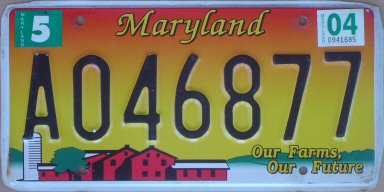
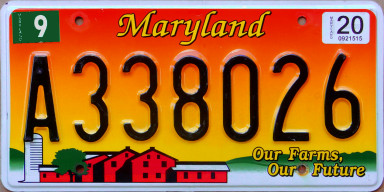
Our Farms, Our Future non-farm motor vehicle plates.
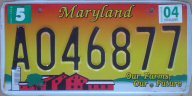
In early 2001, a second optional plate was offered, a loud black-on-orange/yellow fade Our Farms, Our Future agricultural plate. This plate is issued in a common serial format, A000000, shared by cars, MPVs, light trucks, taxis, and trailers; however, trailer plates are limited to the A900000 series. Farm trucks can also get this plate in a different serial format, F/T 00000.


2014 1910 Vintage plate for a modern car, multi-purpose vehicle, or light truck
(Crum photo / plate). 1910 Vintage historic vehicle
unstickered front plate (Davis photo / plate).
In January 2014, the Maryland Motor Vehicle Administration began offering rather plain, black-on-yellow optional plates with the words 1910 Vintage at the bottom, as shown above. It wasn't the MVA's idea to issue these plates, however. A law passed by the state legislature and signed by the governor in May 2013 required the MVA to issue for a period of one year a "special vintage reproduction plate" that resembled the first Maryland state-issued plates from 1910. So, this plate was only issued through December 31, 2014. Anyone who obtained a set by then may continue to use them, but they're no longer available to anyone else.
Although the law provides few clues as to the motivation for such a plate, some of the draft versions of the bill that wound its way through the legislature do. Maryland law allows for original, vintage state-issued plates to be used on historic vehicles whose model year matches the year on the plates. Two matching vintage plates must be used on the front and back of the vehicle, respectively. 1910 was the first year for state-issued Maryland plates, but the 1910 plates were crudely made using inferior materials and methods, and relatively few have survived to the present day. Those that have are generally rather beat-up looking, and cannot be restored to anything approximating their original codition. Extremely few matched pairs of 1910 plates are still in existence. It seems that owners of 1910 antique cars wanted the state to authorize a replica 1910 plate that they could legally use instead of the original 1910 plates or modern Historic plates.
 Actual 1910 plate (Ritterhoff plate) |
The resulting 1910 Vintage plate looks nothing like the actual 1910 plate, shown at right, other than the colors being more-or-less the same. The law required that the reproduction plate resemble the original plate, but provided no specific details other than the color scheme. It seems that the MVA either had no idea what a real 1910 plate actually looked like, or they didn't care, and just chose to follow the letter of the law rather than to honor its intent.
1910 Vintage plates are authorized for use not only on 1910 model vehicles, but on all
years of historic vehicles and street rods, as well as on all modern passenger cars, multi-purpose vehicles, and trucks up
to one ton capacity. Sequentially-numbered plates for cars, MPVs, and trucks all share serial format
VR00000, with the lowest plate number issued to the general public apparently being
VR00301. According to one source, plate numbers VR00001 through VR00300 were reserved for VIPs, presumably people
with political connections. Sequentially-numbered handicapped plates use format
VR0000 .
I've also seen photos of several 1910 Vintage vanity plates.
.
I've also seen photos of several 1910 Vintage vanity plates.
Sequential plates for historic vehicles and street rods use formats VL00000 and VG00000, respectively. I have not actually seen the street rod version, but I assume it has a corresponding designation on the plate similar to the historic vehicle plate shown above.

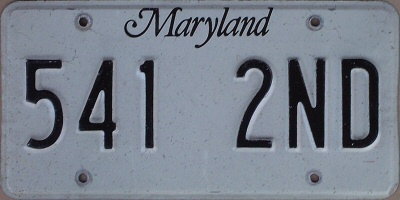
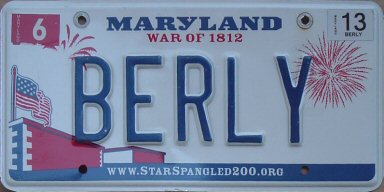

Standard base vanity plates (plate WSCONSN photographed in actual use).
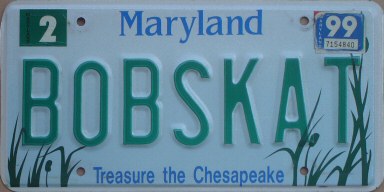


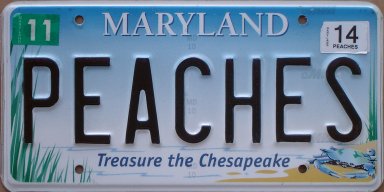
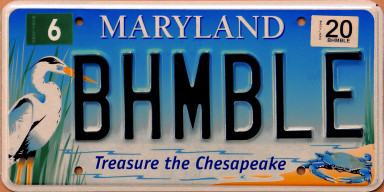

Special interest base vanity plates
(plates KLF NAF and P TO photographed in actual use; CMPOINT is a Mattes photo of a plate in actual use).
Vanity plates have been made for cars, light trucks, and multi-purpose vehicles on the various standard bases, as well as the Chesapeake, Our Farms, Our Future, and 1910 Vintage special interest plates; the latter is also available for historic vehicles and street rods. The so-called "Maryland Proud" design with the state flag graphic along the bottom edge became the standard base for vanity plates on September 26, 2016. The two different Treasure the Chesapeake designs, standard black-on-white plates, and standard War of 1812 plates are no longer issued, but continue to be valid if continuously registered.
The maximum number of characters and spaces on all of these plates is seven. The shield logo was omitted on all vanities on the standard black-on-white base, and the blue heron graphic was omitted on all green-lettered, first-generation Chesapeake vanity plates, regardless of the number or spacing of characters on either plate. On the black-on-blue, second-generation Chesapeake plate, the bird graphic is to the far left rather than centered; vanity plates on this base with six or fewer characters and spaces contain the bird graphic; those with seven characters and spaces have the bird omitted from the plate. The War of 1812 vanity plates have slightly different graphics than used on the sequentially-numbered passenger car version; the U.S. flag is significantly smaller. Despite that, on seven-character plates, the first character is nevertheless stamped right over top of the flag and is hard to read.
From the examples I've seen, it appears that no graphic elements are omitted on seven-character, third-generation Protect the Chesapeake special interest plates.
Vanity plates on the black-on-white base were only briefly issued with the www.maryland.gov legend at the bottom in 2005; after that, the legend was once again omitted on new issues. Perhaps the state thought including the web address somehow constituted a state endorsement of the message the vanity plate conveyed.
Vanity registrations are also available on handicapped plates, standard historic vehicle and street rod plates, regular motorcycle plates, handicapped motorcycle plates, historic motorcycle plates, and street rod motorcycle plates; all of these are addressed further down the page.

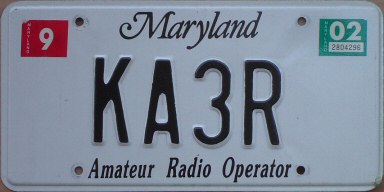
(Plate W3YZL: Ellis photo of plate in use)
Amateur radio operator plates are issued with the serial number that matches the radio operator's call sign, up to seven characters. They differ from vanity plates in that they carry the screened legend Amateur Radio or Amateur Radio Operator at the bottom center. Amateur radio plates are available for passenger cars, multi-purpose vehicles, and trucks up to 1 ton capacity. The same style plates are issued to all of these vehicle types.
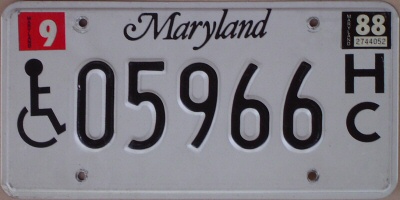


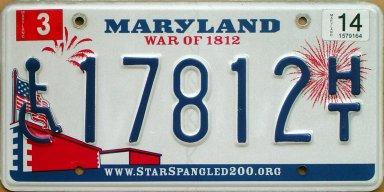
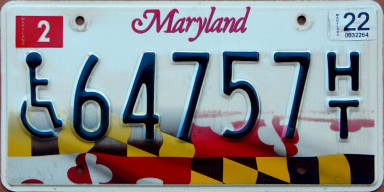

Standard base handicapped plates: Version 1 with screened wheelchair symbol and suffix leetters; version 2 with
embossed wheelchair and suffix letters but no web site; version 3 with state web site legend and H/V suffix,
another version 3 with H/T suffix (Ellis photo of plate in use),
War of 1812 base, "Maryland Proud" base, and disabled veteran.
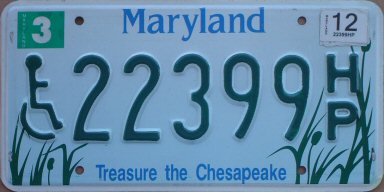
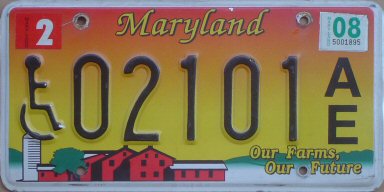


Special interest handicapped plates:
first generation Chesapeake,
Our Farms version 1 with screened suffix letters,
Our Farms version 2 with embosssed suffix letters (unstickered front plate;
plate in use), second-generation Chesapeake.
 Long-term handicapped windshield placard |
Handicapped persons have the option of obtaining either handicapped license plates, or standard plates with a long-term handicapped placard to be hung from the vehicle's inside rear view mirror.
Regular handicapped plates on the standard black-on-white base were issued with the wheelchair graphic at the far left, in serial format 00000x/x, where the letters issued were H/C, H/D, H/V, and H/T, in that order. Presumably the letter H stands for handicapped; apparently the variable second letter has no hidden meaning. There is no distinction between handicapped car vs. truck or multi-purpose vehicle plates. H/C series and early H/D series have a screened wheelchair graphic and alpha suffix; beginning at about 36000H/D, and continuing into the H/V and H/T series, these elements are embossed. The state's web site address began appearing on standard handicapped plates in 2005 at approximatly serial number 69000H/V. The state was issuing handicapped plates in the early H/T series when this base was discontinued in June 2010. Existing plates on the reflective white base may continue to be renewed, however.
On June 14, 2010, Maryland introdued a new War of 1812 standard base plate for several personal vehicle plate types, including handicapped plates. On this base, the serial format continued unchanged, and serial numbers began without interruption in the early H/T series. Despite using a slightly different graphic than on passenger car plates, with a smaller U.S. flag, the embossed wheelchair symbol is nevertheless stamped directly over the flag graphic, making both the wheelchair and the flag difficult to see. To me, at least, it seems disrespectful to the flag to stamp over it this way. The wheelchair also appears to be rolling down a red handicapped ramp on this plate.
On September 26, 2016, the state discontinued the War of 1812 base and introudced another new standard base plate for the same plate types. This new "Maryland Proud" base features a graphic of the state flag along the bottom edge. Handicapped plate numbers on this base again pick up where the previous base left off, starting in the mid H/T series.
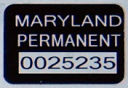 Disabled veteran permanent registration sticker |
Disabled veterans (veterans who are truly handicapped, not necessarily members of the Disabled American Veterans organization) are issued plates with the wheelchair graphic at far left, followed by a serial number in format DV0000. These plates carry the screened legend Disabled Veteran at the bottom. These plates are free of charge to the registrant.
Starting in September 2016, disabled veteran plates get a white-on-black sticker for the rear plate with the words Maryland Permanent. Despite being free, I believe these plates were used with month and year expiration stickers prior to September 2016. The plate shown was apparently originally issued prior to September 2016, based on the presence of the month sticker.
Non-veteran handicapped plates were also available on the two discontinued Treasure the Chesapeake bases, and are available on the current Our Farms, Our Future and Protect the Chesapeake bases. On the green-lettered Treasure the Chesapeake base, the plate featured the wheelchair grapic on the left, followed by a serial in format 00000H/P; the screened bird graphic was omitted. On the Our Farms base, again the wheelchair graphic is at the left, followed by serial format 00000A/E. I have no idea what the letters AE signify, if anything. The handicapped format for the black-lettered Treasure the Chesapeake plate was 0000D/x, with the screened bird graphic in its normal position on the left edge of the plate, and the wheelchair graphic to the right of the stacked letters. The current Protect the Chesapeake handicapped plate continues with the right-justified 0000D/x numbering format with the embossed wheelchair to the right of the plate number from the second-gen plate, beginning at about number 0300D/B.
Sequentially-numbered 1910 Vintage handicapped plates use format
VR0000.
I presume 1910 Vintage handicapped plates are also availabale with vanity plate numbers.


Low speed vehicle (Ellis photo of plate in use); island vehicle or farm area truck
(plate in actual use)
Low speed vehicle plates were introduced in January 2006. A low speed vehicle is defined as a four-wheeled electric vehicle designed to carry no more than four people, with a maximum speed between 20 and 25 miles per hour, that meets certain federal safety standards. In some other states these are referred to as "neighborhood electric vehicles". The plates make these vehicles street-legal. However, golf carts are explicitly not eligible for low speed vehilce plates, probably because they don't meet the safety standards. Low speed vehicles can be either personal-use or commercial-use vehicles. At least one such vehicle has been spotted in use as a taxi, and wearing low speed vehicle plates rather than taxi plates.
Two full-sized plates are issued, but the serial format is 000R00, with no sheild separator and no spaces between any of the characters. It seems like these were intended to be issued on motorcycle-sized plates, but someone somewhere got their wires crossed. The plate bears the legend Low Speed Vehicle along the bottom. The lowest plate number spotted so far is 000R09, so presumably these began at 000R01.
Island vehicles have been required to display license plates since October 1, 2006. These are vehicles that are driven only on islands that have no highway access to the mainland, regardless of vehicle type or usage. Therefore, island vehicles may be either personal or commercial vehicles. Island vehicles share registration class K with farm area vehicles, which are farm-use vehicles that are restricted to a 10 mile radius from the farm. Both island vehicles and farm area vehicles are issued the same plates with serial format 000*00K. Based on the timing, class K plates used on island vehicles should only have a state web site legend at the bottom. Class K plates used on farm area vehicles may or may not have the web site legend.


Member of the House of Delegates legislative body, unstickered standard plate (Hadjadj photo /
plate); member of the state Senate, unstickered Our Farms plate
(plate in actual use); member of the House of Delegates, unstickered
Chesapeake plate
(Ellis photo of plate in actual use)
For many decades, special plates have been issued to certain Maryland state officials, and to members of the U.S. Senate and U.S. House of Representatives from Maryland. The detailed lists of these may be found below.
Since at least the 1950s, every such plate I've ever seen has had a large, ornate, round Maryland state seal emblem (not the little shield separator on current standard issue plates) on the left center portion of the plates. That is, until I spotted the Our Farms optional base issued to a state senator, with no state seal, shown above. At first I thought perhaps they chose to omit the seal from the Our Farms version because seal would have crowded the graphic farm scene at the bottom left, but I've since seen a photo of another Our Farms government official plate that had the seal, so that leaves me clueless about why the plate shown above doesn't have one.
In the past, government official plates had expiration stickers just like any other plate, but none of the recent-issue examples I've seen either in person or in photos of have had stickers, either front or back. I don't know why these plates no longer are used with month and year expiration stickers, or when this changed.
According to the Maryland Motor Vehicle Administration, a few state officials are issued plates with the title of their office embossed on the main body the plate where normally a serial number would be placed. These plates bear no serial number; only the title of the political office. State officials entitled to such plates include the Governor, Lieutenant Governor, Adjutant General, Attorney General, Comptroller, Secretary of State, President (of the State Senate), and Speaker (of the House of Delegates).
For members of state and national legislative bodies, embossed on the main body of the plate is the name of the legislative body, with a number identifying the legislative district below. Office holders with more than one vehicle are issued plates with an alphabetic suffix following the district number for their additional vehicle(s). U.S. Senators are issued plates with either the number 1 or 2; the more senior Senator receives the number 1 plate. The text on these various plates may read US Senate, US Congress, just Senate, which indicates a member of the state senate, and House of Delegates, which is the name of the lower legislative body in Maryland.
Certain office holders in the city of Baltimore also receive special plates. These plates have a graphic City of Baltimore emblem on the left center, the title of the office holder in the remaining center portion of the plate. The plates have no serial number. Known city office holders receiving these plates are Mayor, President (of the) City Council, and Solicitor.
I think it's rather likely that at least some of the above plates are no longer actually used in today's security-obsessed world, however.
These plate types are hard to categorize, because each simultaneously represents multiple plate types. So, I've just lumped them all together here at the end. There may also be other combination plate types of which I'm not aware.


(Plates in actual use)
Historic vehicle and street rod plates may be ordered with vanity registration numbers. These plates are identical to the previous standard black-on-white vanity plates, except for the Historic or Street Rod legend at the bottom. Historic vehicles and street rods may also opt for vanity 1910 Vintage reproduction plates.

(Jackson photo of plate in use)
Handicapped vanity plates look like regular vanity plates with the wheelchair symbol added. There's no stacked letters like there are on regular handicapped plates. These are available on the standard bases as well as the special interest bases. Notice that despite the available space on this particular plate, they still managed to stamp the wheelchair symbol directly over the flag, effectively obscuring both.

(Ellis photo of plate in use)
Here's an interesting oddball plate, spotted by Jeff Ellis. It was obviously issued to a handicapped amateur radio operator, and features elements from both plate types, including the wheelchair symbol, the radio call letters, and the the Amaeteur Radio Operator legend at the bottom.
For many decades, Maryland motorcycle plate dimensions were 4-1/2 inches high by 8-1/2 inches wide, which was different than the 4 inch by 7 inch dimensions used for motorcycle plates in every other state. However, Maryland finally decided to conform to the rest of the country, and since the fall of 2008 is now producing its motorcycle plates in the 4 by 7 inch size. The older, larger plates may still be renewed, however, and are very much still in use.
Both month and year stickers are the same as used on passenger vehicles. Unfortunately, on the 4-1/2 by 8-1/2 inch plates, partly due to the odd spacing of the bolt holes, there is no place that the stickers will actually fit without covering all or part of either the state name, the serial number, or the bolt slots in the upper corners. Therefore, registrants have tended to place their stickers in varying and creative locations on this plate. On the oldest plates issued in the late 1980s, the serial numbers were stamped much higher on the plate, and so motorcycle owners tended to put the stickers in the bottom corners on those plates.
New-sized plates have their bolt holes positioned all the way in the four corners of the plate, and as a result, the sitckers fit somewhat better. The stickers still tend to crowd the state name, however.
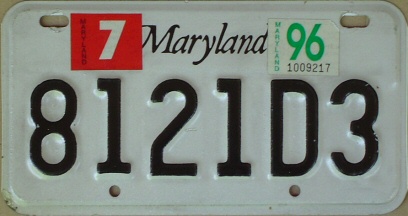
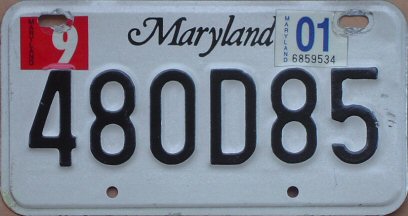


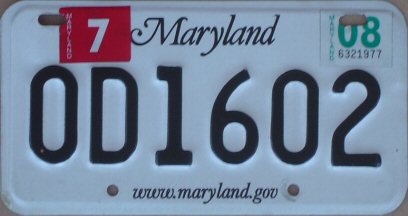
Standard motorcycle plates in the 4-1/2 inch by 8-1/2 inch size: 1996, 2001, 2009 M-series without web web site
legend, 2008 M-series with web site legend, 2008 resumed D-series.
Motorcycle serial formats were initially 00000D, with the "D" indicating Maryland's vehicle class code for motorcycles. This format was quickly exhausted, and formats 0000D0 and 000D00 followed and were also exhausted. Format 00D000 could not be used because it conflicted with truck serial numbers already on the road. So, for reasons known only to the Maryland MVA, format 000M00 was introduced. I suppose that the "M" must stand for motorcycle. After format 000M00 was also used up, the "D" returned and resumed its leftward march across the plate with format 0D0000, which debuted in about July 2006. On all of these plates, the six characters fill the motorcycle plate, leaving no room for the shield separator used on full-sized six character plates.
Beginning some time in 2005, the state's web address www.maryland.gov was added to the bottom edge of regular motorcycle plates. Reportedly this was added at approximately serial number 740M00.

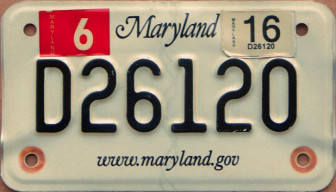
Standard motorcycle plates in the 4 inch by 7 inch size:
2008 (Ellis photo of plate in use); 2016
In October 2008, Maryland motorcycle plates were finally changed to the 4" by 7" dimensions already used by the other 49 states. This occurred in either the 7D0000 or 8D0000 series. The smaller plates required smaller serial dies, but these smaller dies have a different font that the either the previous motorcycle dies or the full-sized plate dies. The differences are most evident by comparing the numbers "6" and "9".
After plate 9D9999 was issued in about March 2009, serial format D00000 was introduced. Serials got up into the mid or upper D30000 series before this base was discontinued in June 2010.
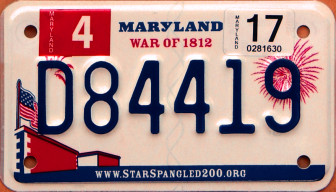
On Flag Day, June 14, 2010, the standard War of 1812 base plate was also introduced for motorcycles. This new plate commemorates the Battle of Baltimore at Fort McHenry, where the Star Spangled Banner was written. The plate features blue serial characters, and red and blue graphics, on a white background. It uses the "small flag" version of the graphics, also used on full-sized handicapped and vanity plates; in this case, the plate number is actually pretty legible. The motorcycle plates on this base continue the previous base's serial format, picking up somewhere between D35832 and D39120.
Upon plate number D99999 being issued in the summer of 2012, the motorcycle serial fromat became 00000Y. The "Y" doesn't stand for anything; the Maryland MVA seems to have abandoned its long practice of incorporating the vehicle class code into the the plate number on non-passenger plates. Plate numbers presumably got to the upper 90000Y series before this base was discontinued.
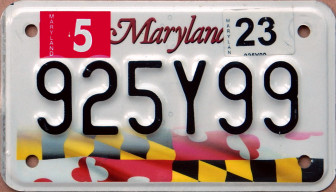
On September 26, 2016, the state discontinued the War of 1812 base and introudced another new standard base plate for the same plate types. This new "Maryland Proud" base features a graphic of the state flag along the bottom edge. Motorcycle plate numbers on this base again pick up where the previous base left off, starting in the very high Y suffix series, somewhere around 98000Y. In December 2016, the 00000Y motorcycle numbering format was exhausted, and subsequent motorcycle plates were then issued in numbering format 000Y00. I have no idea why they skipped format 0000Y0, but when the second format was exhausted, they went back and picked it up.
Please note that organizational member motorcycle plates and military service motorcycle plates are shown on a separate page. Non-personal motorcycle plate types are covered on another separate page.
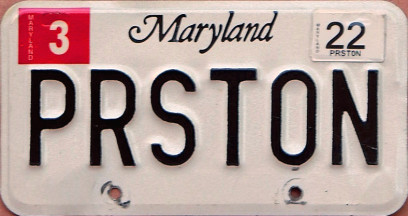
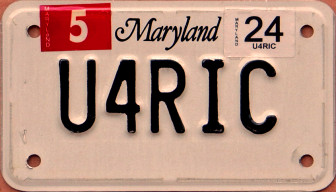
Vanity motorcycle plates in the 4-1/2" by 8-1/2" size issued 1986-2008, and in the
4" by 7" size issued 2008-2010.
Up to six characters are permitted. Vanity plates on the black-on-white base were apparently only briefly issued with the www.maryland.gov legend at the bottom in 2005; after that, the legend was once again omitted on new issues. Perhaps the state thought including the web address somehow constituted a state endorsement of the message the vanity plate conveyed. The 4" by 7" vanity plate shown above would have been issued between the fall of 2008 and June 2010, and it doesn't have a web site legend, either. Vanity motorcycle plates were made on the War of 1812 base, and are now being made on the "Maryland Proud" state flag base.


Handicapped motorcycle plates in the old 4-1/2" by 8-1/2" size and the 4" by 7"
War of 1812 design (both plates in actual use).
This is a fairly obscure plate type, as most people qualifying for handicapped plates probably are not physically able to ride a motorcycle. In any event, for those who are, the motorcycle plates they are issued display the familiar wheelchair graphic to the far left, followed by serial format 0000D/M. On the ones I've seen, which isn't many, the wheelchair graphic and the suffix letters are screened.
I imagine that handicapped motorcycle plates had the state web site legend added, and switched to the smaller 4" by 7" dimensions along with other white-background motorcycle plate types, but I haven't seen any to be able to confirm this. In June 2010, they began being issued on the War of 1812 base, with the plate numbering continuing uninterrupted from the previous base(s). They're now supposed to be issued on the "Maryland Proud" state flag base, but I haven't seen one of those yet, either.


Three historic motorcycle plates in the old 4-1/2" by 8-1/2" size
(second one is a Sallmen photo)
and one in the current 4" by 7" size (Ellis photo).
(The last three were photographed in actual use.)
The criteria for historic motorcycles is the same as for other historic vehicles – the vehicle must be at least 20 years old and in basically stock condition. Historic motorcycle plates have gone back and forth between screened Historic and Historic M/C legends at the bottom of the plate, with a variety of fonts used for these legends. Serial format is 00000L/D; the suffix letters are screened. (Class L indicates a historic vehicle, and subclass D indicates a motorcycle.) The switch to the new smaller 4 inch by 7 inch size occurred somewhere between serials 17136L/D and 18414L/D.
Historic motorcycle plates are available with vanity registrations; these are addressed in the combination motorcycle plates subsection, below.
The criteria for street rod motorcycles is the same as for other street rods – the vehicle must be at least 25 years old and heavily modified or customized. The plates are similar to historic motorcycle plates, but with the screened legend Street Rod at the bottom. Serial format is 00000N/D; the suffix letters are screened. (Class N indicates a street rod; subclass D indicates a motorcycle.) These plates are rare, but they do in fact exist; I've seen one up close in actual use. Unfortunately, the bike's owner wouldn't let me take a picture of his plate.
Street rod motorcycle plates are also vailable with vanity registrations; these are addressed in the combination motorcycle plates subsection, below.


Combination motorcycle plate types:
Two historic motorcycle vanity plates in the old 4-1/2" by 8-1/2" size
(Sallmen photos of plates in actual use).
These are available in both historic motorcycle and street rod motorcycle varieties; up to 6 characters permitted; The appropriate vehicle type legend is screened at the bottom. Both Historic and Historic M/C legends, in several different fonts, have been issued.
These do exist, according to the Maryland MVA, but I've never seen one. I would imagine that they're limited to four or five serial characters. I presume they've been issued on the black-on-white base, the War of 1812 base, and now the "Maryland Proud" state flag base.

(2006 plate in actual use)
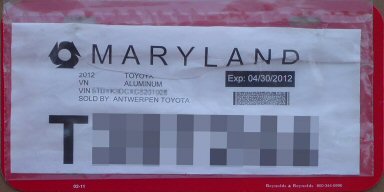
These temporary plates are issued by dealers to their customers who have purchased vehicles and are not transfering the plates from another vehicle. These plates provide time for the MVA to mail the vehicle owner their new permanent metal plates and registration documents. Only one plate is issued for the rear of the vehicle; the same full-sized temporary plate is also issued to motorcycles.
For many years, Maryland used cardboard temporary plates such as the one from 2006 shown above on the left. Then they began issuing these silly paper "plates", shown above on the right, as evidence of temporary registration. I'm not exactly sure when this started, but it was no later than early 2011. The registration number consisted of the letter "T" followed by a six-digit number. These were printed on a standard 8-1/2" by 11" sheet of white paper, which was then folded or cut in half. This particular temporary paper "plate" was placed inside a plastic bag and taped to a dealer's booster plate.
I don't understand how those in authority could have possibly thought that computer-printed temporary registration "plates" on plain white paper was a good idea. Anyone with a computer, a printer, and image-editing software could easily make their own fake "plate". Since the "plate" shown above was issued to my sister, I've chosen to hide the registration number, so that someone doesn't use this photo as the basis for a fake plate that could be associated with her in the MVA database.
In 2016, I saw several new Maryland temporary plates in use that were again actual plates, rather than sheets of paper taped to a dealer booster plate. Apparently, the sheet of paper thing didn't work so well. Unfortunately, I didn't manage to get a photo of one of these new temporary plates.
Month stickers can be white-on-red, or white-on-green, and include the month number as well as the the state name Maryland running down the left side. The state name on the month sticker can be either black or white. Month stickers with Maryland in white are more recent than those with Maryland in black. The red month stickers are intended for the various standard base plates, and the green ones were originally introduced for use on the first generation Chesapeake plates. Both colors of month stickers can be found on all types of Maryland plates, however. If you look closely at the various month stickers on this page, you'll notice that they have not used a consistent font for the month number.
Between 2004 and 2010, Maryland had a fixation for the color green on its year stickers. During these seven years, six of the regular year stickers were either green-on-white or white-on-green. Beginning with the 2011 stickers, all year stickers have been colored black-on-white. There are minor exceptions to both of these statements, however.
Nearly all vehicle types and registration classes have staggered registrations and can expire in any month. The exceptions to this involve certain types of commercial and company-owned vehicle registrations. Therefore, I won't dwell on them here, since this page is supposed to be about personal vehicle plates.
Normally, two-year registrations were mandatory for vehicles owned by individuals through June 30, 2024. Exceptions were made in some cases, such as economic hardship, or in instances where a motorist has at least a year remaining on a registration of a different class vehicle, and is transfering the unused portion to the new vehicle. Effective July 1, 2024, one-year registrations are again standard, with two-year registrations remaining available as an option.
Plates always expire at 11:59 pm on the last day of the month indicated. For staggered registrations, the expiration month is the same as the month the vehicle was initially registered. For example, a personal vehicle newly registered on June 7, 2016 would have its first registration period valid through June 30, 2018.
When a registered vehicle is sold or disposed of, the plates do not stay with the vehicle. The plates can remain with the owner and be transfered to a replacement vehicle. Otherwise, the plates must be returned to the MVA.
Related pages on this site |
Elsewhere on the web |
Thanks to those who have directly contributed to the information on this page: Jeff Ellis, Christopher Jackson, Xavier Hadjadj, "Tiger" Joe Sallmen, Linda Black, Greg Crum, and Darrell Davis.
Hadjadj, Sallmen, Ellis, Jackson, Crum, Davis photographs are presumed to be copyrighted by Xavier Hadjadj, "Tiger" Joe Sallmen, Jeff Ellis, Christopher Jackson, Greg Crum, and Darrell Davis, respectively, and are used with permission. Ritterhoff plate is from the collection of Paul Ritterhoff.
This page is W3C valid |
