|
|
 |
|
|
|
|
This page covers the various types of Maryland license plates typically issued for personal vehicles that are not otherwise addressed on their own pages. Latest noteworthy updates to this page
|
|
On this page I address various types of Maryland license plates typically issued for personal vehicles, from the 1920s to the present day. However, please note that this page does not cover all types of 1920s-present Maryland personal vehicle plates. Passenger car plates are addressed on a separate page. Organizational member plates, both passenger and non-passenger, are on their own pages. Motorcycle plates and truck plates of all types are covered on separate pages as well. Plates issued to government officials for their personal vehicles are on yet another page. Go to the Maryland index page for links to these other pages.
Maryland license plates dated 1939 and later always indicate, on the plates themselves, or via metal tabs or stickers, the year in which they expire. Exceptions to this include undated, unstickered plates that expired in 1976 and 1981, and front plates issued since 1986, which are not dated and do not bear stickers. I consistently refer to plates by the year that is shown on the plate, regardless of when the plate was actually issued.
Maryland non-passenger plate types (meaning plate types other than standard plates for private passenger cars, and therefore including the other personal vehicle plate types shown on this page) and their expiration stickers, with few exceptions, have closely resembled or been indistinguishable from their passenger car equivalents from the same time period. Because this information is covered in detail on the passenger plate pages and the general information page, I'll just point out when there were deviations from passenger car plates.
My "Pictorial History" pages are intended to be a supplement to the information found in the ALPCA Archives. I am providing additional details and additional photos not found in the archives, and clarifying information when appropriate. When the ALPCA archives cover a subject in great detail, I do not repeat that detail here. I sincerely hope that you find this information useful.
If you find an error or have additional information, or can provide a plate or a photo of a plate that I'm missing, please send me an e-mail. There's a link to my e-mail address at the bottom of every page. Please note that all plates shown that are credited to another person are plates that I am still seeking for my own collection.
Suprisingly, in the early decades of the automobile, electric-powered vehicles were not uncommon. Although the technology was primitive, so was internal combustion engine technology, and for a while, electric vehicles were actually competitive with gas-engined vehicles. By the 1920s, though, electric vehicles couldn't keep up with the advances in gas engine technology, and they went out of production.
Maryland issued distinct license plates to electric vehicles back in the day. Since early electric vehicles were nearly always personal cars, I'm covering these plates on this miscellaneous personal vehicle plate history page.
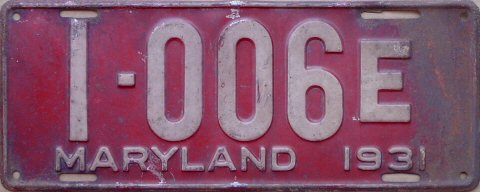 1931 electric vehicle |
Not much is known about Maryland electric vehicle plates. They were apparently issued at least between 1929 and 1944 (I suspect also earlier than that), and they used the letter "E" as a prefix or suffix in the plate number, depending on the year. I had never even seen a photo of one until March 2015, when I was presented with the opportunity to buy the plate shown. (I succesfully completed that transaction, of course.) I believe the numbering on these began at 1-001E in 1931, but I have no idea how many were issued. I would think by 1931 there weren't many electric vehicles still on the road.
|
Modern all-electric vehicles are issued "low speed vehicle" plates (addressed below) if applicable, or else regular passenger car plates or whatever type of plate is appropriate for the vehicle configuration.
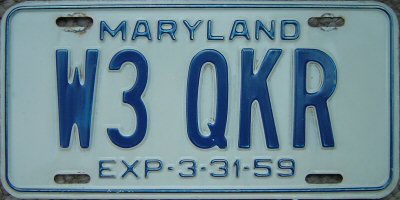 1959 amateur radio car 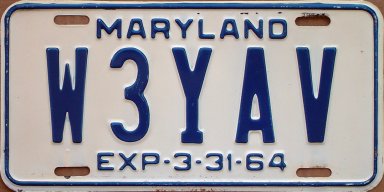 1964 amateur radio car 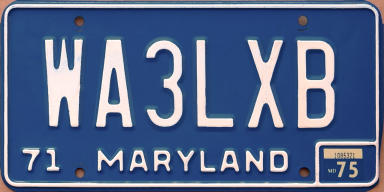 1975 amateur radio vehicle with 1976 serial dies |
Amateur radio plates are reported to have been first issued with 1957 expiration dates. In a sense, these were the first vanity plates, in that the specific plate number was requested by the motorist. The plate serial number matched the radio operator's FCC call sign, probably up to a maximum of six characters. The original intention of these plates was to be able to readily identify vehicles equipped with two-way radios, for civil defense and public safety purposes. Therefore, in order to obtain these plates, the motorist was required to have a ham radio installed in the vehicle, and I remember as a boy in the 1960s seeing vehicles with ham radio plates always also sporting enormous antennas. I'm not sure when the requirement to have a ham radio in the vehicle was dropped. The spacing of the FCC call sign characters evolved over the years. As best I can tell, plates with expiration dates between 1957 and 1962 have a space after the numeric digit indicating the FCC zone; 1963 and 1964 plates have equally widely spaced characters, and plates from 1965 forward have no spacing between the characters. These plates did not contain any identifying legend. 1957-1970 plates with March 31 expiration dates were issued for cars; any with April 30 expiration dates were issued for trucks. There isn't a way to distinguish amateur radio car vs. truck plates on the 1971 base. |
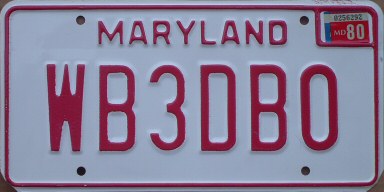 1980 amateur radio car 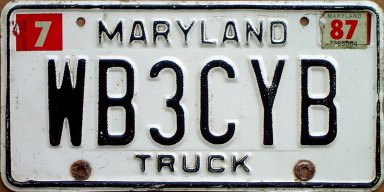 1987 amateur radio truck |
Standard amateur radio platesThese plates still did not carry any identifying legend when issued for passenger cars. However, amatuer radio plates issued to trucks did carry a Truck legend at the bottom center. Likewise for those issued to multi-purpose passenger vehicles, at least on the black-on-white 1981 base plate; those had the legend MPV at the bottom.
| |
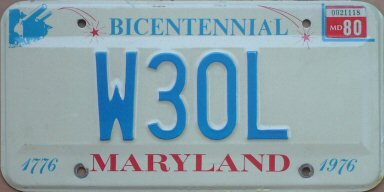 1980 Bicentennial amateur radio car 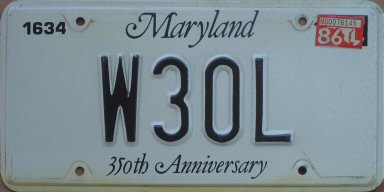 1986 350th Anniversary amateur radio car or MPV |
Special interest amateur radio platesPlates with amateur radio call signs were also issued for cars and MPVs on the optional U.S. Bicentennial base (1976-1980), and optional 350th Anniversary base (1984-1987). These plates did not have vehicle type legends. It's unclear whether an amateur radio operator plate type was actually offered on these bases, or motorists simply ordered vanity plates with call signs. (By the way, the year stickers on the 350th Anniversary plate shown at left were applied in the wrong location; they actually belong in the lower right corner of the plate.) |
 (Ellis photo of plate in use) 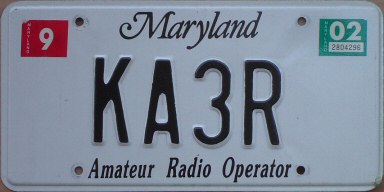 |
Standard amateur radio platesAmateur radio plates are issued with the serial number that matches the radio operator's call sign, up to seven characters. On the reflective black-on-white base, they differ from vanity plates in that they carry the screened plate type legend at the bottom center. Apparently this legend was originally Amateur Radio but was later changed to Amateur Radio Operator. Amateur radio plates are available for passenger cars, multi-purpose vehicles, and trucks up to 1 ton capacity. The same plate design is issued to all of these vehicle types. |
 (Ellis photo of plate in use) |
Combination amateur radio plate typesIt would seem that handicapped radio operators are able to obtain combination plates that bear their call letters and have the Amateur Radio Operator legend, but also display an embosssed wheelchair symbol that grants them access to handicapped parking spaces. I don't know how long this obscure plate type has been produced. |
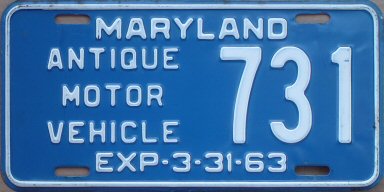 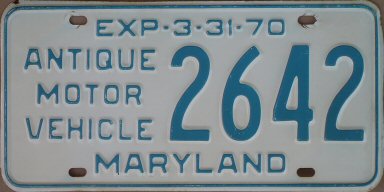 |
Antique license plates were first issued with 1960 expirations. They displayed the legend Antique Motor Vehicle horizontally on the left portion of the plate, with each word stacked above the other. Verified serial formats include 000 and 0000. Antique vehicles always had March 31 expiration dates, regardless of whether they were issued to cars or trucks. Site visitor Russ Baer reports that he bougnt a 1928 Graham-Paige automobile in September 1958 and titled it as an antique vehicle in October 1958, but it was issued regular 1959-expiration passenger car plates. However, the 1960-expiration plates issued to this vehicle were Antique Motor Vehicle plates. It would seem that the antique vehicle type classification existed prior to distinct antique vehicle plates, though I have no idea how much so. By the way, through 1981, antique vehicles were considered class A (passenger car), subclass H (historic, I suppose) vehicles by the Maryland motor vehicle department, regardless of whether the vehicle in question was actually a passenger car. |
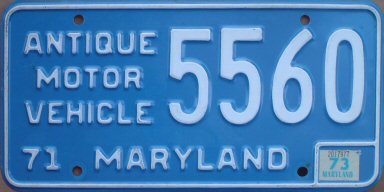 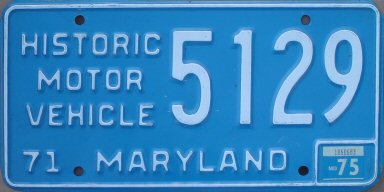 |
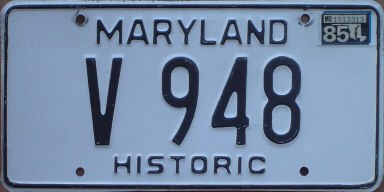
1971 base plates were made with both the legends Antique Motor Vehicle and Historic Motor Vehicle. In both cases, the legend is stacked horizontally on the left portion of the plate. Whether there was a difference in what could be considered antique versus historic, or whether the antique plates were issued first and the historic plates issued later, is not clear. There were more significantly more plates made of the antique variety. The serial numbers of each type do not provide any obvious clues. Format 0000 was used for both types of plates. Historic plate numbers seem to mostly be in the lower 5000 series, but site visitor Darrell Davis reports having one in the 6200 series. Antique plate numbers were both lower and higher than historic plate numbers. I doubt that the same numbers were issued on both plate types, but I don't know for sure that they weren't. |
  1981 historic vehicle |
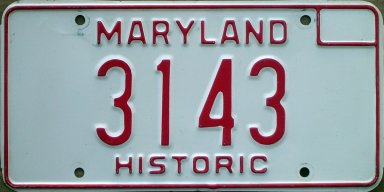
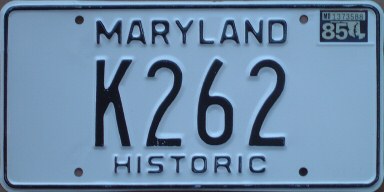
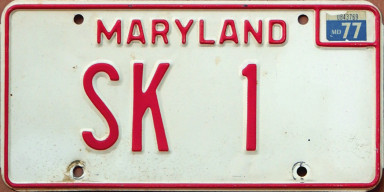
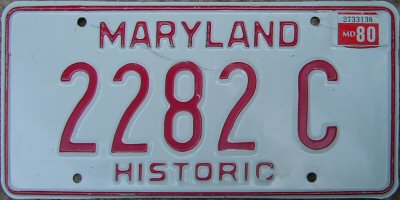
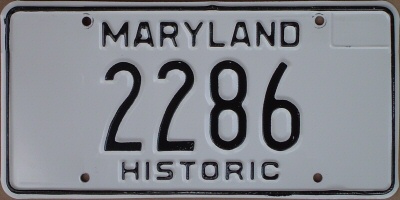
Standard historic vehicle platesBy the time the 1976 red number base was issued, the term "antique" had been retired, and all such plates carried the simple legend Historic at the bottom of the plate. A variety of serial formats were used, and it's not completely clear what the sequence was. An educated guess would be, on the 1976 base, first 0000, then x000, then x0000 and x 0000, then finally 0000 x. In the case of formats x0000 and x 0000, a space separator was added at some point, but one format's serial numbers picked up where the other left off. The 1980 plate pictured is a natural. On the 1981 black number base, the sequence started over, but the spacing between the between the letter and numbers was slightly different; I believe the order was 0000, x000 and x 000, x 0000, and lastly 0000 x. Again, x 000 picked up where x000 left off. Sometime in about 1981, historic vehicles went from being class A, subclass H vehicles (regardless of whether they were passenger cars, although most were), to being class L vehicles.
| |
 1982 historic motorcycle  1987 historic motorcycle vanity (Hennessey photo / plate) |
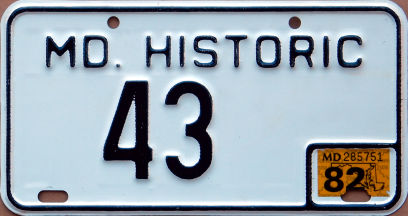
Combination historic vehicle plate typesVanity registration numbers were permitted on both the 1976 and the 1981 full-sized historic bases. Historic motorcycle plates and historic vanity motorcycle plates were introduced some time after the debut of the 1981 base in March 1980. Sequentially-numbered historic motorcycle plates, at least, were in use no later than February 1982, probably earlier. Prior to the introduction of this plate type, if someone wanted to register their motorcycle as antique or historic, they had to use a full-sized antique or historic vehicle plate on their bike. I remember seeing this done a few times back in the day. I don't know whether historic motorcycle vanity plates came out at the same time as sequential plates, or later. Historic motorcycle plates, whether sequentially numbered or vanities, were rather strange looking, with Md. Historic across the top of the plate. Many of the the sequentially-numbered plates, including the one shown at left, were made incorrectly, with the bolt attachment points upside-down from where they should be. The round bolt holes were supposed to be at the bottom and further in where they didn't interfere with the sticker, and the longer bolt slots were supposed to be at the top. |
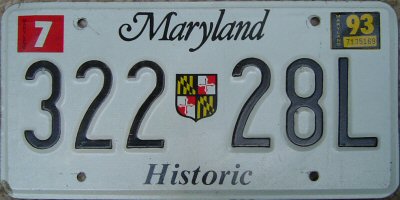  Historic vehicle plate converted from biennial to permanent registration (plate in actual use)  Historic vehicle plate with natural permanent registration (plate in actual use) 
|
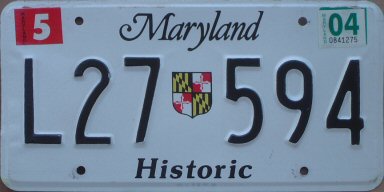
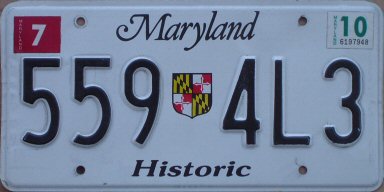
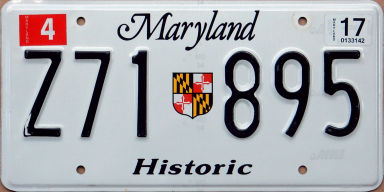
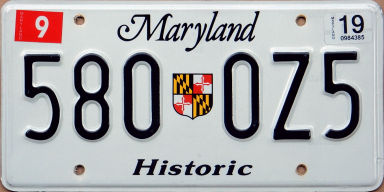
Standard historic vehicle platesHistoric vehicle plates on the reflective black-on-white base again have the legend Historic at the bottom of the plate. Sequentially-numbered historic plates were initially assigned serial format 000*00L, with the "L" indicating the vehicle class code. This format was eventually used up, and a second format L00*000 was introduced. In late 2005, a third format 000*0L0 began to be issued. So far, this progression was pretty predictable. The third format lasted until the spring of 2010. Then, rather than continue to use the letter "L" in the remaining available positions, someone at the MVA thought it would be a good idea to retire that letter in favor of the letter "Z", which has nothing to do with the vehicle class code for historic vehicles. So, "Z" was used in the same positions, in the same order, as was "L", starting with format 000*00Z introduced in the spring of 2010, then Z00*000, and then format 000*0Z0 as of early 2016. Curious minds wondered whether a third letter would be used once the same three letter positions were used up. But no, the state continued using the letter "Z" in a fourth format, introducing 000*Z00 in the spring of 2019. These plates are issued for all unmodified historic motor vehicles other than motorcycles. Modified historic motor vehicles are issued street rod plates, covered below.
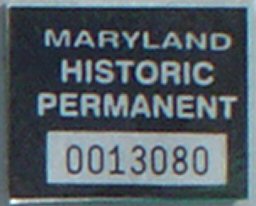
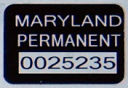
As of January 1, 2007, a historic vehicle 60 years or older may choose to obtain a one-time, permanent, non-transferable registration. This option is available only to vehicles actually registered as historic vehicles, not street rods. These permanent registrations are indicated with a white-on-black sticker with the words Maryland Historic Permanent in place of an expiration year, as shown. At this writing, such permanent regisrations are charged a one-time fee of $50, rather than the biennial $51 registration fee that non-permanent historic vehicles and street rods are charged.
| ||
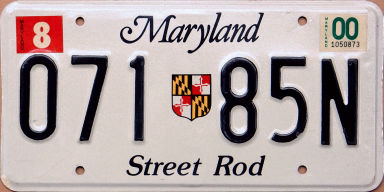 |
Standard street rod platesA short time after the introduction of the reflective black-on-white base, street rods were split out from historic vehicles into their own class. A street rod is a heavily modified or customized vehicle over 25 years old. Non-motorcycle street rod plates have serial format 000*00N, with the "N" indicating the vehicle class, and with the screened legend Street Rod displayed along the bottom of the plate. Even after 30+ years, new plates are still being issued in this same numbering format. | ||
 (plate in actual use)  50 year historic vehicle plate with permanent registration (plate in actual use)  (plate in actual use) |
50 year historic vehicle and street rod platesBeginning in early 2016, Maryland began issuing specific plates for historic vehicles and street rods over 50 years old. These plates are black-on-white, have the text 50 Year Historic or 50 Year Street Rod at the bottom, and use serial formats L0000x or N0000x, without any shield graphic, respectively. Strangely, they're only issued as single (rear) plates. Otherwise, there seems to be no reason for these plate types to exist, and yet they do. The fees, restrictions, etc. are no different for vehicles 50 or more years old vs. those under 50 years old. Vehicles at least 60 years old can pay a one-time fee and get the permanent historic sticker described above, while those between 50 and 60 years still have normal two-year registration periods and get normal month and year expiration stickers. It turns out that the reason for these 50 year plates is precisely because they're issued as single plates. A state law was passed that allowed vehicles over 50 years old to only display a single, rear plate. Law enforcement needed a way to distinguish between historic vehicles and street rods that were allowed to display one plate from those that were not, and the solution was to introduce these two 50 year plate types. | ||
 1910 Vintage historic vehicle (unstickered front plate) (Davis photo and plate) |
Special interest historic vehicle and street rod platesBoth historic vehicles and street rods could obtain the limited-edition 1910 Vintage plates, which were intended, but failed, to resemble Maryland's first state-issued license plate from the year 1910. The vehicle did not actually have to be a 1910 model to qualify for these plates. 1910 Vintage plates were issued during 2014 only, but are able to be used and renewed beyond then. Historic and street rod versions of this plate may be identified by their specific serial formats VL00000 and VG00000, respectively. I have not actually seen the street rod version, but I assume it has a designation screened on the plate under the state name, similar to the historic vehicle version shown. | ||
 1989 historic motorcycle  2010 historic vanity (plate in actual use)  2009 street rod vanity (plate in actual use)  2008 historic motorcycle vanity (Sallmen photo of plate in use) |
Combination historic vehicle and street rod plate typesHistoric motorcycle plates are issued with serial format 00000L/D. These have been observed with legends Historic and Historic M/C. Street rod motorcycle plates are also issued, and use serial format 00000N/D. The one I've seen had the Street Rod legend, but I was unable to take a photo of it. Vanity registration numbers may be obtained on full-sized and motorcycle historic plates, as well as full-sized and motorcycle street rod plates. They're just like regular and motorcycle vanity plates on the reflective black-on-white base, except that they have the legend indicating that the vehicle is either historic or a street rod. On the full-sized plates, the maximum number of characters and spaces is seven, and on the motorcycle plates, the limit is six. I understand that vanity plates were also offered on the 1910 Vintage historic vehicle and street rod plates. |
 1975 vanity 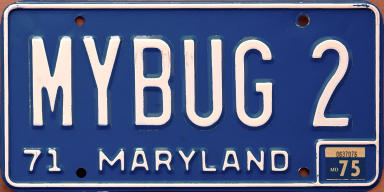 1975 vanity with 1976 serial dies |
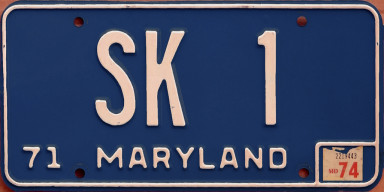
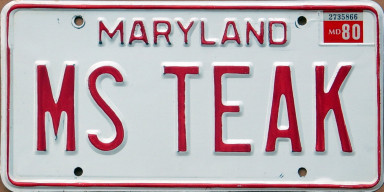
Vanity plates were first made available on the dated 1971 base for both cars and trucks, with a maximum of six characters. I recall that vanity plates were not available when this base made its debut in March 1970. It wasn't until well over a year later, on July 1, 1971, that vanity plates were introduced. Thus, the very earliest Maryland vanity plates bore natural 1972 expiration stickers. There was no way to distinguish a vanity plate issued to a car versus a truck on this base.
|
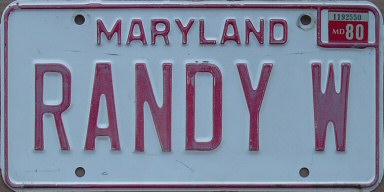 1980 passenger car vanity 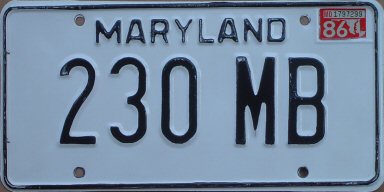 1986 passenger car vanity |
Standard passenger car vanity platesVanity plates issued for passenger cars on the standard-issue 1976 and 1981 bases had no legend embossed at the bottom center of the plate. I believe that the maximum number of characters remained at six on these bases.
| |
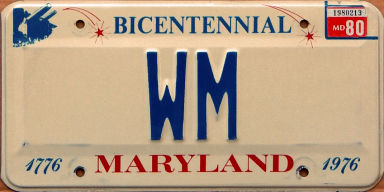 1980 Bicentennial passenger car vanity 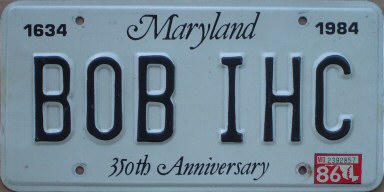 1986 350th Anniversary passenger car or MPV vanity |
Special interest vanity platesVanity plates were made available for passenger vehicles on the optional U.S. Bicentennial base. They were also offered for both passenger cars and multi-purpose vehicles on the optional 350th Anniversary base; however, the shield logo was omitted on all 350th Anniversary vanity plates regardless of the number or spacing of characters on the plate. Vanity 350th Anniversary plates issued to MPVs did not have any legend to distinguish them from their passenger car counterparts. The maximum number of characters on these bases was most likely also six. | |
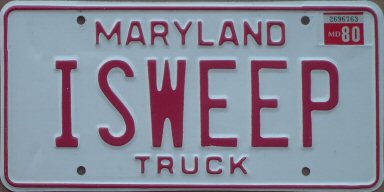 1980 truck vanity 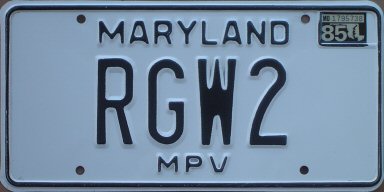 1985 MPV vanity 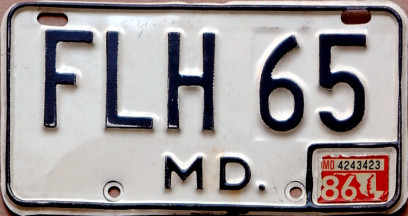 1986 motorycycle vanity 1987 historic motorcycle vanity (Hennessey photo / plate) |
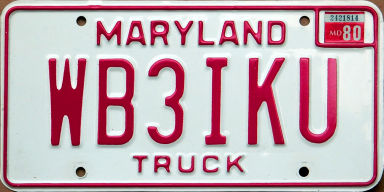
Combination vanity plate typesVanity plates were again available for trucks on the standard-issue 1976 and 1981 bases, but now had the legend Truck embossed at the bottom center of the plate. Vanity plates were first available for historic vehicles on the 1976 red-number base, with the legend Historic at the bottom. Vanities plates were offered for multi-purpose vehicles with MPV at the bottom of the plate, at least on the painted black-on-white 1981 base and probably also on the earlier red-on-white base. Vanity plates were introduced for both regular motorcycles and historic motorcycles on with the black-on-white 1981 base, with a maximum of six and four characters, respectively. Historic motorcycle plates were rather strange looking, with Md. Historic across the top of the plate. |
 1988 regular vanity 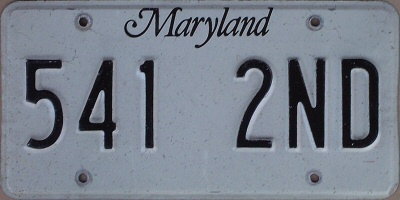 Regular vanity unstickered front plate 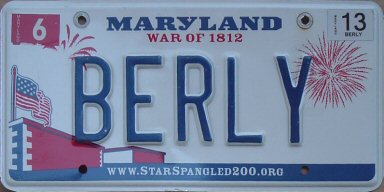 2013 regular vanity  2018 regular vanity (plate in actual use) |
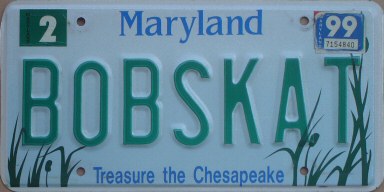
Standard base vanity platesVanity plates are available for cars, multi-purpose vehicles, light-duty trucks, and light-duty trailers on the same standard-issue bases. There's nothing on the plate that indicates the vehicle type. The maximum number of characters and spaces is seven. The reflective black-on-white base was issued between 1986 and June 2010 for all of these vehicle types; I would imagine that vanity trailer plates have continued to be issued on this base since June 2010. The shield logo was omitted on all vanities, regardless of the number or spacing of characters on the plate. Vanity plates on the black-on-white base were only briefly issued with the www.maryland.gov legend at the bottom in 2005; after that, the legend was once again omitted on new issues. Perhaps the state thought including the web address somehow constituted a state endorsement of the message the vanity plate conveyed. On June 14, 2010, the War of 1812 plate became the standard base for many personal plate types, including vanity plates. War of 1812 vanity plates have slightly different graphics than used on the sequentially-numbered passenger car version; the U.S. flag is noticeably smaller. Despite that, on seven-character plates, the first character is nevertheless stamped right over top of the flag and is hard to read. On September 26, 2016, the so-called "Maryland Proud" plate became the standard base for the same personal plate types that had been issued War of 1812 plates, including vanity plates. "Maryland Proud" plates have a graphic of the Maryland state flag along the bottom edge of the plate. There's no difference other than the plate number between sequentially-issued and vanity versions of this base. |
 1999 first generation Chesapeake vanity  2007 Our Farms vanity (plate in actual use) 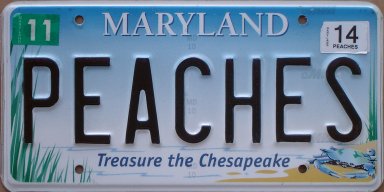 2014 second generation Chesapeake vanity with blue heron omitted 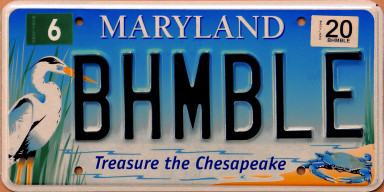 2020 second generation Chesapeake vanity with blue heron present  2023 third generation Chesapeake vanity (Mattes photo of plate in use) |
Special interest vanity platesVanity registrations may also be had on the special interest bases. Vanity plates are available for cars, multi-purpose vehicles, light-duty trucks, and light-duty trailers on both the various Chesapeake bases and the Our Farms, Our Future base. There is nothing on these special interest vanity plates that would indicate the vehicle type. Vanity plates are also available for cars, multi-purpose vehicles, light-duty trucks, historic vehicles, and street rods on the 1910 Vintage limited edition plate. Such plates issued to historic vehicles and street rods are marked as such, but those issued to other vehicle types are not. The maximum number of characters on all of these plates is seven. The blue heron graphic was omitted on all first generation, green-lettered Chesapeake vanity plates, regardless of the number or spacing of characters on the plate. On the second generation, black-on-blue Chesapeake plate, the bird graphic is normally to the far left, rather than centered. Therefore, Chesapeake vanity plates with six or fewer characters and spaces retain the bird graphic, but those with seven characters and spaces have the bird omitted from the plate. As of October 29, 2018, a third generation Chesapeake plate is now being issued. This one depicts the Chesapeake Bay Bridge rather than a blue heron, and has the text Protect the Chesapeake along the bottom. From the one example I've seen, it appears that no graphic elements are omitted on seven-character plates. |
 2011 handicapped vanity (Jackson photo of plate in use) 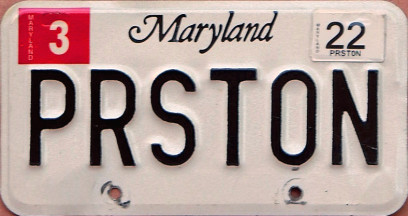 2022 motorcycle vanity 2009 street rod vanity (plate in actual use) 2008 historic motorcycle vanity (Sallmen photo of plate in use) |
Combination vanity plate typesVanity registrations are available on full-sized standard handicapped plates and regular motorcycle plates, but with a maximum of six characters in both cases. Handicapped motorcyclist plates may also be ordered with vanity registration numbers, but I don't know what the maximum number of characters might be. I'd guess maybe four or five are the most that would fit. Special interest handicapped plates are also available with vanity registration numbers up to six characters. On the second generation Chesapeake plate, the bird on the left side of the graphic would be omitted if necessary to make room for characters. In such cases, I suppose that it's possible that the embossed wheelchair symbol might then go on the left side of the serial, rather than on the right. Vanity plates are also available on historic vehicle and street rod plates, both the full-sized and motorcycle versions; these have the appropriate legend identifying the vehicle type at the bottom of the plate. On the full-sized plates, the maximum number of characters and spaces is seven, and on the motorcycle plates, the limit is six. |
 |
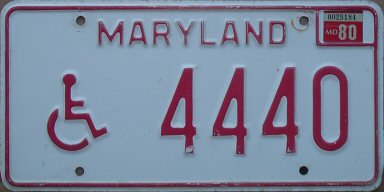
Handicapped plates were first issued on the white-on-blue 1971 base, and though I'm not exactly sure in which year, it was likely late in the life of this base. The plate consisted of an embossed wheelchair graphic followed by a numeric serial; serial format was 00000, with 10001 apparently the first plate number issued. There was nothing on the plate to indicate the vehicle type. |
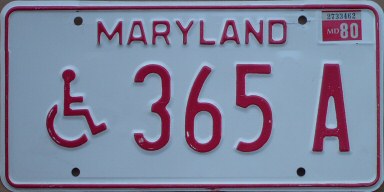 1980 handicapped person passenger car |
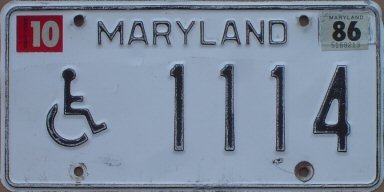
Standard passenger car handicapped platesHandicapped plates continued on the 1976 red-on-white base, and the 1981-black-on-white base, with an embossed wheelchair graphic. A variety of serial formats were used on these two bases; I'm not sure that I know what they all were, and in any event, it's not clear what the sequence was. Passenger car handicapped plates had no legend at the bottom.
| |
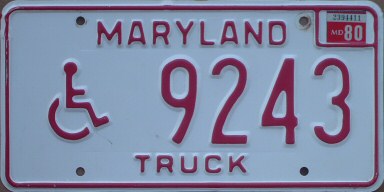 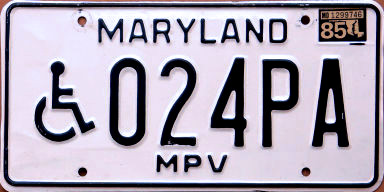 1985 handicapped person multi-purpose vehicle |
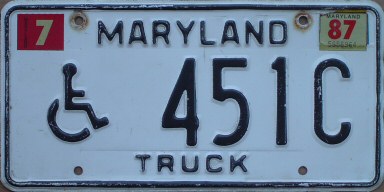
Combination handicapped plate typesHandicapped persons registering trucks or multi-purpose vehicles were issued plates similar to handicapped passenger car plates, but with the legend Truck or MPV embossed at the bottom of the plate, respectively. These handicapped plate types had their own serial formats, but again, I haven't figured them out. I'm not aware of handicapped plates being issued for any vehicle type other than cars, trucks, and multi-purpose vehicles during this period. I have no information regarding whether handicapped plates could be ordered with a vanity registration number prior to the current base, or were available on the optional Bicentennial or 350th Anniversary base plates.
|
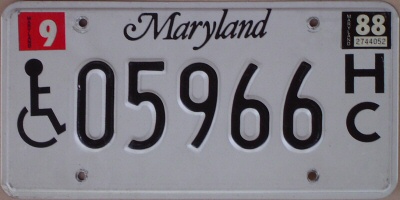    
|
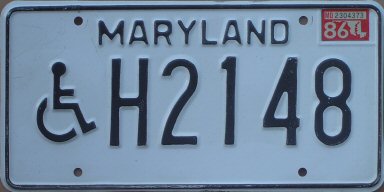
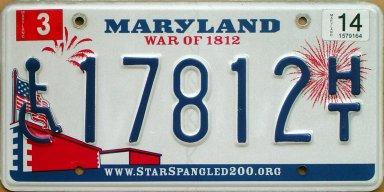
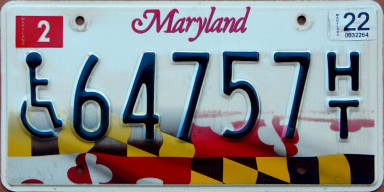
Standard base handicapped platesRegular handicapped plates on the reflective black-on-white base were issued with the wheelchair graphic at the far left, followed by the serial number in format 00000H/x. The serial suffix letters used were H/C, H/D, H/V, and H/T, issued in that order. I would imagine that the letter "H" must stand for handicapped, but the various second letters have no apparent meaning, since they've been issued in succession. There is no distinction between handicapped car vs. truck vs. multi-purpose vehicle plates on this base. H/C series and early H/D series plates have a screened wheelchair graphic and alpha suffix; beginning at about 36000H/D, and continuing into the H/V series, these elements are embossed. The state's web site address began appearing on regular handicapped plates in 2005 at approximatly serial number 69000H/V. The state was issuing handicapped plates in the early H/T series when this base was discontinued in June 2010. Existing plates on the reflective white base may continue to be renewed, however. On June 14, 2010, Maryland introdued a new standard War of 1812 base plate for several plate types, including handicapped plates. On this base, the previous serial format continued unchanged, and serial numbers continued without interruption, starting in the early H/T series. Despite using a slightly different graphic than on passenger car plates, with a smaller U.S. flag, the embossed wheelchair symbol is nevertheless stamped directly over the flag graphic, making both the wheelchair and the flag difficult to see. To me, at least, it seems disrespectful to the flag to stamp over it this way. The wheelchair also appears to be rolling down a red handicapped ramp on this plate. On September 26, 2016, the so-called "Maryland Proud" plate became the standard base for the same personal plate types that had been issued War of 1812 plates, including handicapped plates. "Maryland Proud" plates have a graphic of the Maryland state flag along the bottom edge of the plate. There's no difference other than the embossed wheelchair and the numbering format between regular passenger car and handicapped versions of this base. Numbering continues uninterrupted from the War of 1812 base, starting in the mid H/T series. | |

|
Disabled veteran plates
Disabled veterans (veterans who are truly handicapped, not necessarily members of the Disabled American Veterans organization) are issued plates with the wheelchair graphic at far left, followed by a serial number in format DV0000. These plates carry the screened legend Disabled Veteran at the bottom. I don't know if the wheelchair symbol has always been embossed or not. These plates are free of charge to the registrant. Starting in September 2016, disabled veteran plates get a white-on-black sticker for the rear plate with the words Maryland Permanent. Despite being free, I believe these plates were used with month and year expiration stickers prior to September 2016. The plate shown was apparently originally issued prior to September 2016, based on the presence of the month sticker. | |
 2012 first generation Chesapeake handicapped (version 3) 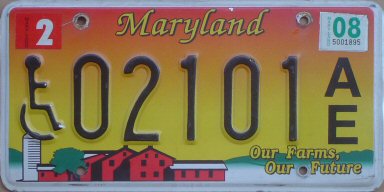 2008 Our Farms handicapped (version 1)  Our Farms handicapped (version 2) unstickered front plate (plate in actual use)  2009 second generation Chesapeake handicapped |
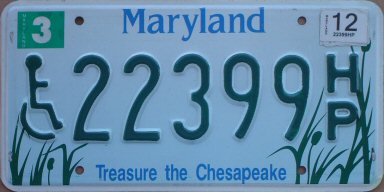
Special interest handicapped platesNon-veteran handicapped plates have also been available on the successive generations of the Chesapeake special interest base, and are available on the Our Farms, Our Future special interest base. These plates are available for passenger cars, multi-purpose vehicles, and light trucks. On the first generation green-on-white Chesapeake base, the plate featured the wheelchair grapic on the left, followed by a serial in format 00000H/P; the screened bird graphic was omitted. Early versions had screened wheelchair graphics and alpha suffix characters; beginning at roughly plate number 13500H/P, the wheelchair graphic was embossed but the alpha suffix remained screened; starting at approximatly 14000H/P, both the wheelchair symbol and the alpha suffix were embossed. On the Our Farms base, again the wheelchair graphic is at the left, followed by serial format 00000A/E. The wheelchair graphic has always been embossed on this base; the A/E suffix was screened up to about serial 02300A/E or 02400A/E, and since then has been embossed. Beats me what "AE" is supposed to stand for or signify, if anything. The handicapped format for the second generation black-on-blue Chesapeake plate was 0000D/x, with the screened bird graphic in its normal position on the left edge of the plate, and the wheelchair graphic to the right of the stacked letters. The wheelchair symbol and the suffix letters have always been embossed. The second letter is variable on this base, but it only got up to the early "D/B" series. If I were to guess, I'd say that the "D" stands for disabled, but who knows? I presume the wheelchair logo was placed to the right on this base so that it would not appear that the bird was pecking the head of the person in the wheelchair. The limited-edition 1910 Vintage special interest plate, which was intended, but failed, to resemble Maryland's first state-issued license plate from the year 1910, was also available in a handicapped version. 1910 Vintage plates were issued only during 2014, but may be used and renewed beyond then. I have it on good authority that the serial format of the handicapped version of this plate is VR0000 with the wheelchair symbol on the right side of the plate. I have never actually seen one of these. As of October 29, 2018, a third generation Chesapeake plate is now being issued. This one depicts the Chesapeake Bay Bridge rather than a blue heron, and has the text Protect the Chesapeake along the bottom. The handicapped version of this plate continues with the right-justified 0000D/x numbering format with the embossed wheelchair to the right of the plate number from the second-gen plate, beginning at about number 0300D/B. | |
 2009 motorcycle handicapped (plate in actual use)  2015 motorcycle handicapped (plate in actual use) (Ellis photo of plate in use) 2011 handicapped vanity plate (Jackson photo of plate in use) |
Combination handicapped plate typesMotorcyclists are able to get handicapped plates as well. On the reflective black-on-white base, the plates display the wheelchair graphic to the far left, followed by serial format 0000D/M. Perhaps "DM" stands for disabled motorcyclist? On the examples I've seen, both the wheelchair symbol and the stacked alpha characters are screened. Handicapped motorcycle plates were then issued on the War of 1812 base, continuing the same 0000D/M serial format, and I presume now on the "Maryland Proud" base, though I haven't actually seen one yet. It would seem that handicapped radio operators are able to obtain combination plates that bear their call letters and have the Amateur Radio Operator legend, but also display an embosssed wheelchair symbol that grants them access to handicapped parking spaces. I don't know how long this obscure plate type has been produced. Non-veteran handicapped plates are available with vanity registration numbers on the standard bases, with up to six characters. Apparently, vanity hanidcapped motorcycle plates are also offered, but I've never seen one. Special interest handicapped plates are also available with vanity registration numbers, again with up to six characters. On the second-generation Chesapeake plate, the bird on the left side of the graphic would be omitted if necessary to make room for serial characters. In such cases, I suppose that it's possible that the embossed wheelchair symbol might then go on the left side of the serial, rather than on the right. |
That's a fair question. The original intent apparently was to create a distinct class for truck-based passenger vehicles. When this class was created in 1979, it included full-sized passenger vans, truck-based wagons such as the Chevy Suburban, SUVs (which were all truck-based at the time), motor homes, and not-for-hire buses. Inexplicably, all three-wheeled vehicles were also lumped into the multi-purpose passenger vehicle (MPV) category.
As the lines between car and truck have become blurred over the years, the multi-purpose vehicle class expanded to include just about any passenger vehicle that wasn't a sedan or a traditional station wagon. Later included in this class were all passenger mini-vans, car-based SUVs, tall wagon-like vehicles (often called "crossover vehicles" by the automotive industry), and so on. Enclosed three-wheeled vehicles continued to be considered MPVs, but open three-wheeled vehicles were eventually reclassified as motorcycles.
With the proliferation of all these vehicle types as personal vehicles, the MPV plate type ran a close second place to passenger car plates in terms of number of plates issued for many years.
 Early MPV issued with a 1979 sticker under the 1980 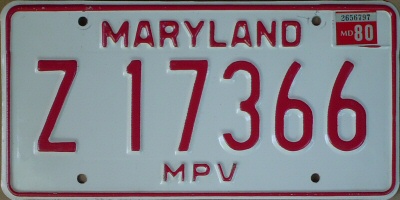 Late issue 1980 MPV 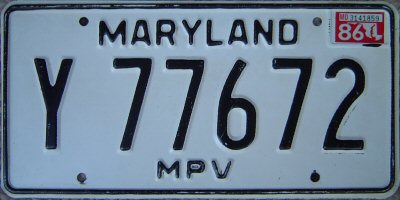
|
Standard base MPV platesMaryland introduced the multi-purpose passenger vehicle plate type on the red-on-white base in January 1979. I remember encountering my first MPV plate on a snowy day at my university campus. Prior to this time, passenger vans, SUVs, motor homes, and private buses such as church buses were issued regular passenger car plates, and at least some three-wheeled vehicles were issued motorcycle plates. The only serial format on this base was Z 00000, and the embossed legend MPV adorned the bottom center of the plates. On the red-on-white base, serials never got beyond the lower numbers of the Z series. Early MPV plates issued in January and February 1979 were issued with 1979 stickers, which expired at the end of March 1979. Plate number Z 01233, shown at left, has a blue 1979 sticker under the red 1980 sticker. The vast majority of red-on-white MPV plates, however, had natural 1980 stickers which expired at the end of March 1980. In March 1980, the painted black-on-white base replaced the red-on-white base, but had the same serial format and legend. Serial format was again Z 00000, but as mini-vans and small SUVs were introduced in the early- and mid-1980s, this class became increasingly popular and the Z series was exhausted. A new Y 00000 format was introduced fairly late in the life of the black-on-white base, but it had already reached the upper serial numbers when this base was discontinued in early 1986. |
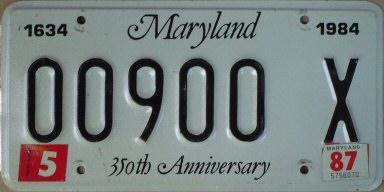 1987 350th anniversary MPV version 1 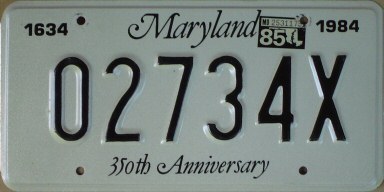 1985 350th anniversary MPV version 2 |
Special interest MPV platesThe multi-purpose passenger vehicle class was introduced too late to get a version of the optional U.S. Bicentennial plate. However, the optional 350th Anniversary base, introduced in mid-year 1983, was made available for multi-purpose passenger vehicles. The serial format was initially 00000 X, but for no apparent reason was later changed to 00000X without a space separator. In both cases the actual letter "X" was constant. This plate type did not have a shield separator; apparently the manufacturing process was set up only to apply the shield graphic to the center of the plate. That may help to explain why the MPV version of the extra-cost 350th Anniversary base was a slow seller. There was no text identifying the vehicle type, since the bottom of the plate was used for the 350th Anniversary legend. (By the way, the sticker on the 1985 plate shown at left was applied in the wrong location; it actually belongs in the lower right corner of the plate.) |
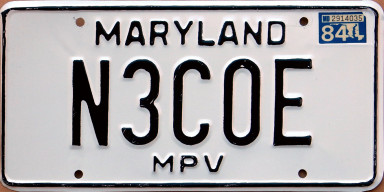 1984 amatuer radio MPV 1985 handicapped MPV 1985 vanity MPV |
Combination MPV plate typesOn at least the black-on-white standard base, various special plate types that were assigned to a multi-purpose vehicle carried the MPV legend at the bottom. These combination plate types include amateur radio operator plates, handicapped person plates, vanity plates, and possibly orgainzational member plates as well. I believe the same is true of the earlier red-on-white standard base, but I'm not certain. Multi-purpose passenger vehicles could get ham radio call signs or vanity registrations on the 350th Anniversary base, but these were indistinguishable from equivalent passenger car plates on that base. |
 1993 MPV, version 1 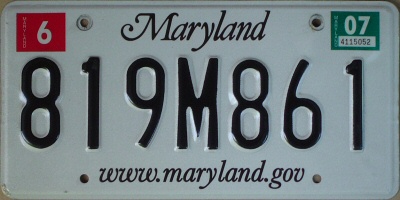 2007 MPV, version 4 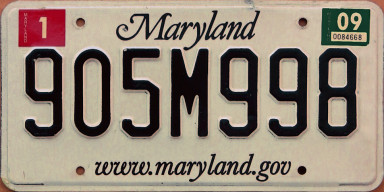 2008 MPV, version 5, made by New Jersey |
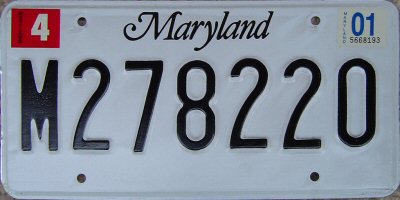
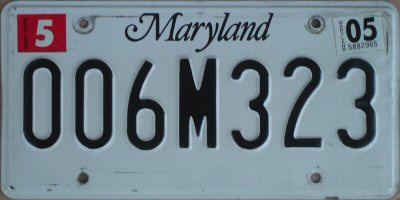
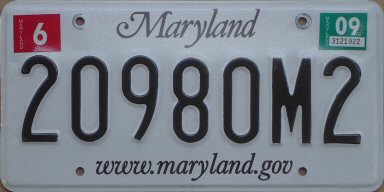
Standard base MPV platesMulti-purpose passenger vehicle (MPV) plates have been issued in a variety of serial formats on the standard script Maryland base. In all cases, however, the serials consist of seven characters – the letter "M" in various positions, which identifies the vehicle class, and six numeric digits. With seven serial characters, there's no room for a shield separator. MPV plates were initially assigned serial format 000000M on this base, with no legend at the bottom. This format was exhausted in the late 1990s, and format M000000 was introduced. This second format was also exhausted in 2002, and a third format 000M000 was issued through April 2007, until it too was used up. MPV plates were then issued in format 00000M0 until June 2010. All of these formats remain in use. Early in 2005, the legend www.maryland.gov was added to the bottom of standard base MPV plates beginning at about serial 480M000. MPV plates made with strange-looking, squared-off plate numbers were issued for a few months beginning in October 2006. Maryland arranged for New Jersey to stamp out over 30,000 pairs of plates for them, including 15,000 pairs of MPV plates, due to the Maryland plate manufacturing facility at the state prison in Jessup being shut down for three weeks due to inmate unrest. New Jersey used their own serial dies, which are much more square-shaped than than the rounded Maryland die characters. The serial number range for New Jersey-made MPV plates is 895M000 to 909M999. The Maryland dies reappeared in November 2006 at serial 910M000, but New Jersey die MPV plates continued to be issued through at least January 2007. Effective June 14, 2010, newly-registered multi-purpose passenger vehicles and regular trucks are being issued the same standard plates as are regular passenger cars. There is no longer a distinct numbering format or range specific to cars, MPVs, or trucks; all three vehicle types now share the same numbering scheme. These plates are addressed in greater detail on the Maryland passenger car plate history page. Existing MPV plates may continue to be used, however.
| |
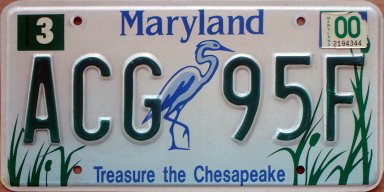 2000 first generation Chesapeake MPV plate  First generation Chesapeake MPV unstickered front plate with extra-cost BAY prefix (Ellis photo of plate in use) |
Special interest MPV platesMulti-purpose passenger vehicles were able to obtain the optional green-on-white Treasure the Chesapeake environmental plates issued from 1991 through 2003. Serial format xxx*00x was used uniquely for MPV plates; with only six characters, there was room for the blue heron bird graphic in the center of the plate. All serial characters were variable, but sequentially-numbered versions of this plate never got out of the early A series; specifically, up to AEY*99W, according to one report. Again, there was no legend to identify the vehicle type. Although no longer issued, these plates remain in use. A small number of these plates were made with a "BAY" serial prefix; these were sold for substatially more money than their bretheren with ordinary, sequentially-issued serial prefixes. Maryland plate spotter Jeff Ellis reports that the plate shown at left, only the 41st such plate issued, is the actually the highest-numbered one he's ever encountered. Similar "BAY" suffixed plates were issued on the passenger base, but they stand out much more on MPV plates because they're so far beyond the standard serial range. Multi-purpose passenger vehicles may also obtain plates made on the optional Our Farms, Our Future agricultural base, the subsequent Chesapeake environmental bases, and the limited-edition 1910 Vintage base. However, there is not a distinct serial format or range for multi-purpose vehicles on any of these three bases, but rather, cars, MPVs, and light trucks (as well as taxis on the Our Farms and second-generation Chesapeake bases) all share the same formats and serial ranges. These plates are addressed in greater detail on the Maryland passenger car plate history page. |
Historic vehicles and street rods are restricted-use registration classes, as vehicles registered as such are permitted to be driven only occassionally. These plate types have a sufficient history to warrant their own section on this page, however. Farm area vehicles are also restricted-use vehicles, since they may only be drive in a ten mile radius from the farm to which they're registered. Since this isn't a personal vehicle plate type, they're not addressed on this page; you can read about them on the Maryland truck plate history page.
That leaves two other restricted-use plate types that may be used for personal vehicles, which are covered below.
 (Ellis photo of plate in use) |
Low speed vehicle plates were introduced in January 2006. A low speed vehicle is defined as a four-wheeled electric vehicle designed to carry no more than four people, with a maximum speed between 20 and 25 miles per hour, that meets certain federal safety standards. In some other states these are referred to as "neighborhood electric vehicles". The plates make these vehicles street-legal. However, golf carts are explicitly not eligible for low speed vehilce plates, probably because they don't meet the safety standards. Two full-sized plates are issued, with a bizarre 000R00 serial format, with no shield separator and no spaces between any of the characters. This serial format is otherwise only used for motorcycle plates, using different letters. Apportioned truck and bus plates also use the same pattern of numbers and letters, with still different letters, but they have a shield separator dividing the serial number in half. It seems to me that perhaps these were intended to be issued on motorcycle-sized plates, but someone somewhere got their wires crossed. The plates bear the legend Low Speed Vehicle along the bottom. Plate numbers began at 000R01. Low speed vehicles can be either personal-use or commercial-use vehicles. Fellow plate spotter Jeff Ellis has seen several low speed vehicles bearing these plates in use at Baltimore's Inner Harbor, including at least one being used as a taxi. |
 2013 restricted-use farm truck or island vehicle (version 2) (plate in actual use) |
Island vehicles have been required to display license plates since October 1, 2006. These are vehicles that are driven only on islands that have no highway access to the mainland, regardless of vehicle type or usage. Therefore, island vehicles may be either commercial or personal vehicles. I gather that prior to this date, island vehicles were usually driven without any plates. Registration fees for island vehicle plates are negligible. Island vehicles share registration class "K" with farm area vehicles, and both are issued the same plates with serial format 000*00K. However, farm area vehicle plates have been issued on this base since 1986. In all likelihood, any class K plate without a legend would have only been used on a farm area vehicle; a class K plate with the state web site legend might have been used either on an island vehicle or a farm area vehicle. |
Related pages on this site |
Elsewhere on the web |
Thanks to those who have directly contributed to the information on this page: Jeff Ellis, Christopher Jackson, Dave Hennessey, "Tiger" Joe Sallmen, Russ Baer, Darrell Davis, and Justin Mattes.
Sallmen, Ellis, Jackson, Hennessey, Davis, and Mattes photographs are presumed to be copyrighted by Joe Sallmen, Jeff Ellis, Christopher Jackson, Dave Hennessey, Darrell Davis, and Justin Mattes, respectively, and are used with permission.
This page is W3C valid |