example license plate home page  Rick Kretschmer's License Plate Archives  example license plate

Frequently Asked Questions
(and some questions that I just made up)

Home

Latest noteworthy updates:


On this page:
Conventions used throughout this web site
Definitions of license plate terms
Questions about license plate collecting in general
Questions about U.S. license plates in general
Questions from people searching for specific license plates
Questions from people who have one or more old license plates
Questions about using old ("year of manufacture") license plates on old cars
Questions about restoring or repainting old license plates
Questions about this web site
Related links

Conventions used throughout this web site

Top

Definitions of license plate terms as used throughout this web site

Click on the links (the colored, underlined words) to see examples.

Top

Questions about license plate collecting in general

Q: Why on earth would anyone collect license plates, of all things?
A: You might not realize that there's really two parts to your question. The first part is Why would anyone collect anything? For countless reasons, certainly. For the thrill of the hunt, for the mental stimulation, for the sense of holding history in one's hands, for personal memories, to name a few. The second part of the question is Why specifically license plates? Well, why not license plates? Like stamps and coins, they are issued by the government, are seen and used daily, they vary from year to year and place to place, they often have graphic images, and so on. Collecting license plates is very much like collecting stamps or coins or baseball cards or comic books or Boy Scout patches. It's just not as well-known of a hobby.

I can't speak for everyone, but in my case, I've always been a car enthusiast and a keen observer of license plates since my early childhood. By taking up license plate collecting while in my mid 40s, in a way I am returning to my youth. (Actually, the more I think about it, I do feel like I'm in the midst of a mid-life crisis, so perhaps this is a nerd's equivalent to the proverbial red sports car.)

Q: Isn't it against the law to possess license plates that aren't registered to your car?
A: First, I'm not a police officer or a lawyer, and the applicable laws vary from place to place, so don't take anything I say about this as the gospel truth. Generally this would only potentially be an issue if you have plates that haven't yet reached the expiration date shown on the plate. But even then, if you keep a low profile by not putting them on your car, not trying to sell them on eBay, and not trying to cross the border with them, you should be fine. Of course, you wouldn't want to drive around with expired plates on your car, either. Currently, eBay prohibits the listing of license plates that have been expired for less than three years, but this is just an arbitrary eBay rule that has nothing to do with any law. Other online auction sites do not have such a rule. Otherwise, there should be no problem at all with the older plates.

Q: I sold my car and the DMV in my state made me turn in the plate that was on it. So, where do all of these license plates come from if DMVs don't let people keep them?
A: If the plate had not yet expired when your car was sold or you cancelled your insurance, you probably did have to surrender the plate. But in other situations - if the plate had already expired before you sold the car, if you move to another state and re-register your car there, or if your state issues you a new plate when your old plate is about to expire - often the DMV doesn't want the old plate back. Owners of large fleets of vehicles such as rental car companies frequently have an understanding with the DMV where they don't have to turn in plates they are no longer using. Ultimately many of these various plates find their way into the hands of collectors.

Q: How expensive is license plate collecting, anyway?
A: It can be as expensive or inexpensive as you want it to be. It doesn't necessarily take a lot of money to acquire some nice plates. If you're collecting fairly recent, ordinary plates, and you're a little bit resourceful, you can get many nice plates for free, or for very little money. The vast majority of plates I've bought have been pretty inexpensive. On the other hand, certain rare plates can be very costly.

Q: What are some free or inexpensive ways of acquiring license plates?
A: Ask everyone you know if they have any old plates laying around. You'd be surprised at how many people do and will give them to you for free. Meet new people and ask them, too. One collector I know made a point of noticing when people had moved to his neighborhood from out of state, introducing himself to them, and then asking them to give him the plates from their old state once they re-registered their cars in the new state.

Go to car dealers, auto repair shops, and auto body shops, and see if they have any expired plates that they will let you have. Probably auto junkyards would charge you for old license plates, but the price might be reasonable. Look for license plates at flea markets and yard sales, and if you don't see any, ask. There may be a whole box of them that just haven't been put on display. Sometimes antique shops will have old license plates, but the general consensus among license plate collectors is that these tend to be overpriced. But certainly there must be some bargains out there.

One other piece of advice to save money: Buying groups of plates is usually less expensive on a per-plate basis than buying them one at a time, especially when you factor in shipping costs. Of course, buying this way only makes sense if the group consists mostly of plates you actually want.

Q: What determines the value of a license plate?
A: Just like anything else, supply and demand. Factors affecting the supply of a particular type of plate would include the age, the number of vehicles registered in that jurisdiction at that time, whether the jurisdiction issued single plates or pairs, whether the jurisdiction required motorists to surrender plates that were no longer in use, and so on. The type of vehicle for which the plate was intended influences both supply and demand, so it's hard to make generalizations about how the vehicle type ultimately determines value. Demand will always be greater for plates in excellent condition than in poor condition.

Q: Do rare license plates make good investments?
A: Don't buy license plates as investments; buy them because you love license plates. An old, rare license plate could quickly lose much of its value if someone finds a stash of similar plates, or if the condition of the plate were to deteriorate.

Q: Are there any widely-accepted ways to characterize the condition of a license plate?
A: License plate collectors almost universally use a grading scale to indicate the condition of a license plate. The grades are, from best to worst, mint, excellent, very good, good, fair, and poor. Often you will find these grades abbreviated to one or two letters, such as M, EX, VG, G, F, and P. Many collectors also make up and use intermediate grades that fall between the primary grades. These vary from collector to collector, but are usually self-explanatory. For example, to describe a plate whose condition falls between very good and excellent, a collector might use terms such as very very good (VVG), very good plus (VG+), very good to excellent (VG/EX), or excellent minus (EX-).

Q: What are the criteria or standards for assigning a grade to a plate?
A: ALPCA has developed a License Plate Grading Guide that gives criteria for determining plate grades. But these standards are pretty vague and leave room for subjective interpretation. So, even using the ALPCA grading criteria, what you might consider to be "excellent", I might consider to only be "very good plus". Because of this, several collectors have created web pages with pictures of plates in various conditions showing the grades that they have assigned to them based on their individual interpretation of the ALPCA grading standards. I have a Pictorial Guide to License Plate Grading page myself, which also includes links to several other collectors' grading pages.

Q: I'm intrigued. How can I get started collecting license plates?
A: I suppose the first thing would be to consider what kinds of plates you'd like to collect, or whether you'd like to set any collecting goals. Many newer collectors are content to just collect various, random plates. There's nothing wrong with this, if that's what you want to do, but I have heard a good number of experienced collectors regret that their collection had no focus in their early days of collecting. One common goal for new collectors is to try to get a plate from each of the 50 U.S. states.

But there are a countless number of ways you can specialize to collect specific types or categories of plates. For example, perhaps you're fond of plates from your home state, or plates from places you've been to, and you want to concentrate on collecting plates from those places. Maybe there's a certain type of graphic plate that interests you - say, plates with images of lighthouses, or fish, or cars, or whatever else on them. Many established collectors try to get a plate from each state from the year they were born, which can be considerably more challenging than just one per state, depending on your age. You may want to consider collecting plates that align with your profession or your other interests. For example, if you're a paramedic, maybe you'd like to collect ambulance plates. If you're a sports fan, many states now issue special interest plates with logos of various professional and college sports teams. Maybe you'd like to try to find plates that have your name or initials or favorite number on them. The possibilities are absolutely endless.

Anyway, once you know what you are looking for, then start looking. Or perhaps you need to start looking in order to get an idea of what you'd like to specialize in. Or maybe you've decided you don't want to specialize at all, and would just like to collect random plates that catch your eye. In any case, please have a look at the plates on my trade box page. Visit the suggested sites for buying license plates. Also, go to my links page as well as other license plate links pages to find personal web pages of other license plate collectors; many of them also have license plates available for trade or sale.

Once you've looked enough that you've gotten a feel for the market, then finally consider purchasing your first plate. Also, if you're serious about collecting, I would strongly recommend becoming a member of ALPCA and obtaining a current or recent copy of Bob and Chuck Crisler's License Plate Values price guide. Both are invaluable resources to the collector.

Q: I've seen thousands of plates for sale on eBay and on various plate collectors' web sites. I'm overwhelmed! How do I decide which ones to buy?
A: Hopefully, you've already read the answer to the previous question. If you've narrowed down your search to one or a few categories of plates, or have a specific collecting goal in mind, you can then filter out everything else in your mind. Don't try to look at every license plate listed on eBay! Use the search feature to just find the ones that meet your criteria. If you have a Crisler guide or have developed a sense of what these plates are worth, then you can also ignore the ones that are overpriced. There are plenty of others that will come along that will be priced more reasonably. Also, I'd recommend being selective about plate condition, and just ignore the many old rusted pieces of junk that you see on eBay. Then, when you find one or several that you like and that are priced right, just go for it.

Q: I understand that license plate collectors hold swap meets where they trade plates and display plates from their collections. How can I find out when and where these are held? If there's one in my area, perhaps I can come check it out.
A: Plate meets are an excellent forum for collectors to trade, buy, and sell plates and develop friendships with each other. You can save a lot of money by not having to pay for shipping like you would if you bought plates on eBay. Of course, depending on the location, there may be some travel expenses involved, but plate meets are held in various locations all over the U.S. They are most frequently held on Saturday mornings during the spring and fall, but there are also meets held on other days of the week, at other times of the year, and in other countries. ALPCA also holds an annual international convention for several days each summer; the specific location varies each year, but it is nearly always in the U.S, or occassionally in Canada. This event is the ultimate license plate meet!

Schedules of upcoming license plate meets are posted both on the ALPCA Plate Meets page and on the LicensePlates.cc Events page. Both sites include both ALPCA and non-ALPCA meets; most plate meets are listed on both sites, but not necessarily. However, it's important to note that ALPCA-sanctioned meets are only open to ALPCA members. Other license plate collecting organizations may have similar restrictions for attendance at meets that they sponsor. A number of plate meets are independent of any collecting club, but they're not necessarily open to the public, either. Each plate meet on both schedules has a contact person identified; if you have any doubts, it's best to check with that person about their attendance policy before trekking out.

Top

Questions about U.S. license plates in general

Q: When and where were the first U.S. license plates issued?
A: The first state-issued license plates were in Massachusetts in 1903. But it's really more complicated than that.

New York was the first state in 1901 to require that vehicles be registered with the state, but that state did not issue license plates until 1910. Until then, each New York motorist had to provide or make their own license plate. This was a common practice during this time, and is somewhat similar to the way small boats are registered today. As you can imagine, these plates were usually homemade. One common method was to attach metal house numbers to a piece of leather and hang it by leather straps from the bumper or radiator.

Also, before some states issued plates, or even required vehicles to be registered, many cities, towns, and counties had their own vehicle registration requirements and even issued their own license plates. In some cases, local plates continued to be required even after a state began issuing plates.

Collectively, all of these old plates that preceded state-issued plates are called pre-states. See some examples of Maryland pre-state plates.

Massachusetts plates from 1903 to 1907 did not indicate a year or other date. They were originally considered to be permanent. West Virginia and Pennsylvania were the first states to issue license plates with a date, which in both cases was 1906. It is reported that the West Virginia plates were actually issued in 1905 and bore the expiration year. However, West Virginia went to a multi-year undated plate for the next couple of years after that. Pennsylvania began issuing license plates in 1906, and these indicated the year of issuance. Pennsylvania was the first state to realize it could collect registration fees on a recurring basis and also keep its registration records current by requiring motorists to re-register and obtain new plates each year.

Q: What was the last U.S. state to begin issuing license plates, and in what year?
A: The last of the current 50 states to issue license plates were Alaska in 1921 and Hawaii in 1922. But Alaska and Hawaii did not become states until 1959. The last of the other 48 states to issue plates was Florida in 1918.

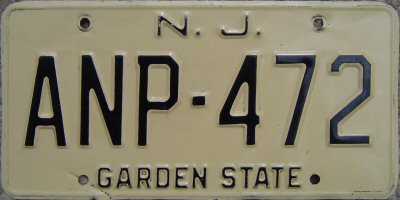
  1959 New Jersey
New Jersey 1959 issue
Q: What are the oldest license plates still in continuous use?
A: Delaware plates from 1941 forward are still allowed to be used today. These oldest plates are porcelain coated and have white numbers on a black background. They were first issued with metal tabs that indicated a 1942 expiration date. (Delaware also allows modern reproductions of these porcelain plates to be used legally.) Other states with very old license plates still in use are Oregon plates issued from 1955 (with a stamped 1956 initial expiration date) forward, New Jersey black-on-tan plates first issued in 1959, and California gold-on-black plates first issued in 1963.

Q: What is the oldest passenger car plate design that is still issued today?
A: This gets a little tricky, because it depends on whether you consider minor changes in a plate's appearance, or a switch to a new numbering scheme, to constitue a design change or to just be a continuation of the same design. Below are some plates that might qualify as the oldest design still being issued; you be the judge.
  • Delaware has issued completely flat gold-on-blue plates with a gold border since 1970. However, the typeface, or font, of the registration numbers was revised in 2002 and again in 2003, causing some recently issued plates to look "different". It's reported that they've now gone back to the original font, but it's hard to tell since they constantly re-use old plate numbers.
  • Minnesota graphic plates with the lake scene were first introduced in 1977 with 1978 expiration dates, but have been repeatedly updated with both minor design changes and serial format changes since then. The most recent serial format change was in 1997 and the most recent changes to the serial dies and plate design were in about 1998 or 1999.
  •   2008 North Carolina
    North Carolina "First in Flight"
    North Carolina "First in Flight" graphic plates showing the Wright Brothers' biplane were first issued in 1982 and continue to be issued today. The current serial format was begun in 1985. However, in 2007 the state began issuing these plates with the registration numbers painted red, rather than blue.
  • North Dakota "Discover the Spirit" graphic plates are currently the longest to be continuously issued with no change whatsoever. These were introduced in 1993.

Q: Which states issue plates in pairs, and which issue single plates?
A: There are 31 states that issue plates in pairs, plus Washington, D.C. That leaves 19 states that only issue single plates to go on the rear of the vehicle. Mostly these 19 states are in the south. The easist way to describe which states are in which category is to show you visually.

Top

Questions from people searching for specific license plates

Q: I'm looking for a (year) (type) license plate from (jurisdiction). Do you have one you will trade or sell?
A: I keep my trade box page (my list of plates available for trade or sale) up to date, so look there. If you don't find what you're looking for there, I don't have one available. If you've spotted what you're searching for on one of my other web pages, you're most likely looking at something from my permanent collection. I probably will not trade or sell plates from my permanent collection, unless you really make it worth my while. Also, please keep in mind that some plates shown on this site are not from my collection. These are always identified, except on the North Carolina plate pages and on my grading page. In any case, if you haven't found what you want anywhere on my web site, it's extremely unlikely I even have what you want.

Q: I'm looking for a (year) (type) license plate from (jurisdiction). Will you keep an eye out and let me know if you come across one somewhere?
A: Sorry, but unless you're a friend or family, I'm not likely to remember or keep track of who you are and what you're looking for. Instead, I'll give you some places to continue your search yourself. See the next question.

Q: I'm looking for a (year) (type) license plate from (jurisdiction). Where might I be able to find one?
A: First, check my trade box page if you haven't already. Second, try the links in the suggested sites for buying license plates section of my links page. The eBay license plates category usually has between 6,000 and 10,000 license plate listings at any point in time. Use the search feature to zero in on what you're looking for. If you don't find what you're after on eBay, check back regularly, because the inventory turns over quickly. Third, try some of the personal web pages of other license plate collectors; many (most?) of them have license plates available for trade or sale. There are links to a number of these on my own links page, and also a lot more of them on the pages listed in the links to more license plate links pages section of my links page.

Q: I've looked in all of the places you mentioned, and I've come up empty. Got any other suggestions?
A: Check out some other online auction sites. You're not as likely to find what you want on these as you would on eBay, but you never know. Besides eBay, I've also seen license plates listed on Zimzy and Wagglepop. There are almost certainly other smaller auctions sites out there, too, that you could find on your own.

Join one or more of the larger online license plate collecting discussion groups, such as the Yahoo! PLATES group, and post a message to the group describing what you're looking for.

Go to a large antique or classic car show where they have booths selling parts and accessories. There will most likely be people selling old license plates for owners of old cars to put on their vehicles. You'll increase your chances of finding plates from the state you're looking for if you attend a show that's in or near that state.

A couple of really big antique car shows that have reputations for having lots of old license plates for sale are held in Hershey, Pennsylvania (near Harrisburg) each October, and in Concord, North Carolina (near Charlotte) each April and September. These are both huge events that last for several days. There certainly must be other car shows in your state, too.

You could also try going to a license plate collector swap meet listed on the LicensePlates.cc Events page and ALPCA Meets page. Again, a meet held in or near the state you're looking for would be your best bet. However, I'd recommend contacting the meet host identified in the listing first, because ALPCA-sanctioned meets, as well as many non-ALPCA meets, are not open to the general public.

Q: I'm looking for a (year) (type) license plate from (jurisdiction). I don't even know what they look like; do you at least have a picture of one you can send me?
A: If it's a passenger plate from Maryland or Pennsylvania, or a 1959 passenger plate from any state, chances are good that I have a picture of the plate you're looking for right on my web site. Go back to the index and find the appropriate page. If it's one of these plates and you don't see a picture, I don't have one, but for the Maryland and Pennsylvania plates, you can get a pretty good idea of what it should look like by reading the text on the appropriate Pictoral History page. Otherwise, I can't help, but use the links listed in one of the previous questions to find other collectors' web sites.

Top

Questions from people who have one or more old license plates

Q: I have an old license plate that I can't identify. Do you know (where it is from) (how old it is) (what it was used for) ?
A: If it's from Maryland, my other pages on this web site ought to be able to help you clearly identify it. If it's from Pennsylvania, my web site has detailed information about passenger car and truck plates, as well as plates marked "Suburban". For other types of Pennsylvania plates, you could probably make an educated guess based on the information I've provided about passenger car plates.

I'm a fairly new collector with rather limited collecting interests, so I can't readily provide you with details about all kinds of obscure mystery plates. I especially know very little about license plates from outside of the U.S. and Canada. A couple of really comprehensive international license plate web sites that may be of help to you in identifying your plate are License Plates of the World and The Francoplaque License Plate Collectors site.

Q: I have an old metal Pennsylvania license from the 1920s that doesn't look at all like anything on your Pennsylvania passenger car license plate web pages. Among other things, it has the words "Display on Middle of Back" embossed on it. Can you identify what this is? Could it be perhaps a motorcycle license plate?
A: What you have is not a vehicle license plate at all, but rather a hunting license. Even today, hunters display their hunting licenses on the backs of their jackets. Back then, a metal plate would have been the most appropriate material for a hunting license because it held up to the elements well.

Q: I have a license plate that, other than the registration number, just simply says "USA". Do you know what this could possibly be?
A: You mean something like this? Actually, yes. From 1962 until 2005, members of the U.S. military stationed in Germany were issued license plates for their personal vehicles that were marked "USA". They're no longer issued; previously issued "USA" plates are still in use but are being phased out.   Note: the plate shown in the link in this answer was previously in my trade box.

Q: I have an old (year) (type) license plate from (jurisdiction). Do you know what it's worth?
A: Well, I can tell you what you probably already could guess. Generally, the older the plate, the better the condition, and the smaller the population of the state or other issuing jurisdiction, the more the plate will be worth. Frequently though, even very old license plates aren't necessarily worth a whole lot of money.

Q: I understand all that, but will you provide me with an estimate of the value of my specific plate?
A: Sorry, but no. I get requests like this pretty regularly, and I've responded to them in the past, but frankly, there's just nothing in it for me. See the next question.

Q: I have an old (year) (type) license plate from (jurisdiction). Do you know any place where I could get an estimate of its value?
A: I don't know of anyone who will give you a specific appraisal. But if your plate is a standard-issue U.S. or Canadian passenger car plate, you can find one estimate of its value in Bob and Chuck Crisler's License Plate Values price guide. This guide also has some limited information about values of some U.S. and Canadian optional issue, motorcycle, dealer, handicapped, vanity, and amateur radio operator license plates. You used to be able to order this book online, but their web site is now disabled. It's possible you could find a copy of this book second-hand somewhere.

But bear in mind that the Crisler guide is just that, a guide. I've seen lots of plates sell for well below and well above the value listed in the guide, even between two experienced license plate collectors. If your plate is another type of non-passenger plate, or a plate from another country, you're pretty much on your own. The only other suggestion I could offer would be to see what similar plates have sold for on eBay.

Q: I have an old license plate, or a group of plates, that I'd like to sell. Would you be interested in buying?
A: Possibly. Please check my want list page if you haven't already. If it's on the list, I'm interested. However, I'm a small-time collector on a limited budget, so I may or may not be in a position to buy your plate(s) at any given time. Also, I'm not going to just mail a check to someone I've never heard of, and hope that they will send me the license plate they say they have. Read the "fine print" on my want list page for more information. If your license plate is not on my want list, then I probably would not buy it. If you have plates you're selling as a group, I might consider buying the group if it includes things I actually want. I'll happily take any free license plates regardless of whether they're on my want list, though.

Q: I have an old license plate, or a group of plates, that I'd like to sell. Do you have any suggestions about how I could do this?
A: Your best bet is probably to list it on eBay. eBay is a very popular online auction web site. Using eBay will ensure the widest possible audience, and will maximize the chances that you will get the true market price for your item. If you've never sold anything on eBay and don't want to take the time and effort to learn how, then I'd suggest finding a business or a person in your local area that will sell your items on eBay for a fee or a percentage. These are called "trading assistants"; this is equivalent to selling on consignment. eBay has a Trading Assistants Directory that you can use to find one near you.

(Although I'm not an official eBay trading assistant, I am an eBay seller, and I have performed unofficial trading assistant services from time to time, both on eBay and otherwise. I've sold license plates on behalf of other people via eBay, through my trade box web page, and at license plate collector swap meets. I may be able to help you sell your plates. Send me an e-mail with some specifics and we'll see. Let me know the approximate number, age, and condition of the plates, and where they may be mostly from; please also tell me where the plates are presently located. Keep in mind that somehow I would need to get the plates from you in order to sell them; I'm located in Raleigh, North Carolina.)

Another option would be to sell your old license plates to a local antiques dealer. One that deals in antique collectible items would possibly be interested. Of course, realize that you're not going to get top dollar for your plates this way, as the dealer will guess at the retail price he might get, subtract the profit he wants to make, and offer you the difference. If he's not familiar with old plates, he'll probably guess very conservatively (low) at the price he could get.

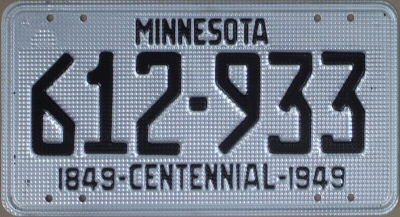
  1949 Minnesota
A plate in my permanent
collection, contributed by a
visitor to this web site

Q: I'd like to help you with your collection and give you a free license plate. But if I do, will you keep it for your collection, or are you just going to turn around and sell it?
A: Well, it depends on whether it's a plate that I'm specifically looking for. The honest answer is that most, but not all plates I've been given have gone straight into my trade box. But these plates nevertheless do truly help me with my collection, because they provide me the means to get the plates I really want. And either way, your plate will end up in a good home with a collector who is glad to have it. If you are still troubled by this, check my want list to see if your plate is one I would intend to keep. I do sincerely appreciate all free license plates. But I'd probably rather not have a plate that comes with strings attached.

Top

Questions about using old ("year of manufacture") license plates on old cars

Q: I have a classic (year) (make) car. If I get a set of old license plates, can I register these old plates to the car and legally drive the car with the old plates on it?
A: In some states you can, under what are called "year of manufacture" (YOM) laws. But in most cases, the year of the plate has to match the vehicle model year or year of manufacture. For example, a 1962 vehicle could only use license plates that were also from 1962. Specifics of these laws vary, so check with your state's DMV for more information.

Q: You seem to know a lot about Maryland license plates. Which year of Maryland plates would be correct YOM plates for my classic (year) car?
A: As you probably already realize, the answer to this question is not obvious, because many old Maryland plates are stamped with a March expiration date. I've been told that in Maryland, the year shown on the plate (the issue year up to 1937, and the expiration year from 1939 forward) must match the model year of the vehicle. For example, to register a 1957 model car with YOM plates, you'd need plates that indicated an expiration date of 3-31-57. 1976 and 1981 vehicles would use the undated, unstickered plates that expired in those years. But I'm not positive about any of this - I'm a license plate collector, not a classic car owner, and I don't live in Maryland - so check with the Maryland MVA to be certain.

  1939 Maryland
YOM plate for 1938 and 1939?
Q: What about me? I have a 1938 model car that I'd like to get YOM plates for, but there were no Maryland plates made with the year 1938 on them. What plates am I supposed to use? Or am I just out of luck?
A: A very good question for which I have no definite answer. If I were to speculate, I'd say that Maryland plates with a 3-31-39 expiration might be able to be used for both 1938 and 1939 model cars. These plates were used for 15 months between January 1938 and March 1939. But you'll have to get the correct answer from the Maryland MVA.

Top

Questions about restoring or repainting old license plates

Q: I have a rusty old (year) (jurisdiction) plate that I want to have restored and use on my classic (year) (make) car. What do you think?
A: Unless you have a sentimental attachment to that particular plate (perhaps it belonged to your grandfather), you should compare the cost of restoration vs. the cost of buying a similar plate in excellent original condition, or one that has already been restored. Unless the plate is very old and/or rare, it may be cheaper to find a better plate than the one you have. For example, let's say it costs $50 to restore your plate. If similar plates in excellent original condition go for $200, restoration would make economic sense. If similar plates in excellent original condition can be had for $15, restoration certainly does not make economic sense.

Q: What are the correct colors for repainting a (year) (jurisdiction) (type) plate?
A: If you're asking this question, you're either considering painting a plate yourself or are perhaps going to take it to an auto body shop to be repainted. Don't do it! Amateur repainted plates are good for nothing except for being professionally repainted. Probably the same with a body shop paint job. Unless you have an example of an unfaded, original paint plate for them to copy, it's very unlikely that they're going to get the color just right. And if you had such an example, you wouldn't be asking this question. My advice is to go to a professional license plate repainter or restorer, or don't bother. But to answer the question, I don't have any information about specific paint color codes; all I could tell you would be vague colors such as "dark blue numbers on a dark yellow background", which you probably already knew.

Q: Are repainted plates worth more or less than original paint plates?
A: Generally, even a professionally repainted plate is worth significantly less than an original plate in the same condition, at least to a license plate collector. But classic car owners seem to love restored and repainted plates; after all, they've restored their cars, so why would they object to a repainted license plate? Depending on the condition of the plate prior to the repaint, the accuracy of the paint colors, and the quality of the work done, repainting an old plate can either increase or decrease the value of that particular plate from what it was. Even if the value increases, whether it will increase enough to offset the cost of the repainting is another question that you will need to consider.

Q: Can you recommend anyone who professionally restores or repaints old license plates?
A: I can't recommend anyone from firsthand experience, but I can refer you to some people who professionally restore and/or repaint old license plates. Go to my suggested sites for restoring and repainting old license plates section on my links page for links to a few plate restorers with web sites, and to a list with contact information for a few additional restorers who don't have web sites. The restorers with web sites all display examples of their work on their sites.

Top

Questions about this web site

Q: Where did you get all of the information about license plates that's on this site?
A: A combination of ways. Perhaps the most significant is by direct observation of plates actually in use. Even when I was a kid in the 1960s, I paid careful attention to license plates I saw. For example, much of what I wrote on the 1954-to-present Maryland web pages are details that I saw firsthand as a child, teen, and young adult, and have retained all these years.

Another method is by looking at lots and lots of current pictures of old plates. Nearly every day I look at license plates that are newly listed on eBay and which fall into categories I'm interested in. I do this not necessarily to buy, but to learn from. This is one way that I've been able to reconstruct which serial number ranges were issued in which years on multi-year base plates, for example.

A third method is plain old research, which takes on a variety of forms. I've read archives of old state motor vehicle laws, studied old photographs of vehicles, read articles and books written by other license plate researchers, consulted with collectors who are experts about particular categories of plates, explored various state DMV web sites, and so on.

There's one more way that I want to mention. Ever since I created this web site, there are people who make a point of sending me information about plates that they've observed - such things as new plate styles, changes to existing plate designs, new serial number formats, new year sticker colors, etc. This is especially helpful to me with regard to my Maryland and Pennsylvania pages, since I don't frequently see these plates in actual use any more. Similarly, I get e-mails from people who provide additional details, clarifications, corrections, etc. related to information I've already reported on the various pages on this site.

Q: Why do you spend so much time studying license plates and putting all this on a web site?
A: Because it's fun!

Q: I'm don't understand some of the terminology you use, such as "natural", "passenger", and "serial format". Can you explain some of these terms?
A: I guess you must have missed my Definitions of License Plate Terms, above on this page.

  My current license plate
The plate currently on my own vehicle
Q: What is the license plate from my vehicle doing pictured on your web site?
A: I took a photo of your plate and put it on my site simply because it was a good example of that particular type of plate. Your plate number is not sensitive personal information like your Social Security number is. After all, it's on display for thousands of people to see every time you leave your garage. Also, there's generally no way to connect a plate number to a specific individual without access to a police or DMV database, and those are highly secure. Notice that I haven't identified or shown you, your vehicle, or where it was parked. I hope you'll realize there's no harm being done and no privacy being invaded here. To show my sincerity about this, pictured at right is the plate currently on my own personal vehicle. If you are still bothered about this, contact me, and I will take down the picture of your plate.

Q: How do you decide whether to use a candid photo of a plate on the street, or use a another plate collector's photo?
A: There is a method to my madness. If I have a choice of which photo to use for a given plate type, this is the order that I would choose from:
  1. A photo I've taken of a plate I currently own
  2. A photo I've taken of a plate I previously owned
  3. A photo I've taken of a plate I've never owned; which is owned by another plate collector
  4. A candid photo I've taken in a parking lot of a random plate in actual use
  5. A photo taken by someone else of a plate they own, where that person has given me permission to use their photo
  6. A photo taken by someone else of a plate they don't own, where the photographer has given me permssion to use their photo.
Note that I do not post on my site any plate photos I've found on eBay or elsewhere on the web, without first getting permission from the original photographer. I hope that others will treat me the same way.

Q: What's up with all that "extremely important" God and heaven stuff on a license plate collecting site?
A: You're referring to the light purple box at the bottom of the front page of this site, and the page it links to. I'm a committed Christian, and I want this site to reflect that.

I figure I have two choices. I can either keep my hobby completely separate from my faith, or I can find ways to combine them. If I keep them separate, then every minute and every dollar I spend on my hobby is less I have to serve God with. If I'm serving God while I'm enjoying my hobby, then the dilemma is greatly reduced.

Jesus instructed his followers to tell the world about him (Matthew 28:18-20), and there's no reason to think that Christians of the 21st century are exempt from this command. But, on the other hand, it's detrimental to the cause if I'm too "in your face" about it and end up driving people away. So I've tried to keep it visible, yet low-key. If you're looking for answers about God, or if you're curious, then have a look. If you're not, that's okay, too; feel free to enjoy the rest of the site.

Q: What does that "W3C HTML 4.01" logo that's at the bottom of your pages mean?
A: It means that that web page has been validated, meaning that the HTML programming code used to create the page follows the rules and syntax of HTML version 4.01. This means that web browsers that support HTML 4.01 (most all do) should have no problems presenting that page. If you click on the W3C logo on any given page, that particular page will be re-validated and you will be shown the results. Since I actually write all of my own HTML code, rather than use web page software to create it for me, I thought it would be a good idea to make sure it is valid code. W3C stands for the World Wide Web Consortium, an international group that develops web standards.

Q: I have a question that's not addressed on this page or anywhere else on your site. How can I get my question answered?
A: Send me an e-mail and ask away. I'll do my best to give you an answer.

Top

Related links

Other related pages on this site
About Rick and His Crazy Hobby, and about this web site
A Pictorial Guide to License Plate Grading

License plate collecting FAQ pages elsewhere on the web
ALPCA Frequently Asked Questions
PL8S.com Frequently Asked Questions
Guide to License Plate Collecting

Top


Home


  This page is
Valid HTML 4.01 Transitional
W3C valid
Send me an e-mail with any questions or comments.

All text and photographs © copyright 2004-2008 by Rick Kretschmer, except where noted. All rights reserved.
This page last modified: May 8, 2008