|
|
 |
|
|
|
|
This page covers the history of Maryland license plates used by vehicle dealers and other automotive-related businesses. Latest noteworthy updates to this page
|
|
From 1910 to 1937, Maryland license plates displayed the calendar year in which they were valid. Plates dated 1939 and later always indicate, on the plates themselves, or via metal tabs or stickers, the year in which they expire. Exceptions to this include undated, unstickered plates that expired in 1976 and 1981, and front plates issued since 1986, which are not dated and do not bear stickers. I consistently refer to plates by the year that is shown on the plate, regardless of when the plate was actually issued.
Maryland non-passenger plate types (meaning plate types for vehicles other than private passenger cars) and their expiration stickers, with few exceptions, have closely resembled or been indistinguishable from their passenger car equivalents from the same time period. Because this information is covered in detail on the passenger plate pages and the general information page, I'll just point out when there were deviations from passenger car plates.
On the various Maryland non-passenger plate history pages, for plates dated 1953 and earlier, I've listed the specific years and plate numbers that I've seen firsthand or in photos. This will hopefully be useful in identifying patterns and figuring out the mysteries surrounding some of these plates.
Dealer plates are used not only by retail vehicle dealers, but also by vehicle manufacturers and distributors. Dealer plates and other automotive-related business plates are not assigned to a specific vehicle, and therefore may be moved from vehicle to vehicle as needed. These plates enable the business to drive otherwise unregistered vehicles on public roads. Dealer plates and related plate types were issued in pairs until the early 1970s (well, except for motorcycle dealer and trailer dealer plates); since then, only single rear plates are issued.
My "Pictorial History" pages are intended to be a supplement to the information found in the ALPCA Archives. I am providing additional details and additional photos not found in the archives, and clarifying information when appropriate. When the ALPCA archives cover a subject in great detail, I do not repeat that detail here. I sincerely hope that you find this information useful.
If you find an error or have additional information, or can provide a plate or a photo of a plate that I'm missing, please send me an e-mail. There's a link to my e-mail address at the bottom of every page. Please note that all plates shown that are credited to another person are plates that I am still seeking for my own collection.
Vehicle manufacturers and distributors do not have specific plate types in Maryland; instead, they are issued the same dealer plates as retail vehicle dealers.
 (Mason photo / plate)  (Willard plate) |
Non-motorcycle dealersDealer plates have been issued since 1910, the very first year that Maryland issued license plates of any type. Unlike the 1910 passenger plates, however, 1910 dealer plates were made of porcelain, as were the 1911-1914 dealer plates. The word Dealer was displayed on the plates, to the right of the serial and under the state abbreviaton and year. Some dealer plates from this period had an "A" serial prefix, but the meaning of this is not known.
|
|
Motorcycle dealersVery little is known about these plates, but reportedly they existed as early as 1912. |
 (Francis plate) 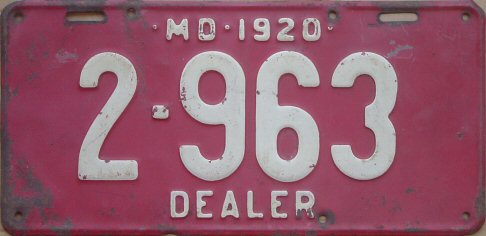
|
Non-motorcycle dealersFor 1915, like other plate types, dealer plates switched to embossed steel plates. These plates bore the legend Dealer along the top edge in 1915, 1916, 1917, and 1919, and along the bottom edge in 1918 and 1920. These plates were approximately 7 1/4 to 7 3/8 inches tall, rather than the normal 6 inches, to accommodate the legend. A dash was added between the hundreds and thousands digits starting in 1917. Some dealer plates from this period had an "A" prefix, but the meaning of this is not known.
|
|
Motorcycle dealersThese plates reportedly existed, but no details are available. |
(no picture available)
In 1921 only, dealer plates were identified with a "D" serial suffix.
Plate numbers observed
|
These plates reportedly existed, but no details are available.
 (Willard plate)  Repainted 1931 new vehicle dealer (Mahaney photo / plate)  Repainted 1936 used vehicle dealer (Mahaney photo / plate) |
Non-motorcycle dealersFrom 1922 on, the word Dealer was embossed vertically along either the left or right side of the plate. A separate plate type for used vehicle dealers began in 1931 or possibly earlier, with the letters "UC" either stacked left of or flanking the serial number.
|
|
Motorcycle dealersThese plates reportedly existed, but no details are available. |
There were no dated 1938 Maryland plates; in 1938 Maryland converted from calendar year registrations to a March 31 expiration date for all plate types. Plates issued in 1938 were valid for 15 months and indicated a 3-31-39 expiration date. All Maryland plates from this point forward show the expiration year rather than the issue year. Beginning with 1952 expirations, dealer plates and most other non-passenger plate types switched from March 31 to April 30 expiration dates.
 1948 used vehicle dealer (Sallmen photo / plate) |
Non-motorcycle dealersDealer plates continue to be identified with a vertical Dealer legend, located along the left edge for new car dealers, and along the right edge for used car delears. Used car dealer plates were additionally identified with a stacked "U/C" prefix.
|
|
Motorcycle dealersThese plates resembled regular motorcycle plates, but the serial number consisted of a small "D" prefix, followed by one-, two-, or three-digit number. Obviously produced in small quantities.
|
 1958 new vehicle dealer  1969 used vehicle dealer |
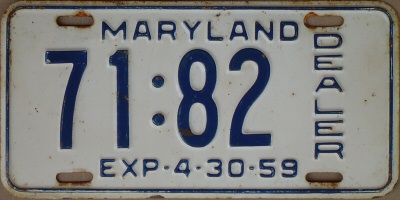
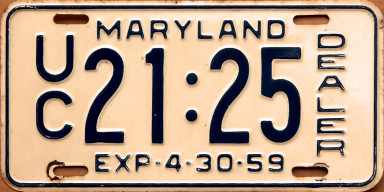
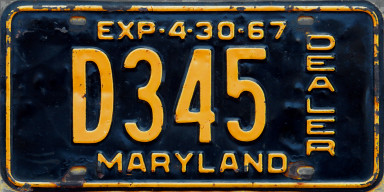
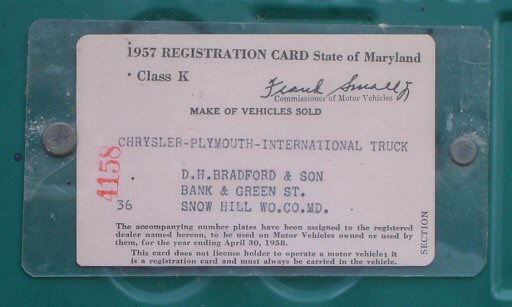
Non-motorcycle motor vehicle dealersThe serial formats for motor vehicle dealer plates were 00-00 and x0-00 during 1954-1964, and 0000 and x000 during 1965-1970. Prefix letters were variable; the 1967 dealer plate's "D" prefix doesn't stand for dealer; it's just the prefix letter used between prefix letters "C" and "E". The word Dealer ran vertically down the right side of the plate for both new and used vehicle dealer plates, and these plates expired annually on April 30. Used vehicle dealer plates carried the stacked letters "U/C" down the left side of the plate; new vehicle dealer plates had no corresponding designation. Probably vehicle manufacturers and distributors were issued the new vehicle version without the U/C designation. Often, dealers attached the registration card to the back of the plate in some manner. The 1958 expiration dealer plate at left has the registration card laminated and riveted to the back of the plate. The rivets are visible on the front of the plate, just to the left of the dash and to the right of the number "8". This registration card indcates that new vehicle dealers were Class "K" registrations back then. I've also seen a 1959 expiration used car dealer registration card that indicates used vehicle delaers were Class "M" registrations. Who knew? While Maryland registration classes have remained largely unchanged since 1953, today, Class "K" registrations are for farm area trucks and island vehicles and Class "M" reigstrations are multi-purpose passenger vehicles (SUVs, mini-vans, and motor homes, mostly), while non-motorcycle motor vehicle dealer registrations are now all Class "1A". See the 1957-1958 dealer registration card.
|
|
 1955 motorcycle dealer  1957 motorcycle dealer (Willard plate)  1958 motorcycle dealer (Sallmen photo / plate) 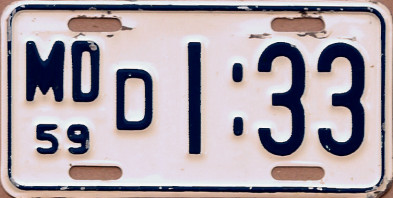 1959 motorcycle dealer  1970 motorcycle dealer (Harbold plate) |
Motorcycle dealersThese plates closely resembled regular motorcycle plates. There's no distinction made between new and used motorcycle dealers. At least in the case of the 1958 dealer plate, the state abbreviation and expiration year were on the opposite side of the plate than they were on regular motorcycle plates, and the separator character went between the small "D" prefix and the first digit. The 1955 and 1957 dealer plates had the state and year on the same side as regular motorcycle plates, but had no separator character. I have no information about what the 1954 or 1956 dealer plates looked like, other than that they also had the same small "D" serial prefix or suffix. From 1959 through at least 1964, the state name and year stayed on the same side as regular plates, the serial consisted of an even smaller "D" prefix followed by a three-digit number, with the separator between the second and third characters. Note, however, that the 1960 plate uses a diamond separator character, the same as on full-sized plates of that year, but different from the colon used on regular 1960 motorcycle plates. 1962 motorcyle dealer plates used a colon separator, the same as regular motorcycle plates but different from the dash used on full-sized plates. I can't tell you which separator characters were used on motorcycle dealer plates dated 1961, 1963, or 1964. 1966 motorcycle dealer plates use an even smaller "D" prefix with no separator character. I haven't seen one, but I assume the 1965 plates were the same. It's worth noting that by 1966, if not earlier, regular motorcycle plates had exhausted the all-numeric format and were issued with a full-sized letter in the prefix position. However, the "D" prefix was apparently skipped on 1966 regular motorcycle plates. Joe Sallmen tells me that 1967 motorcycle dealer plates have a full-sized "D" prefix – he's got one, along with the registration card indicating that it's a dealer plate. But that year, regular motorcycle plate numbers beyond 9999 apparently only used prefix letters "A" and "B", and after that used suffix letters. Starting with the 1968 plate, to more clearly distingush dealer plates from regular plates, the legend DLR, stacked vertically, was embossed on the left center portion of the plate, just to the right of the state abbreviation and year. A three-digit serial number occupied the right half of the plate. This format continued through 1970. |
|
|
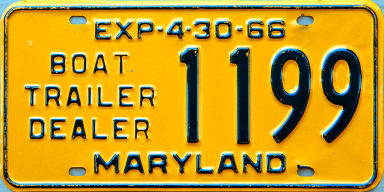
Boat trailer dealersI only discovered that this plate type even existed in the summer of 2018, when a 1966 expiration boat trailer dealer plate was listed on eBay. I won that auction, and that plate is now in my collection and is shown at left. Since then, I've discovered that boat trailer dealer plates were apparently only issued with 1966 and 1967 expirations. These plates bore the text Boat Trailer Dealer horizontally on the left center portion of the plate, with the words stacked vertically. The serial format was 0000. This plate type was apparently replaced with the more generic trailer dealer plate type starting with the 1968 expiration plate. I'd guess that trailer dealers used regular dealer plates prior to 1966. Why only boat trailer dealers got 1966 and 1967 plates, I can't begin to guess. |
|
|
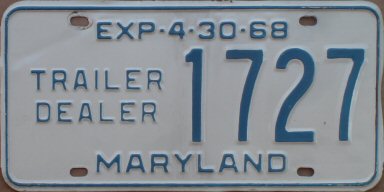
Trailer dealersApparently the state discovered that there are trailer dealers who sell other types of trailers besides boat trailers, and switched to a more inclusive trailer dealer plate beginning with the 1968 expiration plate. These plates bore the legend Trailer Dealer horizontally on the left center portion of the plate, with the words stacked vertically. The serial format was 0000. |
   1975 dealer |
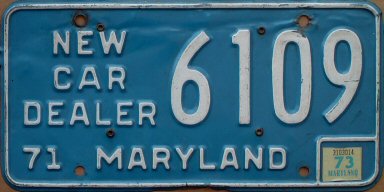
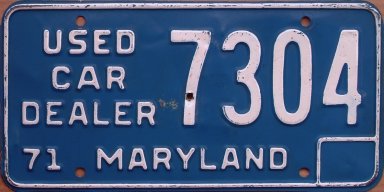
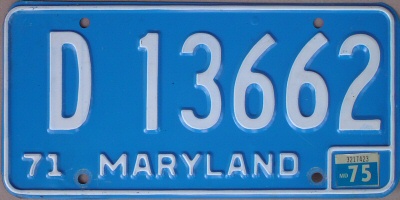
Non-motorcycle motor vehicle dealersOriginally on the 1971 base, motor vehicle dealer plates carried either the legend New Car Dealer or Used Car Dealer, displayed horizontally on the left center portion of the plate with each word stacked above the other. The serial formats were 0000 and x000. Apparently these plates were used regardless of the types of motor vehicles the dealer actually sold – car, truck, or otherwise. I believe that all non-motorcycle motor vehicle dealer plates were issued in pairs until and including these plates. Partway through the life of this base, both of these types of dealer plates (new and used car dealers) were recalled and replaced with plates in the format D 00000. I've read that this occurred in August 1972, so both the old types and the new type should theoretically exist with 1973 expiration stickers. These new plates contained no text identifying the plate type, and there was no longer a distinction between new and used vehicle dealer plates. These were issued as single plates, as have all dealer plates since then. The 1973 expiration new car dealer plate at left also has its registration card laminated and riveted to the back of the plate, with the four rivets visible on the front of the plate. Unfortunately, this registration card doesn't say what the registration class code is, so it sheds no light on exactly when dealer registrations changed from being Class "K" (new vehicle dealers) and Class "M" (used vehicle dealers) to Class 1A (motor vehicle delaers). I'm going to guess that this change of registration classes occurred at the same time that the new and used car dealer plates were replaced with generic dealer plates. See the 1972-1973 dealer registration card. |
Motorcycle dealersMotorcycle dealers used the same base plates and stickers as regular motorcycles. However, motorcycle dealer plates contained a small, embossed, horizontal legend DLR on the left body of the plate, followed by a serial in formats 000 or 0000. There's no distinction made between new and used motorcycle dealers. |
|
|
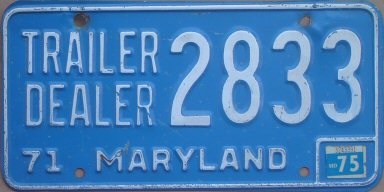
Trailer dealersTrailer dealer plates carried the legend Trailer Dealer displayed horizontally on the left center portion of the plate with the words stacked vertically. The serial format was 0000. Apparently these plates were not recalled, as the new and used car dealer plates were. |
When staggered expirations were introduced in Maryland in 1986-1987 for many plate types, dealer plates continued with April 30 expiration dates. However, beginning with the 1987 expirations, they were also issued an April month sticker.
|
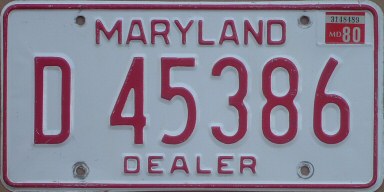
Non-motorcycle motor vehicle dealersMotor vehicle dealers continued with the serial format D 00000 on both the 1976-1980 red-on-white base and the 1981-1987 black-on-white embossed base. The legend Dealer was embossed at the bottom of the plate. |
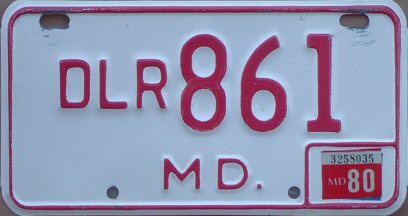 1980 motorcycle dealer |
Motorcycle dealersMotorcycle dealers used the same base plates and stickers as regular motorcycles. However, motorcycle dealer plates contained a small, embossed, horizontal legend DLR on the left body of the plate, followed by a serial in formats 000 or 0000. |
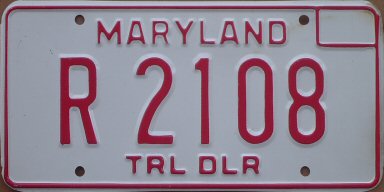 1976 trailer dealer |
Trailer dealersDuring this period, trailer dealer plates used serial format R 0000, and the legend Trl Dlr was embossed at the bottom edge of the plate. |
All full-sized dealer and automotive business plates on the black-on-white reflective base have a consistent serial format 0x00000, where the first two characters identify the type of business to which the plate was issued. All such plates have a screened legend at the bottom that also identifies the type of business. Motorcycle plates can only accommodate six serial characters, so these get a slightly different format.
Dealer plates switched from April expirations to staggered expirations in 1992; the first staggered registration period ranged from November 1992 to October 1993. Month assignment was, and continues to be, based on the company name. Until 1997, these plates were registered one year at a time; they're now registered for two year intervals.
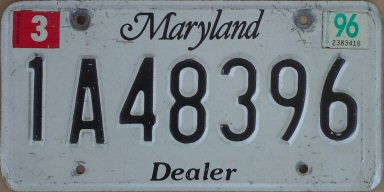 1996 dealer, serial format 1  2010 dealer, serial format 2 (plate in actual use) |
Non-motorcycle motor vehicle dealersThe regular motor vehicle dealer plate has the legend Dealer at the bottom of the plate. The serial format 1A00000 was issued from 1986 (with 1987 expiration dates) until approximately September 2005, when all possible numbers had been issued. Subsequent issues of regular dealer plates are now in format 2A00000. This new format makes little sense, since dealers are considered "Class 1" registrations, while recyclers (salvage yard operators) are considered "Class 2" registrations. Dealer plates were all prefixed with 1A (regular vehicle dealers), 1B (motorcycle dealers), or 1C (trailer dealers). It would have made a lot more sense to me to have gone to format 1D00000 for regular dealer plates. But the Maryland MVA refuses to consult me before making these kinds of decisions! |
Motorcycle dealersThese plates are similar to regular motorcycle plates, but with a screened M/C Dealer or just "Dealer" legend at the bottom of the plate, and bearing serial format 1B0000. |
|
|
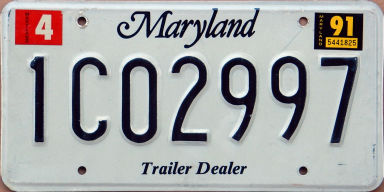
Trailer dealersThese are identified with the legend Trailer Dealer and serial format 1C00000. |
Specific plate types are issued to several additional types of automotive-related businesses that have a need to drive unregistered vehicles. Like dealer plates, all of these plate types are interchangeable, meaning that they are not registred to a specific vehicle, and so can be readily switched from one vehicle to another. The notes pertaining to expiration dates in the dealer plate section above also apply to these other automotive business plates.
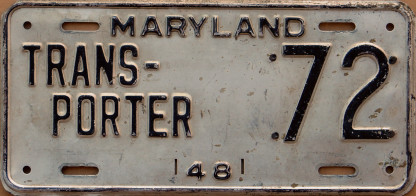 1948 new vehicle transporter |
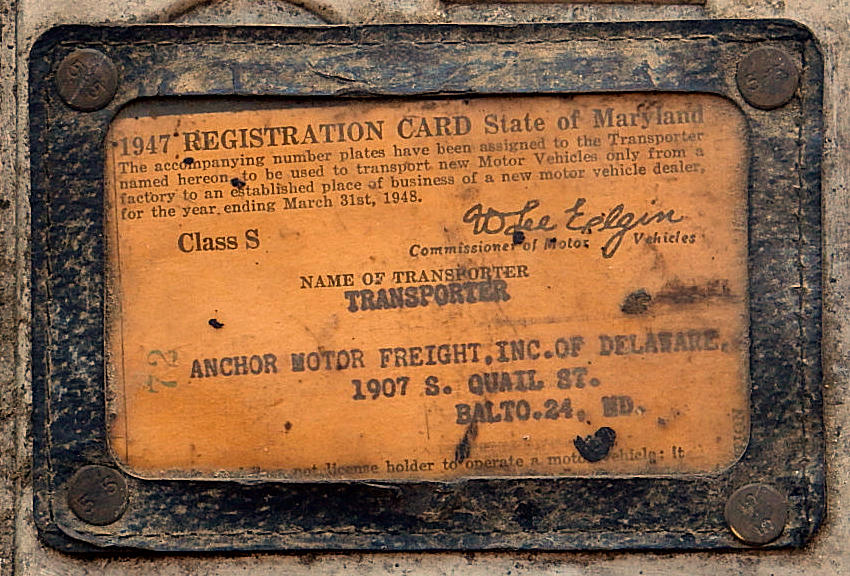
TransportersTransporter plates were and still are used to move or deliver unregistered vehicles. These plates don't go on trucks carrying unregistered vehicles, but rather on the unregistered vehicles themselves when they're being driven on public roads. Transporter plates were made on the 1945 and subsequent bases; I'm assuming the 1942 base also. By the time of the 1948 base, if not earlier, there were three different types of transporter plates. Plain transporter plates are by far the most common. These have the text Trans- over Porter displayed horizontally on the left portion of the plate. This type was issued at least since the 1945 base; possibly also on the 1942 base. By 1948, if not earlier, these plain transporter plates were specifically for transporting new vehicles. See the 1947-1948 new vehicle transporter registration card. By 1948, if not earlier, there was also a type that had the text Used Car over Trans- over Porter horizontally on the left portion of the plate. The purpose of these plates should be self-explanatory. Also by 1948, if not earlier, there was another type that bore the rather lengthly text New & Used / Car Trailer / Trans- / Porter displayed horizontally in four lines on the left half of the plate. (The slashes indicate the line breaks and were not actually on the plate.) Your guess is as good as mine regarding what exactly this means.
|
|
Finance companiesAutomotive finance companies were issued these plates to facilitate the movement of repossessed vehicles. The words Finance Company were stacked one above the other on the left side of the plate, with a numeric serial number on the right side. The examples I've seen have had two- or three-digit numeric serials. I'm not aware of this plate type existing before the 1948 base, but that doesn't mean it didn't.
|
||
 (Willard plate) |
Auto repairers and auto wreckersI don't know much about these two plate types, except that they were supposedly introduced on the 1948 base and also issued on the 1952 base. Today, auto repairers would get transporter plates, but apparently in the 1940s there was a distinction made between businesses whose primary purpose was to drive unregistered vehicles, versus businesses for which driving unregistered vehciles was secondary. The usage of "auto repairer" plates should be obvious; most likely "auto wrecker" plates were issued to salvage yard operators and other automotive dismantlers. The latter plate type reappeared in the 1970s as first "wrecker" and then "recycler" plates. I've never seen or heard of a "wrecker" plate issued between the mid-1950s and mid-1970s, so I don't know what type of plates salvage yard operators would have been issued during these years – my guess would be either used car dealer or transporter plates.
|
|
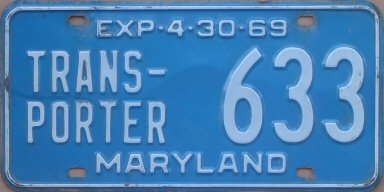
TransportersTransporters are either in the business of moving or delivering vehicles, or in a business where moving or delivering vehicles is incidental to the primary activity. These plates allowed them to drive otherwise unregistered vehicles on the street rather than have to load them onto a truck or trailer. A typical application would be for driving freshly-imported vehicles from the docks to a storage lot a short distance away. The plain version with just the text Trans- stacked above Porter on the left center portion of the plate is by far the most common type, and most likely the only type issued in the later years of this time period. In the mid-1950s, this plain verion was issued specifcally for transporting new vehicles. Serials were numeric; formats verified include 00 and 000, but format 0000 was likely also issued. I assume the version with the text Used Car over Trans- over Porter on the left portion of the plate was continued at least through the 1954 plate, but I don't know this for a fact. The version with the rather lengthly text New & Used / Car Trailer / Trans- / Porter displayed horizontally in four lines on the left half of the plate was definitley issued on the 1954 plate. (The slashes indicate the line breaks and were not actually on the plate.) I've never seen one on a plate later than 1954, but these were very low-volume plates, so my not seeing one doesn't mean that they don't exist. Again, despite the wordiness, I don't know specifically for what situation this plate type would have been used. |
|
|
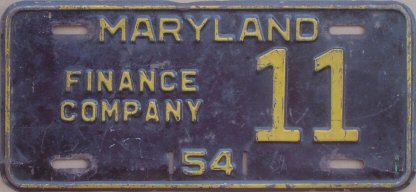
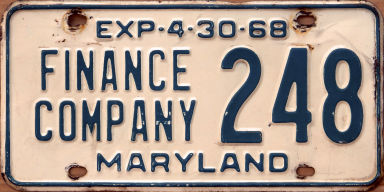
Finance companiesAutomotive finance companies were issued these plates to facilitate the movement of repossessed vehicles. The words Finance Company were stacked one above the other on the left side of the plate, with a numeric serial number on the right side. The examples I've seen have had two- or three-digit numeric serials.
|
|
Auto repairers and auto wreckersThe auto wrecker plate type, and I presume also the auto repairer plate type, were issued on the 1954 expiration plate. I have no information about either type being issued after that, at least until the auto wrecker plate type made an apparent comeback on the 1971 base. |
|
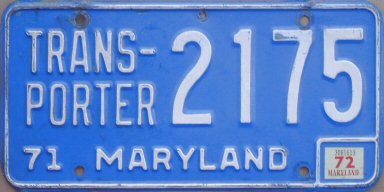
TransportersTransporter plates continued to display horizontally Trans- stacked above Porter on the left center portion of the plate, followed by serial in format 0000. |
Finance companiesAutomotive finance company plates continued in the same format with the text Finance over Company on the left side of the plate, with a numeric serial number on the right. |
|
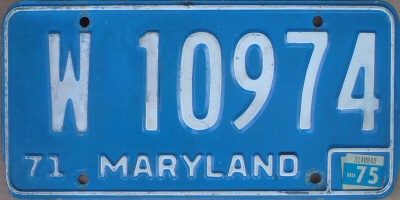 1975 dismantler |
Vehicle dismantlersI came across this plate in June 2007, and it was the first time I had ever seen or heard of a "W" prefix 1971 base. I obtained it from another Maryland plate collector who explained that "wrecker" plates were actually reintroduced on the 1971 base, rather than the 1976 base as I had previously thought. In Maryland plate terminology, a "wrecker" is not a tow truck, but rather a salvage yard operator or other automotive dismantler. (think: car crusher) These plates were used to enable the dismantler to drive operable, unregistered vehicles. My guess is that these were introduced midway through the life of the 1971 base, at the same time as the "D" prefixed dealer plates. Probably auto dismantlers were issued either used car dealer or transporter plates prior to these "W" prefix plates. No doubt serials began at W 10001 on this base. |
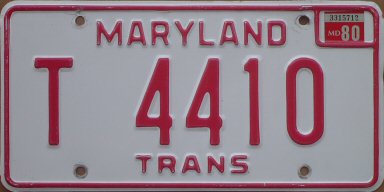 1980 transporter 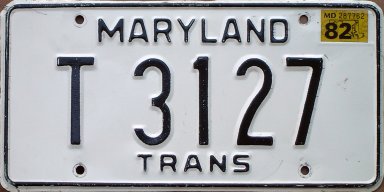 1982 transporter |
TransportersSerial format was T 0000, not to be confused with the T 00000 format issued for farm trucks. Transporter plates carried the legend Trans at the bottom of the plate. |
|
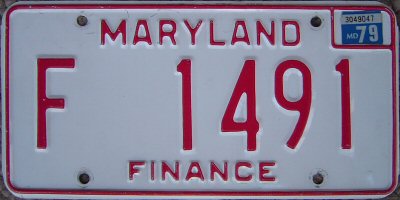
Finance companiesSerial format was F 0000, and the plates carried the legend Finance at the bottom center. |
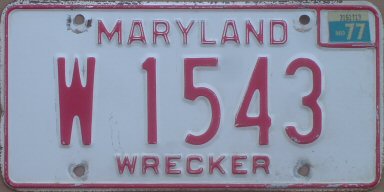 1977 dismantler (version 1) 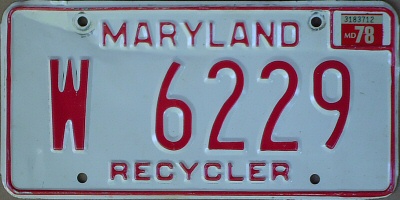 1978 dismantler (version 2) |
Vehicle dismantlersOperators of automotive salvage yards and other vehicle dismantlers were issued these plates to facilitate the movement of operable vehicles. Serial format was W 0000; on the red-and-white 1976 base, some plates carried the embossed legend Wrecker and others carried Recycler at the bottom. On the black-and-white 1981 base, only the Recycler legend was used. The "recycler" plates had nothing to do with recycling aluminum cans or newspapers, and "wrecker" did not refer to a tow truck. There was no distinction between the two legends; the term to describe an automotive dismantler simply was changed during the life of the 1976 base. Apparently "recycler" sounded more politically correct than "wrecker". The highest "wrecker" plate number I've seen is W 2759; the lowest "recycler" plate on the red-and-white base I've seen is W 4353. |
 2009 vehicle dismantler (plate in actual use) 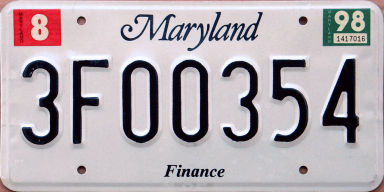 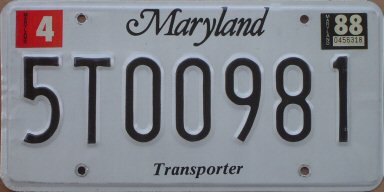
|
All dealer and automotive business plates on the reflective black-on-white base have a consistent serial format of 0x00000, where the first two characters identify the type of business to which the plate was issued. All such plates have a screened legend at the bottom that also identifies the type of business. The various automotive business legends and their associated two character serial prefixes are: Recycler (vehicle dismantler) – "2R"; Finance (vehicle finance company) – "3F"; and Transporter – "5T". There's some doubt about whether finance company plates are still issued or used. Maryland resident and plate spotter Jeff Ellis reports that he hasn't seen one in over ten years. To the best of my knowledge, they still are, but it's my understanding that very few are currently registered and those are seldom actually used. |
I personally would consider tow truck plates to be correctly classified as truck plates, rather than as automotive-related business plates, because they're registered to specific vehicles. But, in the interest of being comprehensive, I'm also addressing them here.
Note that 1976-1980 plates with the legend Wrecker are not tow truck plates, but rather are plates issued to salvage yard operators or other dismantlers to use on driveable vehicles. They're covered above in the non-dealer automotive business section above.
|
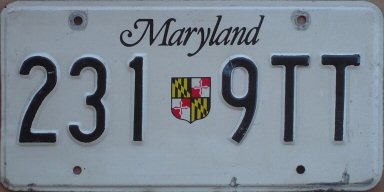
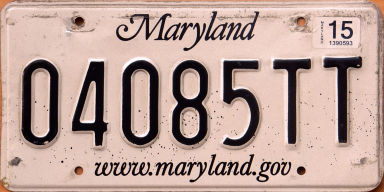
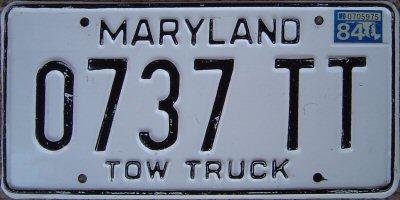
Tow trucks had been issued regular truck plates until 1983, then their regular truck plates were recalled and replaced with plates with format 0000 TT and bearing the legend Tow Truck. The 1984 expiration plate shown is a natural first-year issue. |
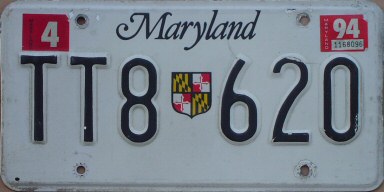 1994 tow truck (version 1) 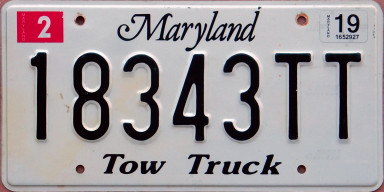 2019 tow truck (version 5) |
Tow trucks and "rollback" trucksTow trucks were originally issued plates on this base with serial format TT0*000, and no identifying legend. When that format was exhausted, then format 000*0TT was begun. In the summer of 2005, the second format also became history, and new plates are now issued in format 00000TT. The web site legend was added in late 2005, beginning at approximately serial number 00700TT; this was replaced with the legend Tow Truck in 2010 somewhere near plate number 07000TT. "Rollback" trucks, the type on which a disabled vehicle sits on the bed of the truck, have largely replaced traditional tow trucks. Both, however, are issued tow truck plates.
|
|
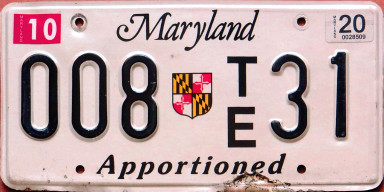 2020 apportioned tow truck |
Apportioned "rollback" trucks"Rollback" trucks which are used both for transporting disabled vehicles, and for shipping vehicles across state lines as freight, are issued apportioned plates with the rather odd format 000*T/E00, where the letters T and E are stacked one above the other, and which bear the legend Apportioned along the bottom. Apparently, there's no need for apportioned plates to just transport disabled vehicles or actually tow vehicles across state lines. Maryland entered the International Registration Plan in 1988, and began issuing apportioned plates to commercial vehicles that cross state lines. The first of these had April 1989 expirations. In 1999, apportioned registrations were partially staggered so that they expire at the end of either January, April, July, or October; however, registrations are still for a single year at a time. Apportioned year stickers for 2005 expirations inexplicably were white on green, rather than black on white as used for most other plates types. Likewise, 2010 apportioned year stickers are black on white, rather than the green on white used on most other plates. |
I personally would consider rental car plates to be correctly classified as commercial passenger vehicle plates, rather than as automotive-related business plates, because they're registered to specific vehicles. Similarly, rental truck plates, if they exist, I would consider to be truck plates. But, in the interest of being comprehensive, I'm also addressing rental vehicle plates here.
The ALPCA archives report that rental cars were assigned a reserved passenger plate serial format Jx 0000 on the 1971 base. I don't know whether there is any truth to this, but I can tell you that my parents owned two private passenger cars with dated 1971 plates in the "J" series – one with prefix JK issued about January 1971, and the other with prefix JW issued about April 1971. These J-series plates were issued in sequence after H-series plates and before K-series plates. So, at the least, a 1971 J-series plate is definitely not always a rental car. Possibly it never is.
I've seen a paper DMV envelope in which plates were packed that may shed some light on this mystery; or, perhaps, raise more questions than it answers. I don't recall the specifics, and I didn't write them down, but the envelope had stamped on it a plate number in the early 0000 Jx series, along with a plate type description that sounded like a rental vehicle of some sort. The use of a serial suffix makes me think that these plates were used for rental trucks, not rental cars. As far as I was previously aware, the 0000 Jx serial format was only used on the 1971 base, but it was issued late in the life of that base to regular trucks, including personal trucks. The envelope I saw bore no indication of an issue year or expiration date of the plate, but it had to be from late 1950s or 1960s, since it was intended for a 12 inch by 6 inch plate, and I'm nearly certain it said Maryland Department of Motor Vehicles. The Maryland DMV became known as the Motor Vehicle Administration in 1971.
 1992 rental car |
For a few years in the 1990s, rental cars were issued their own distinct plates on the reflective black-on-white base. The serial format was D/R*00000, and the expiration month was always March. It's been reported that "DR" stood for "daily rental". Before and after this time, rental cars carried normal passenger car plates. By the end of March 1995, this plate type was off the road, although there may be some examples that were five-year fleet registrations and had later-year expiration stickers. This plate was used for cars and probably multi-purpose vehicles (SUVs and mini-vans) only; rental trucks always bore regular truck plates during this period. |
Related pages on this site |
Elsewhere on the web |
Thanks to those who have directly contributed to the information on this page: Jeff Ellis, Christopher Jackson, "Tiger" Joe Sallmen, Shawn Mahaney, Christopher Mason, and John Willard.
Sallmen, Mahaney, and Mason photographs are presumed to be copyrighted by "Tiger" Joe Sallmen, Shawn Mahaney, and Christopher Mason, respectively, and are used with permission. Harbold, Francis, and Willard plates are from the collections of Harold Harbold, Jeff Francis, and John Willard, respectively.
This page is W3C valid |