 |
|
 |
|
|
|
|
This page covers historical information related to all or most types of Maryland license plates. Latest noteworthy updates to this page
|
|
I created this page as a place for information that didn't clearly belong on any single Maryland plate history page. I expect that I will occasionally add new topics to this page.
My "Pictorial History" pages are intended to be a supplement to the information found in the ALPCA Archives. I am providing additional details and additional photos not found in the archives, and clarifying information when appropriate. When the ALPCA archives cover a subject in great detail, I do not repeat that detail here. I sincerely hope that you find this information useful. If you find an error or have additional information, or can provide a plate or a photo of a plate that I'm missing, please send me an e-mail. There's a link to my e-mail address at the bottom of every page.
Mouse over any image to see a description of the plate. Click on any image to see an enlarged version.
Understanding Maryland's sometimes arcane systems for assigning serial numbers to non-passenger plates can be aided by being aware of the state's registration class codes. Frequently these class codes appear in the serial numbers and can be used to identify the vehicle type. For alphabetic classes, the license plate is assigned to a specific vehicle. For numeric classes, the license plate is not assigned to a specific vehicle.
| Class | Description |
|---|---|
| A | Passenger vehicles not for hire: cars, station wagons, passenger vans, SUVs, motor homes, and private buses until 1980; passenger cars and station wagons only since 1980. |
| B | Passenger vehicles for hire: taxis and non-funeral limousines until late 1980s or 1990s; taxis only since then. |
| C | Commercial (for hire) ambulances; also funeral and cemetery vehicles, including hearses and limousines used exclusively for funerals. |
| D | Motorcycles, including three-wheeled motor vehicles until 1980. |
| E | Trucks; this broad class consists of several sub-classes, as indicated below: |
| EFT | Farm-use trucks over 10,000 pounds GVW, not restricted geographically. |
| EH | Trucks for hire; obsolete class, merged with sub-class EPO regular trucks in 1970. |
| EPD | Dump trucks and cement mixer trucks. |
| EPO | Trucks not falling into any other Class E sub-class. |
| ET | Tow trucks; obsolete sub-class, now split out to separate Class T. |
| F | Truck tractors (the front part of a tractor-trailer) |
| FF | Farm-use truck tractors (that is, the front part of a tractor-trailer, used for farming purposes), not restricted geographically. |
| G | Trailers and semi-trailers. |
| GF | Farm-use trailers and semi-trailers. |
| H | School buses and similar vehicles used to transport school children, with sub-classes as follows: |
| HSB | School buses and similar vehicles, not for hire. |
| HSC | School buses and similar vehicles, for hire as charter buses. |
| I | Charter buses; obsolete class, merged with Class P commercial buses approximately 1988. |
| J | Passenger vans used for van pools. |
| K | Farm-use vehicles with on-road privileges only within 10 miles of the farm; also island vehicles, used only on islands with no access to the mainland. |
| L | Antique or historic vehicles – over 20 years old, not substantially modified, driven only occasionally. |
| LD | Antique or historic motorcycles – over 20 years old, not substantially modified, driven only occasionally. |
| M | Multi-purpose vehicles, since 1979; this catch-all class includes all passenger vans and mini-vans (except van pool vehicles), SUVs, motor homes, private buses (such as church buses), and three-wheeled motor vehicles. |
| N | Street rods – substantially modified vehicles over 25 years old, driven only occasionally. |
| ND | Street rod motorcycles – substantially modified and over 25 years old, driven only occasionally. |
| P | Commercial buses, including both charter buses and fixed-route buses charging fares. |
| Q | Commercial (for hire) limousines not used exclusively for funerals; since late 1980s or 1990s. |
| R | Low speed vehicles, otherwise known as neighborhood electric vehicles; new class introduced approximately January 2006. |
| T | Tow trucks, including the new "rollback" kind where the vehicle sits on the bed of the truck, used only for transporting disabled vehicles. |
| TE | "Rollback" style tow trucks that may be used to ship vehicles as freight. |
| 1 | Vehicle dealers, manufacturers, and distributors; this class consists of several sub-classes, as indicated immediately below: |
| 1A | Dealers, manufacturers, and distributors of motor vehicles excluding motorcycles. |
| 1B | Dealers, manufacturers, and distributors of motorcycles. |
| 1C | Dealers, manufacturers, and distributors of trailers. |
| 2 | Automotive dismantlers, recyclers, and scrap processors (junkyard operators); used to drive unregistered vehicles. |
| 3 | Automotive finance companies; used to drive unregistered reposessed vehicles (this class may be obsolete). |
| 4 | Special mobile equipment, either self-propelled or pulled behind another vehicle. |
| 5 | Transporters; used to drive unregistered vehicles being delivered, repaired, inspected, painted, etc. |
Other types of non-passenger plates are assigned regardless of vehicle class. Examples include: plates for state government-owned vehicles, local government-owned vehicles, amateur radio operators, and vehicles operated by or used to transport handicapped persons.
Generally speaking, Maryland uses the same renewal stickers for all types of vehicles and all types of registrations. However, often there have been one or two alternate sticker colors for specific low-volume applications. Shown in the chart below are the colors used for both standard stickers and alternate stickers when applicable.
| Year | Standard sticker colors | Other sticker description | Other sticker colors |
|---|---|---|---|
| 2000 | green on white sticker | ||
| 2001 | blue on white sticker | ||
| 2002 | white on green sticker | ||
| 2003 | white on blue sticker | ||
| 2004 | green on white sticker | ||
| 2005 | black on white sticker | 5 year fleet registration: Apportioned vehicle: |
blue on white sticker white on green sticker |
| 2006 | green on white sticker | 5 year fleet registration: | white on blue sticker |
| 2007 | white on green sticker | 5 year fleet registration: | (none observed) |
| 2008 | green on white sticker | 5 year fleet registration: "Smart" sticker: |
black on white sticker black on white sticker |
| 2009 | white on green sticker | "Smart" sticker (pilot): "Smart" sticker: |
black on white sticker black on light green sticker |
| 2010 | green on white sticker | "Smart" sticker: Apportioned vehicle: |
black on white sticker black on white sticker |
| 2011 | black on white sticker | 5 year fleet registration: | white on green sticker |
| 2012 | black on white sticker | 5 year fleet registration: | (none observed) |
| 2013 | black on white sticker | 5 year fleet registration: | white on green sticker |
| 2014 | black on white sticker | ||
| 2015 | black on white sticker | 5 year fleet registration: | (none observed) |
| 2016 | (not yet issued) | 5 year fleet registration: | black on white sticker |
| 2017 | (not yet issued) | 5 year fleet registration: | (none observed) |
| 2018 | (not yet issued) | 5 year fleet registration: | (none observed) |
In 2008, Maryland began issuing some different-looking year stickers to a relatively small number of motorists. These new stickers are fairly obvious due to their colors being different than regular year stickers. However, the more significant difference is that these new stickers' serial numbers match the serial numbers of the plates to which they're assigned. Hence the term "smart" sticker; the sticker is "smart" enough to know which plate it goes with. Several variations of smart stickers have been observed thus far, as shown and described below. All smart stickers are 1-1/2 inches wide by 1 inch high, slightly smaller than 2010 and prior regular stickers which are 1-1/2 inches wide by 1-3/16 inches high.
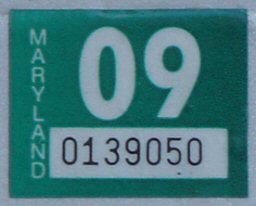


2009 regular sticker shown for comparasion,
2009 pilot "smart" sticker (Ellis photo of sticker in actual use),
2009 general-issue "smart" sticker type 1 (Ellis photo of sticker in actual use)
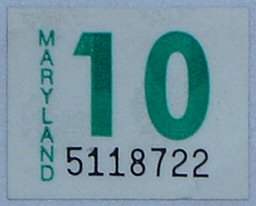

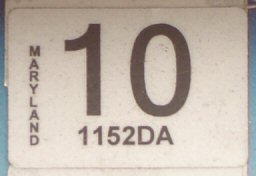
2010 regular sticker shown for comparasion (sticker in actual use),
2010 pilot "smart" sticker (Ellis photo of sticker in actual use),
2010 general-issue "smart" sticker (sticker in actual use)
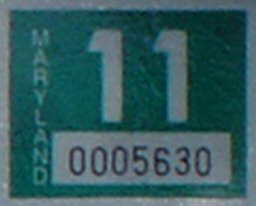
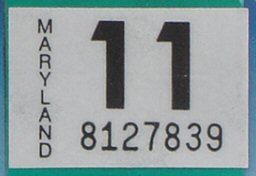

2011 regular 5-year registration sticker shown for comparasion (sticker in actual use),
2011 regular 2-year registration sticker (sticker in actual use), 2011 "smart" 2-year
registration sticker (sticker in actual use)
Plate spotter Jeff Ellis reports that initially, smart stickers were issued only for vanity and amateur radio operator plates in a pilot program. I gather that even among these few plate types, smart stickers were only issued to those motorists who renewed their registrations online. These early smart stickers use a wide font for the year, and are always black on white in color. They've been spotted in 2008, 2009, and 2010 versions, with the 2008 version being exceptionally rare.
Following the apparently successful pilot, smart stickers are now being issued for all plate types to motorists who renew their registrations online. These general-issue smart stickers use a narrow font for the year. They've been seen in 2009 and 2010 editions so far. For unknown reasons, 2009 general-issue smart stickers have come in two different color schemes; initially black on light green, followed by black on white. Unfortunately, I don't yet have an image of the black on white general-issue 2009 smart sticker. 2010 versions are vastly more common, since most registrations are for two year periods. All of these are colored black on white.
Now, 2011 regular, non-smart stickers with sequential serial numbers are being made in the same smaller size, and same colors, black on white, as the 2011 smart stickers. Contrast these stickers, which are being used for one-year and two-year registrations, with the older style white-on-green 2011 stickers that were issued in 2006 to fleet vehicles with five-year registrations.
Related pages on this site |
Thanks to those who have directly contributed to the information on this page: Jeff Ellis.
Ellis photographs are presumed to be copyrighted by Jeff Ellis, and are used with permission.
This page is W3C valid |
