|
 Rick Kretschmer's License Plate Archives
|
 |
Maryland Vintage Plate Program Information
Legally using "year of manufacture" license plates on your antique or classic vehicle
| |
This page has information about so-called "year of manufacture" (YOM) plate programs that permit owners
of antique and classic vehicles to use license plates from the year the vehicle was made. Mostly,
this page addresses the applicable laws and other information specific to motorists living in the state
of Maryland.
Latest noteworthy updates to this page
- February 21, 2019 – Upgraded my 1939 plate.
Elaborated on the MVA not allowing YOM plates with designs still in use. Other minor
text updates.
- February 15, 2016 – Upgraded my 1955 passenger car
plate. Updated discussion of the MVA objecting to correct plate colors, and added mention
of the MVA denying the use of plate designs still in use for YOM purposes.
|
|
|
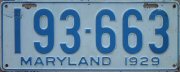 |
"Year of Manufacture" or YOM refers to a program offered in a number of states that allows owners of antique, historic,
and classic vehicles to legally drive their vehicles using license plates from the year that the vehicle was made.
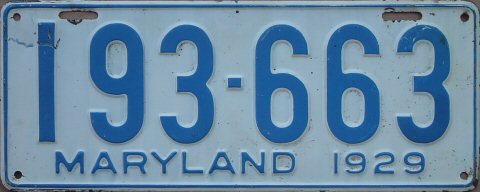
For example, you could drive your 1929 Ford Model A while displaying 1929 license plates rather than current plates.
Actually, "year of manufacture" is probably a misnomer, because at least in some of the states that I'm familiar with,
including Maryland, it's the model year of the vehicle that matters, not the year it was actually built.
Not every state has a YOM plate program, however, and even among those that do, the applicable laws and regulations vary
tremendously from one state to the next. Therefore, it's difficult to provide much in the way of general information
or guidelines that would be applicable in most situations.
To find out whether your state even permits YOM plates, and what the rules are, you'll need to check with the Department
of Motor Vehicles or equivalent agency in your state. Unfortunately, however, there's a very good chance that you'll
be given incorrect or out-of-date information by your DMV. Alternatively, if you're a member of an antique or classic
car club, your club, or knowledgeable members within your club, can probably provide you with accurate information that's
relevant to your state and to your vehicle.
Top
The Maryland Motor Vehicle Administration (MVA) has no information about YOM plates that I can find on their
web site. However, Maryland law does permit their use and
spells out the requirements that must be met. Below are links to the relevant sections of state law pertaining to
YOM plates. Throughout this law, what are commonly known as YOM plates are referred to as "vintage registration
plates".
Maryland Transportation Code, Title 13 (Vehicle Laws – Certificates of Title and Registration of Vehicles):
Top
(First, the disclaimer. I'm not qualified to give legal advice, I have no inside knowledge of the workings of the
Maryland MVA, and I have no firsthand experience trying to register or use vintage license plates in Maryland, so don't
rely on anything I say. The statements below are my own personal interpretations and opinions only, based on my
familiarity with old Maryland license plates, and from secondhand reports from Maryland motorists who have registered
or have attempted to register vintage license plates with the MVA.)
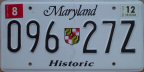
You'll still need a set of these!
|
- Vehicles registered in Maryland as Class L (historic motor vehicle) or Class N (street rod) vehicles,
including Class L and Class N motorcycles, are
eligible to display vintage license plates in lieu of the current Class L or Class N plates. You have to
actually keep the vehicle currently registered as a Class L or Class N vehicle, and while you're using the vintage
plates on the vehicle, you must keep the current plates somewhere in the vehicle. Therefore, the normal
Class L or Class N restrictions apply – the vehicle cannot be a daily driver, you can't use it for
commercial purposes, etc.
(I do know of at least one instance where a motorist used old cars as daily drivers, and so had regular, current
Class A passenger car plates on the cars as required by law, rather than Class L historic plates. However,
despite the cars being registered as a Class A vehicles, the motorist was nevertheless able to register vintage
YOM plates with the MVA for those cars.)
- According to the law, only vehicles at least 25 model years old are eligible to use vintage license plates,
despite Class L registrations being available for cars 20 model years old and older. To meet the 25 year
age requirement, during 2019 the vehicle in question must be from model year 1994 or earlier. In 2020,
model year 1995 vehicles will become eligible for vintage plates for the first time.
The
most recent plates that are not still valid for use were last valid in September 1987, so it would seem that
vehicles from model years 1988 and newer are not able use plates corresponing to the vehicle model year, despite
the law.
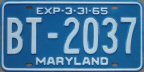
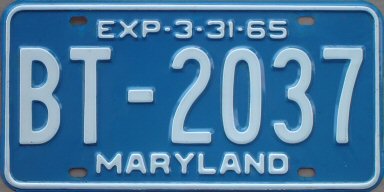
Correct for a 1965 model car
|
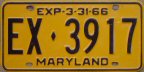
Technically correct but not
always allowed on a 1965
model car
|
- The law says the plates must have been issued in the same year as the model year of the vehicle.
Okay, let's use an example to understand this better. Say you have a 1965 Impala; therefore, you can use
plates that were issued in 1965. By my own interpretation, which counts for nothing, both the plates
showing a 1965 expiration date and those showing a 1966 expiration date would comply with this requirement.
(Between 1939 and 1986, all car registrations expired each March 31, and new plates (or renewal tabs or stickers)
began to be issued and could be displayed beginning March 1 each year. Therefore, 3-31-65 expiration plates
were issued through February 28, 1965. 3-31-66 expiration plates were issued beginning March 1, 1965.)
So, in our 1965 Impala
example, the MVA would allow the blue 3-31-65 plates, but might not allow the yellow 3-31-66 plates, even if the
1965 Impala was manufactured after March 31, 1965. (More about this in the next section covering actual MVA
experiences.)
- The vintage plates must have been actually issued by the state of Maryland. Obviously, this means
you can't use vintage plates from another state or country, nor can you legally use reproductions of vintage
Maryland plates.
- The law does not specify whether a plate number that is already in use, either on another registered
vintage plate from a different year or on a current plate, will be allowed or not.
- The vintage plates must be a matched pair and attached to the vehicle front and rear.
- The owner must register the vintage plates with the Motor Vehicle Administration and pay a one-time
registration fee of $25.50, in addition to the normal Class L or Class N registration fees.
Top
The law pertaining to the use of vintage registration plates has some problems as it's written. It has
contradictions, gray areas, and catch-22s. Also, it's apparent that the Motor Vehicle Adminstration's practices
are often inconsistenly applied and at times contrary to the law. Therefore, let's address some real-life
situations and discuss how the Maryland MVA actually interprets and implements the law.
- So what year plates are correct for my vehicle?
- The Maryland MVA seems to always allow vintage plates where that the year on the plate (or sticker) matches
the model year of the vehicle. If the plate only indicates the year, this is simple. For example, a
1929 Model A would need a set of 1929 plates. A 1956 Packard Caribbean could use a set of "56" plates, even
though they actually expired at the end of March 1956.
For plates showing a specific expiration date, again, the MVA has no problem with plates where the expiration year
matches the vehicle model year. So, using our 1965 Impala example, the blue plates showing a 3-31-65
expiration date should be approved without incident.
Where it gets sketchy is when the expiration year on the plate is the next year after the vehicle model
year. Even though yellow 3-31-66 expiration plates were issued in 1965 and technically comply with the law
for a 1965 model year car, the MVA does not necessarily allow them. I have heard from historic car owners
who have had no problem registering such plates, and I've heard from others who said the MVA adamantly refused
to allow such plates. I don't know whether their policy has changed over time, or whether the law is
being carried out inconsistently. The bottom line is, you're taking a chance if you buy a set of plates
to use on your ride if the expiration year on the plate is different than the vehicle model year.
- What plates can I use for my pre-1910 vehicle?
- The first state-issued plates came out in 1910. Between 1904 and 1909, the state assigned motorists
a plate number, but they had to provide their own plates. These "pre-state" plates were invariably undated
and were frequently made by attaching metal house numbers to a piece of leather. The law says vintage
plates must be state-issued, so technically, pre-1910 plates wouldn't meet that requirement. I have no
information about how the MVA actually deals with this situation.
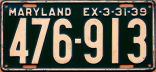
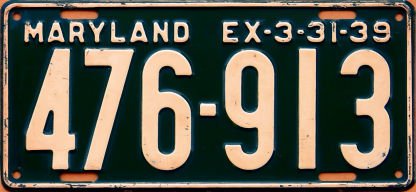
The 1939 expiration plate was
the only plate used during 1938
|
- What plates can I use for my 1938 vehicle?
- I can't give you a definite answer to that question. There were no Maryland license plates with the
year 1938 or "38" on them; the state went directly from 1937 registration year plates to 1939 expiration year
plates. In actual practice, 1937 plates were used during calendar year 1937, and plates showing a March 31,
1939 expiration date were used during all of 1938 and the first quarter of 1939. Since the MVA doesn't
consistently allow plates with an expiration year following the vehicle model year, they might allow 3-31-39
expiration plates on a 1938 vehicle, but I would not be surprised to hear they insist that 1938 vehicles can only
use non-existent 1938 plates.
- What plates can I use for my 1972, 1973, 1974, or 1975 vehicle?
-
All plates issued and used during the 1971 through 1975 expiration years had the year "71" stamped on them.
For the 1971 expiration year, the plates were used without renewal stickers. For the 1972 through 1975
expiration years, year stickers applied to both plates indicate the actual expiration year. In other words,
even plates newly issued in 1974 had a "71" stamped on the plate; they were issued with the "75" sticker affixed
to indicate the plates expired in 1975.
I've heard reports of the MVA refusing to approve these plates for 1972 to 1975 model vehicles because, even
though the plates had the correct year stickers on them, the plates were stamped with the year "71". The
motorists were told they needed to find vintage plates with the correct year stamped on them. Once again,
the MVA was requiring something that never existed. I don't think they refuse all vintage plates for
1972 to 1975 model year vehicles, but I'm sure it happens from time to time, depending on the clerk.
- What plates can I use for my 1976 or 1981 vehicle?
- Maryland did not issue any plates or stickers with the year 1981 on them. Neither did they issue
plates or stickers with the year 1976 on them, with the exception of optional
Bicentennial plates for passenger cars. They issued undated, unstickered plates
that expired in 1976 and 1981. The MVA should have no problem with undated, unstickered red-on-white plates
for 1976 model vehicles, or undated, unstickered, painted black-on-white plates for 1981 model vehicles.
However, MVA clerks are not license plate historians, and so I would not be surprised if in some cases they
refused to allow such plates to be registered unless they have non-existant 1976 or 1981 stickers affixed.
Again, if that's your situation, you're at their mercy.
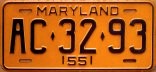
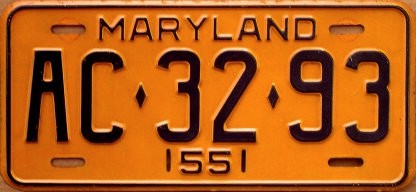
Only single plates were issued
during several years, including
those that expired in 1955
|
- Didn't Maryland only issue single car and truck plates in some years? What does the MVA require for those
years?
- The law says the vintage plates must be a matched pair and attached to the vehicle front and rear; it makes
no exception for the years when only single plates were issued – expiration years 1945, 1946, 1947, 1954,
and 1955. It's therefore impossible to legally use vintage plates on vehicles from those model years based
on a strict interpretation of the law.
I've heard numerous reports of the MVA prohibiting motorists from registering a single vintage plate from one
of these years in which only single plates were issued. I don't know if they're being hardnosed and are
strictly following the law as written, or whether they're just ignorant of the fact that car and truck plates
simply weren't issued in pairs in those years. Regardless, if you own a vehicle from one of these model
years, and the MVA has told you that you must have a matched pair of vintage plates, you're in a real no-win
situation, unfortunately. All I can suggest is that you contact a state legislator about getting the law
changed to correct this problem.
- They don't require a matched pair of plates for a motorcycle, do they?
- Even though the law does not make an exception for motorcycles, as far as I know, the MVA recognizes that
motorcycle plates have only ever been issued as single plates and allows single vintage motorcycle plates.
- Any way that I can get the MVA to approve reproductions of vintage plates for my vehicle?
- Well, the law is clear that only real plates issued by the state of Maryland may be used. However,
I've heard reports that the MVA has, in at least some cases, approved reproduction plates for use. I doubt
they realized that the plates were not authentic. Let's face it, MVA clerks are not experts on what vintage
plates are supposed to look like. However, realize that if you pay to have reproduction plates made, the
MVA does have a legitimate basis for refusing to authorize them for street use. Do so at your own
risk.
- What's the MVA's take on repainted vintage plates?
Does the MVA care if my vintage plates are the correct color?
- The law does not specify whether repainted plates are allowed, or whether the colors must be correct.
In practice, I believe that repaints are okay as long as the colors are reasonably correct. The MVA has a
list of what colors were used in what years, and requires that vintage plates have colors that conform to their
list. It's possible that you could get away with a different shade of the same color used on the original
plates from that year.
However, I've heard from Maryland motorists who have had arguments with the MVA over semantics. For
example, whether a given plate color was yellow or orange or gold. Their list of the supposedly correct
plate colors for each year does not have any visual examples. I've seen this list, and it has several
unfortunate errors. Besides the obvious errors, there are in some cases rather subjective and, in my
opinion, inaccurate color descriptions. For example, the list says 1955 plates are orange, while 1966
plates are "yellow / gold". In reality, the 1955 plates are kind of a school bus yellow color, and the
1966 plates are probably a shade or two lighter than that. You can see for yourself, as original
paint examples from both years are shown on this page. If they consider your 1955 vintage plates to be
yellow, they may very well refuse to allow them because their list says they should be orange. Vice-versa
for the 1966 plates. It will make no difference if your plates have original, unfaded paint.
Another big problem with this color list is that it doesn't account for the years when motorcycle plates were
different colors, or had other differences, from full-sized plates. The list only shows the colors and
characteristics of full-sized plates. Motorcycle plate colors differed from full-sized plate colors in
expiration years 1943, 1951, and 1953.
- I found some car plates with a cool plate number that I want to use on my truck. Can I?
Oops, I found out I'm using truck plates on my car! Why didn't the MVA stop me?
- There's apparently no requirement that the plate has to be correct for the type of vehicle – so if
you want to run truck plates on your car or vice versa, or if you've done so inadvertently because you didn't know
the difference, there seems to be nothing that says you can't. Plus, MVA clerks probably wouldn't know the
difference in most cases, anyway. Some historic vehicle owners care a great deal whether the plates are
correct for their vehicle, and others don't seem to care, or are just ignorant. Personally, I think it
looks stupid to have plates of the wrong type, but that may just be because I know the difference and I'm a
perfectionist anyway.


This motorist is running truck plates on his 1967 Plymouth Barracuda convertible.
Either he doesn't know or he doesn't care. The MVA doesn't care.
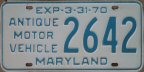
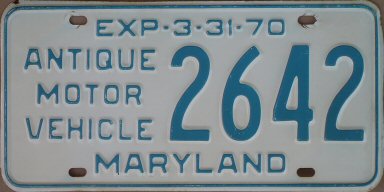
This plate was originally used
on a vehicle that was antique
in 1970. Could you
now use
it on a 1970 model vehicle?
|
- Can I use vintage plates that say "dealer" or "farm truck" or "antique motor vehicle" plates on my ride?
Can I use vintage fire deparment plates on my antique fire truck?
- Those are good questions, and I'm not sure of the answers. It's one thing to use truck plates on a
car, when neither plate type identified the vehicle type anyway. If I were to guess, I'd say the MVA
wouldn't object to you using plates such as dealer or farm truck or antique vehicle plates. I suspect they
would definitley object to you using police or fire department or other government plates, unless the historic
vehicle is actually owned by a police or fire department or other government body.
- I found plates from different years that have the same plate number. Will the MVA let me use one set on my
vehicle and let my buddy use another set on his vehicle?
- So, for example, you found pairs of both 1968 and 1969 plates with the same plate number, and you have a
1968 Road Runner while your friend has a 1969 Charger. As far as I know, the MVA does not care whether
one set of registered vintage plates has the same plate number as another set of registered vintage plates, or
even whether vintage plates have the same number as current plates in use.
- May I use a vintage trailer plate on my old trailer?
- Well, techically, the law says vintage plates may only be used on Class L historic motor vehicles
and Class N street rods. Since your trailer is undoubtedly registered as a Class G trailer, the answer
would seem to be no. However, you may get lucky, as the MVA sometimes makes exceptions to the Class L or N
requirement.
Top
Again, the MVA does not care if your vintage plates are the correct type for your vehicle. The information in
this section is only relevant if you care. The information below is condensed down to the most significant
points for quick reading. For more detailed information, refer to the appropriate Maryland Plate History page
elsewhere on this site. These pages are listed in the left column of the site menu on my
home page, and they're also listed on the Maryland index page.
1910 to 1937 issue years, and 1939 to 1953 expiration years
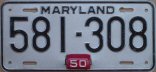
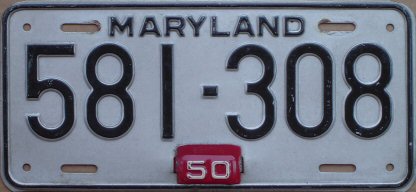
This passenger car plate is
stamped with a 1948 date
under the 1950 metal tab
|
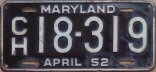
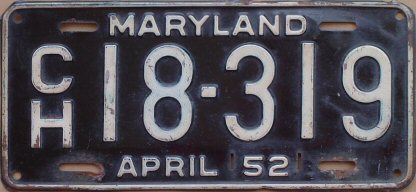
Trucks for hire had the letters
"CH" stacked one above the
other. Not-for-hire trucks
used all-numeric plates like
passenger cars.
|
Plates were issued annually and were valid throughout the calendar year from 1910 to 1937. Beginning in 1939,
and continuing through 1951, all plates expired on March 31 of the year indicated, regardless of whether the full
expiration date was on the plate. This means there were no plates with the year 1938 on them. Beginning with
1952 expirations; cars and motorcycles retained their March 31 expirations, while most other vehicle types changed to
April 30 expirations. Post-1938 plates with only the year on them actually indicate the expiration year,
and expired in March or April of the year shown.
Metal expiration year tabs were used in some years to extend the life of a plate beyond the year stamped on the
plate. These served the same purpose as today's expiration year stickers. Metal tabs were used to indicate
1943, 1944, 1946, 1947, 1949, 1950, 1951, and 1953 expiration years on non-motorcycle plates. Motorcycles received
new plates annually during these years.
- Passenger car plates have all-numeric plate numbers – no letters, and no words or abbreviations other
than the state name, the year or expiration date, and the legend Drive Carefully during some
years. For 1952 and 1953 expirations, the expiration month must also be March. Other than in 1910,
plate numbers with three or fewer digits are not passegner car plates – they're usually bus plates. By
1921, and continuing through 1953, the lowest number for a passenger car plate was either 30-000 or 30-001. Plates
numbers in the range 800-000 to 999-999 are suspected to be truck plates prior to 1952; they definitely are truck plates
on 1952 and 1953 expirations as they indicate an April expiration month. Also, any plate with a small metal disk
rivited to it, bearing a number 2 through 9 or the letter X, is also a truck plate.
- Truck plates are tricky during these years. Most years, trucks that were not for hire, were equipped
with pneumatic tires and were of one ton capacity or less, just used passenger car plates. On 1952 and 1953
expirations, truck plates were limited to the serial range of 800-000 to 999-999, and indicated an April expiration
month. I suspect, but don't know for certain, that 1948-1951 expiration plates used a similar serial range for
trucks, but only the expiration year is shown on these plates. Trucks for hire had distinct plates, with a stacked
"C/H" (commercial vehicle for hire) serial prefix or suffix, beginning in about 1933 or possibly earlier. Plates
with a small metal disk rivited to it are for trucks with a capacity of two tons and up.
1954 to 1970 expiration years
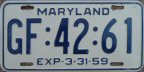
Passenger car plates have
the letters at the beginning
|
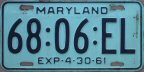
Truck plates have letters at
the end; first letter is always
"E" for not-for-hire trucks
|
New plates were issued annually. For expiration years 1954 through 1956, only the expiration year is indicated
on the plate. From 1957 to 1970, the exact expiration date is indicated.
- Passenger car plates have plate numbers consisting of two letters followed by four numbers. If the exact
expiration date is indicated, it's always March 31. If only the year is indicated, the expiration date is
still March 31 of the year indicated. So, for example, a plate that just says "56" on it was actually valid
from March 1955 to March 1956.
- Truck plates have numbers consisting of four numbers followed by two letters, and have April 30 expiration
dates, but so do other plate types such as taxis and trailers. The first letter in the plate number is the
key to identifying the specific plate type. Plates issued to private light trucks such as pickup trucks
always have "E" as the first letter during these years. Trucks for hire had the first letter "H". If
only the year is indicated, the expiration date is still April 30 of the year indicated.
1971 to 1975 expiration years
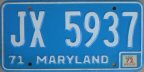
Passenger car plates have
the letters at the beginning.
All 1971-75 plate have "71"
stamped on them.
|
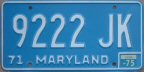
Truck plates have the letters
at the end; first letter is
always D, E, or J
|
All plates used for 1971 through 1975 expiration years had "71" stamped on them. For the 1971 expiration year,
the plates were used without renewal stickers. For the 1972 through 1975 expiration years, year stickers applied
to both plates indicate the expiration year.
- Passenger car plates consist of two letters followed by four numbers. Only the expiration year is
indicated on the stickers, or on the plate itself if no stickers. For passenger car plates, the actual
expiration date was always March 31 of the year indicated. The car plate shown at right with a "72"
sticker was valid from March 1971 to March 1972 with this sticker.
- Truck plates consist of four numbers followed by two letters, and have April 30 expiration dates, but so do
other plate types such as taxis and trailers. The first letter is the key to identifying the specific plate
type. Plates issued to private light trucks as well as trucks for hire are identifed by the first letter
being a D, E, or J during this period. (Plates with this numbering format and first letter "H" are
trailer plates during these years.) The truck plate shown at right with a "75" sticker was valid
from April 1974 to April 1975 with this sticker.
1976 to 1987 expiration years
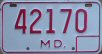
This unstickered plate is
correct for a 1976 motorcycle;
it expired in March 1976
|
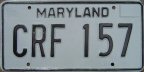
This unstickered plate is
correct for a 1981 car;
it expired in March 1981
|
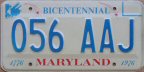
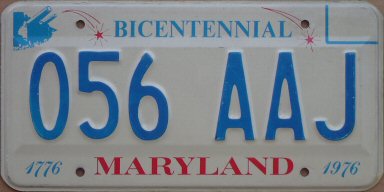
Optional Bicentennial plates
were the only ones with the
year 1976 on them
|
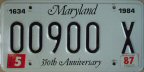
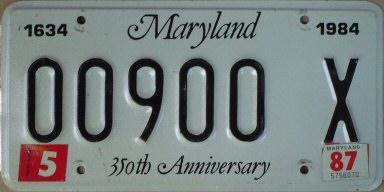
Optional 350th Anniversary
MPV plates were not marked
as such
|
Standard plates
Standard 1976 and 1981 expiration plates were not dated or stickered. Standard 1976 expiration
plates have red numbers on a white background; 1981 expiration plates have black numbers on a white background.
Expiration year stickers were applied front and rear to the 1976 and 1981 expiration plates to validate them for
subsequent years through 1980 and 1986, respectively. Some 1986 and all 1987 expirations were indicated with month
and year stickers on the rear plate only.
- Passenger car plates have three letters followed by three numbers on standard plates.
- Multi-purpose passenger vehicle (MPV) plates were introduced in January 1979 with March 1979 expirations.
MPVs are SUVs, passenger vans, mini-vans, motor homes, and privately-owned buses. Before then, MPVs were
issued passenger car plates, and MPVs that already had car plates kept them until March 1980. Starting with
the 1981 expiration plate, all MPVs used MPV plates. Standard plates were clearly identified with the
abbreviation MPV stamped at the bottom edge, and had serials with one letter followed
by five numbers.
- Truck plates are clearly identified with the word Truck stamped along the bottom of
the plate. Regular truck plates had one letter followed by five numbers. Neither
Bicentennial nor 350th Anniversary plates were issued to
trucks.
Optional plates
Bicentennial and 350th Anniversary graphic
plates had the years 1976 and 1984 screened on them, respectively, and were used without stickers during those initial
expiration years. Expiration year stickers were applied front and rear to the 1976 and 1984 expiration plates to
validate them for subsequent years through 1980 and 1986, respectively. Some 1986 and all 1987 expirations were
indicated with month and year stickers on the rear plate only. Neither Bicentennial nor
350th Anniversary plates were issued to trucks.
- Passenger car plates have three three numbers followed by three letters on both optional
Bicentennal plates (available for 1976 to 1980 expirations) and
optional 350th Anniversary plates (available for 1984 to 1987 expirations).
MPVs also used Bicentennal passenger car plates.
- Multi-purpose passenger vehicle (MPV) plates had numbers consisting of five numeric digits followed by the
letter "X" on the optional 350th Anniversary plates (available for 1984 to 1987
expirations). These plates did not say "MPV" on them. MPVs used the passenger car version of the
optional Bicentennal plates (available for 1976 to 1980 expirations).
1986 and subsequent expiration years
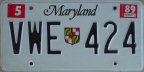
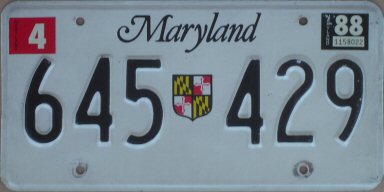
Standard passenger car
plates were issued with this
numbering format 1986-2004
|
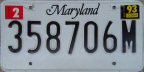
Standard MPV plates were
issued with this numbering
format approx. 1986-1998
|
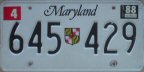
Standard truck plates were
issued with this numbering
format 1986-1992
|
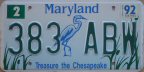
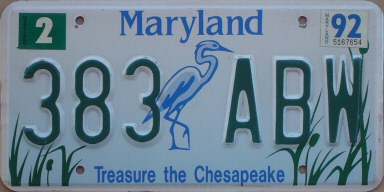
Optional Chesapeake plates
were issued with this design
1991-2003. This numbering
format is for a passenger car.
|
Remember, to be eligible for YOM plates, vehilces must be at least 25 years old according to the law, based on the model
year, and the expiration year on the sticker must either match the model year, or possibly be the year after the model
year.
However, I've heard reports of the MVA denying owners of late-1980s and 1990s vehicles from using appropriate vintage
plates, because the plate designs used in those years are still in use with current expiration stickers. Whether
the MVA consistenly prevents these plates from being used for YOM purposes despite the law, I don't know.
Neither passenger car plates, multi-purpose passenger vehicle plates, nor truck plates, on either the standard or
optional designs, had anything stamped or printed on them to identify the vehicle type. The only way to tell the
plate type is from the plate numbering format.
Standard plates
Reflective black-on-white plates with the state name screened on the plate in a stylistic font were
introduced as standard plates in February 1986; nearly all had initial expiration dates in 1987 and beyond; a very few
were issued with 1986 expirations. These plates were issued in pairs; month and year stickers were correctly
applied to the upper corners of the rear plate; no stickers were affixed to the front plate. This plate design
remains in use today.
- Passenger car plates had three letters followed by three numbers on standard plates issued through September
2004.
- Multi-purpose vehicle plates had plate numbers consisting of a six-digit number followed by the letter M
in position 7 through the late 1990s. Other numbering formats were subsequently used, but these are not yet
eligible for use as vintage plates.
- Truck plates issued through the spring of 1992 had all-numeric, six-digit plate numbers on standard
plates. Truck plates issued between the spring of 1992 to June 2010 have plate numbers with a letter in
position 3 of the six-character plate number.
Optional plates
The first generation Treasure the Chesapeake optional plate, which had
green plate numbers, was introduced in very late 1990, so the earliest plates of this design could be considered to be
vintage plates. Generally, the earliest of these would have 1992 expiration stickers, though a small number were
receiced 1991 expiration stickers. The month and year stickers were different colors than those used on standard
plates through 1995. This plate design is still in use.
- Passenger car plates had plate numbers consisting of three numbers followed by three letters.
- Multi-purpose vehicle plates had plate numbers with letters in positions 1, 2, 3, and 6 of the six-character
plate number.
- Truck plates had letters in positions 2 and 3 of the six-character plate number.
Top
Unfortunately, old license plates suitable for YOM use don't grow on trees. Some will be easy to find, and some
may be very difficult or even impossible to find.
The Where can I find old license plates? section of my FAQs page will provide you with
some useful tips for finding old license plates.
Top
Top
Page credits
Thanks to those who have directly contributed to the information on this page:
Jeff Ellis, Sam Korper, August Paro, Mark Vahlkamp.
This page is

W3C valid
|