 |
|
 |
|
|
|
|
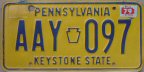
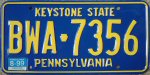
This page covers the history of Pennsylvania passenger car license plates during the era of base plates used for over a decade at a time, beginning in 1977. Latest noteworthy updates to this page
|
|
From 1906 until 1979, Pennsylvania license plates displayed the year of issuance. However, plates and/or stickers dated from 1941 until 1979 actually expired on March 31 of the following year. The last non-staggered registrations bore a 1979 sticker, which actually expired on March 31, 1980. Staggered registrations were first issued in October 1979, and first expired at the end of September, 1980. Staggered registration stickers have the expiration month and year printed on the stickers rather than the issue year.
Pennsylvania has consistently issued single passenger plates since 1952. All Pennsylvania license plates, excluding motorcycle plates, since those with 1956 issue dates have been 6 inches high by 12 inches wide.
My "Pictorial History" pages are intended to be a supplement to the information found in the ALPCA Archives. I am providing additional details and additional photos not found in the archives, and clarifying information when appropriate. When the ALPCA archives cover a subject in great detail, I do not repeat that detail here. I sincerely hope that you find this information useful.
If you find an error or have additional information, or can provide a plate or a photo of a plate that I'm missing, please send me an e-mail. There's a link to my e-mail address at the bottom of every page. Please note that all plates shown that are credited to another person are plates that I am still seeking for my own collection.
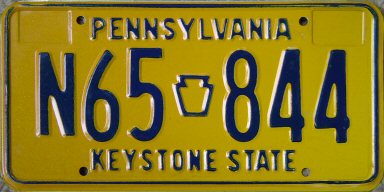
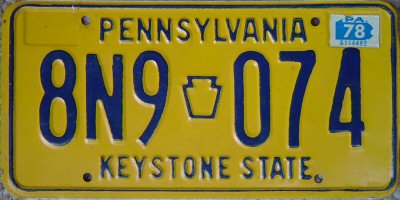
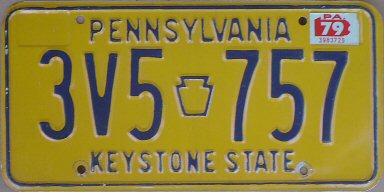
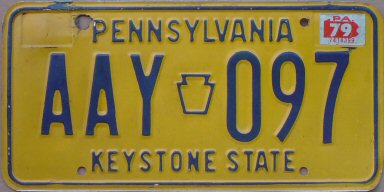
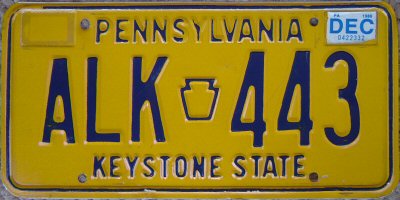
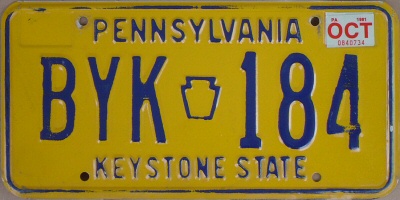
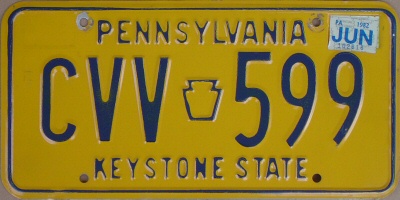
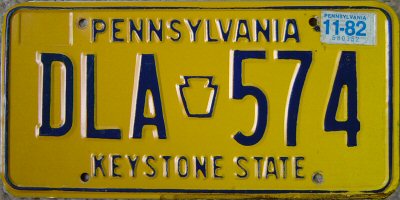
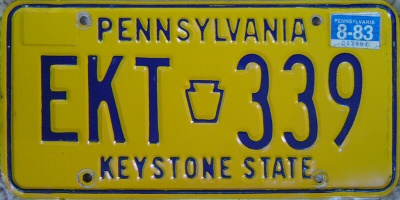
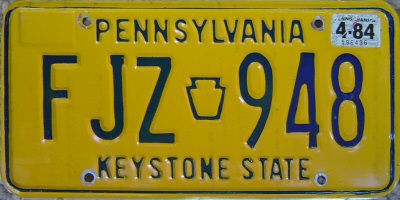
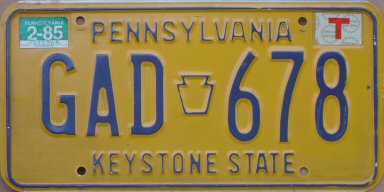
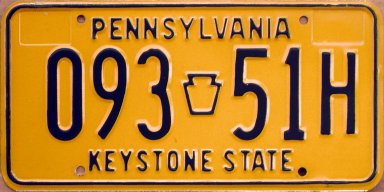
Naturals, 1977 issue to 1985 expiration. Two natural 1979 issues are shown, with old and new serial formats.
Two natural 1982 expiration plates are shown, with different style expiration stickers. The 1985 expiration plate
has an exposed "T" stricker. Close-ups of 1979 through 1982 stickers are shown below.
The general reissue of March 1977 swept away the Bicentennial plates that had become so "last year". Keeping with the tradition of alternating colors, the new base plate had dark blue letters on a dark yellow background, but this time the background was reflective sheeting rather than painted. At the center of the plate was a large, embossed keystone outline; the legend at the bottom proclaimed Keystone State for the first time. At the top of the plate were the state name and the two sticker wells in the upper corners. On this base, there was no etched date in either well, nor was there any embossed date on this plate. The plate was used during its first year without stickers, and in subsequent years with stickers.
As was the practice on the previous Bicentennial plates, probably at least initially, even-year stickers were supposed to go in the upper right corner, and the odd-year stickers in the upper left corner. But sticker placement became problematic to new registrants, because on this base the temporary "T" sticker was now consistently placed in the upper right corner during manufacture. Motorists therefore usually placed their first expiration sticker over top of the "T" sticker, regardless of whether it was an even or odd year, and then proceeded to apply subsequent expiration stickers in alternating sticker wells.
Other serial formats not shown above
|
There were a few significant changes in Pennsylvania license plate issuance during the time this yellow base was issued. For the first few years, numbering formats followed the same pattern as had been used on the previous few bases. The sequence of serial formats was 000*000, x00*000, 000*00x, and 0x0*x00. (The asterisk indicates the position of the keystone separator.) However, upon reaching serial 9Z9*999 in approximately August or September 1979, the one-letter numbering format was suddenly and unexpectedly discontinued, and new plates began to be issued in the xxx*000 format that was quite common across the U.S. at the time. A small number of early Axx*000 series plates were issued with 1979 registration stickers. Staggered registration was then introduced in October 1979, with the earliest stickers indicating a September 1980 expiration, since Pennsylvania initially registers vehicles for 12 inclusive months. When the 1979 annual stickers all expired at the end of March 1980, renewals were assigned staggered expiration dates ranging between September 1980 and August 1981.
The blue-on-yellow base continued to be issued to new registrants until early 1984, with natural 1985 expirations. In mid-year 1983, a new base was introduced; however, existing stocks of the old base continued to be issued simultaneously with the new base until they were depleted, and the yellow bases continued to be renewed for another 15 years. After the March 1977 reissue, Pennsylvania did not have another general reissue until late 1999. By 1999, these 1977 bases had become pretty awful looking, and they were replaced as quickly as the tri-color base plates became available, without even waiting for the old yellow plates to expire one last time.
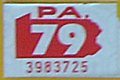 1979 sticker (passengers expired March 1980) |
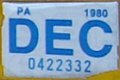 1980 passenger sticker (Sept. - Dec. only) |
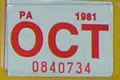 1981 sticker (January - December) |
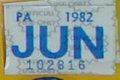 1982 sticker, type 1 (January - August) |
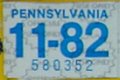 1982 sticker, type 2 (September - December) |
Staggered registration stickers contain both the expiration month and year on a single sticker. All stickers for a given year have the same colors. For some reason, the 1980 stickers (which were dated September-December only), all 1981 stickers, and the January-August 1982 stickers featured the expiration month in large prominent letters, while the expiration year was so small you had to be inches away to read it. At a distance, these stickers looked like month stickers only.
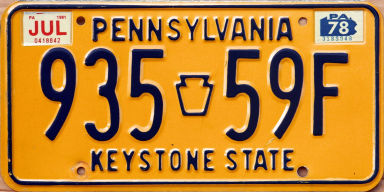 This plate expired in July 1981, not July 1978. |
This scheme was not well thought-out for a couple of reasons. An example of one problem: if a motorist already had 1978 and 1979 year stickers, then received a staggered 1981 expiration and dutifully placed the 1981 month sticker sticker over the 1979 sticker in the left well, it then appeared that the plate expired in 1978 rather than 1981. An example of a plate with this very issue is shown at right. A second problem: The 1980 and 1982 stickers had the same color scheme, and two stickers were displayed on the plate at a time. Therefore, beginning in September 1981 when the September 1982 expiration renewal stickers were issued, there would be no way to distinguish between a plate with 1980 and 1981 stickers, and one with 1981 and 1982 stickers, except from inches away.
Before this second problem actually occurred, the state realized what would happen, and beginning with the September 1982 sticker, the format was changed to display a large numeric month and two-digit year. This sticker format continues unchanged to the present day.
| 1977 – | no sticker | Natural serials: all numeric; letter in position 1; letter in position 6; letter in position 2 approx. to early alphabet. |
|---|---|---|
| 1978 – | blue-on-white sticker | Natural serials: letter in position 2, approx. middle alphabet. |
| 1979 – | red-on-white sticker | Only issued Mar. - Sept. 1979; natural serials: letter in position 2, approx. late alphabet; xxx*000 format, AAA to very early Axx series. |
| 1980 – | blue-on-white sticker | Only issued Oct. 1979 - Jan. 1980; natural serials: xxx*000 format, approx. early to middle Axx series. |
| 1981 – | red-on-white sticker | Natural serials: xxx*000 format, approx. middle Axx series to late Bxx series. |
| 1982 – | blue-on-white sticker | Natural serials: xxx*000 format, approx. early Cxx series to middle Dxx series. |
| 1983 – | white-on-blue sticker | Natural serials: xxx*000 format, approx. middle Dxx series to late Exx series. |
| 1984 – | black-on-white sticker | Natural serials: xxx*000 format, approx. early Fxx to early Gxx series on this base. |
| 1985 – | white-on-green sticker | Natural serials: xxx*000 format, approx. early Gxx series on this base, with expirations early in the year. |
| 1986 through 2000 – | No naturals, renewals only; see subsequent sections for sticker colors. Latest renewal sticker should be 12/00. | |
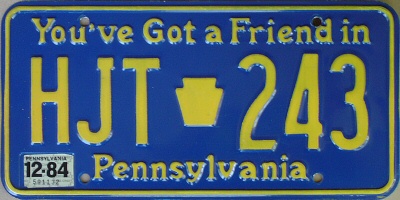
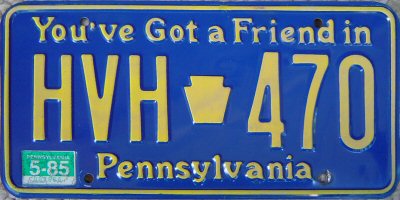
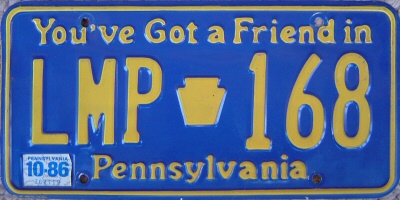

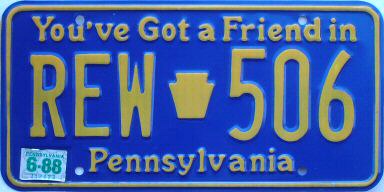
Natural 1984 to 1988 expirations.
About mid-1983, a new base plate was introduced, but even though six-plus years had elapsed since the last general reissue, this new base was issued to new registrants only. This plate was dark yellow on dark blue, of course, and this time the keystone separator was solid rather than just an outline as was used on the previous base. The most notable feature was the use of the state's then-current tourism slogan, with the words You've Got a Friend in across the top of the plate, and continuing with Pennsylvania centered at the bottom. This entire slogan, including the state name, was embossed using mixed-case letters. The use of embossed lower-case letters is fairly rare in license plate history. Anyway, this base plate had only a single sticker well in the lower left corner, with just an empty spot in the lower right corner. The intent was of course for motorists to only display a single sticker in the well, but many of them continued the practice of the previous two bases by placing alternating year stickers in the two corners. The serial format continued to be xxx*000, beginning in the HAA series.
This base was somewhat controversial and unpopular due to the slogan, and it was short-lived. Some people considered the phrase to be gramatically incorrect. One account states that the Quakers, a Pennsylvania-based Christian denomination formally known as the Society of Friends, found the slogan to be patronizing. The serial range got up to the late Rxx series; the highest series reported having been seen is RUY.
I'm not aware of any Friend plates being issued with 1983 expiration stickers.
| 1984 – | black-on-white sticker | Natural serials: HAA to approx. early Hxx series on this base. |
|---|---|---|
| 1985 – | white-on-green sticker | Natural serials: approx. early Hxx to late Jxx series. |
| 1986 – | blue-on-white sticker | Natural serials: approx. early Kxx to early Mxx series. |
| 1987 – | white-on-red sticker | Natural serials: approx. early Mxx to early Pxx series. |
| 1988 – | green-on-white sticker | Natural serials: approx. early Pxx to late Rxx series on this base. |
| 1989 through 2002 – | No naturals, renewals only; see subsequent sections for sticker colors. Latest renewal sticker should be 6/02, or perhaps 8/02. | |
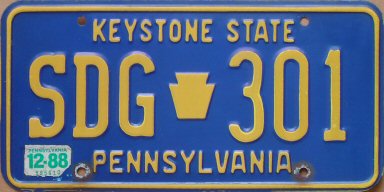
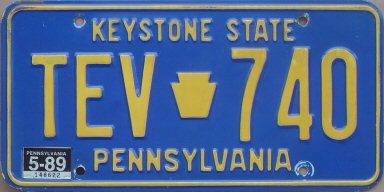
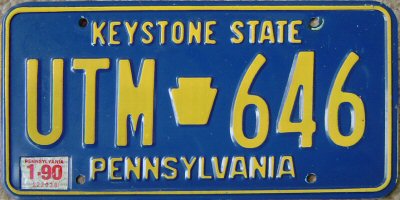
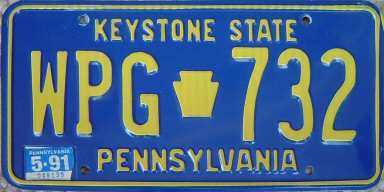
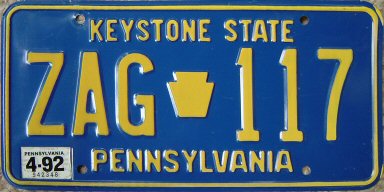
Natural 1988 to 1992 expirations with 6-character plate numbers.
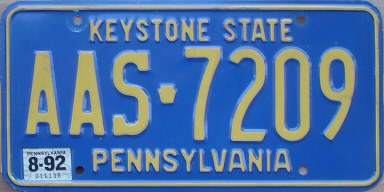
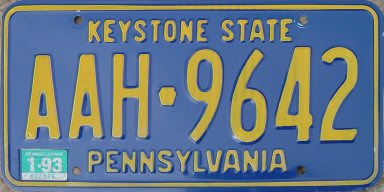
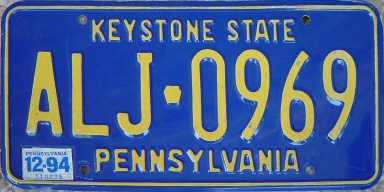
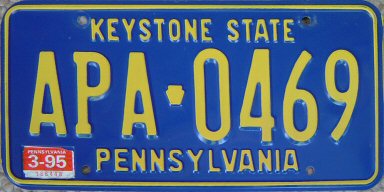
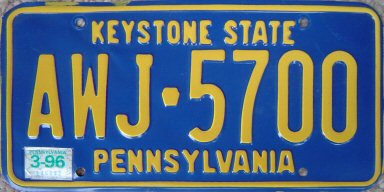
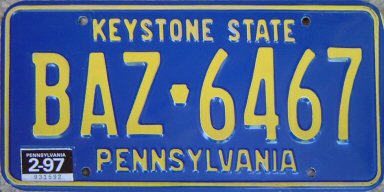
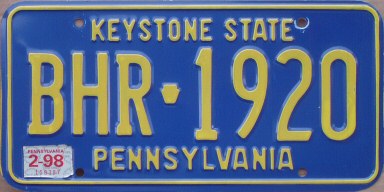
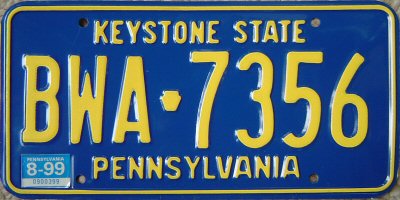
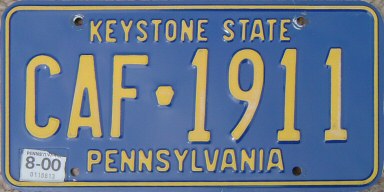
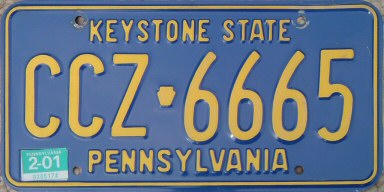
Natural 1992 to 2001 expirations with 7-character plate numbers.
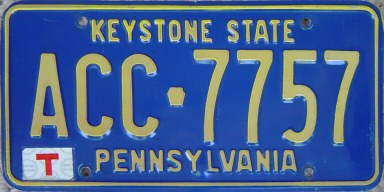 This T-stickered plate was issued late 1991 or early 1992. |
In late 1987, the tourism slogan used for the previous four years was summarily dismissed, and the legend Keystone State made its reappearance. The legend and the state name also inexplicably reverted back to all upper-case letters. Otherwise, these plates were identical visually to the previous "Friend" base. The legend was placed at the top of the plate, and the state name and single sticker well continued at the bottom. Once again, this plate was issued to new registrants only, and the bases introduced in 1977 and 1983 continued to be valid with appropriate stickers. The serial format remained xxx*000, and started in the SAA series on this base.
During 1991, serial ZZZ*999 was reached, exhausing the format. A new serial format xxx-0000 was begun, starting in the AAA series. These were the first 7-character standard passenger car plates ever issued by Pennsylvania. Adding the seventh character necessitated shrinking the keystone separator back to the size used from 1958 to 1970. The serial numbers reached the early Cxx series, specifically to the CEG series according to several reports, when this base stopped being issued in June 2000.
I'm not aware of any blue Keystone State plates being issued with 1987 expiration stickers.
| 1988 – | green-on-white sticker | Natural serials: xxx*000 format, SAA to approx late Sxx series on this base. |
|---|---|---|
| 1989 – | white-on-black sticker | Natural serials: xxx*000 format, approx. late Sxx to late Uxx series. |
| 1990 – | red-on-white sticker | Natural serials: xxx*000 format, approx. late Uxx to late Wxx series. |
| 1991 – | white-on-blue sticker | Natural serials: xxx*000 format, approx. late Wxx to late Yxx series. |
| 1992 – | black-on-white sticker | Natural serials: xxx*000 format, approx. late Yxx series and Zxx series to ZZZ; xxx-0000 format, AAA to approx. beginning Axx series. |
| 1993 – | white-on-green sticker | Natural serials: xxx*000 format, approx. late Zxx series to ZZZ; xxx-0000 format, approx. early Axx series. |
| 1994 – | blue-on-white sticker | Natural serials: xxx-0000 format, approx. middle Axx series. |
| 1995 – | white-on-red sticker | Natural serials: xxx-0000 format, approx. late Axx series. |
| 1996 – | green-on-white sticker | Natural serials: xxx-0000 format, approx. end of Axx series and beginning of Bxx series. |
| 1997 – | white-on-black sticker | Natural serials: xxx-0000 format, approx. early Bxx series. |
| 1998 – | red-on-white sticker | Natural serials: xxx-0000 format, approx. middle Bxx series. |
| 1999 – | white-on-blue sticker | Natural serials: xxx-0000 format, approx. late Bxx series. |
| 2000 – | black-on-white sticker | Natural serials: xxx-0000 format, approx. end of Bxx series and beginning of Cxx series on this base. |
| 2001 – | white-on-green sticker | Natural serials: xxx-0000 format, approx. early Cxx series on this base; no naturals after 5/01 expiration. |
| 2002 – | blue-on-white sticker | No naturals, renewals only. Latest renewal sticker should be 6/02, or perhaps 8/02. |

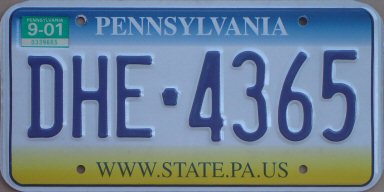

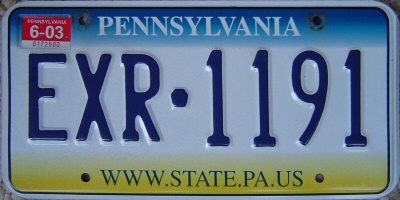
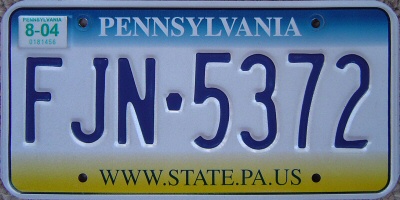
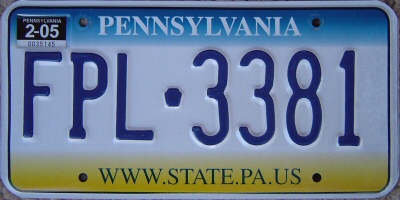
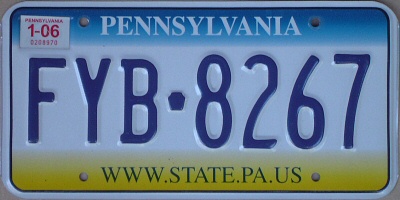
Natural 2000 to 2006 expirations.
Sometime during the late 1990s, it dawned on Pennsylvania officials that the state could not go on forever without a plate reissue of some kind. Some of the yellow plates were over twenty years old, and since in Pennsylvania the plate stays with the owner and not the vehicle, there were a significant number of these still on the road. After two decades of use, many of them had become pretty ratty looking and even unreadable.
The decision was made to replace all plates, both the yellow and the blue bases, with a new design. The yellow plates were replaced first, on an accelerated basis between September 1999 and February 2000. Yellow plates with January expirations were replaced first, and those with December expirations were replaced last, as quickly as the new plates could be made. Serials on this new base began in the DAA series; the last of the tri-colored plates that replaced old yellow plates were issued in the DDN series and originally had a December 2000 expiration sticker.
According to information provided by the state, the blue plates were then replaced over a two-year period between July 2000 and June 2002, as they came up for renewal. Blue plates registered in even-numbered zip codes were scheduled to be replaced between July 2000 and June 2001, and those registered in odd-numbered zip codes between July 2001 and June 2002. However, it's reported by one license plate collector who's a Pennsylvania resident that this deadline was later exteneded to August 2002. I'm not clear about why this would have been necessary. The new plate was issued to all new registrants beginning July 2000, with the earliest expiration date of June 2001. The remainder of the DDN series not issued as yellow-base replacements were issued this way.
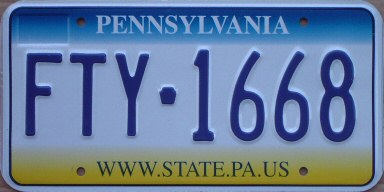 This plate was issued circa mid-year 2004. |
This plate has the familiar sticker well to the left of the state name, both of which were moved back to the top of the plate. However, it's not unusual for collectors to come across plates on this base with no stickers. There are two reasons for this. One is that the old "T" (for "temporary") stickers introduced in 1975 were no longer placed on the plate pending the arrival of a real sticker. Instead, the bare plate was issued along with a temporary window sticker. Second, is that residents of Philadelphia were initially required to display "real" (not temporary) window stickers to indicate their plates were valid rather than plate stickers. This was done because theft of plate stickers was apparently a problem that was both significant and primarily limited to Philadelphia for some reason. Apparently some Philadelphia residents did not like being singled out with different stickers, and so for a while they were given the option of receiving a plate sticker or a window sticker. Reportedly, Philadelphia window registration stickers were discontinued in December 2003.
Serial formats and dies continued from the previous base, with the serial numbers starting in the DAA series. Other than the serial number and the keystone separator, the remainder of the plate is screened. This base was the first Pennsylvania standard passenger car plate to ever have more than two colors, and the first to have any screened elements. It also has the distinction of being the first license plate anywhere in the United States (and perhaps in the world) to display a web address, www.state.pa.us, which is the address of the state government's home page.
The highest observed letter sequence on this base is FYC. Some very late Fxx series plates were issued with natural early 2006 expiration stickers on this base before the existing stock was used up. The latest reported natural 2006 expiration on this base is April. This base plate continues to be renewed with stickers.
In an apparent reaction to the late-1970s yellow plates having been on the road for over twenty years, state law was revised to require plates to be replaced after ten years of use. This meant that these tri-color fade plates would have been due for replacement beginning in late 2009. However, in November 2008, the law was again revised to eliminate the requirement to replace plates solely because of their age. This was passed as a cost-saving measure, justified, I'm sure, due to the worsening economy and projected state budget shortfalls. Now, instead, individual plates will be replaced free of charge if they're determined to be illegible by a law enforcement officer or a certified inspection mechanic. And now, in an effort to get more old plates off the road, the state in its wisdom has decreed that fade-band plates can no longer be transfered from one vehicle to another. So, gradually, one at a time, these tri-color fade plates will be removed from the road, but they will not disappear completely anytime soon.
| 2000 – | black-on-white sticker | Natural serials: DAA series to approx. early Dxx series on this base. |
|---|---|---|
| 2001 – | white-on-green sticker | Natural serials: approx. early Dxx to late Dxx series on this base. |
| 2002 – | blue-on-white sticker | Natural serials: approx. end of Dxx to middle Exx series. |
| 2003 – | white-on-red sticker | Natural serials: approx. middle Exx series to early Fxx series. |
| 2004 – | green-on-white sticker | Natural serials: approx. middle Fxx series. |
| 2005 – | white-on-black sticker | Natural serials: approx. late Fxx series. |
| 2006 – | red-on-white sticker | Natural serials: some early year expirations in very late Fxx series; otherwise no naturals, renewals only. |
| 2007 and beyond – | No naturals, renewals only; see subsequent section for sticker colors. | |
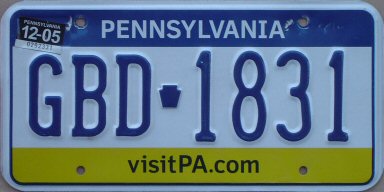
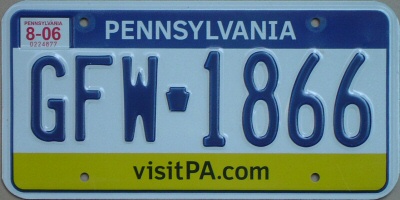
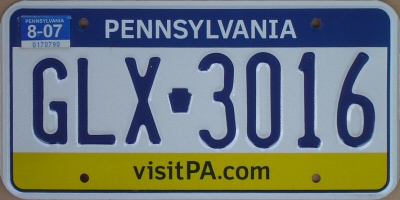
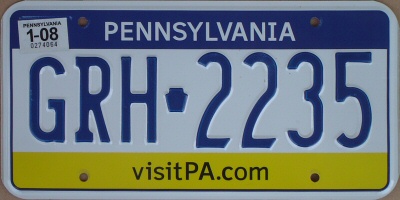
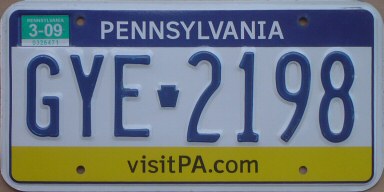
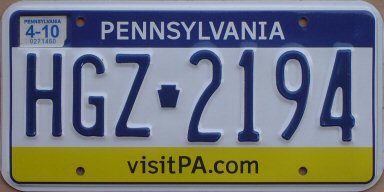
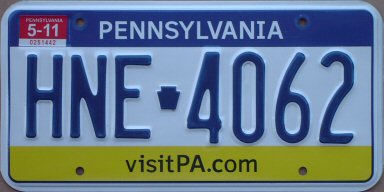
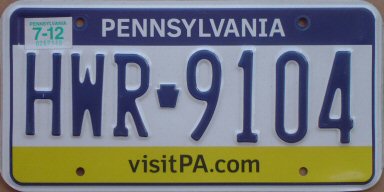
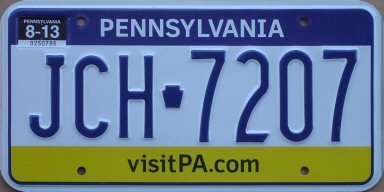
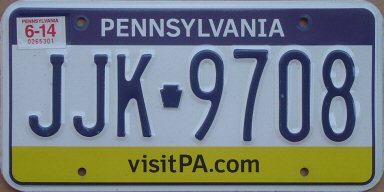
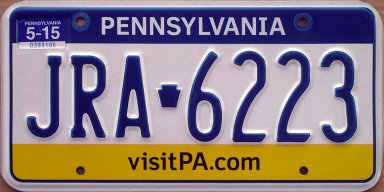
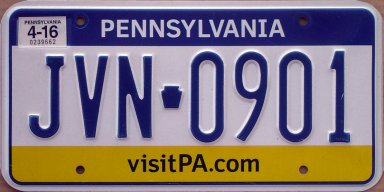
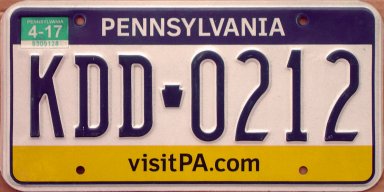
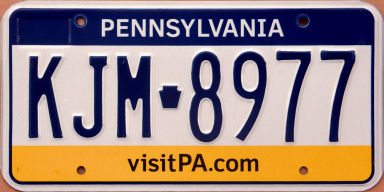
Natural 2005 to 2017 expirations; unstickered plate issued in 2017.
In late December 2004, Pennsylvania began issuing a modified version of the blue/white/yellow tri-color license plate. In Pennsylvania, the initial registration period is for 12 months inclusive; therefore, the earliest issues of this new base had November 2005 expirations.
This plate differs from the previous base in several subtle, but noticeable ways. The blue and yellow bands no longer fade to white gradually, but rather have distinct boundaries; the blue band is now dark blue rather than light blue; and the fonts used for the word "Pennsylvania" and for the web site address have been revised. The size of the keystone separator has been enlarged slightly. Perhaps most significantly, the web site address itself has been changed to visitPA.com. This site proclaims itself to be the official tourism web site for the Commonwealth of Pennsylvania. This plate design is not a replacement for the previous tri-color fade design. Rather, it's a "mid-course adjustment" to the tri-colored base, and is being used concurrently.
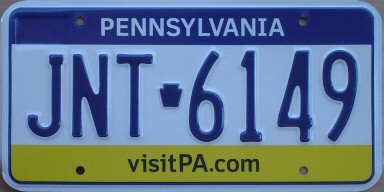 This plate was issued late 2013 or early 2014. |
Through 2016, plates with no expiration sticker affixed were issued by car dealers; the motorist was also given a temporary paper registraiton slip indicating an expiration date to display in the rear window. Once the title and registration was processed by the state DMV, an expiration sticker for the plate was mailed to the motorist. In some instances, for reasons unknown, the expiration sticker was never affixed to the plate. The plate shown at right is such an example.
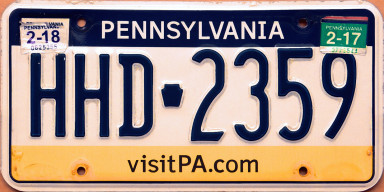 Feb. 2018 expiration sticker issued in late 2016. |
Pennsylvania ceased issuing expiration stickers effective January 1, 2017. As a result, there are no natural registrations with stickers expiring after November 2017. December 2017 stickers issued for registration renewals probably aren't hard to find. Early 2018 stickers for registration renewals are quite uncommon; the motorist would have had to renew their registration at least a month early in late 2016 to get one.
The state intends to now rely on law enforcement using plate reader technology to identify plates whose registration is expired. Anyway, from that date forward, newly registered vehicles have been issued plates without expiration stickers. Plates with a sticker well in the upper left corner continued to be issued during 2017, mostly during the first half of the year, until inventory was depleted. The highest plate number with a sticker well is likely KLE-9999.
Regarding older plates bearing old stickers that are now expired, the state has taken no action. It's not a problem to drive with an expired sticker within Pennsylvania, because everyone knows what's going on. However, it is potentially a problem for motorists traveling out-of-state. Some Pennsylvania drivers have chosen to take their chances with an expired sticker visible, while others have either somehow covered the expired sticker, or scraped the expired sticker(s) off the plate entirely. These solutions also make the plate look suspicious to someone who doesn't know the back story, so regardless, Pennsylvania motorists with stickered or once-stickered plates run the risk of getting pulled over by out-of-state law enforcement officers who are not familiar with the situation.
| 2005 expiration – | white-on-black sticker | Natural serials: late year expirations in very early Gxx series beginning with GBA. |
|---|---|---|
| 2006 expiration – | red-on-white sticker | Natural serials: approx. early Gxx series. |
| 2007 expiration – | white-on-blue sticker | Natural serials: approx. middle Gxx series. |
| 2008 expiration – | black-on-white sticker | Natural serials: approx. late Gxx series. |
| 2009 expiration – | white-on-green sticker | Natural serials: approx. very late Gxx series to early Hxx series. |
| 2010 expiration – | blue-on-white sticker | Natural serials: approx. early-to-middle Hxx series. |
| 2011 expiration – | white-on-red sticker | Natural serials: approx. middle Hxx series. |
| 2012 expiration – | green-on-white sticker | Natural serials: approx. late Hxx series. |
| 2013 expiration – | white-on-black sticker | Natural serials: approx. very late Hxx series to early Jxx series. |
| 2014 expiration – | red-on-white sticker | Natural serials: approx. early-to-middle Jxx series. |
| 2015 expiration – | white-on-blue sticker | Natural serials: approx. middle-to-late Jxx series. |
| 2016 expiration – | black-on-white sticker | Natural serials: approx. late Jxx series to very early Kxx series. |
| 2017 expiration – | white-on-green sticker | Natural serials: approx. very early to early Kxx series. |
| 2018 expiration – | blue-on-white sticker | No naturals and few renewals; a small number of renewal stickers issued for months early in the year. |
| 2017 issues – | No expiration sticker | Natural serials: approx. middle Kxx series up to KLE. |

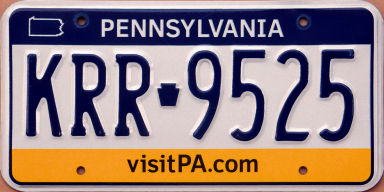
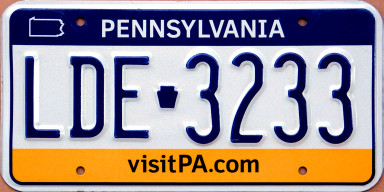
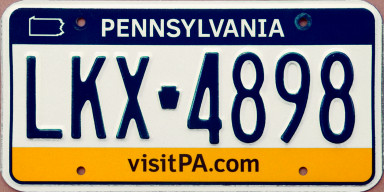
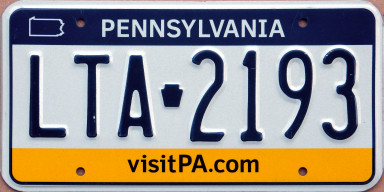
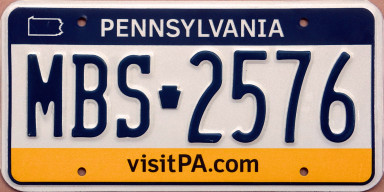

State map outline plates issued in 2017 through 2022.
In June 2017, a slightly redesigned plate, with no sticker well and with a white outline of the state map where the sticker would have gone, began being issued to new registrants. This revised plate design started at plate number KLF-0000. Going forward, there will be no way to know whether a state map plate was issued in 2017 versus later years, except by knowing which plate number ranges were issued in what years. It will become even more important to keep track of this information for future reference.
| 2017 issues – | No expiration sticker; natural serials: KLF series to approx. KPx series. | |
|---|---|---|
| 2018 issues – | No expiration sticker; natural serials: approx. KPx series to KXx. | |
| 2019 issues – | No expiration sticker; natural serials: approx. KXx series to LGx series. | |
| 2020 issues – | No expiration sticker; natural serials: approx. LGx series to LPx series. | |
| 2021 issues – | No expiration sticker; natural serials: approx. LPx series to LWx series. | |
| 2022 issues – | No expiration sticker; natural serials: approx. LWx series to MCx series. | |
| 2023 issues – | No expiration sticker; natural serials: approx. MCx series to MKx series. | |
| 2024 issues – | No expiration sticker; natural serials: approx. MKx series and higher. | |
Back to History of Pennsylvania passenger car plates dated 1906 to 1976
Related pages on this site |
Elsewhere on the web
|
Thanks to those who have directly contributed to the information on this page: Bill Stephens.
This page is W3C valid |

