 |
|
 |
|
|
|
|
On this page I show off my collection of U.S. plates that commemorate various colonial, territorial, and statehood anniversaries. Latest noteworthy updates to this page
| |
This is my collection of license plates commemorating various anniversaries of U.S. states. Each of these plates celebrates the anniversary that the state was first colonized, became part of the U.S., was established as an organized territory, achieved statehood, or some similar event. I began collecting these shortly after I began actively collecting license plates in 2003, after I realized that I already had two examples (Maryland 350th Anniversary and California Sesquecentennial) that had come off of my own cars. This display is arranged chronologically based on the anniversary date.
 |
Maryland Tercentenary 1634-1934As far as I know, Maryland was the first state to promote their anniversary on vehicle license plates. The colony of Maryland was established in 1634 at St. Mary's City. Before the mid-1950s, North American plate sizes were not standardized; this one is 15 inches across, rather than the 12 inch width used today. |
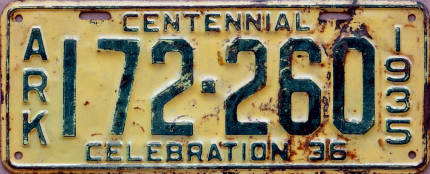 |
Arkansas Centennial Celebration 36Arkansas issued these 1935 plates promoting the state's 100th anniversary in 1936, but in a surprising turn, the 1936 plates didn't even mention the anniversary. Six-digit plates had dimensions are just under 5-1/2 inches by 13-1/2 inches; plates with five or fewer digits were narrower. Colors are supposed to be dark blue numbers on a light yellow background, but this plates's dark blue paint has faded or deteriorated to a dark green color. |
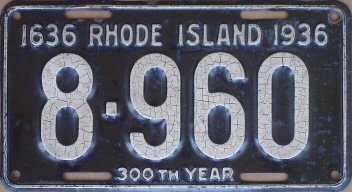 |
Rhode Island 300th Year 1636-1936What is now the state of Rhode Island was first settled by Europeans in 1636, led by Roger Williams after he was kicked out of Massachusetts for his political and religious views. Plate widths varied on these plates, depending on the number of digits in the plate number. This one with four digits measures 11 inches by 6 inches; five-digit plates were 13 inches across. Apparently, plates with three or fewer digits were narrower than 11 inches, as it's been reported that they didn't acknowledge the anniversary due to space limitations; I haven't seen one myself. |
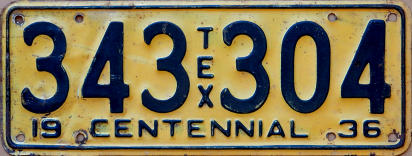 |
Texas CentennialTexas seceeded from Mexico and became an independent country in 1836. The Republic of Texas later joined the U.S. and became a state. This plate celebrates the 100th anniversary of the former event. Passenger car plates had plate numbers that were either all-numeric or had a single letter prefix. |
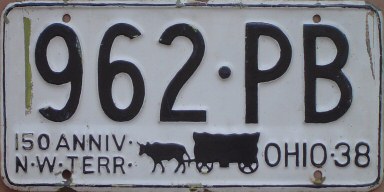 |
Ohio 150th Anniversary Northwest Territory '38The Northwest Territory, organized in 1788, was a vast tract of land that covered all of what is now the U.S. Midwest east of the Mississippi River, including present-day Ohio. Anyway, between 1935 and 1979, Ohio issued different serial formats to motorists living in various parts of the state. This format, with two suffix letters, identified the motorist as being from the western or southwestern portion of Ohio, which included Cincinnati and Dayton. |
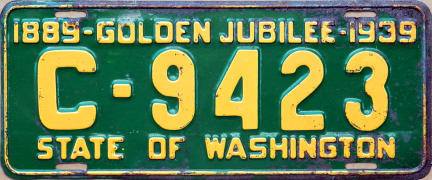 |
Washington Golden Jubilee 1889-1939It should be obvious from the context that "golden jubilee" is a term meaning 50th anniversary. It's more commonly used to refer to a wedding anniversary or the the reign of a monarch. Washington (the state in the Pacific northwest, not the U.S. capital city) became a state in 1889. The "C" plate number prefix is a county code for Spokane County. |
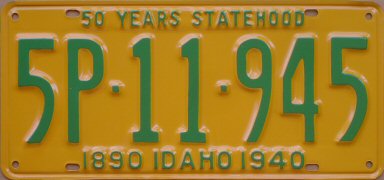 |
Idaho 50 Years Statehood 1890-1940The plate shown is half of a pair of unissued, perfect, mint condition plates that were for sale on an obscure e-commerce web site, to which a visitor to my site alerted me. Thanks, Lynn. The "5P" serial prefix is a county code; while it looks like the the county codes in use today, they employed a different set of codes prior to 1945. "5P" was the code for Canyon County back then. This is another odd-sized plate, measuring 5 5/8 inches high, rather than the 6 inch height that's standard today. |
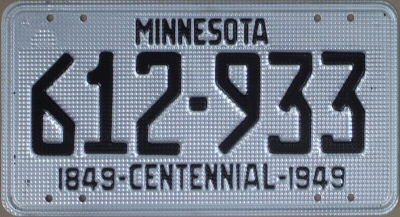 |
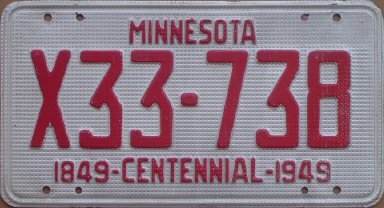
Minnesota Centennial 1849-1949The plate shown is half of a another stunning pair of mint condition plates, this one donated to my collection by a visitor to this site. Thank you, Twyla! The 1949 Minnesota plates were made from thin, unpainted aluminum. The waffle pattern made the plate sturdier, but the paint on the numbers didn't stick to it very well in actual use. These plates recognized the 100th anniversary of the establishment of Minnesota as a territory. This is yet another odd-sized plate, measuring 6 1/2 inches high. |
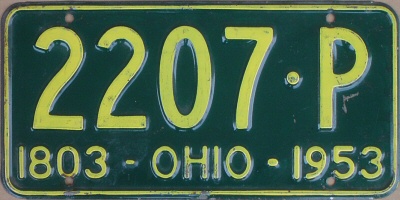 |
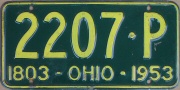
Ohio 1803-1953Ohio's 1953 plate announced its 150th anniversary of statehood without any slogans or graphics. Back then, different serial formats were issued in various parts of the state. This format, with a single suffix letter, identified the motorist as being from the northwestern portion of Ohio, near Toledo. |
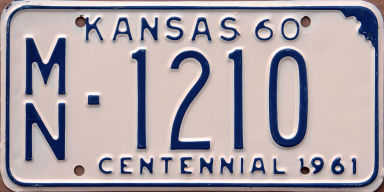  |
Kansas Centennial 1961Kansas was admitted to the Union in 1861. Both its 1960 and 1961 plates commemorated the centennial of that event. The two-letter codes on the left side of these plates indicate that the 1960 plate is from Marion County, while the 1961 plate is from Lane County. |
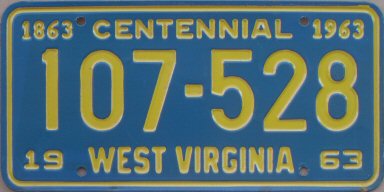 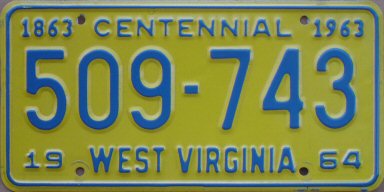 |
West Virginia Centennial 1863-1963West Virginia was created during the midst of the Civil War from the Virginia counties that had remained loyal to the Union. Like Kansas, West Virginia celebrated its 100th anniversary on its plates for two years. The 1963 plate is unusual in that it is debossed – the plate number, state name, etc. are lower than the blue background. The 1964 plate is embossed in the normal manner. |
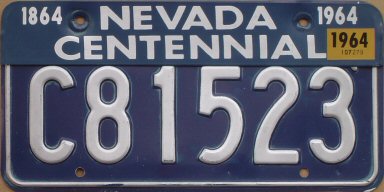 |
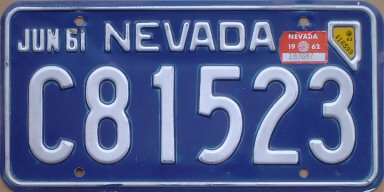
Nevada Centennial 1864-1964Nevada came up with an unusual way to acknowledge their centennial on license plates. The underlying base plate was introduced in June 1960 and initially expired in June 1961. It was then renewed with stickers that extended its life to June 1962 and June 1963, respectively. Nevada then issued a metal strip that read 1864 Nevada Centennial 1964 to validate the plate through June 1964. Then, they issued the 1964 sticker to be affixed to the Centennial strip, which validated the plate for another six months through December 1964. The "C" serial prefix indicates the plate was issued to a motorist in Clark County. This is another free plate given to me by a visitor to this site. Thanks, Tony! See the underlying plate. |
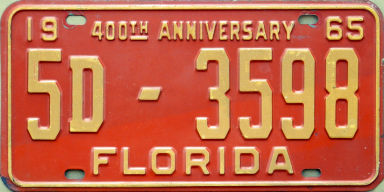 |
Florida 400th Anniversary 1965This plate celebrates the founding of St. Augustine by Spain in 1565. St. Augustine was the first permanent European settlement in what is now the United States. The gold on red colors are the school colors of Florida State University. The "5" means this plate was issued to a resident of Polk County; the "D" is a vehicle weight class code. |
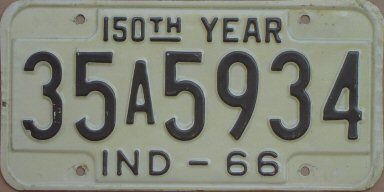 |
Indiana 150th Year '661966 Indiana plates proclaimed the 150th anniversary of statehood. The number(s) to the left of the little letter indicate the county; in this case, "35" is for Huntington County. This serial number format began in 1963 and continued until 2008. |
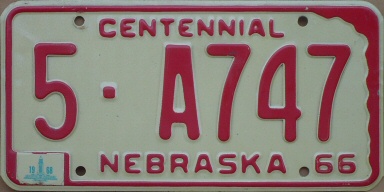 |
Nebraska CentennialNebraska's 100th anniversary of statehood was actually in 1967, but the state issued these centennial plates with only the year "66" stamped on them. The plate was then kept current with stickers for 1967 and 1968. The "5" serial prefix indicates this plate was issued in Dodge County. |
 |
Alaska 1867-1967The U.S. bought the land that is now the state of Alaska from Russia in 1867 for the sum of $7.2 million. At the time, this transaction was ridiculed as being a huge waste of money. This base was issued in 1966 and renewed in 1967 with a sticker. |
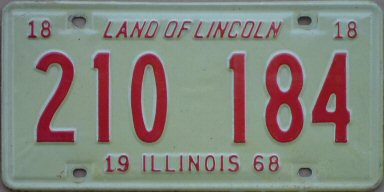 |
Illinois 1818-1968Illinois achieved statehood in the year 1818, and this plate recognizes the sesquicentennial of that event. Illinois was apparently very modest about announcing this milestone; the sole indication that this is an anniversary plate are the numbers "18" in each of the upper corners, which together make up the year 1818. |
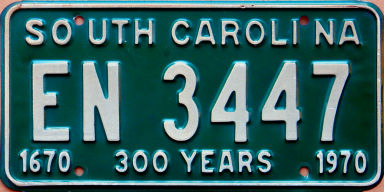 |
South Carolina 300 Years 1670-1970This plate commemorates the first permanent colonial settlement in what is now South Carolina in 1670. Despite the seemingly generic numbering format, the first letter is actually a vehicle type and weight class code; letters "A" through "G" were assigned to passenger cars based on increasingly heavier weight ranges. |
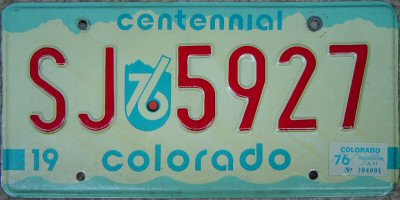 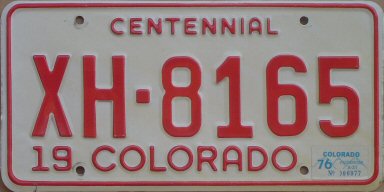 |
Colorado Centennial '76Colorado became a state in 1876, so the red, white, and blue plate with the graphic "76" separator actually celebrates the statehood centennial, rather than the U.S. Bicentennial as you might assume. The graphic base plate is dated 1975, and this example has a "76" sticker covering the "75". This plate was issued in Jefferson County, based on the serial prefix. Towards the end of 1976, the state ran out of the sheeting for the graphic Centennial plates, and so they chose to issue plates for new registrations in this all-embossed design instead. This one is from Chaffee County. Notice that the serial dies on these two plates are completely different. |
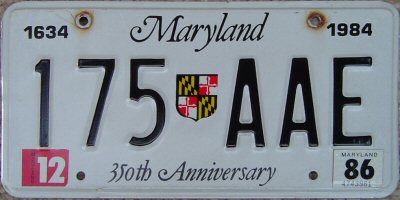 |
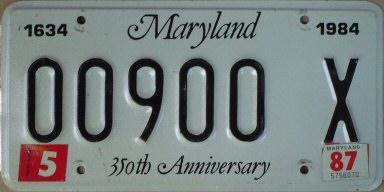
Maryland 350th Anniversary 1634-1984Maryland again celebrated their anniversary through license plates during the mid-1980s. This commemorative plate was an extra-cost optional issue in 1983 and 1984, and could be renewed through September 1987. This particular plate once adorned my 1980 Datsun 210. You can tell from the low registration number that I was one of the early motorists to get this plate. |
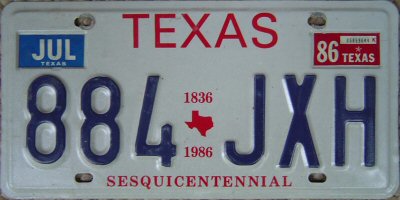  |
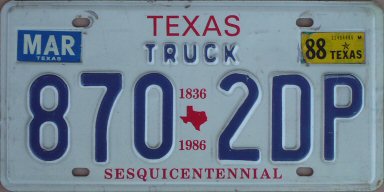
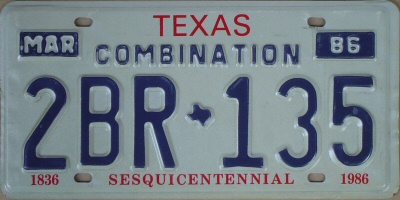
Texas Sesquicentennial 1836-1986These plates celebrate the 150th anniversary of Texas' independence from Mexico. There were two versions of passenger car plates made: the earlier version with Sesquicentennial at the bottom edge, as shown at top left, and the later version with the word Sesquicentennial at the top, as shown at bottom left. I presume that the legend was moved due to it frequently being hidden by license plate frames. There were also a few other versions of the background sheeting used on vanity and non-passenger plates; these are shown further down this page. |
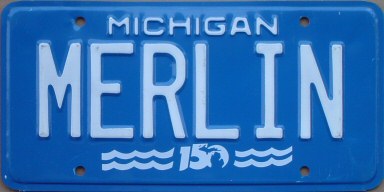 |
Michigan 150Michigan commemorated its 150th anniversary of statehood in 1987, but only on its vanity plates, which were still being re-issued annually at the time. Other vanity plates before and after had the registration year embossed on them, but the 1987 plates only had this clever 150 logo. The logo was applied to the surface of the painted plate; on this particular example, it was put on a bit crooked. |
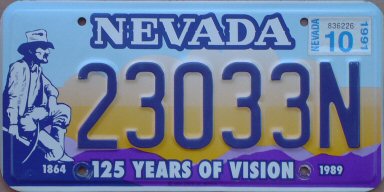 |
Nevada 125 Years of Vision 1864-1989As you've already seen, most state anniversary plates celebrate milestone dates in multiples of fifty years. Nevada is one of the few states to issue a specialty plate for a statehood anniversary that's only a multple of twenty-five. I haven't been able to find much information about this plate, but from what I can gather, it was introduced in 1989 as an optional plate and was available through October 1990. These plates may remain in use if continuously registered. Sequentially-numbered plates all have an "N" suffix letter. |
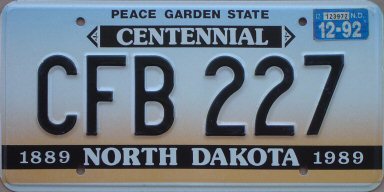 |
North Dakota Centennial 1889-1989North Dakota and South Dakota were both admitted to the Union on the same day in 1889, but no one knows which was first. President Harrison deliberately shuffled the papers before signing them. This plate was the standard issue in North Dakota from 1987 to 1992, and was replaced upon expiration in 1993. |
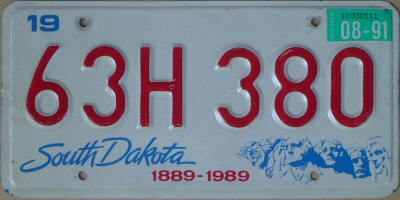 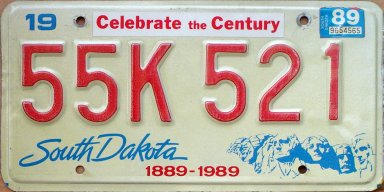 |
South Dakota 1889-1989This plate was the standard South Dakota plate for several years starting in 1987. The "19" in the upper left corner has a matching "87" under the stickers in the upper right corner. The "55" serial prefix indicates the motorist resided in Roberts County, while the "63" prefix indicates Walworth County. Most of these plates were like the top one shown at left, with a blank space along the top edge. Apparently as an afterthought, the state made available a sticker with the legend Celebrate the Century which could be affixed to that blank area. I don't know if the sticker cost extra, but plates that have it are far less common than those that don't. |
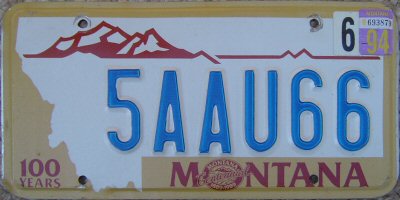 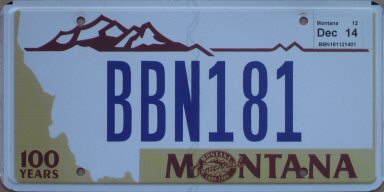 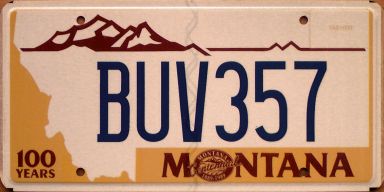 |
Montana 100 Years 1889-1989Montana was admitted to the Union in 1889. The original embossed version (shown at top left), was an extra-cost optional plate to commemorate the statehood centennial. At some point, this design was discontinued, though plates already in use could continue to be renewed. On this plate, the "5" preceding the letters in the serial number identifies this plate as being from Lewis and Clark County. In 2012, Montana resumed issuing this plate design, along with several others that had been discontinued, as no-extra-cost optional plates. The new versions of the 100 Years plate, shown at middle and bottom left, have flat serial characters and are not county-coded. Unlike the other no-extra-cost optional designs, this design shares its numbering format with extra-cost specialty plate designs. Initially these plates used the generic, narrow 3M font for the plate number, but in 2016, Montana scrapped this font and began printing all of its plates with a wider, easier-to-read font. The wider-font plate is a front plate and so doesn't have an expiration sticker affixed. |
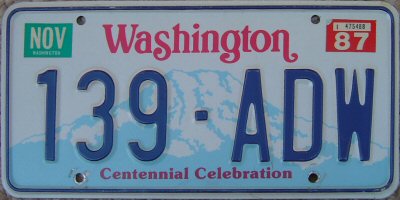 |
Washington Centennial CelebrationAlthough this plate leaves you guessing as to when the centennial actually might be, in fact the state of Washington was also admitted to the Union in 1889. This base was introduced in 1986, and was issued with the centennial legend until about 1991. |
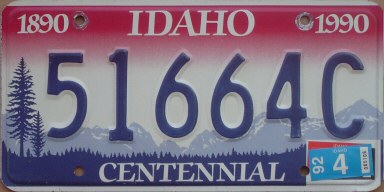 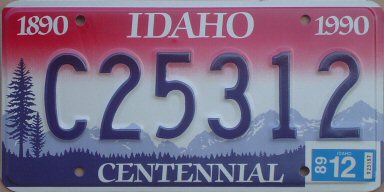 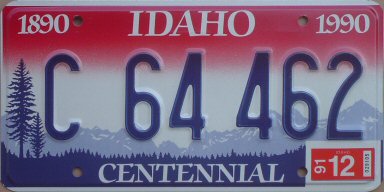  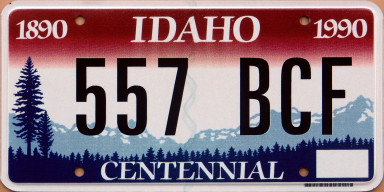 |
Idaho Centennial 1890-1990Idaho introduced this extra-cost optional plate in 1987. Similar to Maryland's 350th Anniversary plate, it was so well-received that it became the basis for the design of the subsequent general issue plate. But the difference is that the Idaho Centennial plate continues to be issued alongside the very similar standard plate design. There were several versions of this centennial plate, with various serial dies and formats. They were first issued in format 00000C, then C00000. Starting at about serial C28000, the plates were made with narrower serial dies and space separators in format C 00 000. As these C-suffix and C-prefix centennial plates expired in 1992, they were replaced with centennial plates with serial format 000 xxx. I believe this format with embossed characters is now also off the road. This same design and format is still being issued and used today, but with flat, black plate numbers. I believe Idaho issues expiration stickers for both the front and rear plates. The flat number plate shown at bottom left is unstickered and unused. |
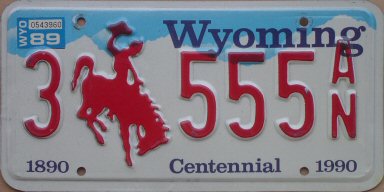 |
Wyoming Centennial 1890-1990Wyoming's centennial plate was used from 1988 to 1992. With the white mountains in the background, it could almost be mistaken for a Colorado plate, but the traditional Wyoming cowboy and bronco silhouette clears up any possible confusion. The number to the left of the bronco identifies the county where the plate was issued; county "3" is Sheridan County. |
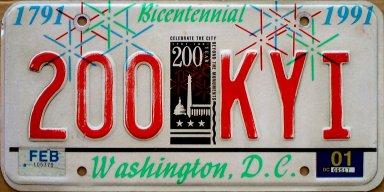 |
Washington, D.C. Bicentennial 1791-1991Washington, D.C. issued general issue Bicentennial plates indicating the years 1776-1976, but those celebrated the 200th anniversary of the United States. This 1791-1991 plate is an extra-cost, optional plate recognizing the 200th anniversary of the District of Columbia. The numbering format for sequentially-numbered plates is 200 xxx, but what's unique is that the numeric portion of the plate number is always "200"; only the serial letters vary from one plate to the next. The small text surrounding the logo in the center of the plate reads, Celebrate the city beyond the monuments. These plates are still in use today. |
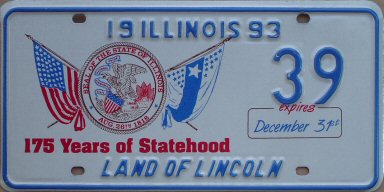 |
Illinois 175 Years of StatehoodIllinois issues a multitude of various special event plates which are valid for temporary use; most are issued in very small numbers. In 1993, Illinois issued this one to commemorate their 175th anniversary of statehood. |
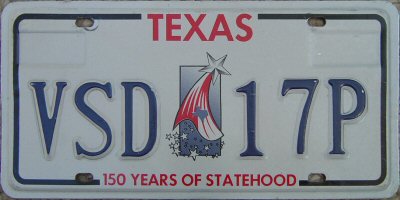 |
Texas 150 Years of StatehoodThis undated plate acknowledges Texas' 150th anniversary of statehood, which was celebrated in 1995. This was a standard-issue plate, but it was only issued for a few months in late 1995 and early 1996. Texas stopped using plate stickers in 1994. |
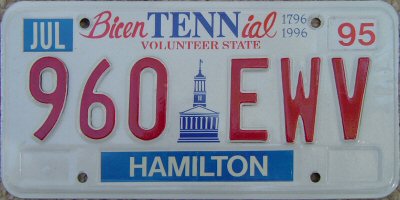 |
Tennessee Bicentennial 1796-1996Tennessee was admitted to the Union in 1796. This plate commemorates the 200th anniversary of statehood with a clever play on the letters "tenn" in Bicentennial also being the abbreviation for Tennessee. The "95" expiration sticker appears to have been placed in the sticker well during the manufacturing process. |
 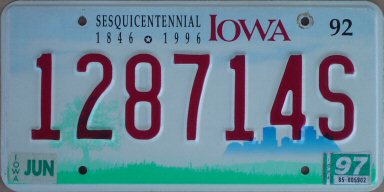 |
Iowa Sesquicentennial 1846-1996Iowa issued two completely different optional plates to celebrate its 150th anniversary – a rather plain red, white, and blue design, and a more colorful graphic plate featuring a city skyline in the background and a tree in the foreground. Either plate cost $15 above the normal registraiton fees. What prompted Iowa to offer both designs, I don't know. |
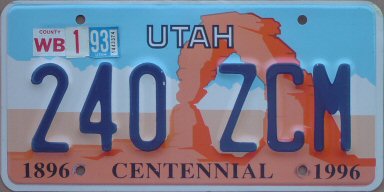 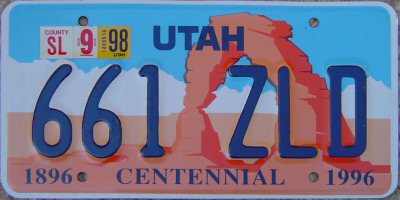 |
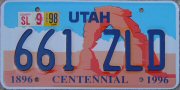
Utah Centennial 1896-1996This optional-issue plate commemorated Utah's admission to the Union in 1896. The plate proved to be very popular with Utah motorists, and it was available to new registrants until 2007. Now a plate with a similar design, but without the centennial legend, has taken its place. On very early versions of the anniversary plate, the state name was white, outlined in navy blue, as shown at top left. It was soon changed to solid navy, as shown at bottom left, to improve legibility. |
 |
Wisconsin Sesquicentennial 1848-1998Wisconsin also issued an optional graphic plate to celebrate the 150th anniversary of statehood, depicting a lake scene. The month and year stickers actually belong in the opposite positions on this plate. |
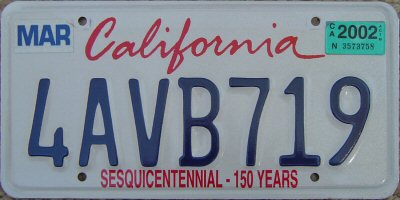 |
California Sesquicentennial – 150 YearsThe legend on this plate redundantly proclaims Sesquicentennial – 150 Years without specifying the date or the event being celebrated. Since it was issued to all new registrants from January 1998 to November 2000, the plate would seem to recognize the 150th anniversary of two events in California history – its acquisition by the U.S. from Mexico in 1848, and its statehood in 1850. Not to mention the gold rush of 1849. This particular plate was issued to my brand-new 1998 Chevy Malibu. |
 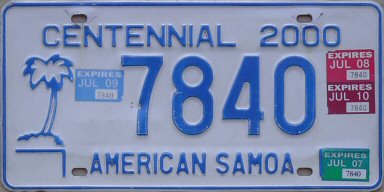 |
American Samoa Centennial 2000American Samoa is a small U.S. territory in the south Pacific Ocean. We apparently worked out an agreement with Great Britain and Germany that the easternmost two of the four main Samoan islands should be ours, and we just went in and took over in 1900. These plates recognize the 100th anniversary of that event, though I can't say whether the locals consider it something to be celebrated. I've had several opportunities to obtain mint condition, unstickered, unissued American Samoa Centennial 2000 plates, but, having never seen an American Samoa license plate in actual use, I held out for plates that were actually issued and used, in order to get a better idea of how the two different bases were validated with expiration stickers. Even so, I've had to resort to also using photos of other used American Samoa plates to try to figure it all out. In any case, it's apparent that Samoans are fond of placing expiration stickers all over their plates. The top plate shown at left, with the narrow dies, is the first of the two Centennial 2000 versions. I've only seen these with expiration stickers ranging from 2003 to 2009, and none with a natural (first year) expiration sticker newer than 2005. I've only seen the previous base with expiration stickers up to 2000, so I don't know what happened for 2001 and 2002 expirations – perhaps they used windshield stickers or something. I believe the badly faded and crumbing sticker in the lower left corner indicates a 2003 expiration. 2003 stickers were colored white on red, but at least some of these seemed to be of inferior quality, causing them to rapidly deteriorate. The bottom plate at left, with the wide dies, I've only seen with expiration stickers ranging from 2006 to 2010, so it seems to be the newer of the two designs. However, I've seen both versions with both high and low plate numbers, as well as everything in between. This baffled me for quite awhile, until someone explained to me that the first digit in the plate number corresponds to the expiration month, just like on West Virginia plates. So those low plate numbers with the newer dies were really higher plate numbers on plates with expiration months early in the year. |
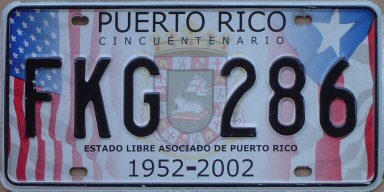 |
Puerto Rico Cincuentenario 1952-2002Puerto Rico's political status is somewhat ambiguous. It's been a U.S. possession since 1898, but in 1952 it adopted a constitution that established it as a self-governing "commonwealth" associated with the U.S., whatever that means. This plate recognizes the 50th anniversary of that commonwealth status. The Spanish text at the bottom translates to Free Associated State of Puerto Rico. I'm not entirely clear whether this was a standard passenger car plate, a no-cost option, or an extra-cost special interest plate, but regardless, it was only issued for a short period of time. Puerto Rico has used windshield stickers to denote current registrations since the early 1990s. |
 |
Louisiana Louisiana Purchase Bicentennial 1803-2003The Louisiana Purchase was actually a vast portion of land covering about the middle third of the continental U.S. that we bought from France in 1803. Its namesake state occupies just a small portion of this area. |
 |
Ohio Bicentennial 1803-2003This plate was issued to celebrate Ohio's entry to the Union in 1803. It was the standard-issue plate from October 2001 through February 2004, but it and other discontinued base plates continue to be renewed today. Incidentally, the Wright Brothers' first flight, alluded to by the Birthplate of Aviation slogan, occurred in 1903, Ohio's centennial year, but in North Carolina. |
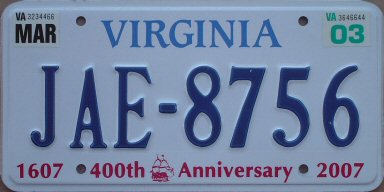 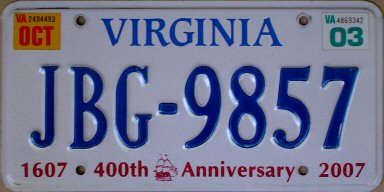 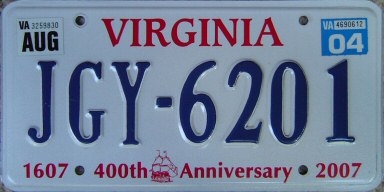 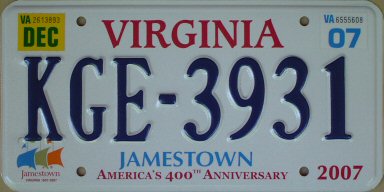 |
Virginia 400th Anniversary 1607-2007Virginia got an early start celebrating the anniversary of the first English settlement in the new world, which occured in Jamestown, Virginia in 1607. In 2002, 400th anniversary plates with the small red ship logo became the state's standard-issue plate. During the first few months of issuance, some plates were made from the leftover previous standard plate blanks with the blue state name. These all had the red text at the bottom either on a decal applied to the plate, or painted directly on the plate. One of each of these is shown at left, but they're unfortunately indistinguishable in photographs. Subsequently, these anniversary plates were consistently made using the new blanks with the red state name and screened text at the bottom, as shown at the middle left. In May 2006, a more elaborate and colorful 400th anniversary plate was introduced with the revised slogan Jamestown, America's 400th Anniversary, as shown at bottom left. Again, these were standard-issue plates, and were issued to all new registrants until early in 2008. |
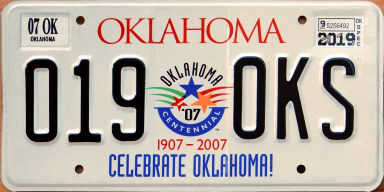 |
Oklahoma Centennial 1907-2007Never seen one of these Oklahoma Centennial plates before? Well, neither had I, until the day I acquired this one in 2018. I knew of their existence since 2007, when they were brand new and I was presented with the opporunity to buy one, but I couldn't afford the asking price at the time. The seller, a fellow plate collector with an intimate knowledge of Oklahoma plates, told me that I might not ever get another opportunity, since these were destined to be a very low-volume design. And it seemed he was right. Fast forward to 2018. That same seller contacted me again and offered to sell this plate to me. It's only the 19th one of these made out of an unknown but apparently small number. I believe his asking price was unchanged from eleven years earlier, but this time I had the both the money and a better appreciation for this plate's scarcity. |
 |
Minnesota 150 Years 1858-2008This extra-cost optional plate was introduced in August 2008 to belatedly acknowledge Minnesota's 150th anniversary of statehood; the actual anniversary was in May 2008. Better late than never, I suppose. The legend Star of the North Sesquicentennial is screened along the bottom edge of the plate. I'm not sure whether the October 2008 expiration stickers attached to this particular plate are correct or not. |
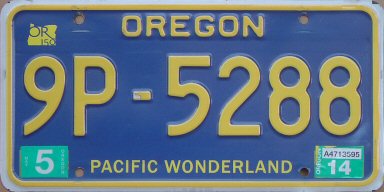 |
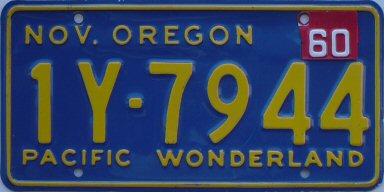
Oregon 150Oregon introduced this extra-cost plate in early 2010 to belatedly acknowledge their 150th anniversary of statehood, which occurred in 1859. The sole indication that this is an anniversary plate is the small state map in the upper left corner, which bears the text OR 150. Otherwise, the plate design is supposed to resemble passenger car plates issued between late 1959 and about the end of 1963. See the original 1960s Pacific Wonderland plate. |
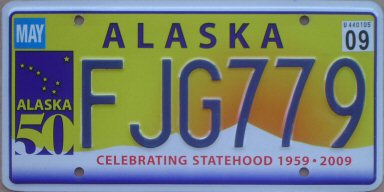 |
Alaska Celebrating Statehood 1959-2009Like me, Alaska celebrated its 50th birthday in 2009. This plate was the standard-issue passenger car plate issued to new registratnts between January 2008 and sometime in the spring of 2010. Plate numbers ranged from the FGF to FUW letter series. |
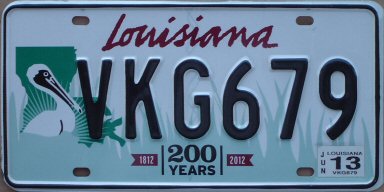 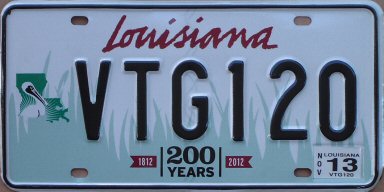 |
Louisiana 200 Years 1812-2012Louisiana introduced this plate as its standard passenger car plate in January 2011 to celebrate its statehood anniversary. Plate numbers began where the previous standard plate left off, somewhere in the VCx series. However, after a short time in use, it was realized that the graphic on the left side of this plate interfered with the legibility of the first letter in the plate number. A revised design with a smaller graphic then came out, reportedly in the midst of the VQx series. Both versions continue to be used, however. In January 2013, the state ceased issuing this plate design and reverted back to issuing new plates with the previous pelican graphic. The highest anniversary plate number reported to be seen in use is in the WTX series. |
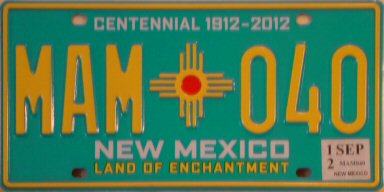 |
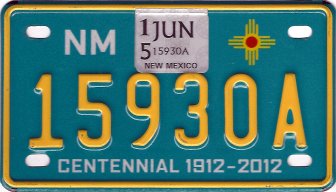
New Mexico Centennial 1912-2012Since about 1999, New Mexico has offered its residents a choice of two different standard license plate designs. In 2010, they discontinued the design depicting a hot air ballon, and in its place, began to issue this statehood anniversary plate as one of the two standard designs. Plate numbers picked up where the hot air ballon plate numbers left off, starting in the LGR series. I really like this plate; I think it's attractive, unique, and easy to read. |
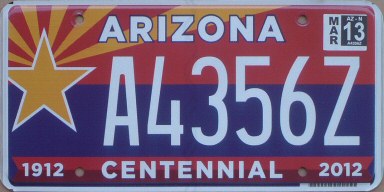 |
Arizona Centennial 1912-2012Arizona introduced this extra-cost special interest plate in the fall of 2011 to acknowledge their 100th anniversary of statehood in 2012. The background graphic on the plate is the Arizona state flag. Arizona was the last of the 48 contiguous states to celebrate its statehood centennial. |
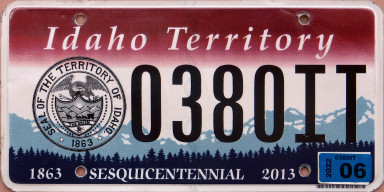 |
Idaho Territory Sesquicentennial 1863-2013A few states have issued plates celebrating their establishment as a territory, but none have made it so clear that the anniversary is that of the territory, rather than statehood. Idaho issued these as extra-cost special interest plates between 2012 and 2017, but they were slow sellers; I've been told that no more than 500 pairs were issued. That's likely due at least in part to the plates visually resembling the standard-issue plates. The IT serial suffix was constant. |
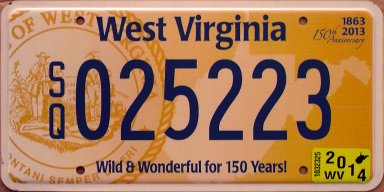 |
West Virginia 150th Anniversary 1863-2013West Virginia introduced this 150th Anniversary design as a no-extra-cost alternative to the standard white-background plate. Despite that, it hasn't been especially popular with West Virginia motorists. Perhaps they don't like the flat, screened plate number characters, which the standard plate does not have. Prefix letters "SQ" are constant; I presume they stand for "sesquicentennial". All anniversary plates expire annually on September 1 of the year indicated on the sticker. |
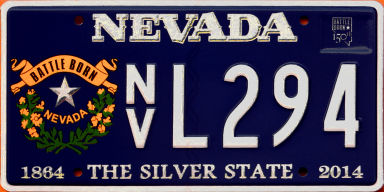 |
Nevada Battle Born 150th 1864-2014This extra-cost specialty plate commemorating Nevada's 150th statehood anniversary was introduced in July 2013 and was available only through October 2016, but plates in use may be renewed and used indefinitely. The graphic design comes directly from Nevada's state flag. The phrase "Battle Born" refers to Nevada having become a state during the Civil War (1861-1865). I specifically wanted an unstickered front plate for my collection, so that the tiny logo in the sticker well in the upper right corner wouldn't be convered up. It's hard to make out even in the larger photo, but it features an outline of the Nevada state map and the the text "Battle Born 150th". |
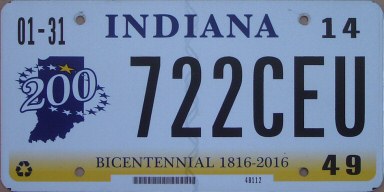 |
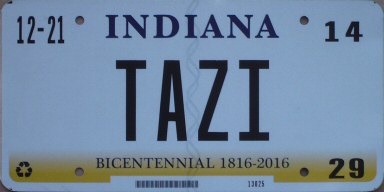
Indiana Bicentennial 1816-2016This was Indiana's standard passenger car plate introduced in 2013; it celebrates Indiana's 200th anniversary of statehood in 2016. In recent times, Indiana replaced nearly all of its license plates every five years, with passenger car plates getting replaced in years ending with a "3" or and "8". So, I expected this plate to off the road by the end of 2018. But Indiana introduced a new design in 2017, a year earlier than expected, and also switched to replacing plates after seven years of use, rather than during a specific year. As a result, this design is gradually being replaced between 2020 and 2023 or so. |
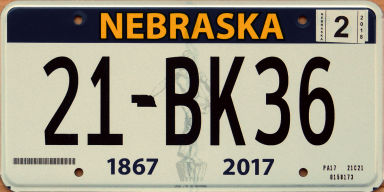 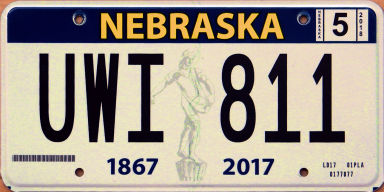  |
Nebraska 1867-2017Nebraska also replaces its plates statewide on a regular basis, every six years as of late. Nebraska's standard passenger car plate design introduced in 2017 recognized their 150th anniversary of statehood that year. Nebraska now issues plates to motorists in its three most populous counties around Omaha and Lincoln in a xxx 000 generic numbering format, while everyone else continues to get plates with a county-specific prefix number. "21" is the code for Scott's Bluff County, and "43" is the code for Colfax County. In 2022, Nebraska slightly revised the design of these plates, changing the plate number font and moving the bar code from the lower left corner and the small printed text from the lower right corner to the top edge of the plate. The bottom plate is an example of the revised design. Both designs were replaced as they expired in 2023 with a completely new design. |
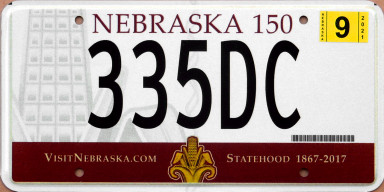 |
Nebraska 150 / Statehood 1867-2017Besides issuing standard plates celebrating its 150th statehood anniversary, Nebraska also issued this special interest plate commemorating the same occasion. I'm not sure how much extra it cost, but it was apparently a slow seller regardless, possibly because of its redundancy with the standard-issue design. |
 |
U.S. Virgin Islands Transfer Centennial 1917-2017The United States purchased what are now the U.S. Virgin Islands from Denmark in 1917 for the sum of $25 million. (There are also nearby British Virgin Islands which are, obviously, British territory.) The U.S. Virgin Islands introduced this standard passenger car plate design in 2016 to commemorate the 100th anniversary of their switching from being under Danish control to becoming a U.S. territory. They call this the "Transfer Centennial". Plate numbers continued uninterrupted from the previous design. Plate numbers beginning with "C" are assigned to motorists on the island of St. Croix. This plate design continues to be issued as of mid-year 2021. |
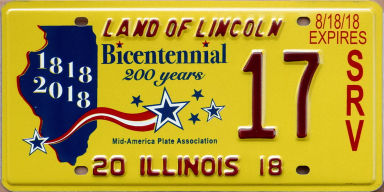 |
Illinois Bicentennial 200 Years 1818-2018The state of Illinois squandered the opportunity to develop a license plate to celebrate their 200th anniversary of statehood in 2018. They certainly could have easily incorporated a bicentennial theme into the regular passenger car plate design introduced in 2017. They could have created a state-sponsored special event plate like they did for the state's 175th anniversary in 1993 (see above). But for reasons unknown, they did neither. The Mid-America Plate Association (MAPA) is a region of the Automobile License Plate Collectors' Association (ALPCA) covering the greater Chicago area. MAPA holds plate meets (gatherings of license plate collectors) several times a year, and makes use of the state's willingness to produce special event plates for each of their events. Illinois special event plates are street-legal license plates valid for 60 days ending on the day (or the last day) of the event. Perhaps realizing that the state was not going to produce a 200th anniversary plate on its own, MAPA incorporated that theme into their special event plate for their plate meet held in Wauconda, Illinois on August 18, 2018. |
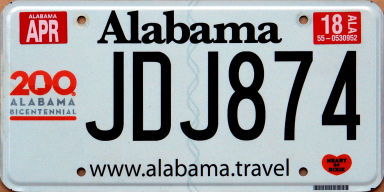 |
Alabama 200 Alabama BicentennialTo celebrate its upcoming 200th statehood anniversary in 2019, Alabama began issuing in 2016 a second no-extra-cost optional plate, with its wildly popular God Bless America design being the first. Despite not costing any more, the statehood plate has been a slow seller. I would guess that its plain design, especially when compared to the vivid green and yellow standard plate, is a major factor. Possibly also the lack of any readily visible county identification; people who live in states with a tradition of county-coded plate numbers and/or county stickers can be rather passionate about being able to identify what county they and their fellow motorists are from. Apparently, this plate is no longer being issued but is still valid for use. |
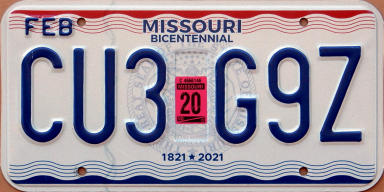 |
Missouri Bicentennial 1821-2021Missouri introduced this standard plate design in October 2018 for passenger cars and some other plate types. The plate recognizes Missouri's 200th anniversary of statehood. This design gradually replaced the previous bluebird design over the course of a few years. Desipte the alphabet-soup numbering format, this one is a regular passenger car plate. |
Yeah, I'm getting really close to finishing my state anniversary plate set. Until a new one is introduced, I'm down to just needing these last two, both only recently issued:
 Colorado –
Both of the two Sesquicentennial 1876-1926 graphic plate designs.
Colorado –
Both of the two Sesquicentennial 1876-1926 graphic plate designs. In most cases, either states didn't issue non-passenger versions of their anniversary plates, or else the non-passenger version was identical in design to the passenger car version, differing only in serial format and possibly the addition of an embossed legend identifying the plate type.
However, in at least a few cases, there were state anniversary non-passenger plate types that actually differed in design from their passenger counterparts. These are the focus of this section. I won't pretend to know all the instances of when this occurred, but as I learn of them, and especially as I acquire actual examples, I'll report on them here.
Corresponding passenger car plates are also shown for comparasion purposes.
Minnesota Centennial 1849-1949
Passenger car plates had all-numeric serials or an "A" suffix, and were colored black on silver (actually unpainted aluminum). Some, but not all, non-passenger types also had the 1849-Centennial-1949 legend at the bottom of the plate. Non-passenger types usually had one or more serial prefix letters. Colors of these plates varied, depending on the type. 1949 non-farm truck plates used both "X" and "Y" prefix letters, and were colored red on silver (aluminum). |
Maryland 350th Anniversary 1634-1984
Passenger car plates on the 350th Anniversary base all had the shield graphic in the center of the plate. Maryland also issued anniversary plates for multi-purpose vehicles (a class which includes all SUVs, passenger vans and motor homes) with serial format of a 5-digit number followed by the letter "X". These were made without any shield. Vanity plates, regardless of whether they had a center space, and amateur radio operator plates were also made without the shield. It's unclear whether handicapped plates might have been made in 350th anniversary versions; if so, they would also be absent the shield. Plates issued to high-ranking government officials would have had a large round state emblem occupying about the left third of the plate, but this emblem was a sticker that was applied to the plate, rather than a difference in the background sheeting. |
Texas Sesquicentennial 1836-1986
Of course there were a wide variety of Texas plate types issued during the sesquicentennial year, just like every other year, with various serial formats and embossed plate types. But what is interesting to me is that I've spotted at least five different varieties of the background sheeting used on these plates. All of these varieties are shown above.
|
Utah Centennial 1896-1996
As I explained above, early issues of the Utah Centennial plate had a hard-to-read state name that was white outlined in blue, but this was soon changed to solid blue. As far as I know, the Centennial plate was a no-cost optional plate available for all plate types. Each plate type numbering scheme on the Centennial plate was distinct from that used on the standard white-background Utah plate of the same type. Utah special interest plates have blank spaces where the graphics and slogans specific to each type go. Those graphic and slogans are actually stickers applied to the plate. So, on the special interst plate shown above, the normal Centennial legend was omitted to allow room for the sticker with the Invest in Children slogan. I assume there was a white state name version of the generic special interest blank plate as well. I really don't know whether or not there were any additional versions of the the Centennial plate blank sheeting. |
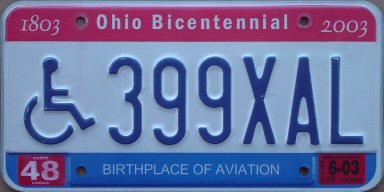
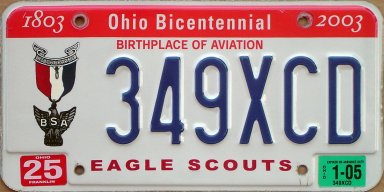
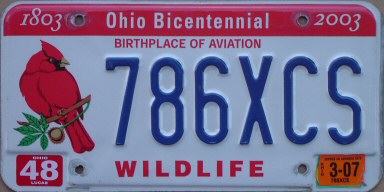
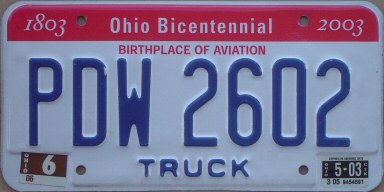
Ohio Bicentennial 1803-2003
Ohio had at least four versions of its state bicentennial base plates. All of these plates had the text 1803 Ohio Bicentennial 2003 screened in white characters on a red band across the top of the plate, but had other differences.
|
New Mexico Centennial 1912-2012
New Mexico didn't do as many states do, and just make their motorcycle plates a miniature version of their full-sized plates. Instead, they rearranged and/or omitted some of the features so that they'd fit better on the smaller plate. That qualifies the motorcycle plate design as being a variation of the full-sized plate design in my book. Regarding the apparent difference in colors between the two plates, they are actually the same colors in real life, and the motorcycle plate image much more accurately depicts those colors. My old camera has problems accurately reproducing certain shades of blue and green, and I have to make manual adjustments to the colors using my photo editing software. For some reason, I had great difficulty in getting the full-sized plate colors even remotely accurate. I therefore used my scanner to get an image of the motorcycle plate. Unfortunately, the scanner can't accommodate a twelve inch long full-sized plate. |
Indiana Bicentennial 1816-2016
I know of two versions of Indiania's statehood bicentennial plates, with and without the logo. The plates shown above are a passenger car plate and a vanity plate, respectively. It would seem that the logo is not used on vanity plates even when there's room for it. I'm not familiar with any other plate types issued on the Bicentennial base, but then, I'm no expert on Indiana plates. Ironically, Indiana suspended its vanity plate program and stopped issuing new vanity plates in July 2013. However, the state has allowed motorists with existing vanity plates to continue to use and renew them. The vanity plate shown above was issued after that date, so it must have been an existing registration that was remade on the new Bicentennial base. |
Related pages on this site |
Thanks to those who have directly contributed to the information on this page: Ross Richardson, Twyla Geier, and Tony Gardner.
This page is W3C valid |