 |
|
 |
|
|
|
|
This page covers this history of Maryland license plates used on passenger-carrying commercial vehicles, such as buses, taxis, limousines for hire, commercial ambulances, and the like. Latest noteworthy updates to this page
|
|
From 1910 to 1937, Maryland license plates displayed the calendar year in which they were valid. Plates dated 1939 and later always indicate, on the plates themselves, or via metal tabs or stickers, the year in which they expire. Exceptions to this include undated, unstickered plates that expired in 1976 and 1981, and front plates issued since 1986, which are not dated and do not bear stickers. I consistently refer to plates by the year that is shown on the plate, regardless of when the plate was actually issued.
Maryland non-passenger plate types (meaning plate types for vehicles other than private passenger cars, and therefore including the passenger-carrying commerical plate types shown on this page) and their expiration stickers, with few exceptions, have closely resembled or been indistinguishable from their passenger car equivalents from the same time period. Because this information is covered in detail on the passenger plate pages and the general information page, I'll just point out when there were deviations from passenger car plates.
On the various Maryland non-passenger plate history pages, for plates dated 1953 and earlier, I've listed the specific years and plate numbers that I've seen firsthand or in photos. This will hopefully be useful in identifying patterns and figuring out the mysteries surrounding some of these plates.
Note that this page does not address Maryland government-owned vehicle plates used on buses, ambulances, and the like. Rather, it covers the plates issued to such vehicles owned by private businesses. In some cases, government-owned vehicles were issued the same plates as privately-owned vehicles, but otherwise, government vehicle plates are found on my History of Maryland Government License Plates and History of Maryland Emergency Vehicle License Plates pages.
I sincerely hope that you find this information useful. If you find an error or have additional information, or can provide a plate or a photo of a plate that I'm missing, please send me an e-mail. There's a link to my e-mail address at the bottom of every page. Please note that all plates shown that are credited to another person are plates that I am still seeking for my own collection.
I define commerical buses as non-government buses that charge fares or that are otherwise available for hire by the general public. School buses, including those that can be hired, are covered in a separate article, below. Privately-owned buses, such as buses owned by churches or Boy Scout troops, as well as buses owned by businesses for which there is no charge to ride on, such as rental car company and hotel shuttle buses, are not considered to be commercial buses, and are not registered as buses by the state. These types of buses were issued passenger car plates until 1979, and have been issued multi-purpose vehicle plates since 1979.
 1923 regular bus with disc removed, disc mounting holes filled in, and repainted  1924 regular bus (Willard plate)  1927 regular bus (Rogers photo / plate) 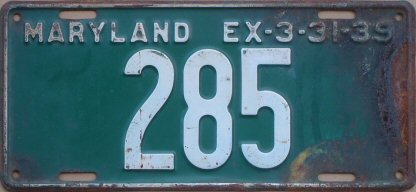 1939 regular bus 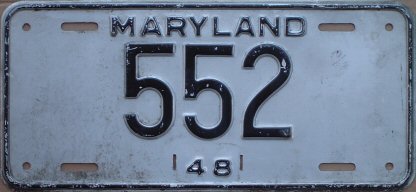 1948 regular bus  1952 regular bus #1 (Olivarri photo / plate) See plate #2 See plate #3 |
Regular bus platesI do not know with certainty much about Maryland bus plates from this era. It's believed that from some undetermined date through 1953, plates issued to buses traveling on fixed routes might only be identified by very low serial numbers on otherwise unremarkable plates. I'll call these "regular" buses, for a lack of a better term, since the plates lack any identifying letter codes or legends. By one account, regular bus plates were numbered between 1 and 1000 during this time. It's also been reported that early bus plates from the late 1910s and 1920s bore either an "A" or "B" on a large circular disk riveted to the plate, or embossed on the plate itself, possibly with a circle around the letter. No explanation of the meaning or purpose of the letters on the disk accompanied this report. The 1924 and 1927 plates shown at left have the low serial numbers and large circular disks that seemed to be unique to bus plates. However, the 1927 plate's disk is embossed with a large letter "X", rather than the expected "A" or "B". I've also seen a vintage photo of a bus with a 1925 plate with a "C" on a circular disk. Again, I do not know the significance of the disks, or of any of the letters on them, previously reported or otherwise. I do know that while these two plates have embossed disks, some of these disks are flat. The disk on the 1927 plate is colored white-on-red, but I'm not sure of the background color on the 1924 plate. If I were to make a wild guess about the disks and the letters on them, I'd venture that the "A", "B", "C", and possibly subsequently-lettered disks were codes for the number of passengers a given bus could carry. I'd speculate that the "X" disk was used on the largest buses, and indicated that the bus could carry more passengers that whatever the range of the second-to-highest bus plate disk authorized. This guess is consistent with the small disks used on truck and trailer plates which bore either a number from 2 to 9 or the letter "X", based on the weight capacity of the vehicle. When local fixed-route buses began receiving distinct plates, which apparently happened no later than 1934, presumably regular bus plates from this point on were issued only to long-distance fixed-route buses. Plate collector Jon Olivarri has in his collection plate numbers 1, 2, and 3, which all have April 1952 expiration dates. This means these plates are some kind of non-passenger plate type, as most Maryland plate types other than passenger cars and motorcycles converted to April expirations beginning in 1952. (Despite the obvious fact that buses do indeed carry passengers, bus plates are considered to be a non-passenger plate type; the term "non-passenger" means that the plate type was used for a vehicle other than a private passenger car.)
|
||
 1937 charter? bus (plate in actual use, from photo at right) 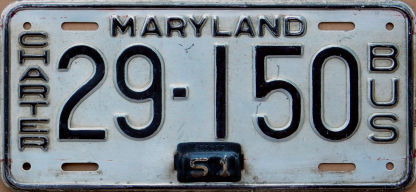  (Olivarri photo / plate) |
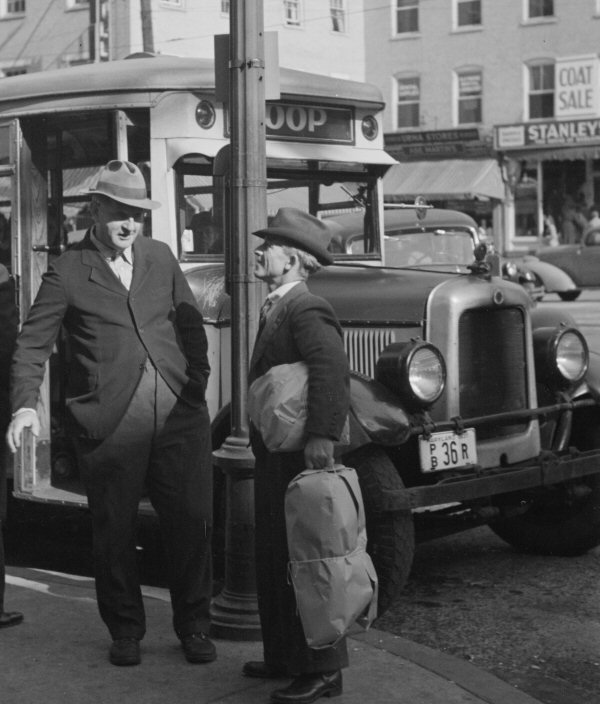
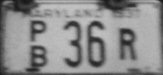
Charter bus platesPlates with a stacked "P/B" prefix were in use by 1937, if not earlier, and used on buses, as shown in the photo at right. I do not know the meaning of the letters P and B on these plates. One report indicates that these P/B plates were used specifically on charter buses. By the time of the 1948 base, however, if not earlier, charter bus plates were clearly identified with the vertical legend Charter Bus. Several commercial vehicle plate types from this era, including P/B bus plates, sometimes have a small letter "R" suffix. It's apparent that this is some sort of special designation, but exactly what it signifies is unclear. The ALPCA archive reports that the "R" suffix indicates "tax refund", but it makes no sense to me why distinct license plates would be issued to businesses receiving tax refunds.
|
||
 1934 zone bus (Willard plate)  1953 zone bus (Willard plate) |
Zone bus platesZone bus plates were reported by others to have been introduced on the 1942 expiration base, but obviously that's not correct. Through 1953, these plates were identified with a small "Z" serial prefix or suffix. Zone buses were city-type transit buses that operated on fixed routes in a limited geographic area. Back then, several private bus companies provided public transportation in and around Baltimore.
|
 1954 PSC intercity bus 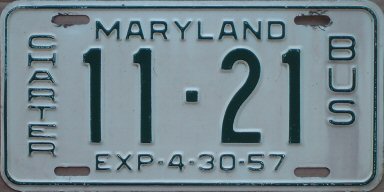 1957 charter bus 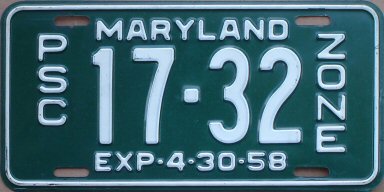 1958 PSC zone city bus 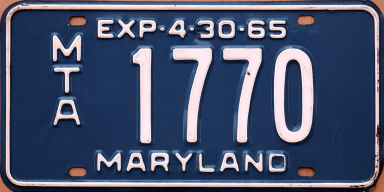 1965 MTA city bus |
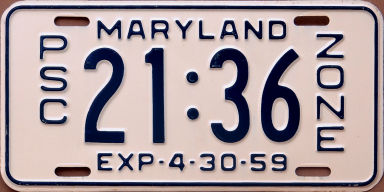
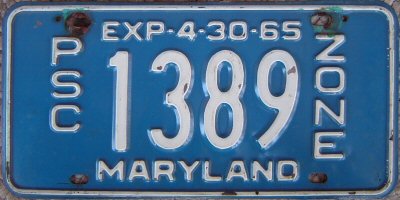
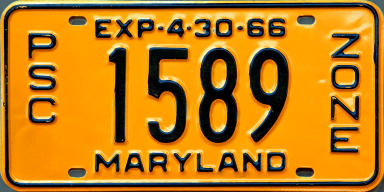
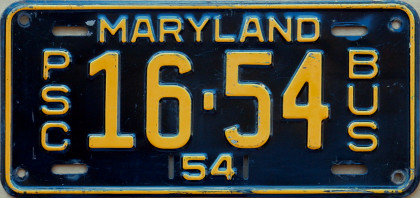
There were several types of buses for hire, each with the vehicle type identified vertically on the left and right edges of the plate. Each of these vehicles types carried serial numbers in format 00-00 (1954-1964) or 0000 (1965-1970), without lead zeroes. Numbering for each type began at 10-01 or 1001. Commercial bus vehicle types were PSC Bus (intercity buses traveling fixed routes, such as Greyhounds), Charter Bus (intercity buses for hire, such as those operated by various small tour businesses), and PSC Zone and MTA (both issued to city-type transit buses operated by private companies that were limited to a certain geographic area). At the time, it was common for one or more private for-profit companies to provide public bus service to a city. PSC stood for Public Service Commission, the state agency that regulated certain types of for-hire transportation. MTA stood for the Metropolitan Transit Authority, another state agency. PSC Zone plates were issued through 1965 expirations. MTA plates were introduced beginning with 1965 expirations. It would seem that the regulation of city transit buses was transfered from the PSC to the MTA sometime during the life of the 1965 expiration plate, in 1964 or early 1965, and so one plate type was replaced by the other. I'm guessing this switch was effective January 1, 1965. The yellow 1966 expiration PSC Zone plate shown below was never issued, and I don't believe any of them were. I was unaware that 1966 PSC Zone plates even existed until April 2020, when this one was offered for sale. My theory is that the 1966 expiration plates were manufactured in 1964 before it was known that they would not be needed. Desipite the switch from PSC Zone to MTA plates, Baltimore area transit buses continued to be operated by the Baltimore Transit Company, a private company.
|
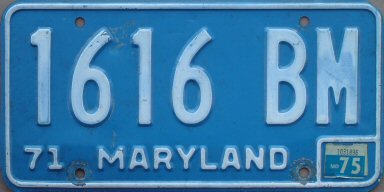 1975 bus, likely intercity 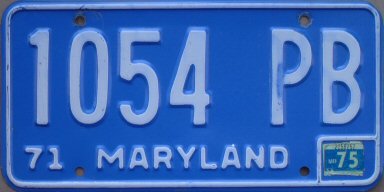 1975 bus, likely charter |
On the 1971 base, fixed-route intercity bus plates and charter bus plates no longer carried text identification of the vehicle type. I'm fairly certain that formerly identified PSC (fixed-route, intercity) buses were assigned plates with serial format 0000 BM, and formerly identified charter buses were given plates with serial format 0000 PB. I do know that both the BM and PB suffix letters were used for bus plates, but it's possible that it was the other way around from what I stated. Anyone out there know for sure which was which? The Baltimore Transit Company, the one remaining private company operating city buses in the Baltimore area, was taken over by the state on April 30, 1970, which happened to coincide with the expiration date of the dated 1970 plate. Plates for Baltimore city buses were issued on the 1971 expiration base during April 1970. They again bore the letters MTA stacked on the left, followed by a four-digit numeric serial, as they had for serveral years. "MTA" referred to the Metropolitan Transit Authority, the state agency that had previously regulated, and now owned and operated Baltimore-area transit buses. Therefore, it's a matter of debate whether dated 1971 MTA plates should be considered commercial bus plates or state government vehicle plates. I say they're government plates. Later during the life of this base, the Metropolitan Transit Authority changed its name to the Mass Transit Administration, so the MTA acronym still "worked" regardless. |
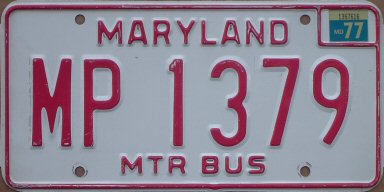 1977 intercity bus 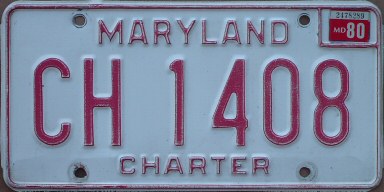 1980 charter bus |
The 1976 and 1981 non-passenger bases generally carried a legend at the bottom identifying the vehicle type, avoiding some of the mystery of the 1971 base bus plates. Intercity fixed-route buses (formerly identified PSC buses) were issued plates in format MP 0000, with the legend Mtr Bus at the bottom center. This somewhat cryptic abbreviation "Mtr" seems to be a shortend form of "motor". But "motor bus" seems redundant, since of course there is no such thing as a "non-motor" bus plate type. It turns out that "Mtr" is more correctly translated as an abbreviation for the term motor carrier, which means a commercial vehicle that carries freight or passengers for hire. So the distinction is actually being made between a motor carrier bus and a motor carrier freight truck, which is another plate type. Anyway, a motor carrier bus was a fixed-route intercity bus like a Greyhound or Trailways bus. Charter buses were assigned plates with the format CH 0000 and the legend Charter. Baltimore-area transit buses were given standard state government plates beginning with the 1976 base. |
 1988 charter bus (Doernberg photo / plate)  2008 bus (plate in actual use)  2019 bus (plate in actual use)  2009 apportioned bus (plate in actual use) |
Commercial buses lost their identifying legends on the sheild base. Initially, format 000*00P was used for fixed-route buses and I00*000 was used for charter buses. (This was one of the very few rare instances where standard-issue, sequentially numbered Maryland plates ever carried the letter "I" in the serial.) However, in 1988, charter buses were merged with fixed-route buses into class P, and the I series plates were recalled and discontinued. Also in 1988, apportioned plates made their debut, and apportioned bus plates were issued with serial format 000*P00 and the screened legend Apportioned at the bottom edge. Apportioned bus plates are issued only to fixed-route buses that cross state lines. Charter buses that cross state lines are explicitly exempt from apportionment requirements. The vast majority of buses registered in Maryland are charter buses, and therefore apportioned bus plates are infrequently seen – just over a thousand have been issued in a little over 20 years. Apportioned year stickers for 2005 were white on green, rather than black on white used for most other plates. Recently issued non-apportioned bus plates now display the state web site addresss www.maryland.gov along the bottom edge of the plate. This feature was added at approximately serial number 085*00P. |
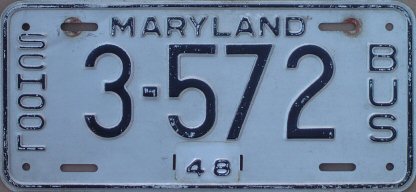 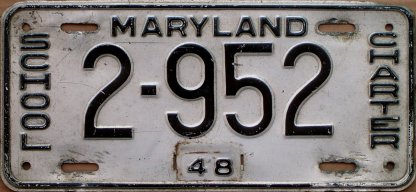 1948 school charter bus 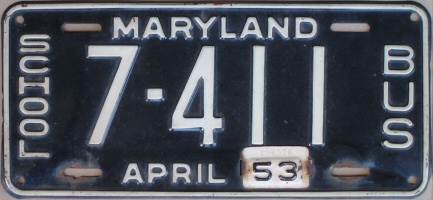 |
Distinct plates for school buses first appeared on the dated 1948 base, which was actually issued in March 1947 and indicated the initial expiration year. This base was renewed with tabs through March 1951, at which time the dated April 1952 base was introduced. This was renewed with a tab through April 1953. I don't know what kind of plates school buses would have used prior to 1947. There were two types of plates issued to school buses: School Bus plates were used on school buses traveling fixed routes, such as those operated by or for a private school or a public school district. School Charter plates were issued to school buses for hire, operated by private bus companies. In other words, these were charter buses configured as school buses. The first word "School" ran vertically down the left edge of the plate; the second word of the plate type ran vertically down the right edge of the plate. Serial format was 0-000 on both bases.
|
 1954 school charter bus 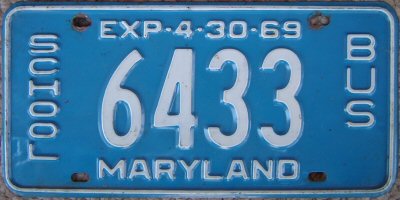
|
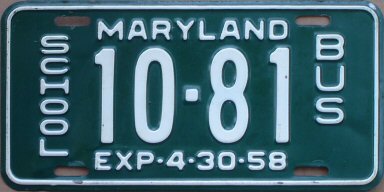
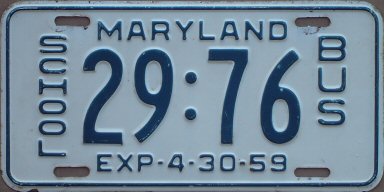
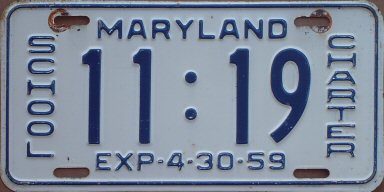
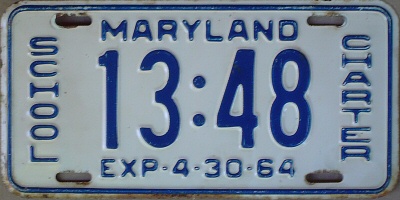
School bus plate types were School Bus (school buses traveling fixed routes, such as those operated by or for a private school or a public school district) and School Charter (school buses for hire, operated by private bus companies). On both plate types, "School" ran vertically down the left edge of the plate; the second word of the plate type ran vertically down the right edge of the plate. Each of these plates carried serial numbers in format 00-00 (1954-1964) or 0000 (1965-1970), without lead zeroes. At the time, school buses operated by public school districts displayed school bus plates, not local government plates. Also, it was not uncommon to see school buses operated by private bus companies to be simultaneously sporting both school bus and school charter plates. Presumably, the same bus could then be used for both purposes.
|
 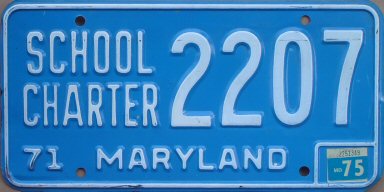 1975 school charter bus 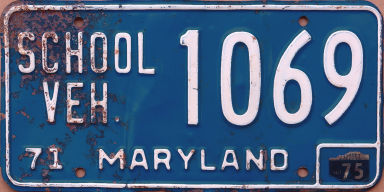 1975 school vehicle |
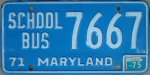
School bus vehicle types were again identified with text on the plate. Plates on the 1971 base carried the legends School Bus or School Charter horizontally with one word stacked above the other, on the left portion of the plate, followed by a serial number in format 0000 without lead zeroes. School buses owned by public school districts continued to be issued school bus plates, not local government plates. Sometime toward the end of the five year period this base was in use, a new "school vehicle" plate type was split out from the school bus plate type. This new plate type was issued to passenger vans that were painted yellow and marked as school buses; the text on the plate was School Veh. It's odd that they didn't spell out the word "vehicle", as there was certainly room to do so. Only actual buses continued with "Sch Bus" plates. (This school vehicle plate is a great example of how I continue to learn new things about old license plates, even plates from my home state of Maryland that were in use during my lifetime. I had always thought that the school vehicle plate type was introduced on the red-on-white 1976 base. That is, until I came across this 1971 base school vehicle plate for sale at a plate meet in March 2018. I don't believe I ever saw one of these in use back in the day, and I know I had never seen any information that indicated that they existed. Surprise!) |
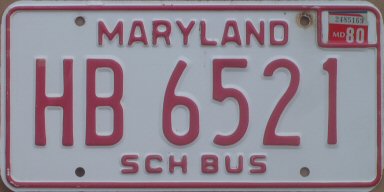 1980 school bus  1980 school charter bus  1981 school vehicle (Childs plate) |
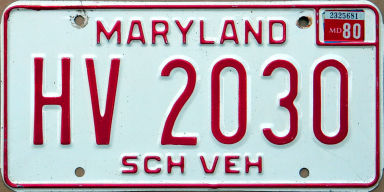
Beginning with the 1976 base, school district-owned school buses were issued standard local government vehicle plates, rather than school bus plates. From this point forward, school bus plates were issued only to school buses operated by private schools or commercial bus companies. The serial format was HB 0000, and the legend was Sch Bus. School charter bus plates had serial format HS 0000 and the legend Sch Char. School vehicle plates, issued to passenger vans that were painted yellow and marked as school buses, had numbering format was HV 0000, and the text Sch Veh.
|
 undated school bus plate with year sticker removed 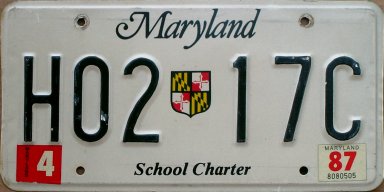 1987 school charter bus with incorrectly placed stickers  2009 school charter bus (plate in actual use) |
Privately-owned school buses and school vans were merged back into a single category on this base, with the serial format 000*00H and the screened legend School Vehicle at the bottom center of the plate. The vast majority of these plates are issued to actual school buses. School charter buses retain their separate plates, with format H00*00C and the screened legend School Charter. The 1987 school charter plate provides a good example of the improper sticker placement that was quite common during 1986, the first year this base was issued. The MVA instructions for sticker placement that accompanied the new plates and stickers were confusing, and many motorists mistakenly concluded that the stickers went in the bottom corners on this base. The 2009 school charter plate shown at left is quite an interesting example. It has a very old serial number, and the small plate type legend that appeared on early issues on this base. However, I got close enough to this plate, when I photograhed it in actual use, to see that it appeared to have a natural 2009 expiration and the plate itself was in brand new condition. The month sticker is also the variety that was being issued in the 2000s, with the state name in white. Unfortunately, I didn't get a chance to see the hologram showing the year the reflective sheeting was manufactured. I'm guessing that this plate, as well as possibly others like it, was hidden away in an MVA office somewhere for 20 or more years before it was finally discovered and then issued. |
Okay, before any of you whipper-snappers out there object to my lumping ambulances together with commercial-use passenger cars, because they're always based on trucks, not cars, allow me to enlighten you that this was not always the case, and the Maryland vehicle classification system still reflects the previous reality. When I was a kid in the 1960s, most ambulances were made from special Cadillac station wagon bodies, similar to hearses, except with windows on the sides. Emergency medical services have certainly come a long way since then.
Information about these Maryland license plate types from this period is scant and contradictory. Much of what I've written in this section is unconfirmed and/or speculative. In fact, many of the following plate types might or might not be for passenger cars for hire.
 1934 taxi or limo for hire (plate owner not identified) 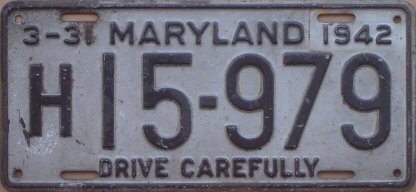 1942 taxi or limo for hire |
"H" series plates (taxi / car for hire)This is the most well-documented type of passenger car for hire during this period. Introduced in 1915 and issued continually through April 1953, this plate type consistently had an "H" prefix or suffix, and no identifying legend. On 1915 to 1917 plates, the H is full-sized; afterwards, it's smaller than the numbers on the plate. This type was issued to taxis and other similar vehicle types such as limousines for hire.
|
|
 1941 hearse / ambulance 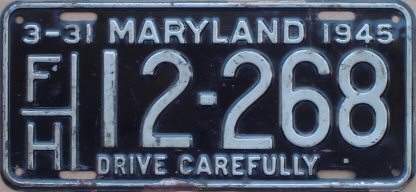 1945 hearse / ambulance 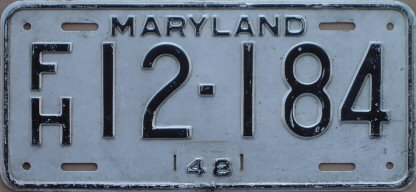 1948 hearse / ambulance |
"F/H" series plates (hearse / funeral truck / commercial ambulance) – through 1951Plates with a stacked "F/H" prefix and no identifying legend were issued no later than the 1941 expiration plate, but most likely well earlier, as well as the 1942, 1945, and 1948 bases. Their purpose has been variously reported as "For Hire" (which seems redundant with the H-series "For Hire" plates described above), "Funeral for Hire", and "Funeral Hearse" by various sources. But in an article published in The (Baltimore) Sunday Sun Magazine dated March 26, 1950, and reprinted in ALPCA's Plates magazine dated December 2018, this plate type is described as being for "commercial [truck type] funeral vehicles for hire – undertakers' hearses, flower coaches, service wagons, and ambulances." This wording almost certainly came directly from the Maryland DMV, as it was known at the time. It would seem to include every type of funeral or cemetery vehicle (other than funeral limousines, which had their own plate type, described immediately below) and also commercial ambulances. Often back then, the very same vehicle served double duty as both an ambulance and a hearse. The person from whom I obtained the "F/H" plates shown at left and the 1949 "F" plate shown below told me that they originally belonged to one R. Madison Mitchell, who was an undertaker (and noted duck decoy carver) in Havre de Grace, Maryland.
|
|
 1949 funeral limousine (Tyler plate) 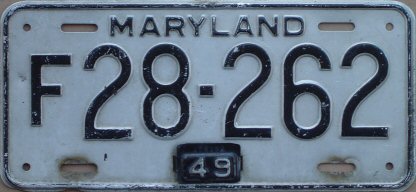 1949 funeral limousine |
"F" series plates (funeral limousine) – through 1951I had never seen or heard of this plate type, with an "F" serial prefix or suffix, until I saw a pair of 1940 expiration plates on eBay (which I unfortunately did not win). I've since discovered "F" plates were used for funeral passenger cars for hire – in other words, funeral limousines. I don't know when these were first issued, but it was no later than 1934; these were last issued on the 1948 base with a 1951 validation tab. The 1949 plate shown at left was also identified as having come from Havre de Grace undertaker R. Madison Mitchell.
|
|
"C" series plates – 1952-1953Plates with a small "C" prefix are reported to have been issued on the 1948 and 1952 bases, although I've only seen them on the 1952 base myself. These have been variously reported to be for commercial vehicles (trucks) or for ambulances and hearses. If they are truck plates, they would have to be for some specific, unusual type of truck, or else these plates would be vastly more common than the are. Since 1954, commercial ambulances and funeral vehicles of all types have always used the letter "C" in the plate number, and most all other types of non-passenger plates using letter codes also changed at starting with the 1954 plates. Considering that I've only come across "F" and "F/H" plates prior to the 1952 base, and "C" plates on the 1952 base, I believe that that "C" plates replaced both the "F" and "F/H" plates two years earlier than the letter codes for other plate types.
|
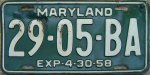
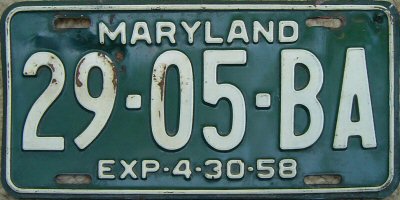 1958 taxi or limo for hire 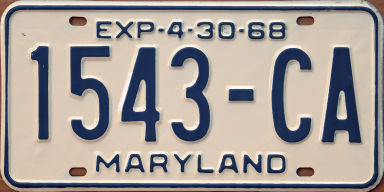 1968 commercial ambulance or funeral / cemetery vehicle  1975 taxi or limo for hire |
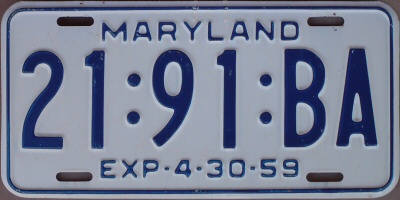
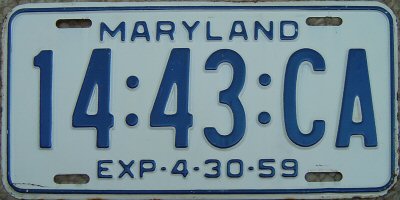
Taxis, limousines for hire, commercial ambulances, hearses, and other funeral or cemetery vehicles, like several other classes of so-called non-passenger vehicles, were assigned the serial formats 00-00-xx (1954-1964), 0000-xx (1965-1969), and 0000 xx (1970-1975). Separators could be dashes, diamonds, or colons through 1969. Taxis and limousines for hire were Class B vehicles and always used the letters "BA" as a serial suffix. Commercial ambulances, hearses and limousines used exclusively for funerals, and other funeral or cemetery vehicles were all Class C vehicles and always used the letters "CA" as a serial suffix. By "commercial" ambulance, I mean an ambulance owned by a privately-owned ambulance business, as opposed to an ambulance owned by a city or county fire department, or by a volunteer fire company or rescue squad. Fire department and rescue squad ambulances were issued undated white-on-red or red-on-white plates with the name of the owning organization (such as a volunteer fire company) embossed on the plates. These are described and shown on my History of Maryland Emergency Vehicle Plates page. As with most non-passenger vehicle plates, the expiration date (stamped on the plate 1957-1970) was 4-30 rather than 3-31 used for standard passenger cars. Note that 1971-1975 plates in serial format 0000 BM are not taxi plates, but rather are bus plates. Site visitor Mike Vickers reports that low-numbered taxi plate numbers were issued to taxis with permits to operate in the City of Baltimore, and that the plate number corresponded to the permit or medallion number. The holder of permit number 1 was issued the first plate number 1001-BA, and so on. The system was a bit convoluted because while permit numbers could end in "00", plate numbers did not during these years. Mike reports that there were (or still are) 1,151 taxi permits in the City of Baltimore, so the plate numbers issued to Baltimore taxis would go up to 2151-BA plus several additional for the permit numbers ending in 00. Higher taxi plate numbers were issued to taxis operating elsewhere in the state, apparently without regard to their permit numbers. Note that I have not been able to verify this information.
|
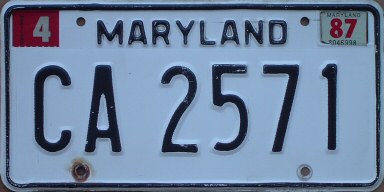
On the 1976 and 1981 bases, regular not-for-hire passenger car plates abandoned serial format xx 0000 in favor of format xxx 000, and so several other plate types appropriated the xx 0000 format, including passenger cars for hire.
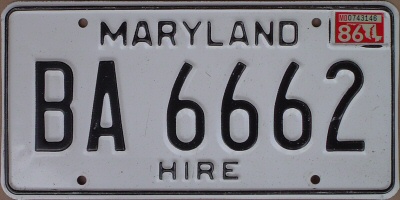 1986 taxi or limo for hire 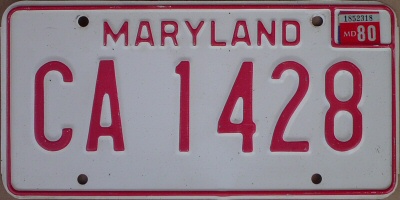 1980 commercial ambulance or funeral / cemetery vehicle |
Taxis and limousines for hire received plates in the format BA 0000, with the legend Hire embossed at the bottom center of the plate. Ambulances owned by private businesses, hearses and limousines used exclusively for funerals, and other funeral and cemetery vehicles received plates in the format CA 0000, with no legend indicating the vehicle type. I don't know whether low-numbered taxi plates were assigned to taxis operating in Baltimore based on their permit numbers on these two bases.
|
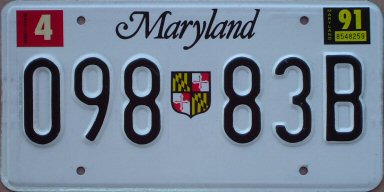 1991 taxi 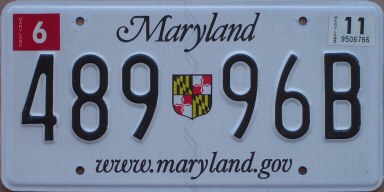 2011 taxi |
TaxisThe format for taxi plates on the standard script "Maryland" base is 000*00B. Taxi owners could also elect the green-on-white "Treasure the Chesapeake" special interest base, which is no longer issued; taxi plates were issued on this base with serial format B00*000. Neither base carries a legend indicating the vehicle type. The state web site was added to the bottom of standard taxi plates in 2005, beginning with serial number 375-00B. Taxis were also permitted to obtain the optional Our Farms, Our Future and current black-on-blue Treasure the Chesapeake special interest plates; however, they shared serial formats and ranges with passenger cars, trucks, and multi-purpose vehicles, so there were no distinct taxi versions of these plates. Since October 1, 2007, taxis are no longer able to obtain either the "Our Farms" or "Chesapeake" plates. However, it's not entirely clear to me whether taxis that were issued these plates prior to that date have been allowed to keep them or not. |
 2009 limousine for hire (plate in actual use) |
Limousines for hireNon-funeral limousines for hire were split out from taxis and given their own vehicle class Q in 1997. However, much to Dave Nicholson's disappointment, Maryland doesn't like to use the letter Q on their plates, so limousines get plates on the standard script "Maryland" base with the format 00000LM. There's no legend identifying the plate type on these, either. The state web site address was added beginning at about serial 03500LM. |
 current ambulance / funeral unstickered front plate |
Commercial ambulances and funeral vehiclesAmbulances owned by private businesses, hearses and limousines used exclusively for funerals, and other funeral and cemetery vehicles all receive standard script "Maryland" base plates in format 000*00C. These plates have never carried a legend identifying the vehicle type. The state web site address now appears on this plate type beginning at about serial 065-00C. |
The ALPCA archives report that rental cars were assigned a reserved passenger plate serial format Jx 0000 on the 1971 base. I don't know whether there is any truth to this, but I can tell you that my parents owned two private passenger cars with dated 1971 plates in the "J" series – one with prefix JK issued about January 1971, and the other with prefix JW issued about April 1971. These J-series plates were issued in sequence after H-series plates and before K-series plates. So, at the least, a 1971 J-series plate is definitely not always a rental car. Possibly it never is.
I've seen a paper DMV envelope in which plates were packed that may shed some light on this mystery; or, perhaps, raise more questions than it answers. I don't recall the specifics, and I didn't write them down, but the envelope had stamped on it a plate number in the early 0000 Jx series, along with a plate type description that sounded like a rental vehicle of some sort. The use of a serial suffix makes me think that these plates may have been for rental trucks, not rental cars. As far as I was previously aware, the 0000 Jx serial format was only used on the 1971 base, but it was issued late in the life of that base to regular trucks, including personal trucks. The envelope I saw bore no indication of an issue year or expiration date of the plate, but it had to be from late 1950s or 1960s, since it was intended for a 12 inch by 6 inch plate, and I'm nearly certain it said Maryland Department of Motor Vehicles. The Maryland DMV became known as the Motor Vehicle Administration in 1971.
 1992 rental car |
For a few years in the 1990s, rental cars were issued their own distinct plates on the screened "Maryland" base. The serial format was D/R*00000. It's been reported that "DR" stood for "daily rental". The only other types of plates using a x/x*00000 format on this base are plates issued to government-owned vehicles. Unlike government vehicles, however, rental cars had month and year expiration stickers on the rear plate. The expiration month was always March. Before and after this time, rental cars displayed normal passenger car plates. By the end of March 1995, this plate type was off the road, although there may be some examples that were five year fleet registrations and had later-year expiration stickers. This plate was used for cars and probably multi-purpose vehicles only; rental trucks always bore standard truck plates. |
As I understand it, this plate type was sort of an early eqivalent to a van pool plate, for vehicles used by people who drove their fellow employees to work for compensation. It was first issued in 1937 and continued at least through most of the 1940s, although I'm uncertain as to exactly how long. Limited transit plates are identified with an "L" prefix and "T" suffix.
I've seen photos of two of these, one with a March 31, 1942 expiration date and the other with a March 31, 1948 expiration date. They're odd-looking plates, and they look like long motorcycle plates. The 1942 plate is black-on-silver in color, measuring 11 inches long by 4 1/8 inches high, according to its owner. The plate was made with only four bolt holes in the extreme corners of the plate. Stacked on the far left are MD/3-31/42; the state abreviation and expiration date. The plate number, L102T in this case, takes up the rest of the plate. The 1948 plate appeared to be identical, except for the plate number and the expiration year. I would speculate based on seeing these plates, that they were supplemental plates, rather than the primary registration plates for the vehicles to which they were issued.
Plate numbers observed
|
 1948 private transportation (Willard plate) |
I know next to nothing about this plate type. I'm told that it's a "private passenger transportation" plate, although I have no solid evidence of that. It may be that this plate type replaced the "limited transit" plates described immediately above, as their intended purposes sound similar. I know of two such plates still in existence, with different but similar plate numbers. Unfortunately, I managed to the delete the photo I took of the second plate before I had a chance to record its plate number. These plates look like ordinary passenger car plates, except for the letters P.T. in place of the expiration year "48" at the bottom center of the plate. I presume that this plate type was renewed for 1949 through 1951 expirations with metal tabs that were the same color as regular year tabs, but also with the letters P.T. Otherwise, if regular year tabs were used, it would defeat the purpose of stamping the plate with those letters. However, I've never seen or heard of such tabs actually existing.
|
|
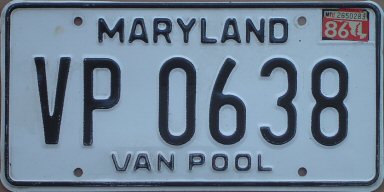
A van pool is sort of a commuter cooperative where the commuters share the cost of a van. Van pool plates were introduced on the red-on-white base, although I'm not certain in what year. On both the 1976-1980 red-on-white base and the 1981-1987 black-on-white base, the serial format was VP 0000 and the plates bore the embossed legend Van Pool at the bottom center. These plates were invariably found on giant 15-passenger full-sized vans. These vans would have been issued regular multi-purpose vehicle plates had they not been used for van pool duty. |
 1988 van pool |
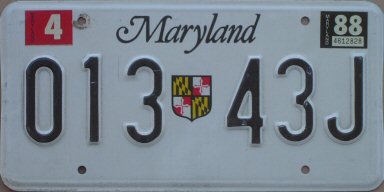
Van pool plates are issued on the script "Maryland" base with serial numbers in format 000*00J, with the letter J identifying the vehicle class. These plates do not contain a legend to identify the vehicle type. This the very last plate type without an identifying legend to be spotted with the state web site address. This occurred in the fall of 2009 at approximately plate number 035*00J, nearly five years after the web site was first seen on multi-purpose vehicle plates. |
Related pages on this site |
Elsewhere on the web |
Thanks to those who have directly contributed to the information on this page: Jeff Ellis, David Doernberg, Christopher Fancher, Christopher Jackson, Patrick Arndt, Jon Olivarri, Nick Yuran, Jim Rogers, John Willard, and Mike Vickers.
Doernberg, Olivarri, and Rogers photographs are presumed to be copyrighted by David Doernberg, Jon Olivarri, and Jim Rogers, respectively, and are used with permission. Tyler, Willard, and Childs plates are from the collections of Wayne Tyler, John Willard, and Jim Childs, respectively.
This page is W3C valid |