 |
|
 |
|
|
|
|
This page addresses the history of Maryland license plates used on non-emergency, government-owned vehicles, and/or issued to government officials. Emergency vehicle plates are covered on a separate page. Latest noteworthy updates to this page
|
|
Maryland government license plates can be a real challenge to positively identify or accurately date. Many of these plates looked nothing like regular Maryland plates, and/or were undated and used for many years or even decades, even while the regular, non-government plates were being replaced annually. On the other hand, during the past few decades, some agency-specific government plates have been reissued with new designs, sometimes repeatedly, while the regular plates and generic government plates soldier on, unchanged. I observed Maryland license plates first-hand on a daily basis from the early 1960s to early 1990s, so I can shed some light on much of this confusion. However, in some cases, what I've written is based on educated guesswork, or very limited observation, or maybe even faulty memory, and so it's just about certain that I've gotten something wrong somewhere.
My "Pictorial History" pages are intended to be a supplement to the information found in the ALPCA Archives. I am providing additional details and additional photos not found in the archives, and clarifying information when appropriate. When the ALPCA archives cover a subject in great detail, I do not repeat that detail here. I sincerely hope that you find this information useful.
If you find an error or have additional information, or can provide a plate or a photo of a plate that I'm missing, please send me an e-mail. There's a link to my e-mail address at the bottom of every page. Please note that all plates shown that are credited to another person are plates that I am still seeking for my own collection.
You might think of these plates as standard-issue, generic, or default Maryland government-owned vehicle plates. These are issued to vehicles belonging to government bodies, departments, etc., that for various reasons do not have their own special plates. There are basically two flavors of standard government plates, one for state-owned vehicles, and the other for vehicles owned by various cities, towns, counties, school districts, regional multi-county agencies, or other local government bodies.
I am unaware of any there being any generic Maryland government-owned vehicle plates issued prior to the 1954 expiration plates. This does not mean that they don't exist; I just have no knowledge or information about them. There were a number of specific government agency vehicle plates issued during this time; these are covered further down this page, and also on the Maryland emergency vehicle plate history page. Otherwise, I don't know what types of plates were issued to government-owned vehicles that were not assigned to one of these agencies.
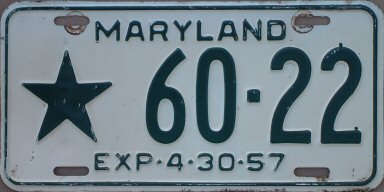
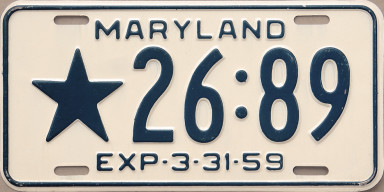
Generic government-owned vehicle plates were replaced annually just like non-government plates during this era. They used the same color schemes and same expiration dates as other annual plate types. Serial formats were 00-00 (through 1964 expirations) and 0000 (1965 expirations forward). Separators on 1964 and earlier plates could be dashes, diamonds, or colons. Lead zeroes were not used; plate numbers started at 1001.
The expiration date was the key to determining whether a particular plate was assigned to a passenger car or non-passenger vehicle, at least on the dated 1957 to 1970 plates, which actually indicated specific expiration dates. As was the practice for non-government plates, a March 31 expiration date indicated that the plate was registered to a car, SUV, passenger van, or similar vehicle, while an April 30 expiration date was used for trucks, trailers, and other non-passenger vehicles. Probably government-owned buses would also have had April 30 expiration dates.
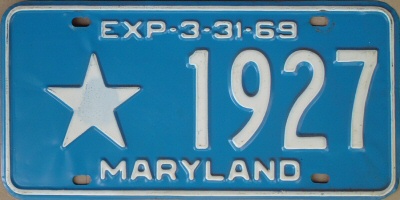
For 1968 to 1970 expirations only, plates issued to government-owned trucks carried the legend Truck on the lower left portion of the plate. Before and after these years, trucks were not explicitly identified.
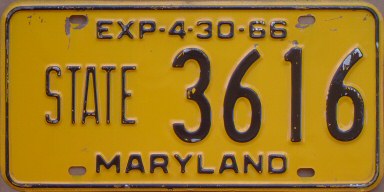 1966 state government truck or other non-passenger  1968 state government car 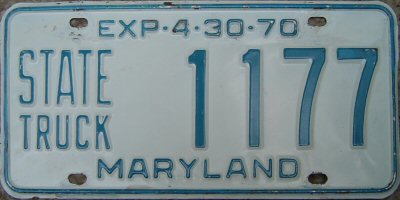
|
State-owned vehiclesThese generic state government plates contained the word State displayed horizontally on the left center portion of the plate, followed by a four-digit serial number located in the center and right center portion. I'm not certain when these "State" plates were first issued, but the earliest I've personally come across, and the earliest that I've even heard of, have 1961 expirations. If "State" plates did indeed debut in 1960 or thereabouts, then I would suspect that prior to then, both state and local government vehicles were issued plates with a large embossed star, covered immediatly below. |
|
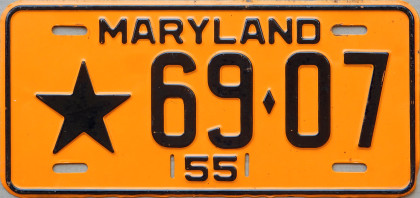 1955 local (or state?) government vehicle plate 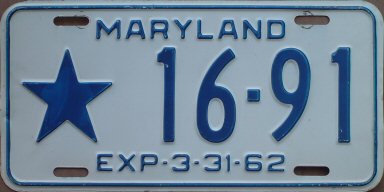 1962 local government car 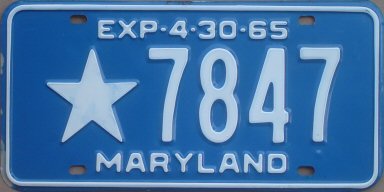 1965 local government truck or other non-passenger 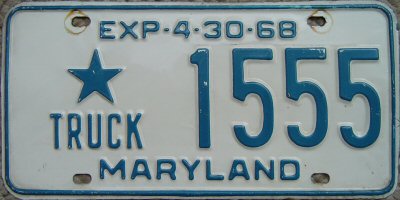 1968 local government truck |
Local government-owned vehiclesLicense plates issued to vehicles owned by cities, counties, etc., were distinctive in that they bore a large embossed star on the left center portion of the plate. The star did not imply that the vehicle was registered to a sheriff's department or police department vehicle. In fact, it was just the opposite – these plates were usually issued to local government vehicles excluding those used for law enforcement or fire and rescue organizations. Most local law enforcement, fire department, and rescue squad vehicles bore undated plates that looked nothing like standard Maryland license plates; these are addressed on my Maryland emergency vehicle plate history page. However, I know that at least a few municipalities did choose to use generic "star" plates for emergency vehicle applications during these years. Serial formats and expiration dates on local government plates were just like those on state-owned vehicle plates, and local government plates issued to trucks also carried the legend Truck, under a smaller star, on 1968 to 1970 expiration plates. School buses owned by school districts or other local government bodies were issued school bus plates, not local government plates, during these years. I've seen "star" plates with expirations as early as 1954. As I mentioned above, I suspect that both state and local government vehicles may have been issued "star" plates between then and 1960, when the first "State" plates were apparently issued.
|
On the 1971 base, generic government-owned vehicle plates were renewed with year stickers, just the same as were privately-owned vehicle plates. Since these plates did not contain specific expiration dates, the location of the word State or the embossed star was varied to distinguish between passenger and non-passenger governemnt vehicles. The registrations for these plates contiued to expire annually each March 31 for passenger cars, or April 30 for non-passenger vehicles. The Truck legend used on 1968-1970 expiration plates issued for government-owned trucks was eliminated.
 1971 state government truck or other non-passenger 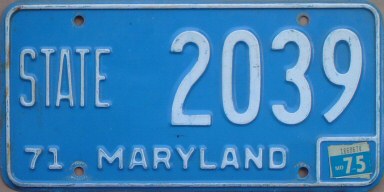 1975 state government car |
State-owned vehiclesThe word State continued to appear horizontally on the main portion of the plate. State-owned passenger car plates displayed the word "State" on the left, before the serial number; non-passenger vehicle plates carried "State" to the right, after the serial number. The serial format in both cases was 0000 and began at 1001. |
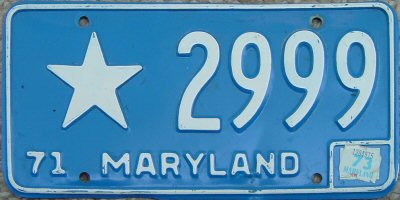 1973 local government car 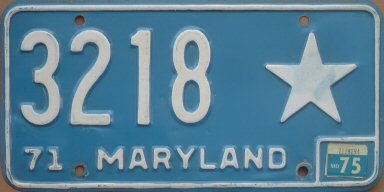 1975 local government truck or other non-passenger |
Local government-owned vehiclesGeneric local government plates continued to use an embossed star figure. On the 1971 base, the star on the left side of the plate indicated a passenger car; the star placed on the right identified a non-passenger vehicle. Again, these "star" plates were generally not used for local police, fire department, or rescue squad vehicles, but there were some known exceptions to this rule. Specifically, the Laurel Police Department and the Laurel Rescue Squad used generic local government "star" plates. Public school buses, which were owned by county and Baltimore city governments, were issued school bus plates during these years. The serial format for both passenger and non-passenger local government plates was 0000 and began at 1001. In the case of the non-passenger plates, serial 9999 was issued towards the end of the life of this base, and a second format x000 was begun, starting with serial A001, or possibly A101. I personally saw alpha-prefixed local government 1971 base plates in use on school district maintenance trucks at my high school. The ALPCA archive incorrectly states that 1971 base plates with a C000 serial format and a star on the right are local government ambulance or hearse or coroner vehicle plates. The archivist inferred that there was some significance to the "C" in the serial number. Based on my own first-hand observation, there was no such significance; the plate numbers were simply assigned consecutively to all types of non-passenger vehicles. |
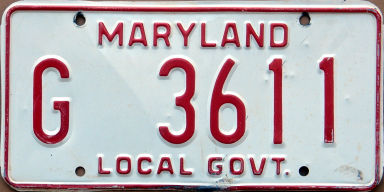
During the statewide replates in 1975, 1980, and 1986-1987, generic government plates were also replaced with new plates that were similar in appearance to those issued for privately-owned vehicles. The red-on-white base, commonly referred to as the 1976 base, was actually used from March 1975 to April 1980; the painted black-on-white base, known as the 1981 base, was used between March 1980 and April 1987 in the case of government vehicle plates.
Maryland realized the folly of annually renewing government plates with year stickers, and so, unlike private vehicle plates, these plates were not issued renewal stickers, and in fact did not even have sticker boxes, at least until they began mysteriously appearing on late-issue plates on the 1981 base. With these plates, Maryland also abandoned their practice of issuing different plates for passenger and non-passenger government vehicles.
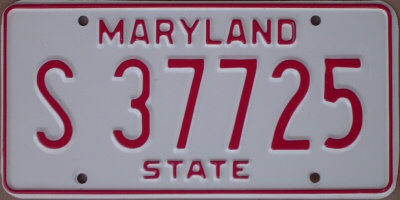 1975-80 state government 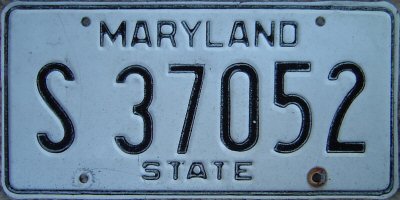 1980-87 state government |
State-owned vehiclesDuring this period, generic state government vehicle plates had serial format S 00000, and bore the legend State along the bottom edge. Serial numbers were not issued randomly, but rather specific blocks of numbers were assigned to various state agencies. I have a couple of pages from a document that lists the number ranges and the state agencies to which they're assigned. From this document, I know that the two plates shown at left were used on state vehicles assigned to the University of Maryland's main campus in College Park. Most of these serial number blocks are continguous and therefore don't stand out in any way. However, two of the number blocks were quite distictive – and it happens that these otherwise generic state government plates were assigned to state agencies that had previously used their own agency-specific plates. On these two generic bases, plates in the S 50000 series were issued to Baltimore transit buses, which by then were owned by the state Mass Transit Administration (MTA); plates in the S 80000 series were assigned to State Highway Administration (SHA) vehicles, probably specifically to SHA trucks, trailers, and other equipment. MTA and SHA plates are addressed in separate articles, below. |
|
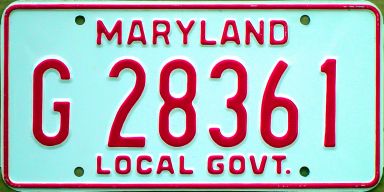 1975-80 local government, version 2 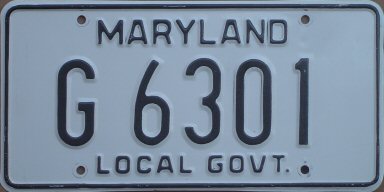 1980-87 local government, version 1 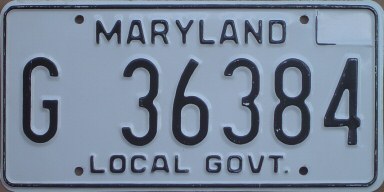 1980-87 local government, version 5 |
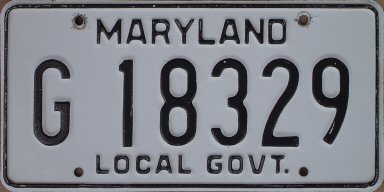
Local government-owned vehiclesGeneric local government plates on the 1976 and 1981 bases bore the legend Local Govt. along the bottom edge, and, for no obvious reason, were issued on both bases in two serial formats, G 0000 and G 00000. During the time these plates were in use, I had only seen the G 0000 format used on vehicles owned by the city of Baltimore, and for a long time believed that this format was used exclusively for them. I have since seen several G 0000 format plates on the 1981 base that had accompanying registration cards showing that they were issued to vehicles owned by the city of Hagerstown. However, the G 0000 series plates seems to be a separate block of numbers intended for a specific usage. I know that it wasn't a case of all city-owned vehicles getting one format and county-owned vehicles getting the other format, because many other cities and towns were issued plates in the G 00000 format. I also know that the G 00000 format was nowhere near running out of numbers. Starting at about serial G 8200 or G 8300 on the four-digit plates, and at G 32000 on the five-digit plates, a vestigial embossed sticker box suddenly sprouted; at about serial G 36000, the space separator was widened, pushing the serial letter and numbers closer to the edge of the plate. Beginning with the 1976 base, most non-emergency local government-owned vehicles were now issued generic local government vehicle plates, including school buses. In most cases, law enforcement and fire and rescue vehicles continued to carry distinctive plates; though there were a few known exceptions to this rule. For example, police vehicles in Baltimore, Laurel, and Takoma Park bore generic local government plates, as did vehicles belonging to the Laurel Rescue Squad.
|
 1986-present state govt. (plate in actual use)  2005-present state govt. (plate in actual use)  2015-present state govt. (plate in actual use)  1986-present local govt. (plate in actual use)  2005-present local govt. (plate in actual use) |
On the reflective black-on-white base in use since 1986, generic state government and local government plates use serial number formats S/G*00000 and L/G*00000, respectively, with two screened, stacked letters and a shield separator. There is no legend identifying these plates as being for government-owned vehicles. There is no distinction between passenger vs. non-passenger vehicles, and so all vehicle types except for motorcycles use these plates. Unlike other Maryland plate types, expiration month and year stickers are not used. Again, State Highway Administration plates appear to be generic state government plates, but are identifiable by their serial numbers being in the S/G*80000 range (trucks, trailers, and equipment), and also in the upper S/G*29000 range (passenger cars), both higher than truly generic state plates. Baltimore transit buses do not have a distinct serial number on this base. In fact, I'm not sure that any state agency other than the SHA has reserved blocks of numbers any more. It may be that they did at the start of this base, but after more than 20 years, I have to think that any such system has long since broken down. Like other Maryland plate types that previously did not have a legend along the bottom edge, both state government and local government plates issued since 2005 now bear the state's web site address, www.maryland.gov, at the bottom of the plate. The web address was introduced beginning at about plate numbers S/G 22700 or S/G 22800, and L/G 75000, respectively. The web address has not yet been observed on any SHA plates. In about August 2014, local government plate number L/G*99999 was issued, and subsequent plates were issued in the format *00000L/G, with the shield at the far left and and the stacked letters at the right. Then, in about March 2015, state government plates began being issued in a similar format *00000S/G, even though they were nowhere near running out of numbers in the old format. I've been made aware of the existence of a generic state government motorcycle plate, which is made on a normal motorcycle blank with serial format S/G*000. This is the only known motorcycle plate that uses the state shield found on full-sized plates. Presumably, such a plate is used on state-owned motorcycles not used by any law enforcement agency. I'm not aware of their being any equivalent generic local government motorcycle plate. Most law enforcement and fire and rescue vehicles use agency-specific plates, although there are occasional exceptions. |
The State Roads Commission (SRC) was established in 1908 to construct, improve, and maintain a statewide system of improved roads and highways. In 1971, the commission was absorbed into the newly-formed state Department of Transportation (DOT), and its responsibilities were largely turned over to the new State Highway Administration (SHA) unit within the Maryland DOT.
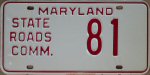
State Roads Commission and State Highway Administration vehicles had distinctive, undated plates for many decades through 1975. As far as I know, these plates were always red on white, and always had the name of the agency embossed on the plate. I don't know when they were first issued. Even today, the State Highway Administration is somewhat of a maverick among state agencies, when it comes to the license plates it uses on its vehicles.
 SRC, circa 1930s to early 1950s? (O'Connor photo / plate)  SRC, circa mid 1950s? (Doernberg plate) |
These State Roads Commission plates are 15 inches long and 6 inches high, a size last used on regular Maryland plates in 1936. Thus, it's easy to conclude that they must be from 1936 or earlier. But, while I've seen a number of examples of these 15 inch SRC plates, I've yet to come across an SRC plate that's 13 inches by 6 inches, the dimensions of regular Maryland plates from 1937 to 1956. Further, the second SRC plate shown at left doesn't have small holes in the corners of the plate. All regular Maryland plates had such holes until 1953. Therefore, I've come to the conclusion that State Roads Commission plates must have continued to be made on leftover 1936 plate blanks well into the 1950s. I'd futher speculate that the plates with the small holes in the corners was made before 1953, and the ones with no holes in the corners were made between 1953 and 1955, give or take. How long these plates might have been used beyond 1955, if at all, I really can't say. |
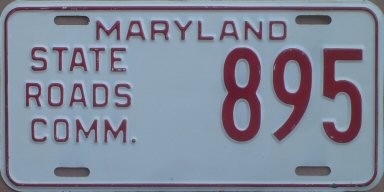 SRC circa 1956-1971  SRC circa 1964-1971 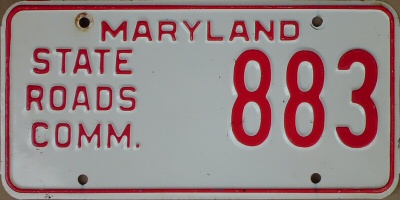 SRC circa 1970-1971 |
Maryland began making license plates in the now-standard 12 inch by 6 inch dimensions in 1956. The State Roads Commission (SRC) was, for all practical purposes related to license plates, abolished in 1971. Therefore, any 12 inch SRC plates would have been made and used between 1956 and 1971. Within this 15 year span, it's possible to further refine when a given plate was manufactured, by comparing plate design variations to corresponding design changes on regular, dated Maryland license plates.
|
 SHA circa 1971-1975 "Highway" (O'Connor photo / plate)  SHA circa 1971-1975 "Hwy." (Doernberg plate) |
In 1971, the newly-created State Highway Administration took over most of the responsibilities, and the assets, of the State Roads Commisssion. All or nearly all of the old SRC's vehicle fleet became SHA vehicles, and new license plates were made with the correct agency name. I can't say for sure whether they did a complete replate, or just created SHA plates as they needed them. My hunch is that all SRC plates were replaced with SHA plates as quickly as possible after the reorganization. In any case, SHA plates would have been made and used only between 1971 and 1975. There were at least two version of SHA plates, with the legends State Highway Adm. or State Hwy. Adm. embossed on the plate, respectively. I don't know which came first, nor why they decided the legend needed tweaking. |
 SHA 1975-1980 (Doernberg plate)  SHA 1980-1987 (version 1) 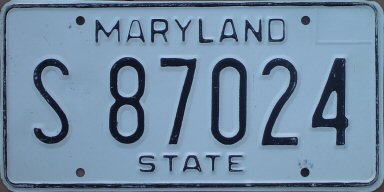 SHA 1980-1987 (version 2) |
Since 1975, the SHA has not used plates that clearly identify the agency, but rather has used generic state government plates. However, these seemingly generic plates can still be identified as being assigned to SHA vehicles by their serial numbers. SHA-specific serial numbers were in the S 80000 series from 1975 to 1987 which is far beyond the numbers used for truly generic state government plates. Besides having their own block of serial numbers at the agency level, individual SHA facilities have their own smaller blocks of numbers assigned within the S 80000 series. I don't pretend to know what these all are, however. Some state government plates in the S 80000 series on the 1980-1987 black-on-white base were made with a sticker box in the upper right corner, which was never actually used, similar to local government plates. I've seen these with serial numbers both higher and lower than those without sticker boxes. I believe these were made late in the life of this base with previously-unissued serials in blocks of numbers assigned to various SHA facilities. At least one SHA facility (La Plata) currently uses its old 1980-1987 license plates as parking space markers for its various trucks and other pieces of equipment. All of these have sticker boxes. The numeric part of the old plate identifying the parking space matches the numeric part of the current plate attached to the vehicle to which that parking space is assigned. |
 SHA truck, trailer, or equipment, 1986-present (plate in actual use) |
On the current reflective black-on-white base, SHA vehicles continue to used what appear to be generic state government plates, but with a distinct serial range that's far beyond anything else issued. The serial format for SHA trucks, trailers, and equipment is S/G*80000, and again, blocks of numbers within that format are assigned to various SHA facilities around the state. On this base, SHA passenger cars have a different, but still distinct block of serial numbers, between about S/G*29600 and S/G*29999. These also fall outside the range of any other state government plates issued to date. Unlike the truly generic plates, SHA-specific plates have not yet been observed with the state web site address along the bottom edge, nor in the new numbering format. |
(no picture available)
Maryland's motor vehicle agency was known as the Office of the Commissioner of Motor Vehicles from 1910 to 1943, the Department of Motor Vehicles from 1943 to 1971, and the Motor Vehicle Administration (part of the Department of Transportation) from 1971 to present.
Prior to the establishment of the Maryland State Police as a separate entity, the Commissioner of Motor Vehicles had under his authority a unit known as the State Police Force. The State Police Force consisted of motorcycle officers who patrolled the state's highways from 1921 until it was replaced by the Maryland State Police in 1935. The undated plates used on these motorcycles were colored white on red, and the body of the plate consisted of the letters C.M.V. followed by a distinguishing number. Some know examples have no other identification, while others have embossed at the top and bottom of the plate Maryland and State Police, respectively.
I also know of at least two different undated Maryland plates with the stacked words Dept. Motor Vehicles on the left side. Both have the state name along the top edge and Drive Safely along the bottom edge. Serial numbers of up to three digits are on the right body of the plate. One such plate is colored silver on black, while the other is black on yellow. Both have long bolt slots top and bottom. The black plate also has small bolt holes in each corner. If I were to guess, I'd say that the black plate was made in the 1943-1947 period, and the yellow plate appears to have been made between 1956 and 1963. It's unknown how long either of these plates were used, or what purpose DMV vehicles might have served.
(no picture available)
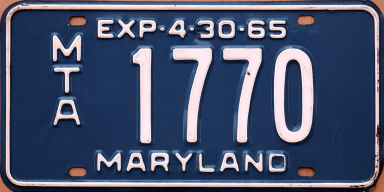
Plates with the letters MTA stacked on the left, with four-digit serial numbers, were issued starting with the 1965 expiraiton plate, and continuing through the dated 1971 base, which was used until 1975. These plates were used exclusively on transit buses used in the Baltimore area. "MTA" referred originally to the Metropolitan Transit Authority, a state agency, which then changed its name to the Mass Transit Administration in the early 1970s.
"MTA" plates with 1965-1970 expirations were not issued to government-owned vehicles, but rather to buses owned by the Baltimore Transit Company, a private company operating city buses in the Baltimore area, which was subject to regulation by the state Metropolitan Transit Authority. See an example of a 1960s MTA plate.
Plates for Baltimore city buses were issued on the 1971 expiration base during April 1970. They also bore the letters MTA stacked on the left, as they had for serveral years. However, the Baltimore Transit Company was taken over by the state on April 30, 1970. The Metropolitan Transit Authority, the state agency that had previously regulated Baltimore city buses, now owned and operated them. Therefore, it could be debated whether MTA plates on the 1971 base should be considered to be bus plates or government plates. I say that while the 1965-1970 expiration MTA plates are commercial bus plates, the 1971 base MTA plates are state government plates.
Read more about MTA bus plates.
During the 1975 and 1980 statewide reissues, Mass Transit Administration vehicles were issued what appeared to be generic state government plates. However, these plates had a distinct serial range in the S 50000 series, much higher than truly generic state government plates. On the current shield base first issued in 1986, MTA vehicles do not appear to have any distinct serial range.
 1975 State Aviation Administration |
The State Aviation Administration (SAA) took over the operation of Baltimore-Washington International Airport (then known as Friendship Airport) from the City of Baltimore in 1972. Overnight, the SAA grew from three employees to over 300. I presume that the SAA also acquired a number of motor vehicles as part of this transaction, or possibly shortly afterward. For no apparent reason, these vehicles were issued 1971 base plates with the letters SAA rather than generic state government plates. The letters ran diagonally downhill on the left side of the plate, and four-digit serials were used, starting at 1001. These were renewed annually with stickers just as generic government plates were during these years. I've seen a couple of examples of SAA plates, but they all have low serial numbers, so this plate was apparently produced in small quantities. SAA vehicles were apparently issued generic red-on-white state government plates during the 1975 statewide reissue. |
Specific license plates have been issued to various government officials in the executive and legislative branches of state government, certain Baltimore city officials, and Maryland's representatives in the U.S. Senate and House of Representatives. The most common of these plates are the House of Delegates plates, issued to members of Maryland's lower legislative body. Frequently, government official plates were issued to politicians' personal vehicles. I don't know if this was true in all cases, however. For example, in past years, the governor's state-owned limousine might have been the vehicle to display the special plates, rather than his personal car.
Although government official plates are still issued, primarily for members of the House of Delegates and state Senate, I expect that in today's security-obsessed world, probably some of the more prominent political officeholders no longer wish to call attention to themselves with these special plates.


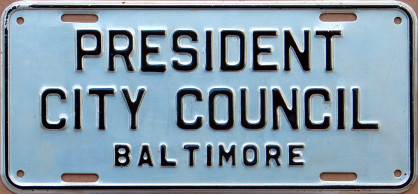

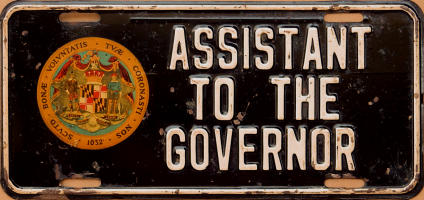
1939 comptroller (plate owner unknown);
1942 governor (Arndt photo / plate),
1945 delegate (Olivarri plate),
1948-51 president, Baltimore City Council;
1952 state senator (Doernberg photo / plate),
1952-53 assistant to the governor;
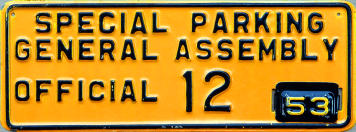
1953 General Assembly parking permit.
It appears that certain state government officials began being issued special plates by the mid 1930s, but information about the early years is available only for a few political offices. Because these plates would have been produced in very small numbers, the lack of information does not mean that specific plates did not exist.
Verified from 1936 forward. During 1936 to 1941, Governor was embossed along the top or bottom edge, while the opposite edge had the state name and issue year or expiration date or year. These plates had no serial number, but rather a large, ornate multi-colored state seal emblem. The 1942 base had the standard caption 3-31 Maryland 1942 at the top, and Governor at the bottom, with a large, ornate state shield in the center, and no serial number. The 1952 base had 19 Maryland |52| at the top (with the vertical lines indicating tab slot locations) and Governor at the bottom, with a large, ornate state shield in center, and no serial number.
Verified from 1936 forward. It's believed, but not verified, that Governor plates went on the governor's official car, while Executive plates were issued to the governor's personal car(s). Executive plates were much less gaudy than Governor plates, with no state seal affixed. During 1936 to 1941, Executive was embossed along the top or bottom edge, while the opposite edge had the state name and issue year or expiration date or year. Serial numbers 1 and 2 are known, and were embossed in the center of the plate. Executive plates during the later years of this period bore no year or date, and can be dated only by the dimensions and colors.
I have zero information about this plate type, beyond the fact that it exists on an undated base that corresponds in colors and dimensions to the 1952 base. This is the only plate of this type that I know to exist from any year. It contains the same state shield commonly used on 1954 and later political plates, but does not have an embossed state name.
Verified from 1942 expiration forward. The 1942 base was similar to the 1942 Governor plate, but with Secretary of State at the bottom, and with a different shield in the center. These plates did not have a serial number.
Verified from 1939 expiration forward. No details available other than what can be surmised from the rusty 1939 expiration plate shown above.
Verified from 1939 expiration forward. 1939 and early 1940s plates had Senate at the top, and of Maryland followed by the expiration date 3-31-yy at the bottom, with a serial number in the center of the plate. These early plates did not have a state shield emblem. There were at least two versions of the 1952 expiration base; one is the rather plain version shown above. There's also a second, much more ornate version as well. The fancy version of the 1952 expiration base had 19 Maryland |52| at the top (with the vertical lines indicating tab slot locations) and Senate at the bottom, with a large, ornate state shield on the left center and a serial number on the right center. The Senate shield emblem was larger than that of the Governor.
Verified from 1939 expiration forward. The 1939 through 1943 expiration plates were similar to the state senator plates from this era, with House of Delegates at the top, and of Maryland followed by the expiration date 3-31-yy at the bottom, with a serial number in the center of the plate, and no state shield emblem. By the 1945 plate, if not the 1944 plate that preceded it, the House of Delegates text had been moved to the left side of the main body of the plate.
The plate shown above has the dimensions, materials, and colors consistent with the base plate used from 1947 to 1951, commonly called the 1948 base. I'm not certain, but I believe this plate was actually a state-assigned vehicle registration plate, rather than a booster plate or a dashboard placard, despite the lack of any plate number, expiration year, or state name. I have no information about this plate type being issued prior to the 1948 base, or about similar plates issued to other Baltimore officials prior to the late 1950s, but that doesn't mean they didn't exist.
Maryland's state legislature is called the General Assembly, and consists of the state Senate and the House of Delegates. Metal parking permits were made for, I presume, senators and delegates to use while on business at the State House. But they exist with 1953 dates only. There is no date stamped on the plate itself, and every single one I've seen has a '53 year tab attached. The tabs were the same as were used to validate 1952 expiration license plates, just in a different color, and with no serial number. These parking plates are not as wide as license plates; only about 11 inches rather than the 13 inch width of license plates during that time or the 12 inch width used since 1956. They don't have bolt holes that would align with license plates, either, so I'm guessing they were used as dashboard placards.
Since 1954, special plates issued to Maryland state officials, and to members of the U.S. Senate and U.S. House of Representatives from Maryland, have usually carried a large, round, ornate Maryland state shield emblem (not the little shield separator on current standard issue plates) on the left center portion of the plates. Notice the variety of serial dies, representations of expiration dates, placement of the office holders' titles, and other details on these plates, even during the same time period.
Holders of state offices where there is only a single office holder are issued plates with the title of their office in the portion of the plate where normally a serial number would be placed. These plates bear no serial number, only the title of the political office. The titles of state officials entitled to such plates include Adjutant General, Attorney General, Comptroller, Governor, Lieutenant Governor, President (of the State Senate), Secretary of State, and Speaker (of the House of Delegates).
For members of state and national legislative bodies, plates are issued with the name of the legislative body in the serial number area, and with a relatively small number identifying the legislative district below. Office holders with more than one vehicle are issued plates with an alphabetic suffix following the district number for their additional vehicle(s). The text on these plates may read House of Delegates, (state) Senate, either Member of Congress or U.S. Congress, and U.S. Senate.


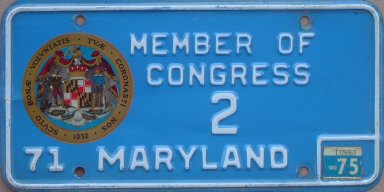
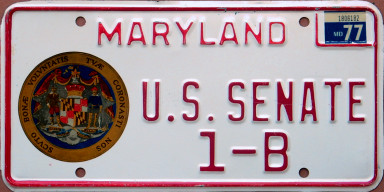
1957 U.S. Representative and U.S. Senator (Estrup plates);
1968 U.S. Senator (Gallagher plate);
1975 U.S. Representative; 1977 U.S. Senator.
Plates issued to menbers of the U.S. Senate are self-explanatory. Plates issued to members of the U.S. House of Representatives are stamped Member of Congress even though, technically, both the Senate and House make up the U.S. Congress. U.S. Senators are issued plates with either the number 1 or 2; the more senior senator receives the number 1 plate. House members are issued plates bearing their district number. Those with more than one vehicle are issued plates with an alphabetic suffix following the number for their additional vehicle(s). I've seen at least one U.S. Senate plate with plate number 24-A; this plate was undoubtedly made in error and was probably supposed to have been a state senator plate.


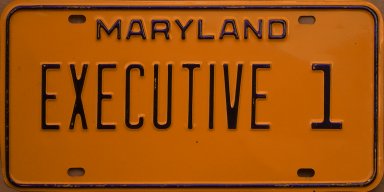
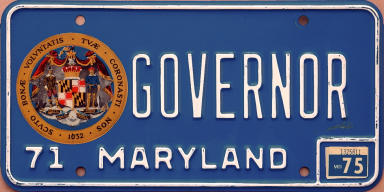

Undated governor plate from 1956 ("Whitey" photo / plate);
1957 governor (Estrup plate);
undated executive plate from 1966 used by the governor; 1975 governor;
1981 lieutenant governor (Childs plate).
I've seen several plates that seem to be Maryland government official plates, but they have no state seal, and have the word Executive taking up the major portion of the plate, followed by a low serial number. Most of the ones I've seen have serial number 1; but I've also seen a few Executive plates with serial number 2. Also, I don't recall seeing any that had a date or year on them, but their colors and other features correspond to plates from specific years. It turns out that "Governor" plates were used on the governor's official state-owned car, while "Executive" plates were issued for use on the governor's personal vehicle(s).
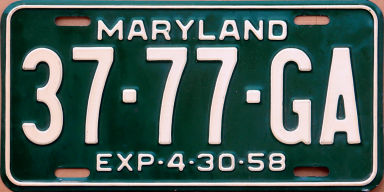
1958 trailer plate
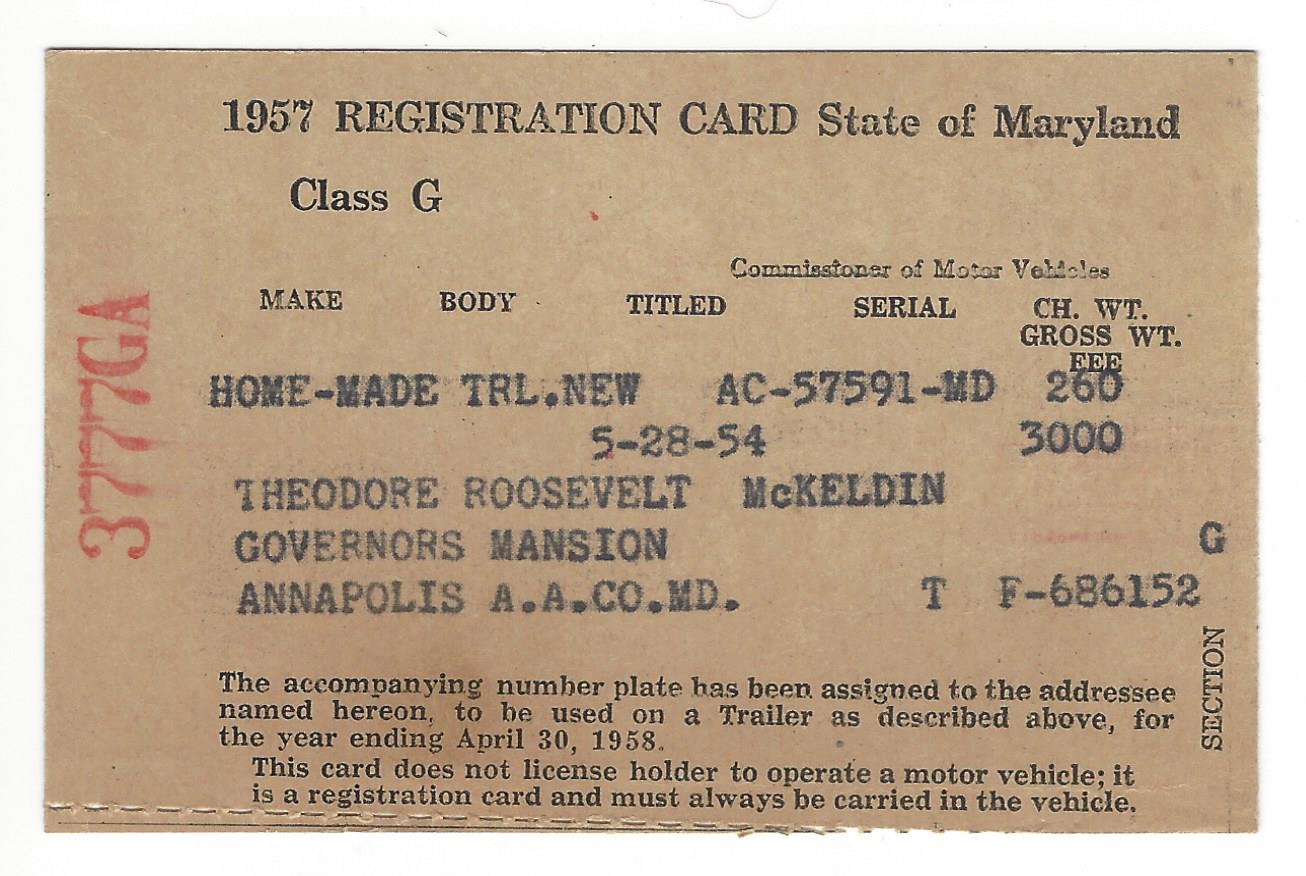
Here's a fun plate. It's an ordinary 1958 expiration Maryland trailer plate. So why is it here, in the section for governor plates? Well, because it is a governor's plate! You see, the registration card for this plate shows that it was registered to Gov. Theodore McKeldin, with an addresss of the governor's mansion in Annapolis. And the trailer was homemade. See the registration card. (The plate number is shown in red along the left edge of the card.)


1965 adjutant general (plate owner unknown);
1968 adjutant general (Doernberg photo / plate);
1968 attorney general (Olivarri plate);
1976 state attorney general (Childs plate);
1980 adjutant general plate on Bicentennial base
(Sells photo / plate).
Apparently only selected state cabinet members get specific license plates. The only ones I know about are for the Adjutant General, Attorney General, Comptroller, and Secretary of State.
Maryland's state legislature is called the General Assembly, and consists of the state Senate and the House of Delegates.


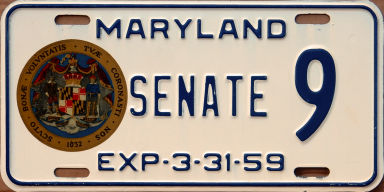

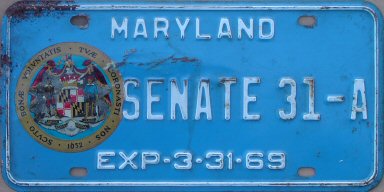
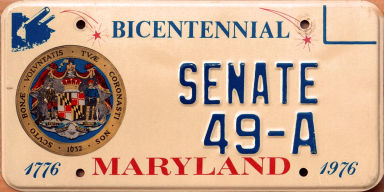
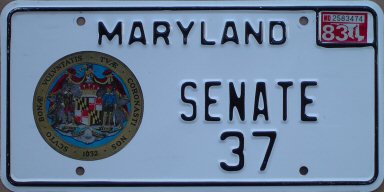
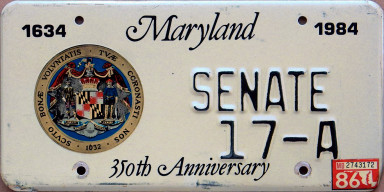

State senator plates: 1955 (Olivarri plate);
1957 (Estrup plate); 1959;
1960 (Sallmen photo / plate); 1969;
1976 Bicentennial base; 1983;
1986 350th Anniversary base;
current Our Farms base (plate in actual use).


State delegate plates: 1957 (Estrup plate); 1959;
1960 (Sallmen photo / plate);
1961 (Olivarri plate);
1970 (O'Connor photo / plate);
1976 (Sells photo / plate);
1977 Bicentennial base (Sells photo / plate);
current standard base (Hadjadj photo / plate)
current Chesapeake base (Ellis photo of plate in actual use).
Unnumbered, office-specific plates are issued for the President (of the State Senate) and the Speaker (of the House of Delegates).
The current state senator plate on the Our Farms base, shown above, does not have the state seal emblem. I have no explanation for this; only guesses. Perhaps the seal would have crowded the graphic farm scene at the bottom left. Or maybe someone thought the colors of the seal would clash with the colors of the plate.
It seems that in recent years, these political plates are used without expiration stickers. I have no information regarding why that is the case, when it began, or how the state keeps track of which plates are current vs. no longer valid for use.

1981 Prince George's County State's Attorney (Childs plate).
The black-on-white plate with the letters S. A. P. G. CO. is quite an oddball. The back of the plate has the words "Prince George's County State's Attorney", or something to that effect, written on it. (A state's attorney in Maryland is equivalent to a district attorney in other states. While they work at the county level, they're actually state government officials.)
I've never heard of Maryland political license plates ever having been issued to state's attorneys, but the plate shows obvious signs of use. The other oddity about this plate is that the white background is reflective, despite it having the embossed state name only otherwise used on painted plates. It's a weird reflective material, too, unlike anything I've ever seen on any other Maryland license plate. If this is a real license plate that was authorized by the Maryland Motor Vehicle Administration, I would presume that it's a 1981 expiration, based on the plate colors and lack of a renewal sticker. However, I'm not sure of this. The lack of an embossed sticker box gives me reason to wonder.


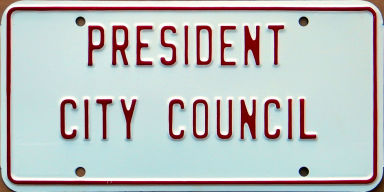
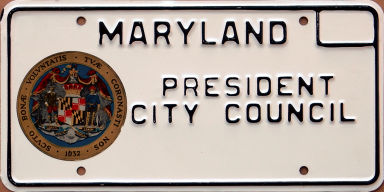
Undated plates from the late 1950s or early 1960s for the Baltimore mayor and city council president
(plate owner unknown);
undated plates from 1975-80 and 1980-86 for the Baltimore city council president.
Certain office holders in the city of Baltimore also receive special plates. Current plates have a graphic City of Baltimore emblem on the left center, the title of the office holder is in the remaining center portion of the plate. The titles of known city office holders receiving these plates include Mayor, President City Council, Comptroller, and Solicitor. These plates have no serial numbers. Older plates had graphics in different positions, different graphics, or no graphics at all.
The two blue-on-white plates shown above for the Baltimore mayor and city council president are undated, but were made and used in the late 1950s or early 1960s, based on the long bolt slots. Since they show no year or expiration date, it's unclear whether these were actual license plates or just state-made boosters. I'm going to speculate that they were used as actual license plates, and were replaced each year with new plates with colors that matched regular license plates. If this is the case, then these would correspond to regular plates with either 1959, 1962, or 1964 expirations.
The red-on-white city council president plate is a similar story. Though undated, the plate colors correspond with plates used between 1975 and 1980. This particular plate is in mint, unused condition, so I don't know if perhaps it was an error plate since it didn't say either "Maryland" or "Baltimore" on it, or it was a prototype, or just what. The black-on-white city council president has the same state sheild as used on state office holder plates. Also, it doesn't say which city, though these were only issued to Baltimore city politicians. Again, I don't know if this plate was considered an error or it was intentionally made this way.
Until 1985, special license plates for foreign diplomats and foreign consuls posted in the United States were issued by the District of Columbia and various states, including Maryland.
Embassies, of course, are offices of foreign goverments that maintain political relations with the government of the country in which the embassy is located; the top official at an embassy is called a diplomat. Logically, foreign embassies and their associated diplomats are normally located in the capital city of the host country.
Maryland once issued license plates to foreign diplomats. Washington D.C. is bordered by Maryland on three sides (and by Virginia on the fourth side). Perhaps some foreign embassies were located outside of the city of Washington in the Maryland suburbs, or perhaps some foreign diplomats had private suburban residences separate from the embassy itself. In any event, Maryland issued relatively few diplomatic license plates compared to Washington D.C. and even Virginia.
Consulates are offices of foreign governments that provide support for their citizens who are traveling abroad, and also look after their nation's business and cultural interests in the country in which they are located. Consular officials are called consuls. Foreign consulates are located in various major cities throughout the U.S., and certainly Baltimore must have its share, hence the need for Maryland consular plates.
Some time in 1985, the U.S. Department of State took over the issuance of all license plates to foreign diplomats and consuls, and the diplomatic plates issued by Washington D.C., Maryland, Virginia, and other states with a diplomatic presence such as New York were all discontinued, as were consular plates throughout the U.S.
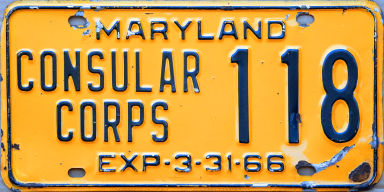 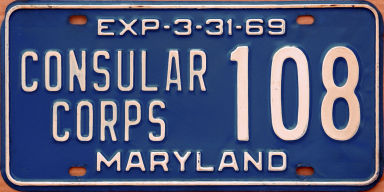 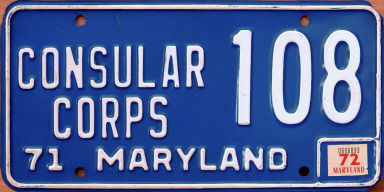
|
Foreign consuls located in Maryland were issued distinct plates during this time period. The plates had the words Consular Corps, one word stacked above the other, displayed horizontally on the left portion of the plate, with a numeric serial on the right portion. One report indicates that consular plates were first issued in Maryland either in 1960 with 1961 expirations, or during 1961 (which would most likely have 1962 expirations). The earliest year I've been able to verify is the 1962 expiration. All consular plates I've seen have plate numbers in the low 100 series. I presume numbering began at 101. The 1966 expiration consular plate is an odd duck. It has the state name and expiration date in the positions otherwise used on 1957-1964 expiration plates. 1965 expiration consular plates also have this reversed positioning. I have not seen 1967 or 1968 expiration consular plates to know if they have the same issue. As far as I know, only Maryland government official plates, including some shown above, had reversed positioning like this. (I have no evidence that foreign diplomats were issued specific Maryland plates prior to the 1976 red-on-white base. Earlier passenger car plates with serial format DP 0000 are apparently not diplomatic plates, as they were issued in that letter series with very high numbers.) |
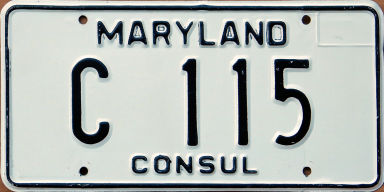
1981 consular corps |
ConsulsConsular plates on the red-on-white 1976 base and the black-on-white 1981 base had the serial format C 000. I suspect numbering began at C 101. I've seen a report that the 1976 base displayed the text Consular embossed at the bottom center of the plate. I don't know if that's accurate or not. As you can see, the 1981 base bore the text Consul. Depending on when in 1985 the Department of State took over issuing consular plates, there may or may not have been Maryland consular plates with 1986 expiration stickers. |
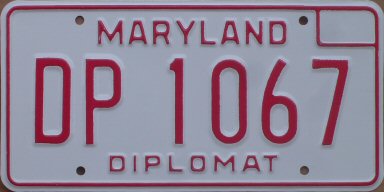
1976 diplomat 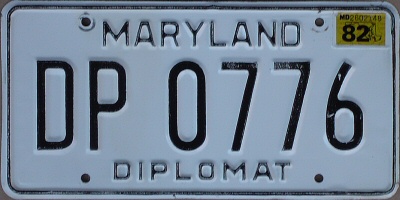
|
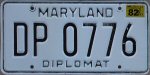
DiplomatsDiplomatic plates on the 1976 red-on-white base and the 1981 black-on-white base were easy to spot. The serial format was DP 0000 (while standard passenger car plates had gone to a xxx 000 format), and they also carried the embossed legend Diplomat at the bottom center of the plate, leaving no room for doubt as to what they were. Again, it's questionable whether the 1985 or 1986 expiration was the last for these plates. |
Related pages on this site |
Elsewhere on the web |
Thanks to those who have directly contributed to the information on this page: Jeff Ellis, David Doernberg, Mike Sells, Tim O'Connor, "Tiger" Joe Sallmen, Xavier Hadjadj, "Whitey", Jim Childs, Patrick Arndt, Bill Aske, Jon Olivarri, and Elliott Plack.
O'Connor photographs © copyright by Tim O'Connor. All rights reserved. Used with
permission.
Doernberg, Sells, Sallmen, Hadjadj, "Whitey", Ellis, and Arndt photographs are presumed to be copyrighted by
David Doernberg, Mike Sells, "Tiger" Joe Sallmen, Xavier Hadjadj, "Whitey", Jeff Ellis, and Patrick Arndt,
respectively, and are used with permission.
Estrup, Childs, Olivarri, and Gallagher plates are from the collections of
Jim Estrup, Jim Childs, Jon Olivarri, and Bradley Gallagher, respectively.
This page is W3C valid |