 |
|
 |
|
|
|
|
This page illustrates the various types of commercial vehicle and government-owned vehicle license plates currently or recently seen on the streets of Maryland. Latest noteworthy updates to this page
|
|
This page illustrates some of the various types of commercial vehicle and government-owned vehicle license plates currently or recently seen on the streets of Maryland. There are also additional types of Maryland license plates, some issued in very small numbers, that do not appear on this page. As I find them, I will add their images to this page.
The black-on-white reflective base with the screened state name has been in continuous use since 1986, and aside from a few graphic special interest plates, was the only valid Maryland plate design between October 1987 and June 2010. Despite the June 14, 2010 introduction of the War of 1812 base as the standard design for several mostly personal vehicle types, the black-on-white base remains the current issue for the majority of plate types. In most instances, plates are issued in pairs, and month and year expiration stickers are applied only to the rear plate.
Please note that, although a good number of the plates shown on this page are from my personal collection, I've shown plates from a variety of sources. Several plates shown belong to other collectors; some of these I photographed and some were photographed by their owners. The plates shown with bolts attaching them to vehicles are photographs of plates in actual use. Primarily, these are photos I've taken; some may have been photographed by others. Any photograph that I didn't take, and any plate that isn't from my collection, is indicated with appropriate credits. All photographs taken by others are used with permission.
I sincerely hope that you find this information useful. If you find an error or have additional information, or can provide a plate, or a photo of a plate that is not shown, please send me an e-mail. There's a link to my e-mail address at the bottom of every page.
Move your mouse over each image to see a description of that plate. Click on any image to see a larger version.
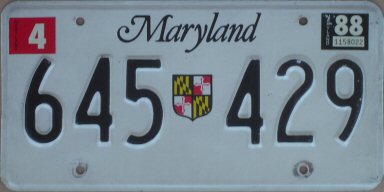

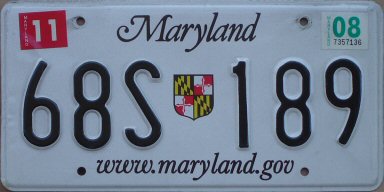
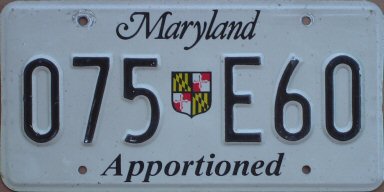
Standard regular truck plates with all-numeric format issued 1986-1992, one-letter format with no web address issued
1992-2005, and one-letter format with the web address issued 2005-2010. Apportioned regular truck plate
(unstickered front plate shown) issued 1988 to present.
Regular truck plates were issued to most types and all sizes of straight trucks and cargo vans, including personal pickup trucks, between 1986 and June 2010. Although no longer issued, they remain valid if continuously registered. Special truck types that did, and still continue to, receive different plates include dump trucks, cement mixer trucks, farm trucks, truck tractors, and tow trucks; these plate types are addressed separately below.
Regular truck plates were first issued in 1986 with serial format 000*000, beginning at about serial 300*000 to avoid conflicting with motorcycle serial numbers from the previous base still in use. Serial 999*999 was reached after only a couple of years, and the format rolled over to approximately serial 000*001 and continued until 299*999 was reached in the spring of 1992. A second format 00x*000 was then begun. With this format, all numbers change before the letter changes. The state web site address was added to the bottom of the plate in 2005 at about serial 23R*000. Both serial formats are still in use, although the all-numeric plates are now seen infrequently.
Effective with the introduction of the War of 1812 base on June 14, 2010, regular trucks regardless of weight are now issued passenger car plates. Truck plates were in the upper "X" series of the 00x*000 serial format when they were discontinued. First the War of 1812 plate and now the "Maryland Proud" plate with the state flag along the bottom are being issued for new passenger car, multi-purpose passenger vehicle, and regular truck registrations. These base plates are covered in detail on the Current and Recent Maryland Personal Vehicle Plates page.
Apportioned truck plates are issued to commercial trucks that cross state lines. Apportioned straight trucks that don't fit into the dump truck or tow truck categories are issued plates in format 000*E00; the "E" identifies the vehicle class code for trucks. The caption Apportioned is screened at the bottom of the plate. Apportioned registrations are partially staggered to expire annually at the end of either January, April, July, or October.

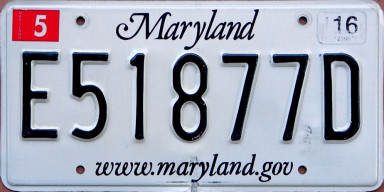
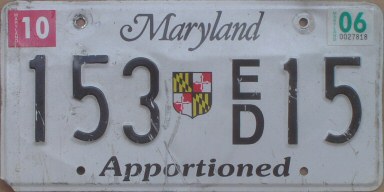
Dump truck with no legend, dump truck with web site legend, apportioned dump truck
Both dump trucks and cement mixer trucks are issued dump truck plates in Maryland. Non-apportioned dump truck plates have serial format E00000D, and no legend to identify the vehicle type. The state web site was added to the bottom of these plates approximately in late 2005, beginning at about serial number E37000D.
Apportioned dump truck plates have the rather odd format 000*E/D00, with the letters E and D stacked one above the other, and screened rather than embossed. These plates bear the legend Apportioned at the bottom. Since about 1999 all apportioned plates, including dump trucks, expire in January, April, July, or October.
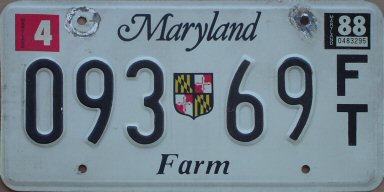

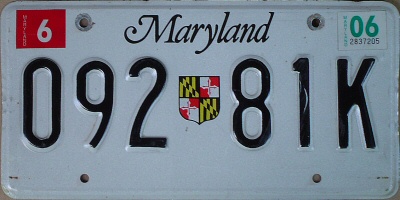

Farm truck;
farm truck tractor (Ellis photo of plate in use);
restricted use farm area truck with no legend; restricted use (farm area truck or island vehicle) with web site legend
(plate in actual use)
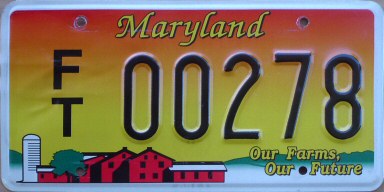
Maryland issues several different types of farm truck plates; three on the standard base, and one on the Our Farms, Our Future special interest base, which is discussed separately.
Farm trucks over 10,000 pounds gross vehicle weight (GVW), other than truck tractors, are issued standard plates in format 000*00F/T, where the F and T are stacked one above the other and occupy one space on the plate. Vehicles with these plates are not restricted geographically. The legend Farm is screened on the bottom center of the plate. Apparently, farm trucks 10,000 pounds GVW and under just get regular truck plates. Regular farm trucks may also obtain Our Farms, Our Future special interest plates. An image of one of these plates is shown further down this page.
Truck tractors (the front part of tractor-trailers) used for farming purposes are issued standard plates in the format 000*00T/R, with the letters T and R stacked one above the other, and the legend Farm screened on the bottom center. There's no geographic restrictions on these, either. Like regular truck tractor plates, they're issued singly and are mounted to the front of the vehicle.
So-called "farm area" motor vehicles are restricted geographically; they may only use public roads within a 10 mile radius of the farm. Farm area plates have the serial format 000*00K, with the "K" indicating the vehicle class. These are not used for farm machinery such as farm tractors or combines; rather, they're used on farm trucks that only use public roads to get from one field to another, for example. The state web site appeared on these plates beginning somewhere around serial 125-00K.
Beginning October 1, 2006, registration class "K" has been expanded to include both farm area vehicles and island vehicles, and since then, the same K-suffixed plates are issued to both. Island vehicles are defined as vehicles that are driven only on islands that have no highway access to the mainland, regardless of vehicle type or usage.
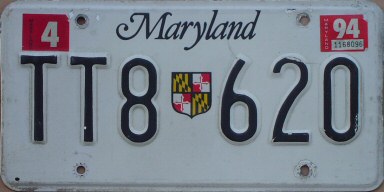
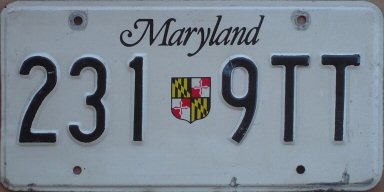
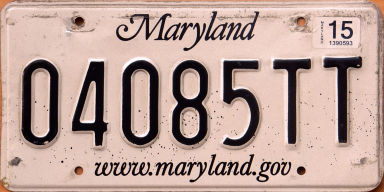
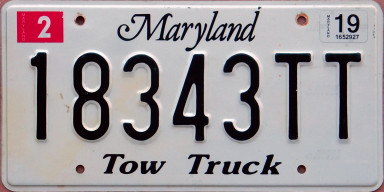
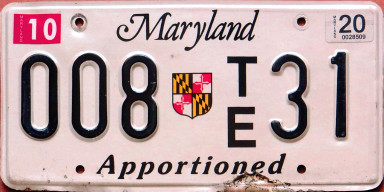
Tow truck plates in version 1, version 2 (unstickered front plate), version 4 (missing its month sticker), and version 5;
apportioned tow truck.
Both old-school tow trucks that actually tow disabled vehicles, and the new-style flatbed "rollback" trucks that transport disabled vehicles are issued tow truck plates. Tow truck plates on the current base were first issued with serial format TT0*000. When that format was exhausted, format 000*0TT was introduced. In the summer of 2005, this second format was also used up, and new plates are now issued in format 00000TT. The web site legend was added to non-apportioned tow truck plates in late 2005, beginning at approximately serial number 00700TT; this was replaced with the legend Tow Truck in 2010 somewhere near plate number 07000TT.
Apportioned tow truck plates are only issued to such trucks that are used in interstate commerce for purposes other than just transporting disabled vehicles. Typically, these would be rollback trucks that serve double-duty, also carrying vehicles being shipped as freight. As you might imagine, not too many of these plates have been issued. Apportioned tow truck plates have the odd serial format 000*T/E00, with the letters T and E stacked, and with the legend Apportioned along the bottom.
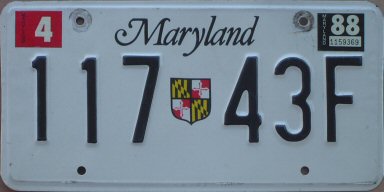

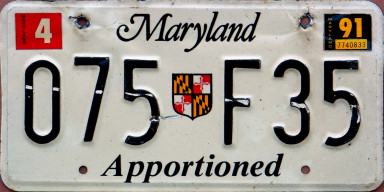
Truck tractor with no legend; truck tractor with web site legend, with a green special interest plate month sticker and a
missing or obscured year sticker (Jackson photo of plate actual in use);
apportioned truck tractor
Truck tractors (cab units of tractor-trailer combinations) were initially all assigned serial format 000*00F when the current base was introduced in 1986; the last character was always "F", indicating the vehicle class. Since 1988, such plates have only been used for non-apportioned truck tractors, of which there are relatively few, since they're restricted to drive only in Maryland. Also initially, these plates were issued in pairs, and the month and year stickers went on the rear plate. Neither is the case any longer, truck tractor plates are now issued as single plates and are mounted on the front of the vehicle. The state web site was added to the bottom of non-apportioned semi-tractor plates at roughly serial 302*00F.
Farm-use truck tractors are addressed in the farm truck category, above.
Apportioned truck tractor plates have the serial format 000*F00, where the letter F is constant and identifies the vehicle class. Apportioned plates are also identified with the screened legend Apportioned along the bottom of the plate. Apportioned registrations are partially staggered to expire annually at the end of either January, April, July, or October. In the case of truck tractors, single plates are now issued and mounted on the front of the vehicle. It's possible that some older truck tractors also have rear plates still attatched.

Commercial ambulance or funeral vehicle (unstickered front plate)
Commercial ambulances, as well as hearses, funeral limousines, and other vehicles used exclusively for funeral- or cemetery-related activity, all receive standard black-on-white base plates in format 000*00C. Like other plate types without a vehicle type legend; the state web site address was added to the bottom of these class "C" plates beginning at about serial 065*00C.
Ambulances run by city or county fire departments, volunteer fire companies, volunteer rescue squads, and the like, are all issued government-owned vehicle plates, which are discussed further down this page.


Bus for hire, apportioned bus for hire (both plates in actual use)
Non-apportioned buses for hire are issued plates with serial format 000*00P, where the letter P is constant and indicates the vehicle class. These would include commerical fixed-route buses that stay within Maryland, and charter buses, which are exempt from apportionment. These plates do not have any legend to identify the vehicle type. Bus plates were finally spotted with the state web site address at the bottom in the fall of 2006, starting at about serial 085*00P.
Apportioned for-hire bus plates are issued with serial format 000*P00 (again with the letter P constant), and the screened legend Apportioned at the bottom edge. Apportioned bus plates are more rare than regular bus plates, as they're only needed on interstate fixed-route buses for hire. Just over a thousand apportioned bus plates were issued in a little over 20 years.
Not-for-hire buses, such as buses owned by churches, Boy Scout troops, and even airport shuttle buses operated by hotels and rental car companies, were issued multi-purpose passenger vehicle (MPV) plates until June 2010, and are now issued passenger car plates. MPV plates are most frequently seen on personal mini-vans and SUVs, and therefore are addressed on the Current and Recent Maryland Personal Vehicle Plates page. School bus plates are covered just below.

Limousine for hire (plate in actual use)
Non-funeral limousines for hire were split out from taxis a number of years ago, and given their own plates on the standard base with the format 00000LM. The web site made its appearance beginning at serial 03500LM.
Funeral limousines are issued the same plate type as hearses and commercial ambulances, covered above. Private limousines not for hire are issued regular passenger car plates.


School bus not for hire, version 1 with small caption at bottom (missing its year sticker); school bus not for hire,
version 2 with large caption at bottom (plate in actual use); school bus for hire,
version 1 with small caption at bottom (plate in actual use)
School vehicle plates are only issued to privately-owned or commercially-owned school buses, including passenger vans painted and marked as school buses, that are not for hire. Typically, such vehicles would be operated by or for a private school. The serial format is 000*00H and the screened legend School Vehicle is at the bottom center of the plate. The fixed letter "H" indicates the vehicle class code.
School charter plates are issued to school buses for hire owned by commercial bus companies. Again, this would include passenger vans painted and marked as school buses. These plates have serial format H00*00C and the screened legend School Charter at the bottom. Note that these plates have nothing to do with charter schools; rather, the legend indicates that the vehicle is both a charter bus and a school bus.
The particular school charter plate shown above is quite an interesting example. It has a very old serial number, and the small plate type legend that appeared on early issues on this base. However, I got close enough to this plate, when I photograhed it in actual use, to see that it appeared to have a natural 2009 expiration and the plate itself was in brand new condition. Unfortunately, I didn't get a chance to see the hologram showing the year the reflective sheeting was manufactured. I'm guessing that this plate, as well as possibly others like it, was hidden away in an MVA office somewhere for 20 or more years before it was finally discovered and then issued.
School buses owned by public school districts are issued standard "L/G" local government plates; these are addressed further down this page.
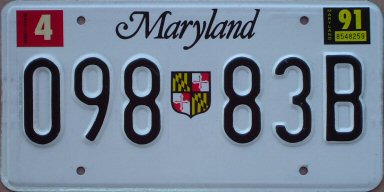
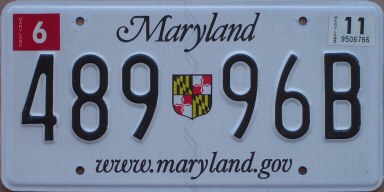
Standard taxi plates without and with the web address legend
The format for taxi plates on the standard base is 000*00B; these plates do not carry a legend indicating the vehicle type. "B" is the vehicle class code for taxis. The state web site began appearing at the bottom of standard taxi plates in 2005, at approximately serial number 375*00B, according to two different alert plate spotters.
Taxi owners could elect the green-on-white first generation Treasure the Chesapeake special interest plates, which when issued for taxis had a distinct serial format B00*000. Taxis were also once permitted to obtain the Our Farms, Our Future and the black-on-blue second generation Treasure the Chesapeake special interest plates; however, on those bases they shared serial formats and ranges with passenger cars, light trucks, and multi-purpose vehicles.
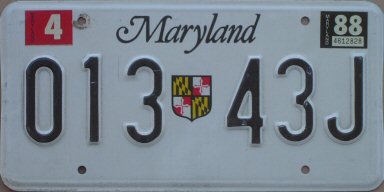
Van pool vehicle
A van pool is sort of a commuter cooperative where the commuters share the cost of a passenger van. Van pool plates are much less common than they once were. Van pool plates are issued with serial numbers in format 000*00J, with the letter J identifying the vehicle class, and no legend to identify the vehicle type. This the very last plate type without an identifying legend to be spotted with the state web site address. This occurred in the fall of 2009 at approximately plate number 035*00J, nearly five years after the web site was first seen on multi-purpose vehicle plates.
All kinds of trailers are issued the same plate type in Maryland, whether recreational house or camping trailers, boat trailers, rental trailers, semi-trailers, etc.
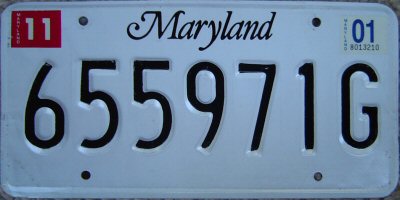
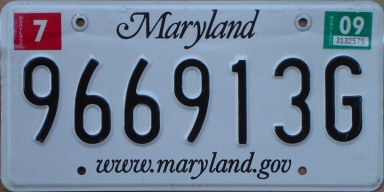
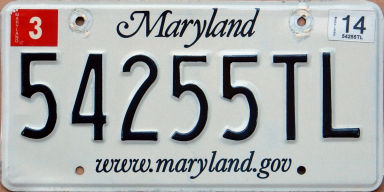
Standard, regular trailer plates in serial format 1 without web site legend, serial format 1 with web site legend,
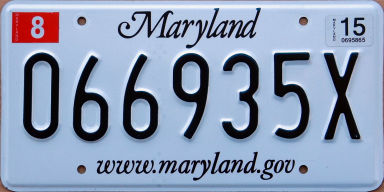
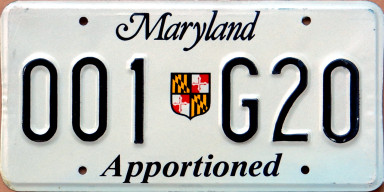
serial format 2, and serial format 3; unissued, unstickered apportioned trailer.
Regular trailer plates are issued to nearly all types and sizes of trailers and semi-trailers. From 1986 until 2008, regular trailer plates had only had one serial format, 000000G. "G" is the vehicle class code for trailers. The state web site address was added to the bottom of the plate in 2005 at about serial 854000G.
In the summer of 2008, plate number 999999G was reached, and a second regular trailer serial format 00000TL was introduced. Having only five variable digits rather than the previous six, this format should have only lasted about one-tenth as long as the previous format – something like 2.2 years, instead of 22 years. Yeah, that was a good plan – not! Well, probably due to the recession, this format actually made it about 3 years before running out of numbers.
In the summer of 2011, a third trailer plate serial format 000000X made its debut. The "X" apparently doesn't stand for anything, but there are once again six variable serial numbers, which ought to last another 20 years or so.
Owners of light trailers may elect to obtain Chesapeake or Our Farms, Our Future special interest plates for their trailers. Trailers on these bases have distinct serial formats. These are addressed in more detail in the following section.
In the early days of the apportioned vehicle program, apportioned trailer plates were issued with format 000*G00 and the caption Apportioned at the bottom. These were discontinued quite a few years ago, as the apportionment of trailers is no longer required by the program. Not many were ever issued, and they're not seen in use any longer. Issued plates would have month and year stickers, but the one shown is an unissued leftover plate.
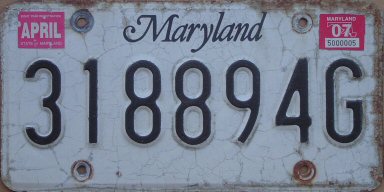
Fleet trailer in serial format 1 without web site legend
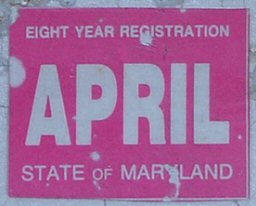 Fleet trailer month sticker |
 2007 fleet trailer sticker |
Businesses that own fleets of trailers may elect to register them for 8 year periods. The business must own either at least 25 rental trailers of any size, or at least 5 trailers with a gross weight over 10,000 pounds. I've only seen these on semi-trailers myself, but I'm told that Baltimore Gas and Electric uses them on all varieties of trailers and non-powered special equipment. Therefore, it would seem that if you own enough of the specified kinds of trailers to qualify for 8 year registrations, you may obtain such registrations for any and all of your trailers.
The same standard base plates used for regular trailer registrations are also issued for 8 year registrations. Since this base was introduced in 1986, the earliest fleet trailer registrations on this base expired in 1994. Fleet trailer plates have distinctive month and year expiration stickers. The month sticker is unique in that it spells out the month name (always April) rather than using the month number, and it's a bizarre hot pink color. The year stickers have the state name horizontally across the top and the state map outline in the center. These were always colored white on red up to and including the 2016 sticker. Reportedly, these did not contain serial numbers until the 2007 year sticker. Beginning with the 2017 sticker, fleet trailer year stickers are colored black on white like most all other Maryland year stickers now are. However, they continue to have the horizontal state name across the top and the state map outline, unlike any other Maryland year stickers.
Maryland only offers three true special interest plates that are available to anyone, directly through the Motor Vehicle Administration - the well-known Treasure/Protect the Chesapeake and Our Farms, Our Future plates, and the new 1910 Vintage plate. These plates have completely different designs than the standard-issue plates. While in some cases these plates are used to raise money for specific organizations, unlike organizational member plates, the MVA collects the money from the registrant and distributes it to the groups after the plates are issued. No actual affiliation with any organization is necessary.
Special interest plates are or have been available to a few specific commercial vehicle types, and in some cases have had distinct serial formats when issued to such vehicles.
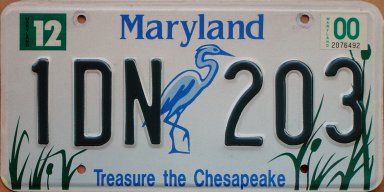
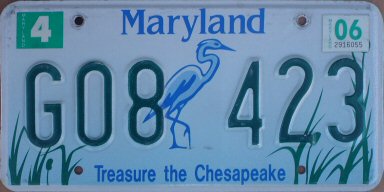

First generation Chesapeake light truck, first-generation
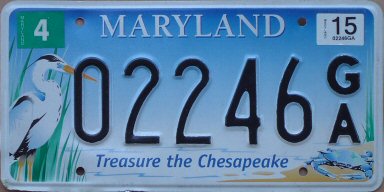
Chesapeake trailer,
Our Farms, Our Future farm truck (unstickered front plate),
Our Farms, Our Future trailer (plate in actual use),
second-generation Chesapeake trailer.
Green-on-white/blue fade Treasure the Chesapeake environmental plates with the blue heron in the middle of the plate were available to new registrants from 1990 to 2003. These plates were issued to several different vehicle types, and each vehicle type used plates with its own distinct serial format. Cars received plates in format 000*xxx, and multi-purpose vehicles (usually SUVs or mini-vans) got plates in format xxx*00x. Light trucks were issued plates with format 0xx*000 in this style. Even taxis and trailers could get in the act with plates in formats B00*000 and G00*000, respectively. Although no longer issued, these plates remain valid if continuously registered.
In early 2001, a second special interest plate was offered, a loud black-on-orange/yellow fade Our Farms, Our Future agricultural plate. This plate is issued in a single serial format, A000000, to cars, MPVs, light trucks, taxis, and trailers; however, trailer plates are limited to the A900000 series. Farm trucks are also eligible to get this plate, and have serial format F/T 00000. On this plate, the stacked letters F/T are screened, while the actual serial numbers are embossed.
In January 2004, a redesigned and more modern-looking Treasure the Chesapeake plate made its debut, with a black-on-blue/white fade color scheme, and a full-color blue heron at the left of the plate. Once again, cars, MPVs, light trucks, taxis, and trailers all share a single serial format 00000x/x, with trailer plates restrcted to a specific serial number range. Suffix letters B/Y, and C/x where the second letter is variable, have been issued to motor vehicles. Trailers are issued these plates with suffix letters G/A.
Since October 1, 2007, taxis are no longer able to obtain either the Our Farms or Chesapeake plates. However, it's not entirely clear to me whether taxis that were issued these plates prior to that date have been allowed to keep them or not.
During 2014, a limited-edition 1910 Vintage special interest plate, intended, but failing, to resemble the first Maryland state-issued plates from 1910, is available for cars, MPVs, light trucks, historic vehicles, and street rods. Cars, MPVs, and trucks all share serial format VR00000, while other formats are used for historic vehicles and street rods.
In October 2018, a third-generation Chesapeake Bay plate was introduced. This one has the revised text Protect the Chesapeake plate at the bottom. It also has a black-on-blue/white fade color scheme, but this plate has an image of the Chesapeake Bay Bridge rather than the heron. Cars, MPVs, light trucks, and trailers all share a single serial format 00000x/x, with trailer plates restrcted to a specific serial number range. Suffix letters C/x, where the second letter is variable, are issued to motor vehicles. Trailers are issued these plates with suffix letters G/A. Numbering continued uninterrupted from the second-gen Chesapeake plates.
Passenger car versions of all four of these plate designs may be seen on the Current and Recent Maryland Personal Vehicle Plates page.
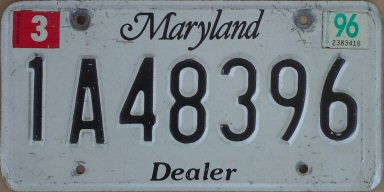


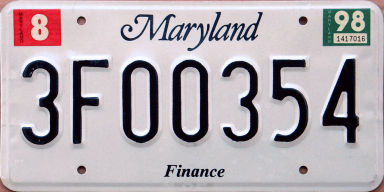
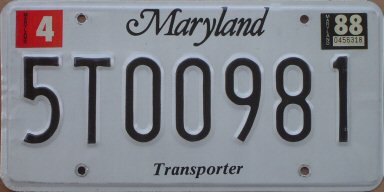
Non-motorcycle motor vehicle dealers with original 1A prefix, and with subsequent 2A prefix
(plate in actual use);
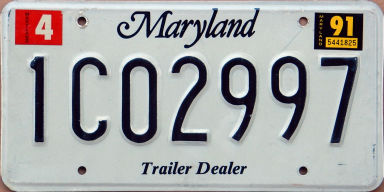
trailer dealer;
vehicle recycler (junkyard operator) (plate in actual use);
finance company;
vehicle transporter.
Dealer plates and other automotive-related business plates are not assigned to a specific vehicle, and therefore may be moved from vehicle to vehicle as needed. These plates enable the business to drive otherwise unregistered vehicles on public roads.
All non-motorcycle automotive business plates have a consistent serial format 0x00000, where the first two characters identify the type of business to which the plate was issued. All such plates have a screened legend at the bottom that also identifies the type of business. The various legends and their associated two character serial prefixes are: Dealer – 1A and 2A, Trailer Dealer – 1C, Recycler – 2R, Finance – 3F, and Transporter – 5T. Motorcycle dealer plates have serial format 1B0000.
Dealer plates are issued not only to new and used retail vehicle dealers, but also to vehicle manufacturers, distributors, and wholesalers. Operators of automotive junkyards are issued "recycler" plates to facilitate the movement of operable vehicles. Automotive finance companies are issued plates to facilitate the movement of repossessed vehicles. Transporters are in the business of moving or delivering unregistered vehicles, or in a business in which moving or delivering unregistering vehicles is incidental to the primary activity, where the unregistered vehicles are actually driven on the street. Typical applications would include driving freshly-imported vehicles from the docks to a storage lot a short distance away, or for a vehicle repair business with multiple facilities to take unregistered customer vehicles from one site to another.
The Finance company plate type has been the subject of speculation that it has become an obsolete type. If so, finance company plates were likely replaced with dealer or transporter plates; if not, well, it's obviously a rather scarce type. Trailer dealer plates are also infrequently seen.
The regular motor vehicle dealer serial format 1A00000 was issued from 1986 until approximately September 2005 when all possible numbers had been used. Subsequent issues of regular dealer plates are now in format 2A00000. This new format makes little sense, since dealers are considered "Class 1" registrations, while vehicle recyclers (junkyard operators) are considered "Class 2" registrations. A "1D" prefix would have been a much better choice, in my opinion.
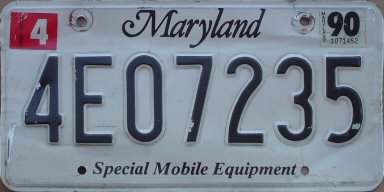


Special mobile equipment plates with older, small plate type legend and newer, large legend
(plate in actual use); low speed vehicle
(Ellis photo of plate in use); restricted use (island vehicle or farm area truck)
(plate in actual use)
These plate types somewhat defy categorization.
These plates are issued to both motor vehicles and trailers using public roads that really could be considered more tools than transportation, such as cranes, mobile compressors, wood chippers used by tree removal businesses, and the like. Special equipment plates follow the serial format of automotive business plates, apparently because like them, they are not registered to specific vehicles and can be moved from one vehicle to another, owned by the same business. These plates have serial format 4E00000 and the screened legend Special Mobile Equipment at the bottom.
Low speed vehicle plates were introduced in January 2006. A low speed vehicle is defined as a four-wheeled electric vehicle designed to carry no more than four people, with a maximum speed between 20 and 25 miles per hour, which meets certain federal safety standards. In some other states these are referred to as "neighborhood electric vehicles". The plates make these vehicles street legal. However, golf carts are explicitly not eligible for low speed vehilce plates, probably because they don't meet the safety standards. Low speed vehicles can be either personal-use or commercial-use vehicles. At least one such vehicle has been spotted in use as a taxi, and displaying low speed vehicle plates rather than taxi plates.
Two full-sized plates are issued, with a bizarre 000R00 serial format, with no sheild separator and no spaces between any of the characters. It seems to me that perhaps these were intended to be issued on motorcycle-sized plates, but someone somewhere got their wires crossed. The plates bear the legend Low Speed Vehicle along the bottom. Plate numbers began at 000R01.
Island vehicles have been required to display license plates since October 1, 2006. These are vehicles that are driven only on islands that have no highway access to the mainland, regardless of vehicle type or usage. Therefore, island vehicles may be either commercial or personal vehicles. Island vehicles share registration class "K" with farm area vehicles, and both are issued the same plates with serial format 000*00K. Based on the timing, class K plates used on island vehicles should only have a state web site legend at the bottom. Class K plates used on farm area vehicles may or may not have the web site legend.


Generic state-owned vehicle plates, versions 1, 2, and 3; State Highway Administration truck/trailer/equipment plate;
local government-owned vehicle plates versions 1 and 2 (all plates in
actual use)
On the standard black-on-white base, government-owned vehicles are usually assigned serials in the format x/x*00000, with state-owned vehicles identified with a stacked "S/G" to the left of the shield graphic, and local government-owned vehicles identified with a stacked "L/G" to the left of the sheild. There is no legend identifying these vehicles as government-owned. Unlike other Maryland plate types, government plates do not display year or month expiration stickers. There is no distinction between passenger vs. non-passenger vehicles, or even motor vehicles vs. trailers. Many law enforcement and fire and rescue vehicles, and some additional state-owned vehicles use different plates than these, however.
The state web site began appearing at the bottom of local government plates at about serial L/G*75000, and on state government plates at about serial S/G*22700 or S/G*22800. However, the State Highway Administration (SHA) has its own reserved blocks of numbers on the standard state government plates; so far none of these have been spotted with the web site. SHA trucks, trailers, and other equipment get plates in the S/G*80000 range, while SHA passenger vehicles are given plates with serials between about S/G*29600 and S/G*29999.
In about August 2014, local government plate number L/G*99999 was issued, and subsequent plates were issued in the format *00000L/G, with the shield at the far left and and the stacked letters at the right. Then, in about March 2015, state government plates began being issued in a similar format *00000S/G, even though they were nowhere near running out of numbers in the old format. A new format state government plate is shown above. No word yet on whether SHA plates have been issued in the new format.


Maryland State Police, Maryland Natural Resources Police (McDevitt photo),
Maryland Transportation Authority Police, Laurel Police, Montgomery County Police, Howard County Fire Department,
Laurel Volunteer Rescue Squad (all plates in actual use)
Some vehicles owned by state and local governments are issued distinctive agency-specific plates rather than the generic S/G and L/G plates. Primarily these vehicles are owned by law enforcement and fire and rescue agencies. Also, independent volunteer fire company and volunteer rescue squad vehicles are issued the same types of plates as government-owned firefighting vehicles and ambulances. Like generic government plates, all of these plates are undated and unstickered, and are used indefinitely. However, some of these plate types have been periodically redesigned and reissued.
The MSP has had several different plates on the black-on-white reflective base. Since the late 1990s, however, they've gone retro and are using bright yellow, all-embossed plates that are reminiscent of plates they used up through the early 1980s. The new plates are reflective and have holograms indicating the year the plate was manufactured, while the original yellow plates were painted. Also, the newer plates read State Trooper rather than the previous State Police.
This state agency uses very unique yellow-on-black plates with a yellow border. The state name appears in yellow at the top of the plate in the familiar script font, and the words Natural Resources Police are stacked one above another taking up most of the body of the plate. The vehicle unit number is stacked vertically on the far right side of the plate.
This state agency has reflective white plates with the words Maryland Transportation Authority across the top of the plate in place of the usual state name, and Police along the bottom, with the agency's sheild on the left side of the plate. This agency previously used plates in the same format as currently used by local law enforcement units, with the serial prefix T/A.
This organization uses standard Maryland plate blanks, with the legend State Fire Marshall at the bottom and the agency's logo at the left of the plate. The serial characters are screened and are black in color, however.
Regardless of the jurisdiction, police vehicle plates from various cities, towns, counties, school districts, local park departments, and community college and state university campuses have the same generic Police logo with a large state shield on a yellow background. Sheriff's department plates have an identical logo, but with the word Sheriff instead. In each case, the name of the juridiction is screened at the bottom of the plate. Plate serial numbers are in the format x/x 0000. The appearance of these plates is rather similar to that of organizational member plates issued to personal vehicles.
The police plate prefix letters observed more or less statewide include M/G for various smaller city and town police departments, P/P for local park police, C/P for various public college and university campus police, S/A for various sheriff's departments, and S/P for school district police. Large police departments in the city of Baltimore and in suburban counties each have their own unique stacked two-letter serial prefix (such as Montgomery County, which has its own M/C prefix as shown above); lower population counties don't have county police departments.
Be aware, however, that many local police agencies have elected to just run the generic "L/G" local government plates on their police vehicles, rather than use these special police or sheriff plates.
These plates are made on standard Maryland plate blanks, but they are distinctive in that they contain no graphics, and all text on the plates is embossed with red characters, other than the familiar screened, script state name at the top. The embossed text typically includes the name of the agency and the vehicle unit number, but it can vary considerably in appearance from one agency to the next. Letter codes at the beginning and end of the plate serial number identify the vehicle type and the county in which the agency is based, respectively.
In the past, at least one local rescue squad instead chose to use generic "L/G" local government plates; I don't know whether there are any that still do so.
Until 2008, Maryland standard motorcycle plates were issued with dimensions of 4 1/2 inches high by 8 1/2 inches wide, which was different than the 4 inch by 7 inch dimensions used for motorcycle plates in every other state. In October 2008, Maryland began issuing motorcycle plates in the 4 by 7 inch size. Regular motorcycle plates in the new size have been seen in use, but so far there's no word regarding whether any other motorcycle plate types have been spotted in the new size. I'm sure it's just a matter of time.
Motorcycle dealer plates are similar to regular motorcycle plates, but with a screened M/C Dealer or just Dealer at the bottom of the plate, and bearing serial format 1B0000. Both month and year stickers are the same as used on most types of full-sized plates. Unfortunately, there is no place on the 4 1/2 by 8 1/2 inch plates where the stickers will fit without covering all or part of either the state name, the serial number, or the bolt slots in the upper corners. Presumably, any newly made motorcycle dealer plates are in the new 4 by 7 inch motorcycle plate size.


State Police motorcycle (plate owner kept confidential);
Baltimore City Police motorcycle (McDevitt photo of plate in actual use)
I don't know anyone who's actually seen one of these in use, but I've seen a photo of a generic state government motorcycle plate. If it can be believed, this is the only Maryland motorcycle plate with the same screened Maryland shield found on many full-sized plate types. The serial number consists of a stacked S/G to the left of the shield, and a three-digit number to the right of the sheild. I have no information about any equivalent generic local government motorcycle plates.
The MSP has had several different graphic motorcycle plates on the reflective white base. Since the late 1990s, however, they've gone retro and are using plain, bright yellow motocycle plates. These look similar to their full-sized bretheren, but they're fully screened rather than embossed, and they typically have an "MC" serial prefix.
Local police and sheriff's department motorcycles get plates that are basically miniature versions of full-sized local law enforcement plates. They have the same screened Police or Sheriff shield graphic on the left, and even have the same two-letter serial prefixes used on the full-sized plates. However, some law enforcement motorcycle plates have the agency name at the bottom, and some don't.

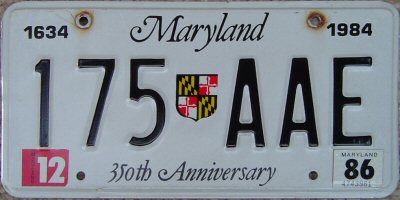
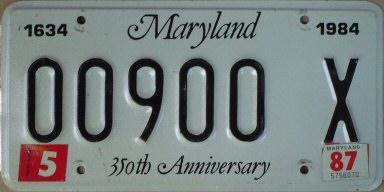


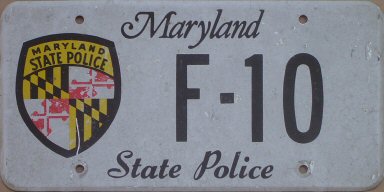
Circa 1985 State Police (Doernberg plate),
1986 350th Anniversary passenger car,
1987 350th Anniversary multi-purpose vehicle,
1988 charter bus (Doernberg photo / plate),
1992 rental car, circa 1986-1996 State Police.
One Maryland plate that looks like it should be included among the "currrent and recent" is the 350th Anniversary plate. These were special interest plates issued only in 1983 and 1984, and the last of them expired in September 1987, the same time as the old all-embossed standard plates. The 000*xxx serial format used for passenger cars on the 350th Anniversary plate was re-used on first generation Chesapeake passenger car plates.
A few plate types introduced during the life of the current plates have been discontinued. Among these are plates issued specifically to rental cars in the early 1990s. These were only on the road a few years when they were discontinued; before and since, rental cars have been issued regular passenger car plates. "D/R" supposedly stood for "daily rental". Other obsolete plate types include charter bus plates, with serial format I00*000; apportioned trailer plates with serial format 000*G00; and possibly finance company plates with format 3F00000.
The Maryland State Police have had a couple of previous plate types based on the standard Maryland plate design. Current Maryland State Police plates are black on reflective yellow, however. A few other law enforcement agencies also have now-obsolete plates that were based on the standard base plate.
Most plate types that use stickers to indicate the expiration date use the same type and color of stickers. These are addressed on the personal vehicle plate page. Exceptions are noted below.
White-on-green month stickers are intended for these bases, while red-on-white month stickers are intended for use on the standard base. In actual practice, though, either color month stickers are readily seen in use on any base plate.
These have distinct white-on-red (some call it white-on-pink) month and year stickers, regardless of the year through 2016. The 2017 sticker is black on white, and has the state name horizontally across the top and the state map outline in the center, similar to earlier fleet trailer stickers, but different from all other Maryland year stickers. The month stickers used for 8 year registrations are also unique in that they have the name of the month (always April) spelled out, rather than the month number.
Normally, year expiration stickers for 5 year registrations look the same as those of 1 and 2 year registrations. The main distinguishing feature would be the very low serial numbers on the 5 year stickers. However, in some years the colors that were ultimately used for 1 and 2 year registration stickers have varied from what was used for 5 year registrations. The same month stickers are used for both.
For no apparrent reason, 2005 year stickers issued to apportioned vehicles were colored white on green, as opposed to the normal black-on-white issued to other vehicle types. It would seems that beginning in 2009, all stickers for all years are being made black on white and 1 inch high; therefore, one-year apportioned registrations are getting different 2010 stickers than did most two-year regular registrations, which were issued green-on-white, 1-3/16 inch high stickers.
Otherwise, as far as I know, apportioned month and year stickers have been identical to those of non-apportioned one- and two-year registrations. Apportioned years stickers do seem to have a distinct sticker serial number range, however, higher than the very low serials on the five-year stickers, but otherwise lower than the stickers issued to non-apportioned vehicles, with two or more lead zeroes in the serial number. If apportioned year stickers didn't have a reserved serial range, they would otherwise have high numbers; since they're one-year registrations, they're actually issued after most other stickers for any given expiration year, since the vast majority of vehicle registrations are for two years.
Plates always expire at 11:59 pm on the last day of the month indicated. For truly staggered registrations, the expiration month is the same as the month the vehicle was initially registered. For registrations where the expiration month is pre-determined, the first registration period would not exceed the specified number of years, plus a partial month if applicable. So, for example, the first registration period for a one-year non-staggered registration could be as little as one month, and as long as 13 months minus one day.
Trailers that are part of fleets that meet certain criteria may be optionally registered for up to eight years at a time. The qualifications for 8 year registrations are described in detail in the trailer plate section of this page. These registrations always expire at the end of April in the given year.
This is another optional registration plan. I believe this option is available for businesses that register at least 25 non-apportioned motor vehicles. Passenger cars, multi-purpose vehicles, motorcycles, historic vehicles, and street rods with five year registrations always expire at the end of March; just about all other vehicle types with five year registrations would expire at the end of April. It's possible that dump trucks and cement mixer trucks with five year registrations expire at the end of May; otherwise, I'm sure they would also expire at the end of April.
Since 1999, apportioned vehicles have been on a semi-staggered schedule; their registrations can expire at the end of January, April, July, or October. I don't know how the specific expiration month is determined. Apportioned registrations periods are for one year only.
These are plates not assigned to specific vehicles; they include dealer, recycler, finance company, and transporter plates, as well as special mobile equipment plates. Until 1992, these always had April expirations; since then, they can expire in any month. However, the expiration month is determiend based on the name of the business, so all plates registered to that business expire in the same month. Until 1997, interchangeable plates were registered one year at a time; they're now registered for two year intervals.
Company-owned registrations of all other vehicle types were given staggered registrations beginnning in late 1998 for new reigstations, and renewals were converted to staggered registrations in 1999. Vehicle types including passenger cars, taxis, commercial ambulances, hearses, motorcycles, light trucks, trailers, historic vehicles, multi-purpose vehicles, street rods, and commercial limousines, when owned by individuals, were converted to two-year registrations during 1992-1993, and have registrations that expire in the same month as initially registered.
From what I can tell, medium duty and heavy duty regular trucks, dump trucks, farm trucks, truck tractors, school buses, van pool vehicles, commercial buses, and tow trucks still always get one-year registrations, regardless of ownership. Likewise with the geographically restricted registration class, which includes farm area trucks and island vehicles, a fairly new designaion.
Fellow plate historian Jeff Ellis, who lives in Maryland, reports that also beginning in 1999, renewals of company-owned vehicle registrations for passenger cars, taxis, commercial ambulances, hearses, motorcycles, light trucks, historic vehicles, multi-purpose vehicles, and street rods went to two-year registration periods. Odd-model year vehicles went to two-year periods upon expiration in 1999, while even-model year vehicles waited to begin two-year registrations in 2000. All other company-owned vehicle types not otherwise addressed above were also converted to two-year registrations in subsequent years, until the last type – trailers – finally went to two-year registrations in 2007. Now, all company-owned vehicles, unless otherwise excluded above, are also given expiration months that match the month of the initial registration.
When a registered vehicle is sold or disposed of, the plates do not stay with the vehicle. The plates can remain with the owner and be transfered to a replacement vehicle. Otherwise, the plates must be returned to the MVA.
Many Maryland plate types have no identifying legend, and can only be identified by the serial number format. Here's the cheat sheet you need to identify plate types. Note that this chart does not specifically list the 700-plus types of organizational plates.
Key to serial format symbols –
* = shield graphic
& = blue heron graphic
[ ] = other graphic
 = handicapped wheelchair symbol
/ = letter preceding slash is stacked above the letter following the slash
x = variable serial letter
0 = variable serial number
= handicapped wheelchair symbol
/ = letter preceding slash is stacked above the letter following the slash
x = variable serial letter
0 = variable serial number
| Serial Format | Legend | Usage |
|---|---|---|
| [ ]M/H 000 | Medal of Honor | Congressional Medal of Honor recipient |
| [ ]x/x 000 | none; various | Member of the organization indicated on the graphic and/or legend |
| 000*000 | none | Regular truck (black-on-white older standard base; format 1 of 2) |
| 000*00B | none; web site | Taxi (standard base) |
| 000*00C | none; web site | Ambulance, hearse, or other funeral or cemetery vehicle |
| 00000D | none (small plate) | Motorcycle (black-on-white older standard base, format 1 of 6) |
| 000*00F | none; web site | Truck tractor driven only in Maryland |
| 000*00H | School Vehicle | Privately-owned school bus not used as a charter bus |
| 000*00J | none; web site | Van pool |
| 000*00K | none; web site | Farm-use vehicle restricted to 10 mile radius from farm; since Oct. 2006, also all vehicles used on islands with no mainland access. |
| 000*00L | Historic | Historic vehicle (format 1 of 8) |
| 000*00N | Street Rod | Modified historic vehicle |
| 000*00P | none; web site | Commercial bus; a charter bus that may be driven both in and beyond Maryland, and/or a bus traveling fixed routes in Maryland only. |
| 00000 X or 00000X | 350th Anniversary | Multi-purpose vehicle* (obsolete special interest plate last used in 1987) |
| 00000Y | War of 1812 (small plate) | Motorcycle (previous standard base, format 2 of 2) |
| 00000Y | none (small plate) | Motorcycle (current standard base introduced September 2016, format 1 of 3) |
| 000*00Z | Historic | Historic vehicle (format 4 of 8) |
| 0000D0 | none (small plate) | Motorcycle (black-on-white older standard base, format 2 of 6) |
| 000*0L0 | Historic | Historic vehicle (format 3 of 8) |
| 0000Y0 | none (small plate) | Motorcycle (current standard base introduced September 2016, format 3 of 3) |
| 000*0Z0 | Historic | Historic vehicle (format 6 of 8) |
| 000D00 | none (small plate) | Motorcycle (black-on-white older standard base, format 3 of 6) |
| 000*E00 | Apportioned | Regular truck used in interstate commerce |
| 000*F00 | Apportioned | Truck tractor used in interstate commerce |
| 000*G00 | Apportioned | Trailer used in interstate commerce (discontinued) |
| 000M00 | none; web site (small plate) | Motorcycle (black-on-white older standard base, format 4 of 6) |
| 000*P00 | Apportioned | Commercial bus traveling fixed routes in and beyond Maryland |
| 000R00 | Low Speed Vehicle | Low speed neighborhood electric vehicle |
| 000Y00 | none (small plate) | Motorcycle (current standard base introduced September 2016, format 2 of 3) |
| 000*Z00 | Historic | Historic vehicle (format 7 of 8) |
| 00x*000 | none; web site | Regular truck (black-on-white older standard base, format 2 of 2) |
| 1B0000 | Dealer; M/C Dealer (small plate) | Motorcycle dealer, manufacturer, or distributor |
| 0D0000 | web site (small plate) | Motorcycle (black-on-white older standard base, format 5 of 6) |
| 0Z0*000 | Historic | Historic vehicle (format 8 of 8) |
| B00&000 | Treasure the Chesapeake | Taxi (first-generation Chesapeake special interest plate) |
| D00000 | web site (small plate) | Motorcycle (black-on-white older standard base, format 6 of 6) |
| D00000 | War of 1812 (small plate) | Motorcycle (previous standard base, format 1 of 2) |
| G00&000 | Treasure the Chesapeake | Trailer (first-generation Chesapeake special interest plate) |
| I00*000 | none | Charter bus (discontinued; merged with commercial bus) |
| L00*000 | Historic | Historic vehicle (format 2 of 8) |
| Z00*000 | Historic | Historic vehicle (format 5 of 8) |
| 0000D/M
| none; web site (small plate) | Handicapped motorcycle (black-on-white older standard base) |
| 0000D/M
| War of 1812 (small plate) | Handicapped motorcycle (previous standard base) |
| 0000D/M
| none (small plate) | Handicapped motorcycle (current standard base introduced September 2016) |
| &0000D/x
| Treasure the Chesapeake | Handicapped (second-generation Chesapeake special interest plate) |
| 000*0TT | none | Tow truck or rollaway flat-bed truck used to transport disabled vehicles (format 2 of 3) |
| [ ]0000x/x | none; various (small plate) | Motorcycle riding member of the organization indicated on the graphic and/or legend |
| 1xx&000 | Treasure the Chesapeake | Regular truck up to 10,000 pounds GVW (first-generation Chesapeake special interest plate) |
| [ ]A/A0000 | Anne Arundel Co. | Anne Arundel County police vehicle |
| [ ]B/A0000 | Baltimore Co. | Baltimore County police vehicle |
| [ ]B/C0000 | Baltimore City | City of Baltimore police vehicle |
| [ ]C/P0000 | various | Campus police vehicle from various state universities and community colleges |
| DV0000
| Disabled Veteran | Handicapped military veteran |
| [ ]H/C0000 | Howard Co. | Howard County police vehicle |
| [ ]M/C0000 | Montgomery Co. | Montgomery County police vehicle |
| [ ]M/G0000 | various | Police vehicle from various cities and towns other than the city of Baltimore |
| [ ]P/G0000 | Prince George's Co. | Prince George's County police vehicle |
| [ ]P/P0000 | various | Park police vehicle from various park jurisdictions |
| [ ]S/A0000 | various | Sheriff's department vehicle from various counties and the city of Baltimore |
| [ ]S/P0000 | various | School police vehicle from various school districts |
| [ ]T/A0000 | (uncertain) | Maryland Transportation Authority Police (obsolete design) |
| TT0*000 | none | Tow truck or rollaway flat-bed truck used to transport disabled vehicles (format 1 of 3) |
| VR0000 |
1910 Vintage | Handicapped (special interest plate) |
| [ ]x/x0000 | none; various | Member of the organization indicated on the graphic and/or legend |
| H00*00C | School Charter | School bus for hire as a charter bus |
| L00*00x | 50 Year Historic | Historic vehicle at least 50 years old |
| N00*00x | 50 Year Street Rod | Modified historic vehicle at least 50 years old |
| 000*xxx | 350th Anniversary | Passenger car (obsolete special interest plate last used in 1987) |
| 000&xxx | Treasure the Chesapeake | Passenger car (first-generation Chesapeake special interest plate) |
| 0xx*x00 | none; web site | Passenger car (black-on-white older standard base; format 2 of 2) |
| xxx*000 | none | Passenger car (black-on-white older standard base; format 1 of 2) |
| [ ]x/x/x 000 | none; various | Member of the organization indicated on the graphic and/or legend |
| xxx&00x | Treasure the Chesapeake | Multi-purpose vehicle* (first-generation Chesapeake special interest plate) |
| 000000G | none; web site | Trailer (standard base, format 1 of 3) |
| 000000M | none | Multi-purpose vehicle* (black-on-white older standard base; format 1 of 4) |
| 000000X | web site | Trailer (standard base, format 3 of 3) |
| 00000M0 | web site | Multi-purpose vehicle* (black-on-white older standard base; format 4 of 4) |
| 000M000 | none; web site | Multi-purpose vehicle* (black-on-white older standard base; format 3 of 4) |
| 1A00000 | Dealer | Motor vehicle dealer, manufacturer, or distributor (format 1 of 2) |
| 1C00000 | Trailer Dealer | Trailer dealer, manufacturer, or distributor |
| 2A00000 | Dealer | Motor vehicle dealer, manufacturer, or distributor (format 2 of 2) |
| 2R00000 | Recycler | Issued to junkyard operators for movement of unregistered vehicles |
| 3F00000 | Finance | Issued to vehicle finance companies for movement of repossessed vehicles (possibly discontinued) |
| 4E00000 | Special Mobile Equipment | Mobile equipment, self-propelled or not |
| 5T00000 | Transporter | Issued to automotive-related businesses for movement of unregistered vehicles |
| A000000 | Our Farms, Our Future | Passenger car, multi-purpose vehicle*, light truck, taxi (special interest plate; format 1 of 4) |
| A100000 | Our Farms, Our Future | Passenger car, multi-purpose vehicle*, light truck, taxi (special interest plate; format 2 of 4) |
| A200000 | Our Farms, Our Future | Passenger car, multi-purpose vehicle*, light truck (special interest plate; format 3 of 4) |
| A300000 | Our Farms, Our Future | Passenger car, multi-purpose vehicle*, light truck (special interest plate; format 4 of 4) |
| A900000 | Our Farms, Our Future | Trailer (special interest plate) |
| M000000 | none | Multi-purpose vehicle* (black-on-white older standard base; format 2 of 4) |
| 00000A/E
| Our Farms, Our Future | Handicapped (special interest plate) |
| &00000B/Y | Treasure the Chesapeake | Passenger car, multi-purpose vehicle*, light truck, taxi (second-generation Chesapeake special interest plate; format 2 of 2) |
| &00000C/x | Treasure the Chesapeake | Passenger car, multi-purpose vehicle*, light truck, taxi (second-generation Chesapeake special interest plate; format 1 of 2; C/B series issued first, before B/Y; C/A series issued after B/Y, then C/C to C/H series issued seqeuntially) |
| 00000C/x | Protect the Chesapeake | Passenger car, multi-purpose vehicle*, light truck (third-generation Chesapeake special interest plate) |
| 000*00F/T | Farm | Farm-use straight truck over 10,000 pounds GVW, not geographically limited (standard base) |
| &00000G/A | Treasure the Chesapeake | Trailer (second-generation Chesapeake special interest plate) |
| 00000G/A | Protect the Chesapeake | Trailer (third-generation Chesapeake special interest plate) |
| 00000H/C
| none | Handicapped (black-on-white older standard base; format 1 of 4) |
| 00000H/D
| none | Handicapped (black-on-white older standard base; format 2 of 4) |
| 00000H/P
| Treasure the Chesapeake | Handicapped (first-generation Chesapeake special interest plate) |
| 00000H/T
| web site | Handicapped (black-on-white older standard base; format 4 of 4) |
| 00000H/T
| War of 1812 | Handicapped (previous standard base) |
| 00000H/T
| none | Handicapped (current standard base introduced September 2016) |
| 00000H/V
| none; web site | Handicapped (black-on-white older standard base; format 3 of 4) |
| 00000L/D | Historic; Historic M/C (small plate) | Historic motorcycle |
| *00000L/G | web site | Local government vehicle (format 2 of 2) |
| 00000LM | none; web site | Limousine for hire |
| 00000N/D | Street Rod (small plate) | Modified historic motorcycle |
| *00000S/G | web site | State government vehicle (format 2 of 2) |
| 00000TL | web site | Trailer (standard base; format 2 of 3) |
| 000*00T/R | Farm | Farm-use "big rig" truck tractor; not geographically limited |
| 00000TT | none; web site; Tow Truck | Tow truck or rollaway flat-bed truck used to transport disabled vehicles (format 3 of 3) |
| 000*E/D00 | Apportioned | Dump truck or cement mixer truck used in interstate commerce |
| 000*T/E00 | Apportioned | Rollaway flat-bed truck used to transport disabled vehicles, but also used for other purposes in interstate commerce |
| [ ]0x/x0000 | War of 1812 | Passenger car, multi-purpose vehicle*, or regular truck (previous standard base) |
| 0xx0000 | none | Passenger car, multi-purpose vehicle*, or regular truck (current standard base introduced September 2016) |
| [ ]C/R00000 | various | Various military campaign ribbon recipients |
| D/R*00000 | none | Rental car (discontinued) |
| [F/D]00000 | Firemen's Association | Maryland State Firemen's Association member |
| F/T 00000 | Our Farms, Our Future | Farm-use straight truck over 10,000 pounds GVW, not geographically limited (special interest plate) |
| L/G*00000 | none; web site | Local government vehicle (format 1 of 2) |
| [ ]P/H00000 | (uncertain) | Purple Heart medal recipient (combat wounded military veteran) |
| S/G*00000 | none; web site | State government vehicle (format 1 of 2) |
| VG00000 | 1910 Vintage | Street rod (special interest plate) |
| VL00000 | 1910 Vintage | Historic vehicle (special interest plate) |
| VR00000 | 1910 Vintage | Passenger car, multi-purpose vehicle*, light truck (special interest plate) |
| xx00000 | none; various | Member of the organization indicated by the prefix letters and/or on the legend |
| E00000D | none; web site | Dump truck or cement mixer truck driven only in Maryland |
| [ ]0000x/x/x | none; various (small plate) | Motorcycle riding member of the organization indicated on the graphic and/or legend |
| xxx0000 | none; various | Member of the organization indicated by the prefix letters and/or on the legend |
| [ ]x/x/x0000 | none; various | Member of the organization indicated on the graphic and/or legend |
| [ ]x/x/x/x 000 | none; various | Member of the organization indicated on the graphic and/or legend |
* Multi-purpose vehicles include SUVs, passenger vans, mini-vans, motor homes, private buses, and three-wheeled vehicles that don't qualify as motorcycles.
Related pages on this site |
Elsewhere on the web |
Thanks to those who have directly contributed to the information on this page: Jeff Ellis, Christopher Jackson, David Doernberg, John McDevitt, Christoper Fancher, and Ed Burr.
Ellis, McDevitt, Doernberg, and Jackson photographs are presumed to be copyrighted by Jeff Ellis, John McDevitt, David Doernberg, and Christopher Jackson, respectively, and are used with permission.
This page is W3C valid |
