 |
|
 |
|
|
|
|
This page addresses special license plates that Maryland issues to members of specific organizations, as well as special license plates available to military veterans based on their service records. Included are examples of the many hundreds of varieties of these plates on the road today. Latest noteworthy updates to this page
|
|
This page illustrates some of the various types of license plates that the state of Maryland issues to members of specific organizations. There are also many additional types of Maryland organizational member license plates, some issued in very small numbers, that do not appear on this page. As I find them, I will add their images to this page.
The black-on-white screened "Maryland" plates were first issued in 1986. On this base, for the first time, all organizational member plates were made distinct in appearance from standard-issue plates. There was now no longer such a thing as reserved-series passenger format organizational member plates.
In the early 1990s, as Maryland began issuing graphic organizational member plates, they apparently loosened the requirements for organizations to obtain their own plates, and since then there has been a virtual explosion of available Maryland organizational member plates. Also, several graphic military-related plates were made available; these require no organizational affiliation other than the appropriate military service. Organizational member motorcycle plates began to be made available as well, although only for certain organizations that are either motorcycle-related, or that are large enough to have a significant motorcycle-riding contingent. Most military service plates are available in motorcycle versions.
Despite the 2010 introduction of the War of 1812 base for several mostly personal vehicle types, and the subsequent 2016 introduction of the "Maryland Proud" base with the state flag at the bottom for those same vehicle types, the black-on-white base remains the current issue for most plate types, including organizational member plates. Full-sized organizational member plates are available for passenger cars, multi-purpose vehicles (typically mini-vans, SUVs, and motor homes), and light trucks. There's no distinction between organizational member plates issued to these various vehicle types.
Please note that, although several of the plates shown on this page are from my personal collection, I've shown plates from a variety of sources. Some plates shown belong to other collectors; some of these I photographed and some were photographed by their owners. The plates shown with bolts attaching them to vehicles are photographs of plates in actual use. Primarily, these are photos I've taken; some may have been photographed by others. Any photograph that I didn't take, and any plate that isn't from my collection, is indicated with appropriate credits. All photographs taken by others are used with permission.
I sincerely hope that you find this information useful. If you find an error or have additional information, or can provide a plate or a photo of a plate that I'm missing, please send me an e-mail. There's a link to my e-mail address at the bottom of every page.
Mouse over any image to see a description of the plate. Click on any image to see an enlarged version.


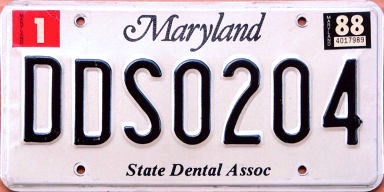


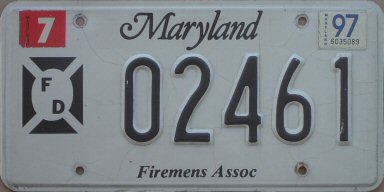
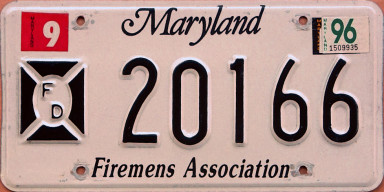
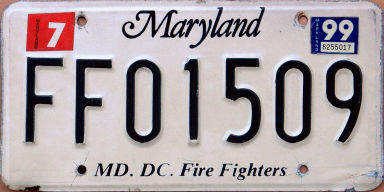
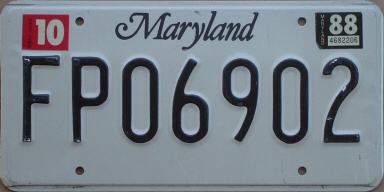




American Legion (O'Connor photo / plate);
unstickered Disabled American Veterans front plate (Kunsman plate);
State Dental Association;
David Taylor Model Basin (organization name unknown, plate in actual use);
Masonic Order (Free State Square Club; Kunsman plate);
unstickered Elks Lodge front plate; two Maryland State Firemen's Association plates, one with a screened maltese cross
emblem and the second with an embossed maltese cross;
"MD. D.C. Fire Fighters" (specific organization unknown); Fraternal Order of Police;
Izaak Walton League (Doernberg photo / plate);
Johns Hopkins University Alumni Association; Knights of Columbus (Kunsman plate);
Maryland Chevelle Club (plate in actual use);
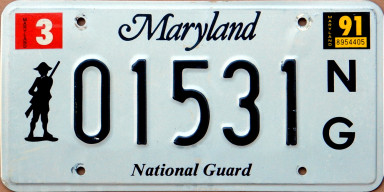
Maryland State Police Alumni Association (Olivarri plate); National Guard;
Pennsylvania State University Alumni Association; Towson State University Alumni Association;
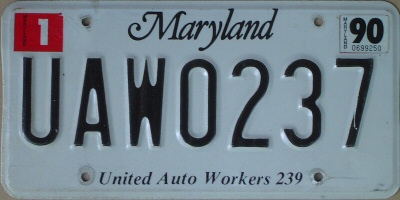
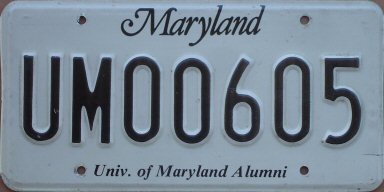
United Auto Workers Local 239; unstickered University of Maryland Alumni Association front plate
With two exceptions, for the first five years or so of the script "Maryland" base plate, all organizational member plates were non-graphic, and their plate numbers were in the formats xx00000 or xxx0000, with the letters uniquely identifying the organization. A few new organizations were given their own plates in addition to the traditional groups that had had organizational plates on the previous all-embossed bases. In most cases, the name of the organization was screened on the bottom center of the plate. Some groups chose not to clearly identify themselves on the plate; these tended to be ethnic-based and police-related organizations who wanted their members to be able to recognize each other on the road, but did not want their vehicles to become easy targets for individuals who had something against their group.
Two organizations were issued what I call minimally-graphic organizational plates during the early years of the script base. These were the same two that had had embossed graphics on the previous base – the Maryland State Firemen's Association and the National Guard. These minimal graphics were all black and at least at first, were screened onto the plate. Firemen's Association member plates had the familiar maltese cross logo with the letters "F/D" inside the center of the cross, but considered part of the serial number. Early issues of this plate had the maltese cross screened, but subsequently the embossed maltese cross reappareed, as seen in the two plates shown above. The National Guard plates had a screened minuteman silhouette, and later a screened line drawing of a minuteman. The other distinction is that these early National Guard plates had the letters "N/G" stacked on the right side of the numeric serial.
In the early 1990s, the state began making graphic organizational plates for those groups who requested them. Most did, and so their non-graphic plates ceased being issued. Many motorists with non-graphic organizational plates then traded them for the fancier variety as they became available. However, I don't think there was ever a requirement to do so. Also, a small number of groups have continued to only offer non-graphic plates to their members even today. Possible reasons include the additional anomynity the non-graphic plates provide, the organization not having a suitable logo or other graphic design, and financial considerations, as the non-graphic plates are less expensive to register.
Beginning in the early 1990s, graphic organizational plates began to appear, for old as well as new organizations. At about the same time, it seemed that every obscure organization or cause or interest group in the world was now able to get their own Maryland plate. The current rule is that an organization only needs 25 members (presumably with vehicles registered in Maryland) to qualify. Lots of individual fire stations and church congregations and labor union locals now offer their own specific organizational plates. The number of different groups with their own plates now number well over 700. Shown below is a representative sampling of available graphic plates, arranged by category of the sponsoring organization.


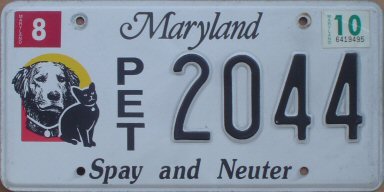


Baltimore Orioles Charitable Foundation (plate in use),
Prince George's County Crime Solvers (Lindken photo / plate),
unstickered Washington Redskins Charitable Foundation front plate (Lindken photo / plate),
Cal Ripken Sr. Foundation (plate in use),
La Leche League (plate in use),
James M. Bryan, Jr. Building Dreams for Youth Foundation (Maryland's Eastern Shore) (plate in use),
Partnership for Animal Welfare (Spay and Neuter),
Ravens All Community Team Foundation (plate in use),
Susan G. Komen for the Cure (Black plate),
Frank J. Battaglia Signal 13 Foundation (plate in use).
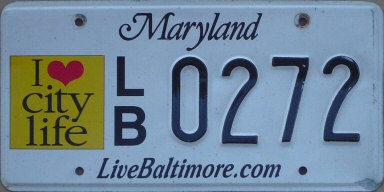
unstickered Live Baltimore Home Center front plate
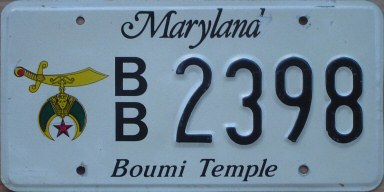


Boumi Temple (Shriners) unstickered front plate, Elks Lodge (plate in use),
Grand Lodge of Masons (plate in use),
Hiram Grand Lodge (Masons) (plate in use),
Moose Lodge (plate in use).


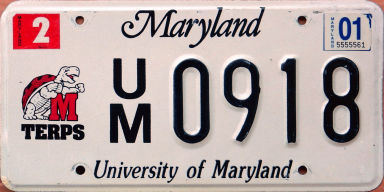


Georgia Tech Alumni Association (Lindken photo / plate);
unstickered Hampton University Alumni Association front plate;
Johns Hopkins University Alumni Association (plate in use);
Kansas University Alumni Association (plate in use);
U.S. Naval Academy Alumni Assocation (plate in use);
Northwestern University Alumni Association (plate in use);
Penn State Alumni Association (plate in use);
Princeton University Alumni Association (plate in use);
St. Mary's College Alumni Association (plate in use);
unstickered University of Maryland University College (plate in use);
University of Maryland Alumni Association, version 1 and version 2 (plate in use);
unstickered University of North Carolina Alumni Association front plate (plate in use).


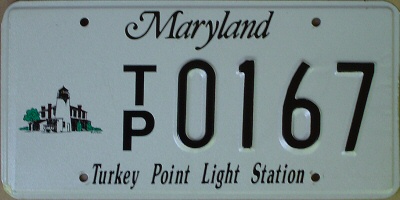
Port Deposit Heritage Corporation (Sallmen photo of plate in actual use),
Project Liberty Ship (plate in actual use),
unstickered Turkey Point Light Station front plate

Sons of Confederate Veterans (Olivarri plate)
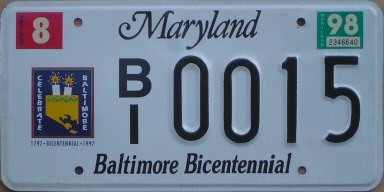


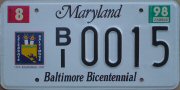
Baltimore Bicentennial Celebration Inc. (1997 event),
unstickered Maryland Commission for Celebration 2000 (Marking the Millennium) front plate
(plate in actual use),
unstickered Prince George's County Tricentennial Celebration Committee front plate (1996 event)
(Hadjadj plate)


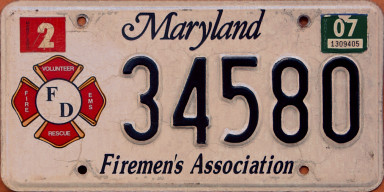


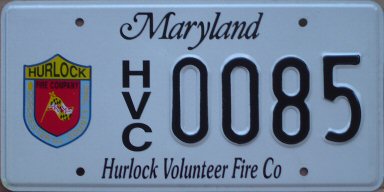

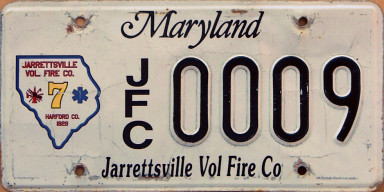
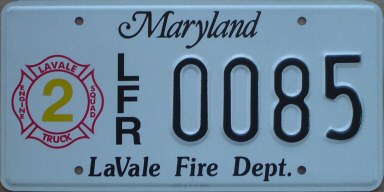


Anne Arundel Alarmers Association (Sallmen photo of plate in use);
unstickered Bladensburg Volunteer Fire Department front plate (plate in use);
IAFF Local 1311, Baltimore County (Balto County Firefighters)
(plate in use);
Earleigh Heights Volunteer Fire Company (plate in use);
Maryland State Firemen's Association;
IAFF Local 36, Washington, D.C. (DC Firefighters Local 36)
(plate in use);
IAFF Local 964, Baltimore (Balto. City Fire Officers)
(plate in use);
Glyndon Volunteer Fire Department (plate in use);
unstickered, unissued Hurlock Volunteer Fire Company;
Hollywood Volunteer Fire Department (Kunsman plate);
unstickered Jarrettsville Volunteer Fire Company front plate;
unstickered, unissued LaVale Fire Department;
generic International Association of Fire Fighters (Professional Firefighters)
(plate in use);
unstickered IAFF Local F260, Naval District of Washington firefighters front plate
(Kunsman plate);
unstickered Sykesville Freedom District Fire Department front plate (plate in use);
unstickered United Steam Fire Engine Company front plate (plate in use).


Mace's Lane High School Alumni Association (plate in actual use);
Mount St. Joseph High School Alumni Association (plate in actual use);
Stanton Bates Alumni Association (plate in actual use);
unstickered, unissued Saint James Parents Association;
Worcester Preparatory School (plate in actual use).


unstickered Amalgamated Transit Union Local 1300 front plate (Hadjadj photo / plate);
unstickered Classified Employees Association front plate (plate in actual use);
Teamsters Union (Hadjadj photo / plate);
NASA James Webb Space Telescope (exact organization name unknown) (plate in actual use);
Office of the Chief Medical Examiner (Ellis photo of plate in actual use);
U.S. Public Health Service (plate in actual use);
Maryland Association of Realtors plate with year sticker removed;
NASA Goddard Employees Welfare Association (Gazi photo of plate in use);
Society of Senates Past (Hadjadj plate);
unstickered, unissued Trial Judges Association;
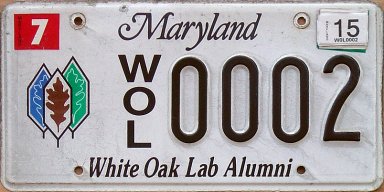
White Oak Laboratory Alumni Association


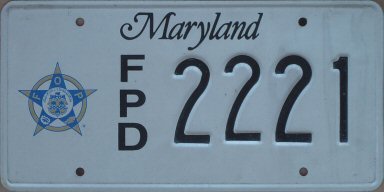


Concerns of Police Survivors (plate in actual use);
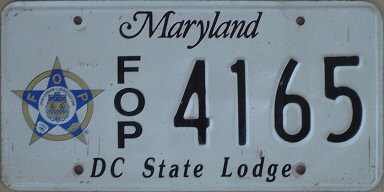
unstickered Fraternal Order of Police D.C. State Lodge front plate;
generic Fraternal Order of Police (plate in actual use);
unstickered Fraternal Order of Police Maryland State Lodge front plate;
Maryland Law Enforcement Officers Inc.(plate in actual use);
Maryland State Police Alumni Association (Olivarri plate);
Police Dispatchers Inc.(plate in actual use);
Anne Arundel County Reserve Officers (plate in actual use)
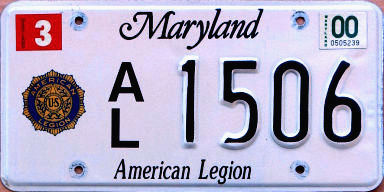



American Legion;
Chief Petty Officers Association (plate in actual use);
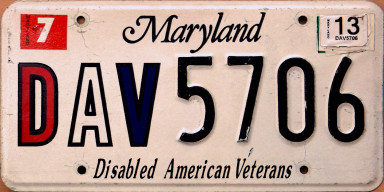
Disabled American Veterans;
U.S. Naval Academy Alumni Association (plate in actual use);
unstickered Maryland National Guard front plate (plate in actual use);
unstickered Veterans of Foreign Wars front plate (plate in actual use);
unstickered Vietnam Veterans of America front plate.


Friends of Maryland State Parks (plate in actual use);
Maryland Zoo (Ellis photo of plate in use)


Lost in the 50's Custom Car Club (plate in actual use);
Ocean City Power Squadron (McDevitt photo of plate in use);
unstickered Porsche Club of America front plate (Hadjadj photo / plate);
Maryland Scuba Association (Kunsman plate);
Saltwater Sportfishermen's Association (plate in actual use)
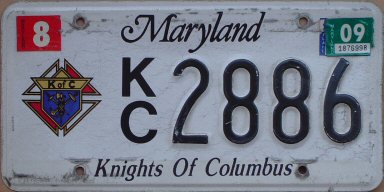

Knights of Columbus,
Queen's Chapel United Methodist Church (Jackson photo of plate in use)
All graphic organizational plates are made on the standard black-on-white, script Maryland base. The serial formats generally follow the pattern of a screened image of the organization's logo on the left side of the plate, followed by two or three stacked letters (which are considered part of the serial) uniquely identifying the organization, followed by a three or four digit serial number. Formats x/x 000, x/x 0000, x/x/x 000, and x/x/x 0000 are used. Format x/x/x 000 is not widely used because the plate numbers would conflict with those of standard passenger car plates. However, there are a few organizations that do have this format because they use at least one serial letter not issued on standard plates (I, O, Q, or U). Usually, the name of the group is screened along the bottom edge of the plate. Firemen's Association plates continue the [F/D] 00000 format introduced in the early 1970s.
Some of the plates pictured above may at first glance appear to be special interest plates; for example, the Maryland's Eastern Shore and Home of Cal Ripken Jr. plates. But they are indeed all organizational. The distribution of organizational plates are actually controlled by the organizations themselves, using whatever criteria they want. Some groups only offer their special plates to their members or employees. Some charitable groups will authorize the issuance of plates to people who have first made a donation directly to the group. In the case of the Eastern Shore plate, for example, this plate is controlled by the James M. Bryan, Jr. Building Dreams for Youth Foundation. Apparently this charitable group realized that perhaps not many people would want to pay for the privilege of displaying plates with the organization's name and logo, and that they could raise more money by offering a more appealing design that doesn't identify the group itself.
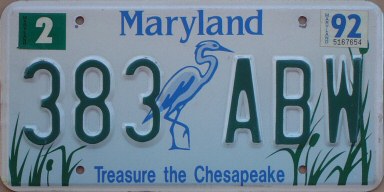
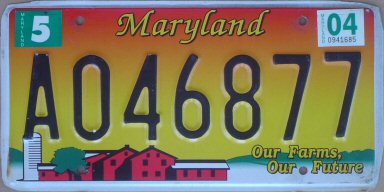
Maryland only offers two true special interest plates that are avaialable to anyone, directly through the Motor Vehicle Administration – the well known Treasure the Chesapeake (in old and new versions) and Our Farms, Our Future plates. These plates are of a completely different design than the standard-issue plates. While these plates are used to raise money for specific organizations, the MVA collects the money from the registrant and distributes it to the groups after the plates are issued. Also, these special interest plates are issued in different serial formats for use on trailers and by handicapped persons, for example, and are also available as vanity plates. Sample versions of these plates were also available to the general public for many years. None of this is applicable to organizational plates.
The best source of detailed information about current Maryland organizational plates is the Maryland Motor Vehicle Administration's web site. The section covering current organizational and military service plates contains a comprehensive listing of all available plates, and for each one, shows the name of the organization and a digital image of that group's plate. However, please note that the MVA site provides no information about obsolete organizational plates that were previously issued on the script Maryland base, including the many discontinued non-graphic organizational plates. Also, although the information is generally accurate, I have spotted a few errors.


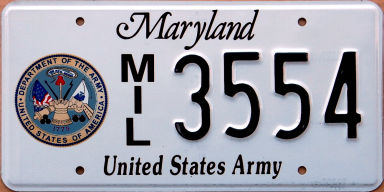
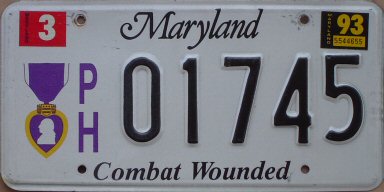
Southwest Asia Service Medal recipient (plate in actual use);
disabled veteran without handicapped parking (plate in actual use);
honorably discharged veteran (plate in actual use);
Congressional Medal of Honor recipient (Ellis photo of plate in actual use);
United States Army active duty member (unstickered front plate);
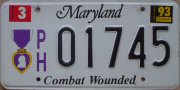
Purple Heart medal recipient.

Disabled veteran with handicapped parking
Maryland has decided it should also issue various military service related plates to veterans and medal recipients. These look just like organizational plates; the main difference is how you qualify to get a set. No organizational membership is required; you just have to be able to show that you qualify for the specific plates you want based on your military service record. Again, what is shown is only a sampling of the available types.
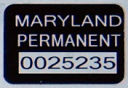 Permanent registration sticker |
Veterans classified by the military as disabled (but not necessarily members of the Disabled American Veterans organization) are issued plates with the screened legend Disabled Veteran at the bottom, which are free of charge to the registrant. Depending on whether the veteran meets the state criteria for handicapped parking priveleges, the plates either have numbering format DV00000 with no embossed wheelchair, or format DV0000 with an embossed wheelchair.
Starting in September 2016, disabled veteran plates get a white-on-black sticker for the rear plate with the words Maryland Permanent. Despite being free, I believe these plates were used with month and year expiration stickers prior to September 2016. The wheelchair plate shown above was apparently originally issued prior to September 2016, based on the presence of the month sticker. The non-wheelchair plate shown above was apparently issued sometime since then.


Harley Owners' Group, Baltimore Chapter;
Maryland State Firemen's Association;
Harley Owners' Group, Fort Washington Chapter (Pang photo);
ABATE (Sallmen photo);
generic International Association of Fire Firghters,
all in the old 4-1/2" inch by 8-1/2 inch dimensions.
All were in actual use when photographed.

Chief Petty Officers' Association (Walker plate) in the new 4 inch by 7 inch dimensions.
A number of groups have arranged for Maryland to issue graphic organizational motorcycle plates to their members. These plates have the organization's logo on the left side of the plate, and the organization's name screened at the bottom edge of the plate. Serial numbers are in the formats 0000 x/x or 0000 x/x/x, using the same letters to uniquely identify the organization as are used on full-sized plates, but on motorcycle plates the letters are at the end rather than at the beginning of the serial number.
Known organizations with motorcycle plates include the various chapters of the Harley Owners Group (each with its own suffix), various other motorcycle clubs, the state organization and various locals of the International Association of Fire Fighters union (again, each with its own suffix), the Maryland State Firemen's Association, the state lodge of the Fraternal Order of Police, the Sons of Confederate Veterans, and the Vietnams Veterans of America.
All miltary service full-sized plate types have equivalent motorcycle plate types, with the exception of the World War II Veteran plate. These look just like organizational motorcycle plates; the main difference is how you qualify to get one. No organizational membership is required; you just have to be able to show that you qualify for the specific plate you want based on your military service record.
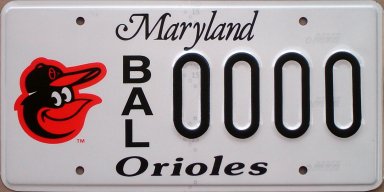
Baltmore Orioles Charitable Foundation sample plate;
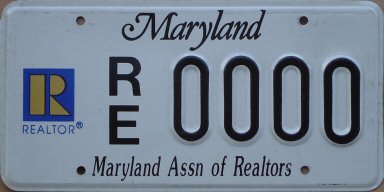
Maryland Association of Realtors sample plate
I've been told that for each of the 700+ types of organizational plate types, the MVA makes only two sample plates, with all of the numeric digits zeroes. The MVA keeps one for internal use, and gives the other to the person in that organization who coordinates the promotion and distribution of the organizational plates to its members. This enables the coordinator to use an image of the sample plate in promotional materials. Only a small number of these organizational sample plates have found their way into the hands of plate collectors.
However, that seems to have changed in the fall of 2016. The MVA had a supply of Orioles organizational sample plates, one of which I was able to obtain, and, so I've been told, Ravens organizational sample plates, which are for a charitable organzation associated with the Baltimore Ravens NFL team. I was not able to obtain one of those, unfortunately. (Just as well, I suppose. I'm a lifelong Orioles fan, but moved away from Maryland before the Ravens arrived, and my football loyalties remain with the Redskins.)
Related pages on this site |
Elsewhere on the web |
Thanks to those who have directly contributed to the information on this page: Jeff Ellis, Xavier Hadjadj, Andrew Pang, "Tiger" Joe Sallmen, David Doernberg, John McDevitt, Bill Ceravola, Jon Olivarri, Christopher Jackson, George Kunsman, Linda Black, Ralph Lindken, Wsam Gazi, and Gary Walker.
O'Connor and Pang photographs © copyright by Tim O'Connor and Andrew Pang, respectively.
All rights reserved. Used with permission.
Hadjadj, Sallmen, Doernberg, McDevitt, Ceravola, Jackson, Ellis, Lindken, and Gazi photographs are presumed to be
copyrighted by Xavier Hadjadj, "Tiger" Joe Sallmen, David Doernberg, John McDevitt, Bill Ceravola,
Christopher Jackson, Jeff Ellis, Ralph Lindken, and Wsam Gazi, respectively, and are used with permission.
Olivarri, Kunsman, Black, and Walker plates are from the collections of Jon Olivarri, George Kunsman, Linda Black,
and Gary Walker, respectively.
This page is W3C valid |