 |
|
 |
|
|
|
|
This page covers the history of special license plates that Maryland issued to members of specific organizations prior to March 1986. Included are reserved-series plates in standard passenger car plate format, and plates with distinct serial formats or other unique features. Latest noteworthy updates to this page
|
|
Organizational member plates are common in most states today, and Maryland currently leads the way with over a thousand different organizational member plates available. But did you know that Maryland pioneered issuing organizational member plates of sorts, by reserving blocks of regular-issue passenger plates for members of specific groups, reportedly as early as the 1920s? These were perhaps the very first organizational member license plates in America. This practice was, as you can imagine, rather subtle and not well documented.
When Maryland converted to a xx-00-00 serial format for the 1954 expiration plates, the practice of reserving serial blocks for organizations became somewhat more obvious. Some are well known and well documented; for example, members of the American Legion were able to obtain plates in the serial format AL-00-00. But there are perhaps many more instances where it is less than clear whether a given alpha series was reserved for an organization at all, and if it were, to which organization. On this page I've documented both organizational reserved alpha series where there is no room for doubt in my mind, as well as reserved series prefixes identified by other collectors and researchers that I have not been able to personally verify. If you find an error or have additional information, or can provide a plate or a photo of a plate that I'm missing, please send me an e-mail. There's a link to my e-mail address at the bottom of every page.
Maryland organizational member plates and renewal stickers have closely resembled or been indistinguishable from their standard equivalents from the same time period. For this reason, I shall not re-hash information available on the passenger car plate page that is applicable to all plate types – things like plate dimensions, plate colors, location of "Maryland" and the expiration date on the plate, sticker colors, etc. Deviations from regular-issue plates or stickers, whether small or large, are noted where applicable.
From 1938 until present, all Maryland license plates have displayed the year of expiration rather than the year of issuance. From 1939 until 1986, all passenger car plates expired annually on March 31. In some years, the expiration month or month and date were indicated, at other times only the expiration year was shown. I consistently refer to these plates by the year shown on the plate, rather than the year the plate was first issued.
Mouse over any image to see a description of the plate. Click on any image to see an enlarged version.
(no picture available)
Maryland passenger car plates had all-numeric serial numbers from the very beginning, up through 1953 expirations. In the June 1983 issue of the ALPCA Newsletter, Ray Frank wrote regarding Maryland passenger plates with serial number ranges reserved for members of specific organizations:
An informal reserved number series began in the 1920s with the 45,000 series allocated for the Tall Cedars, 60,000 for the Knights of Columbus, and 75,000 or 175,000 for Shriners.
This text is repeated almost verbatim in the ALPCA archives, but I haven't found any independent source that could collaborate this information or provide any additional details. I have seen plates on eBay that lead me to believe that the 45-000 was indeed issued to members of the Baltimore Forest (chapter) of the Tall Cedars of Lebanon. I think it's very likely that additional organizations also had reserved blocks of serial numbers through 1953.
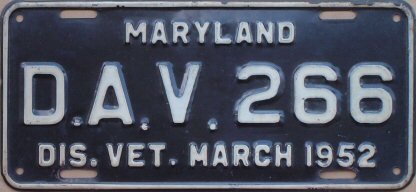

1952 and 1954 Disabled American Veterans
These plates don't fit neatly into the date ranges of the sections above or below, so I decided to give them their own section.
Distinctive and clearly marked plates were issued to members of the Disabled American Veterans beginning on the 1948 base. To my knowledge these were the only overt organizational member plates issued during the time period 1910-1956, at least. The center part of the plate carried the large letters "D. A. V." followed by a serial number, which on every example I've seen, is a two- or three-digit number.
I'm under the impresssion that DAV pates were reissued each year, similar to motorcycle plates, rather than renewed with metal tabs like most other plate types were for 1949-1951 and 1953. The 1952 plate shown above has no tab slots where a '53 renewal tab could be affixed. Also, from what I understand, the 1952 plate design was used for that one year only, while the 1954 plate design shown above was also used for the years 1948-1951, 1953, and 1955, but with different colors. The large organizational legend at the bottom on these plates was quite distinctive. I believe, but am not certain, that 1956 expiraiton DAV plates also looked like the 1954 plate.
During this period, organizational member plates were pretty much limited to various military veterans' organizations, volunteer firefighters, certain groups affiliated with Masons and Shriners, and various other civic organizations.
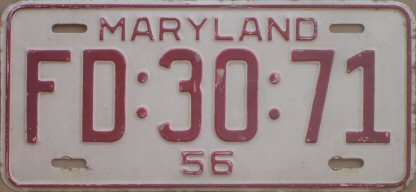

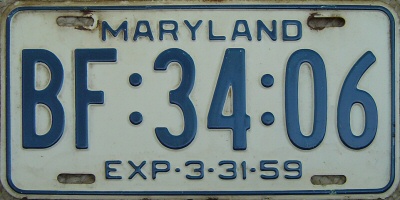

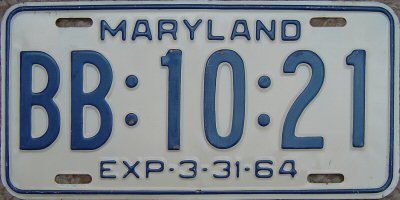

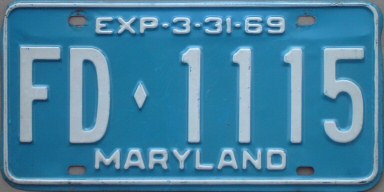
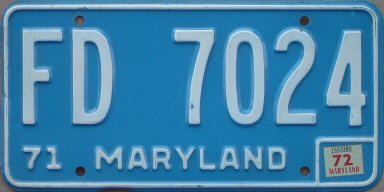

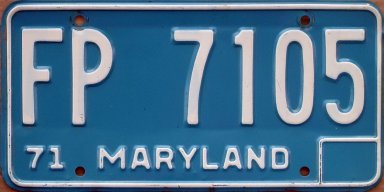

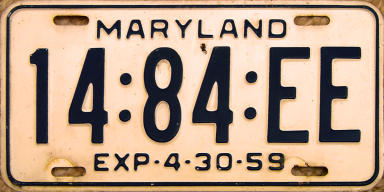
1956 Firemen's Association, 1959 Boumi Temple (Shriners), 1959 Tall Cedars of Lebanon - Baltimore Forest (Masons),
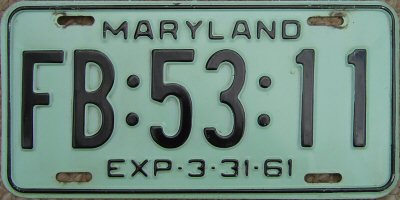
1960 Elks Association, 1961 Optimist Club, 1964 Boumi Temple (Shriners), 1967 American Legion,
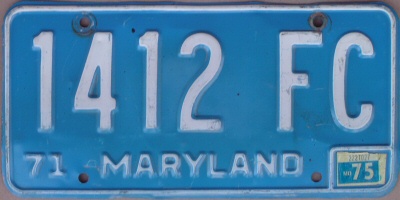
1969 and 1972 Firemen's Association, 1972 Prince Hall (Masons), 1971 Fraternal Order of Police,
1971 Rotary International
During this 22 year span, standard Maryland passenger car plates had serial formats that consisted of two letters followed by four numbers. The specific format varied from xx-00-00 to xx-0000 to xx 0000 as the years went on, and the embossed separator characters varied between dashes, diamonds, and colons.
During this time, a number of organizations were able to reserve specific passenger plate letter prefix combinations for their members. For example, members of the American Legion could get passenger plates with an AL serial prefix. In the vast majority of cases, these reserved series organizational plates were otherwise indistiguishable from regular passenger car plates. Only very keen observers of license plates or those familiar with a specific organization knew there was anything special about these plates. However, a few organizational passenger plate prefixes are fairly apparent to plate historians because the prefixes fall outside of the range issued on standard passenger car plates.
Today, decades later, there is another valuable clue to help determine whether a given alpha prefix was a reserved organizaitonal series. Standard passenger car plates were issued randomly each year; regular motorists couldn't keep the same registration number from one year to the next. By contrast, organizational member plates were distributed by the organization as they saw fit (often with the organization's leaders getting the lowest numbers). Frequently, individual members were able to obtain from the organization the same plate number year after year. So, if you see a series of Maryland plates spanning several years, and the plates all have the same number, you're almost certainly looking at organizational member plates of some kind.
At the bottom of this page is a table of passenger car plate prefixes that are verified, reported, or suspected to have been reserved for organizational members.
Regular truck plates during this time had serials consisting of four numbers followed by two letters, in the formats 00-00-xx, 0000-xx, or 0000 xx depending on the year. Other types of non-passenger vehicle plates also shared these formats, and so the first letter in the serial suffix is key to identifying the vehicle type. Personal light trucks were issued plates with the first letter always an E through 1970, and with the first letter D, E, or J on the 1971 base.
Some people assume that suffix EE truck plates were a Masonic Order reserved series, since prefix EE was a passenger prefix reserved for Masons. Back then, most regular-issue truck plates had suffixes that began with E, and so EE suffix truck plates were simply standard, sequentially-issued truck plates. In support of this assertion, I've never seen any truck plates with, say, suffixes AL or BB or CC, which are other known organizational passenger plate prefixes. There's no reason to think that Masons would have been treated any differently than the American Legion or Shriners or the Knights of Columbus when it came to having reserved-series truck plates. Also, on later bases, no organization with reserved passenger-format plates ever had reserved truck-format plates.
The only standard-format truck plate with a reserved organziational suffix that might have possibly been issued during this time was the Firemen's Association personal truck plate, which would have had had an FD suffix. I have vague memories of seeing these on 1971 base prior to the intoduction of the distinct format Firemen's Association personal truck plate with the maltese cross emblem. But I'm now second guessing whether I might have been imagining things, because in the years I've been collecting plates since 2003, I've never come across one or even seen a photo of one.
FD, of course, is outside the bounds of normal light truck serial suffixes. Suffixes FA, FB, and FC were issued to truck tractors on the 1971 base, but the FD suffixes would have been issued to pickup trucks and other personal light trucks. It's intersting to note that on the 1976 and 1981 bases, truck tractors were issued plates with the letters FA, FB, FC, and FE as prefixes, but they skipped prefix FD, even though by then firefighter organizational plates had a completely different format.
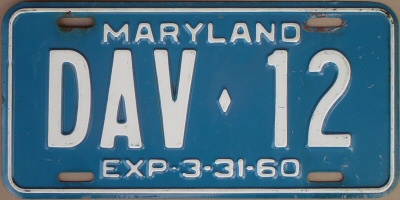

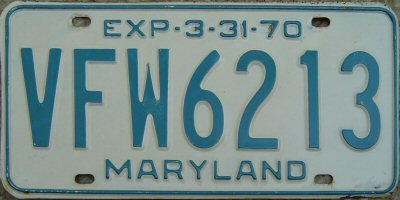
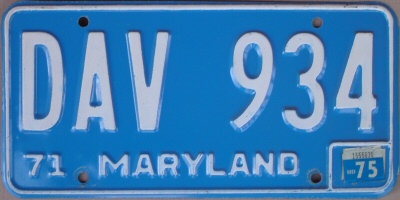
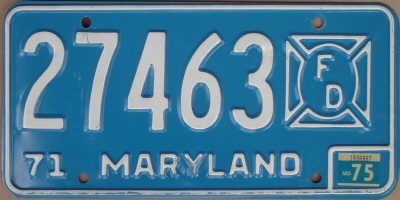
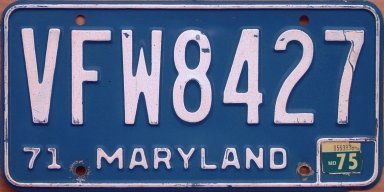
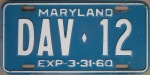
1960 Disabled American Veterans, 1966 Veterans of Foreign Wars,
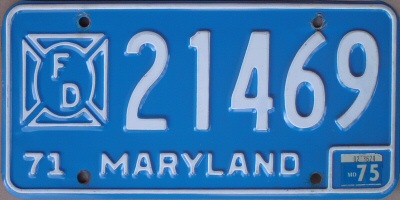
1970 Veterans of Foreign Wars, 1975 Disabled American Veterans, 1975 Firemen's Association personal car,
1975 Firemen's Association personal truck, 1975 Veterans of Foreign Wars
During this period, organizational plates issued to members of the Disabled American Veterans and the Veterans of Foreign Wars were very distinctive because they bore the three-letter prefixes DAV or VFW, respectively. Starting with the 1957 expiration plate, DAV plates became somewhat more conventional in appearance. I don't have any information about 1950s VFW plates; I suspect these weren't introduced until the early-to-mid 1960s.
Through the 1967 expiration plates, serial numbers on DAV and VFW plates were limited to six characters. Since the VFW, at least, had more than 999 members' vehicles registered, a variable letter can often be found in either the fourth, fifth, or sixth character positions through 1967. Beginning with 1968 expirations, VFW and DAV plates could have up to seven character serial numbers, and letters in positions other than the organizational prefix were no longer used. I don't know exactly which year the DAV first had 1,000 members' vehicles registered.
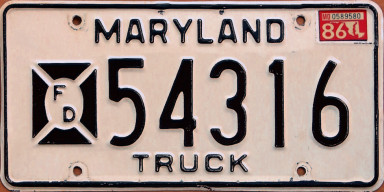
Partway through the life of the 1971 base plate, Firemen's Association reserved passenger series plates in the format FD 0000 were discontinued and/or recalled. The most recent year sticker I've seen on any of these is the '72. These were replaced with new plates in the format [F/D] 00000, with the letters FD inside of an embossed maltese cross on the left side of the plate. At the same time, Firemen's Association organizational member plates with format 00000 [F/D] with the maltese cross on the right were made available for firefighters to use on their personal trucks.
Nowadays, these old firefighter organizational plates with the maltese cross are regularly mistaken for plates issued to actual firefighting equipment. But these white-on-blue plates were only issued to personal vehicles owned by members of the Maryland State Firemen's Association, which is a volunteer firefighters' organization. Official fire department plates from this era were always white-on-red in color, and had the name of the specific fire department embossed on the plate, to the best of my knowledge.
I've seen sample or prototype 1971 base National Guard organizational plates with an embossed minuteman figure, but I've never seen one of these that was actually issued.
Starting with the undated red-on-white 1976 base, and continuing with the undated black-on-white 1981 base, Maryland passenger plates were issued with serial format xxx 000. Most organizations that previously had two-letter reserved passenger prefixes readily adapted to the new format. Those not likely to exceed 1,000 registrations used reserved three letter-prefixes, while larger organizations claimed all combinations within a reserved two-letter block. For example, while Lions Club members had the LC 0000 series reserved in the previous format, they now had the LCA 000 through LCZ 000 series reserved. In reality, no organization ever reached the letter Z, but in theory they could have. While the previous format provided 8,999 plate numbers (each series began at 1001), the new format offered 21,978 distinct serial numbers (each series begain at 001; letters I, O, Q, and U were not used as variable letters).
The most significant exception to the conversion to three-letter reserved series passenger plates was the American Legion. This organization was permitted to retain its traditional AL prefix on the 1976 and 1981 bases, so its plates went from being a reserved passenger-format series to a distinct format altogether.
It's been reported that, unlike other plate types, existing organizational member plates were not renewed in March 1986 with staggered expirations ranging from October 1986 to September 1987, but rather these plates were replaced in March 1986 with organizational plates on the new reflective base that had just been introduced. However, the evidence seems to contradict this report, as numerous examples of organizational member plates with staggered expirations can be readily found, including a few such examples shown below. Since all of these examples are organizational member plates with reserved passenger plate prefixes, I think what's more likely is that perhaps only the organziational member plates with distinct formats were replaced in March 1986, while the reserved passenger prefix plates were renewed one last time along with non-organizational passenger car plates.
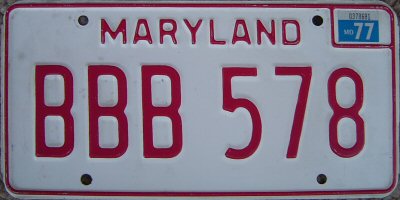

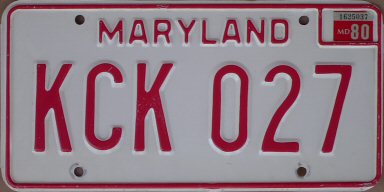
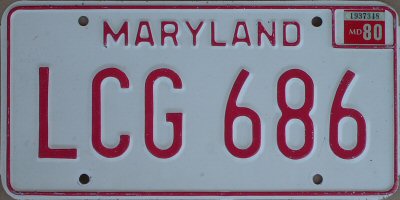

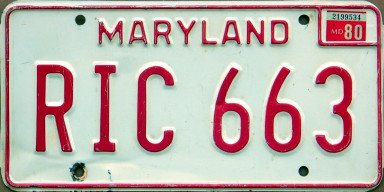
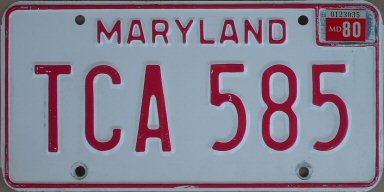
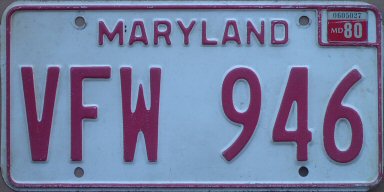
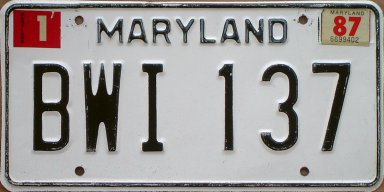
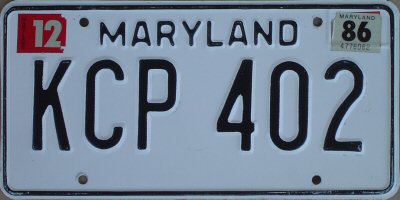
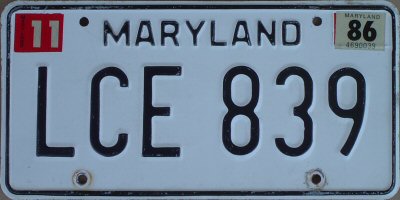
1977 Boumi Temple (Shriners), 1980 Hiram Grand Lodge (Masons), 1980 Knights of Columbus, 1980 Lions Club,
1980 National Guard (Ellis photo / plate), 1980 Rotary International,
1980 Tall Cedars of Lebanon (Masons), 1980 Veterans of Foreign Wars, 1987 BWI Business Partnership, 1986 Knights of Columbus,
1986 Lions Club
On the red-on-white 1976 base, standard Maryland passenger plates were initially issued up to the late Dxx series, and were eventually issued into the HNx series. On the black on white 1981 base, standard passenger plates were first issued up to the mid Exx series, and ultimately made it up to the KHM series. Some of the reserved-series organizational plates fell within the bounds of the initial range of standard issues, and therefore did not stand out in any way. But a larger number had reserved series that were beyond the intial range, or were even beyond the complete range of standard plates. These organizational plates practially jumped out at me as I traveled the streets and highways of Maryland during the life of these two bases. Today, passenger-format plates with serials beyond the normal issuance range for each of these bases, such as the Lions Club and Tall Cedars of Lebanon plates pictured above, are clearly organizational plates.
Disabled American Veterans and Veterans of Foreign Wars plates serial formats continued unchanged from previous bases, and so those with three-digit serial numbers now had the same xxx 000 serial format as regular passenger car plates. However, for unknown reasons, on the red-on-white 1976 base, such plates were made with 1957-1974 serial dies. Compare the "6" and "9" dies on the VFW plate above with those on other 1976 and 1981 base plates. DAV and VFW plates with serial format xxx 000 on the black-on-white 1981 base used current serial dies for numeric digits, but the letter dies were extremely narrow; these are described further in the next section.
At the bottom of this page is a table of passenger plate prefixes that are verified, reported, or suspected to have been reserved for organizational members.
(There were no reserved-series standard format organizational truck plates on the 1976 or 1981 bases.)
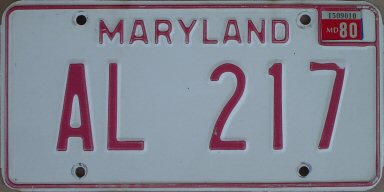

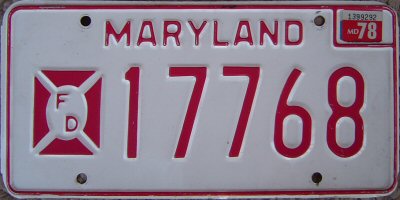

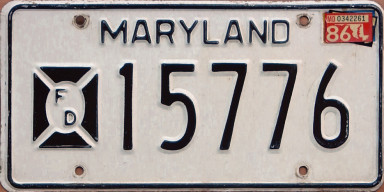

1980 American Legion, 1980 Disabled American Veterans, 1978 Firemen's Association personal car,
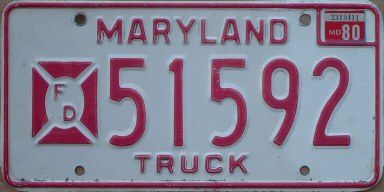
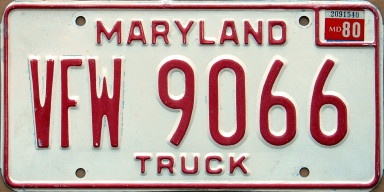
1980 Firemen's Association personal truck, 1980 Veterans of Foreign Wars truck (late issue with narrrow letter dies),
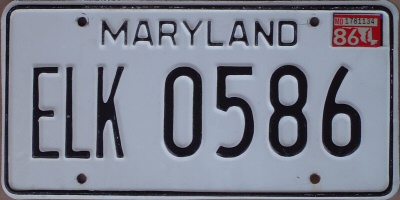
1986 American Legion (O'Connor photo / plate), 1986 Elks Lodge,
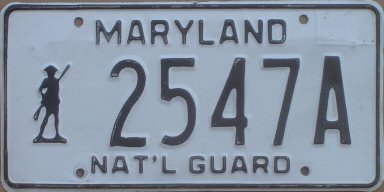
1986 Firemen's Association personal car, 1986 Firemen's Association personal truck, 1981 National Guard,
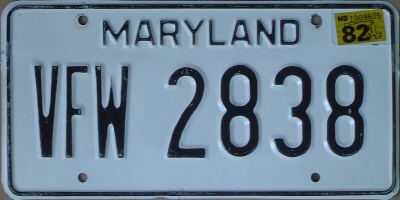
1982 Veterans of Foreign Wars car, 1986 Veterans of Foreign Wars truck
Organizations that previously had distinct formats continued to do so, and a couple of additional organizations received distinct formats on the 1981 base. On both the 1976 and 1981 bases, members of at least some organzations with distinct formats could also register their personal trucks with organizational plates; like other truck plates of this time, organizational truck plates had the word "Truck" embossed along the bottom edge of the plate.
On both the red letter and black letter plates, the Firemen's Association members' personal car plate format continued unchanged from the previous base, except that the maltese cross figure was no longer hollow. However, on the equivalent personal truck plate, the maltese cross was moved from the right side to the left side. Different placement of the cross was no longer necessary to distinguish truck plates from car plates, because truck plates now had the word "Truck" embossed at the bottom of the plate. Again, these plates are now commonly mistaken for official fire department vehicle plates, especially in the case of the truck plates.
Disabled American Veterans and Veterans of Foreign Wars plates also continued their previous formats on the red-on-white 1976 base. However, for unknown reasons, these plates were initially made with 1957-1974 serial dies. Compare the numeric dies on the DAV plate above with those on other 1976 and 1981 base plates. The letters DAV and VFW, respectively, were followed by a one-to-four-digit serial number. DAV and VFW plates with three-digit serials otherwise looked like standard format plates on the red-letter base. DAV and VFW truck plates were issued for the first time, and had the word "Truck" embossed on the bottom.
On late-issue red-letter plates, and on all black-letter plates, DAV and VFW plates were made using current serial dies, but with the letters DAV and VFW stamped using espeically narrow dies regadless of the number of numeric digits, so that even four-digit serials had a space between the letters and numbers. Otherwise, the characteristics of these plate were the same as those of the earlier 1976 base plates.
American Legion plates joined the ranks of distinct format organizational plates on these two bases, keeping the AL prefix, but now issued with a variable number of numeric digits. Trucks were also included, and had a "Truck" legend at the bottom.
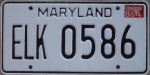
Elks Lodge plates switched from the reserved-series BEx standard format plates on the red-letter base, to distinct format, narrow-die ELK series plates on the black-letter base, with four-digit serials only. National Guard plates switched from reserved-series NGx standard format red-letter plates to distinct format black-letter plates. The black-letter National Guard plates had an embossed minuteman figure on the left, a serial number in format 0000x, and the embossed legend Nat'l Guard at bottom center.
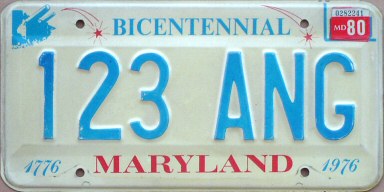
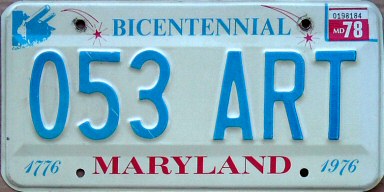

1980 National Guard, 1978 Maryland Institute College of Art, and 1980 Disabled American Veterans plates on the
Bicentennial base
At least a few groups were able to get organizational member plates made on the extra-cost Bicentennial special interest base plate. The ones I know about are apparent either because they have serial numbers beyond the range of sequentially-issued plate numbers, or they've got a distinct serial format. Passenger car plates on this base were issued in the 000 xxx serial format; the highest-known sequential plates issued were in the AFH series.
Bicentennial plates with serial format 000 ANG are reported to have been issued to members of the Air National Guard, but I think that this might be based either on speculation rather than fact, or on incomplete information. I myself believe that these were in fact made available to all members of the Maryland National Guard, whether Army or Air.
Other Bicentennial plates were issued with the format 000 ART. The report on these is that they were issued to people associated with the Maryland Institute College of Art, which apparently was involved with the design of these plates. I concur that this is the most likely explanation for these.
Lastly, there are Bicentennial plates with the letter suffix DAV. I've only seen a couple of these, which makes me think that far fewer than 2,743 of these (as suggested by the serial number of the plate shown above) were actually issued. It's clear that these were organizational member plates for members of the Disabled American Veterans, as vanity plates were not issued with more than six serial characters. Anyway, I'm guessing that these may have been made-to-order, with the serial number preserved from the member's plate number on the standard plate, and the letters DAV moved from the prefix position to the suffix position. Besides serial format 0000DAV, I've also seen serial format 00 DAV, so I assume that formats 0 DAV and 000 DAV are also out there.
Whether other groups were able to get Bicentennial plates with their usual identifying letters as serial suffixes, I can't really say. I don't know of any.
The following table lists information about organizations that had their own Maryland license plates prior to March 1986, which were possibly renewed through September 1987. There have been many hundreds of additional groups that have been issued plates since then, and I'm not going to even pretend to keep up with them all. Current Maryland organizational plates are listed on the Maryland MVA web site.
Although I can personally vouch for much of the information on this table, there are still bound to be omissions, inaccuracies, and downright wrong information. If you can provide any additional or clarifying information, please send me an e-mail.
| Organization Name | 1954-1975 Format(s) | 1976-1987 Format(s) | Notes |
|---|---|---|---|
| Standard passenger plates | xx 0000 | xxx 000 | |
| Ali Ghan Temple (Shriners) | AG 0000 | AGx 000 | |
| American Ex-Prisoners of War | POW 000 | ||
| American Legion | AL 0000 | AL 0, AL 00, AL 000, AL 0000 | Also used on trucks, 1976-1987; these have embossed "Truck" at the bottom. |
| B'nai B'rith (Jewish) | BN 0000 | BNx 000 | |
| Boumi Temple (Shriners) | BB 0000 | BBx 000 | |
| BWI Business Partnership | BWI 000 | ||
| Civil Air Patrol | CAP 000 | ||
| Maryland State Dental Association | DDS 000 | ||
| Disabled American Veterans | DAV 0, DAV 00, DAV 000, DAV0000 | DAV 0, DAV 00, DAV 000, DAV0000, DAV 0000 (standard bases); 0 DAV, 00 DAV, 000 DAV, and 0000DAV (Bicentennial base, 1976-1980) | Also used on trucks on the standard bases, 1976-1987; these have embossed "Truck" at the bottom. |
| Elks Lodge (B.P.O.E.) | BE 0000 | BEx 000 (1976-1980), ELK 0000 (1981-1987) | |
| Maryland State Firemen's Association (volunteer firefighters) | FD 0000, [F/D] 00000 | [F/D] 00000 | These formats issued to private passenger cars. |
| Maryland State Firemen's Association (volunteer firefighters) | 0000 FD (?), 00000 [F/D] | [F/D] 00000 | These formats issued to private trucks; 1976-1987 plates have embossed "Truck" at the bottom. |
| Free State Square Club (Masons) | EE 0000, EF 0000 | EEx 000 | "Free State Square Club" is an umbrella group for Maryland Masons. |
| Fraternal Order of Police | FP 0000 | FPx 000 | |
| Hiram Grand Lodge (Masons) | HG 0000 | HGx 000 | |
| Holy Name Society (Catholic) | HNA 000 (?) | See Note 1 below. | |
| Maryland Institute College of Art | 000 ART | On 1976-1980 Bicentennial base only. | |
| Jerusalem Temple (Shriners) | BJ 0000 | BJx 000 | |
| Knights of Columbus (Catholic) | CC 0000 | KCx 000 | See Note 2 below. |
| Lions Club | LC 0000 | LCx 000 | |
| National Guard | NGx 000 (1976-1980 standard base); 000 ANG (1976-1980 Bicentennial base); ± 0000x (1981-1986 standard base) | 1981 base had an embossed minuteman in the "±" position, and embossed legend "Nat'l Guard" at the bottom. | |
| Optimist Club | FB 0000 | FBx 000 | |
| Maryland Pharmaceutical Association | RXx 000 | ||
| Maryland Press Club | MP 0000 | MPx 000 | |
| Prince George's County Council | PGC 000 | Issued in very small quantities; however, I did actually see one of these on the road at the time. | |
| Prince Hall (Masons) | FM 0000 | FMx 000 | |
| Maryland Psychological Association | PSY 000 | ||
| Rotary International | RI 0000 | RIx 000 | See Note 3 below. |
| Tall Cedars of Lebanon (Masons) | BF 0000 | TCx 000 | |
| Veterans of Foreign Wars | VFW 0, VFW 00, VFW 000, VFW 00x, VFW 0x0, VFW x00, VFW0000 | VFW 0, VFW 00, VFW 000, VFW0000, VFW 0000 | Also used on trucks, 1976-1987; these have embossed "Truck" at the bottom. |
| Yedz Grotto (Masons) | BG 0000 | BGx 000 | |
| unknown organization | BP 0000 | ||
| unknown organization | DB 0000 | ||
| unknown organization | JEA 000 | ||
| unknown organization | MTx 000 | ||
| unknown organization | PPG 000 | Possibly somehow related to PPG Industries, Inc., the glass and paint manufacturer. |
 This plate was issued about August 1980. |
Note 1: Black-on-white passenger car format plates in series HNA through HNE were issued out of sequence in mid-year 1980, partway through the first year of what I refer to as the 1981 base. Other passenger car plates in the mid-H-series weren't issued until early 1985 or so. It has been stated by some knowledgeable collectors that these must have been organizational member plates for the Holy Name Society, which is a Catholic organization. Indeed, the Holy Name Society does have its own plates in format HNA0000 on the current screened "Maryland" base. But, but, but... I personally knew someone who was issued an HNE-series pair of plates in August 1980, and she and her family were Mormons. Also, a plate collector familiar with the Holy Name Society tells me that it's a very small organization that would have never been able to support 5,000 member vehicle registrations in 1980.
Rather, I've concluded that what likely happened is that late in the life of the previous red-on-white base, two batches of HNA-HNE series passenger car plates were inadvertently stamped. The first batch had its embossed features painted red and was issued during the final months of the red-on-white base. The mistake was discovered before the second batch had its raised areas painted. So, the embossed features on this second batch of plates were painted black, and rather than having to keep them in storage for several years until they would be in sequence, the plates were just distributed to new registrants as ordinary passenger car plates, once the black-on-white plates were on the street.
Or, perhaps both were partly true – maybe the HNA plates were issued as organizational member plates, since that's the letter code the Holy Name Society uses on their current plates, and the HNB through HNE plates were given out to the general public as regular passenger car plates. We may never know for sure, unless someone can provide additional information about these plates.
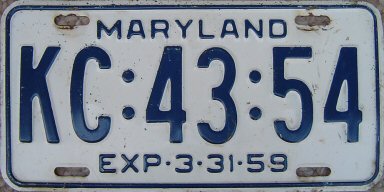 I'm convinced this is not a Knights of Columbus plate. |
Note 2: KC 0000 has been reported as a Knights of Columbus organizational member plate format during the years 1954-1975, but I'm pretty much convinced that it is not. KC-series plates were issued through 1961 expirations, when only letters A through L were used for passenger plates, and sequentially-issued passenger plates did get up into the Lx series. During expiration years 1962-1970, letters A through Z were used for passenger plates, and sequentially-issued passenger plates didn't get past the Jx series during any of these years. During this time, no KC series plates were issued. This leads me to believe that KC series plates were just regular passenger plates, not organizational member plates. Either that, or the Knights of Columbus switched from KC to CC somewhere along the way. On the 1971 base, which was used for five years, passenger plates got up to the SC series. I don't recall having seen a KC series plate on the 1971 base, but they may very well exist as regular passenger plates. Format CC 0000 is verified as a Knights of Columbus organizational member plate during the two-letter years, as is format KCx 000 during the three-letter years.
Also, fellow plate historian Jeff Ellis reports that some late-issue KCx-series plates on the black-on-white 1981 base were issued to motorists who were not members of the Knights of Columbus, similar to what I've documented immediately below regarding late-issue 1976 base Rotary Club plates.
Note 3: In 1979, a fellow college student I knew bought, or had bought for her, a used car. New 1976-base Maryland plates with natural 1980 expiraitons were issued to this car; the registration number was in the RIG 000 series. I asked her at the time whether she or any family members were associated with the Rotary Club, and she responded that they were not. She had no idea how she ended up with RIG-series plates. Apparently, the MVA office where the car was registered had more reserved-series Rotary plates stockpiled than they were going to be able to use before the 1976 base was replaced in 1980, and/or they had run out of regular passenger car plates, so they began issuing reserved-series Rotary plates to people not associated with the Rotary Club. The sequential high for passenger car plates on this base was somewhere in the mid-H series, and the letter "I" has never been used on plates intended for standard issue (with the exception of 1987-1988 charter buses).
Related pages on this site |
Elsewhere on the web |
Thanks to those who have directly contributed to the information on this page: Jeff Ellis, Ross Day.
O'Connor photograph © copyright by Tim O'Connor. All rights reserved. Used with
permission.
Ellis photograph is presumed to be copyrighted by Jeff Ellis, and is used with permission.
This page is W3C valid |