 |
|
 |
|
|
|
|
This page presents the history of Maryland passenger car license plates from 1904 through those expiring in March 1975. Latest noteworthy updates to this page
|
|
From 1910 until 1937, Maryland license plates displayed the year of issuance. During most or all of that period, plates were valid during the calendar year and expired on December 31 of the year indicated. Plates issued in 1938 indicated the expiration date of March 31, 1939 on the plate. Thus, there was no dated 1938 plate. From no later than 1939 until 1986, all passenger car plates expired annually on March 31, and indicate on the plates themselves, or via metal tabs or stickers, the year in which they expire. In some years, the expiration month, or month and day were indicated, at other times only the expiration year was shown. I consistently refer to plates by the year that is shown on the plate, tab, or sticker, regardless of when the plate was actually issued.
All Maryland passenger car plates from 1910 to 1944 were issued in pairs. 1945 to 1947 plates were issued as singles; 1948 to 1953 plates were issued in pairs; 1954 and 1955 plates were issued singly. All Maryland passenger car plates since those expiring in 1956 have been issued in pairs. All Maryland passenger car plate numbers from 1910 to 1953 were all-numeric, but not all all-numeric plates were for passenger cars. The 1957 expiration plates were the first to conform to the North American standard dimensions of 12 inches wide by 6 inches high.
This page addresses sequentially-numbered Maryland passenger car plates. However, while studying these, it's important to be aware of the existence of organizational member reserved-series plates, which between 1954 and 1986 expirations, had passenger car numbering formats with specific letter prefixes. Often, these reserved serial letters were within the range of sequentially-issued plates and cannot be readily distinguished without knowing the specific reserved letter codes. In other instances, the letter codes reserved for an organization were outside the range of sequentially-issued plates, or included letters such as the letter "I" that were not used on sequential passenger car plates. These organizational member plates are are only mentioned in passing on this page, as they're covered in detail on my Maryland organizational member plates through 1986 page.
Similarly, but even less obvious and certainly less well-documented, are the ranges of all-numeric plate numbers reserved for purposes other than statewide passenger car registrations from 1910 through 1953. I address these to the extent that I know about them throughout this page.
I sincerely hope that you find this information useful. If you find an error or have additional information, or can provide a plate or a photo of a plate that I'm missing, please send me an e-mail. There's a link to my e-mail address at the bottom of every page. Please note that all plates shown that are credited to another person are plates that I am still seeking for my own collection.


The solid plate number 5918 went on the rear, while its fraternal twin, the mesh 5918 plate, was obviously intended to be
mounted on the front. The holes allowed air to pass through to the radiator.
(Plate numbers 807, 1643, and 5918 – Willard plates; plate numbers 3232 and 9745 –
Francis plates; plate number 3908 – photo provided by and plate owned by an individual who does not wish to be
credited.
Like many other states at the time, the state of Maryland began requiring vehicles to be registered with the state several years before it actually issued license plates. In Maryland's case, vehicle registration began in 1904, but state-issued plates were not produced until July 1910. During the intervening years, motorists were required to display their state-issued registration number on their vehicles. This was usually done using license plates that were either homemede or made from a kit. As you can see, a wide variety of materials and styles were used. One of the more popular methods was to attach metal house numbers to a piece of dark-colored leather. Motorist-provided and/or locally-issued plates that preceded state-issued plates are collectively called "pre-states".
Many Maryland pre-state plates have a consistent format of the registration number followed by the stacked state abbreviation "M/D". These are obviously Maryland pre-state plates. But many pre-state plates that are known to be from Maryland did not have any state identifier, just the registration number. Others identified the state in fairly obscure ways, such as simply with the letter "M" before the plate number. During the pre-state years, once a motorist registered his vehicle with the state and was assigned a registration number, he kept that number indefinitely. There was therefore no reason to put the year on the plate. Registration numbers began at number 1 and got up into the 9000s during this six-year period. Based on the numbers of vehicles registered each year, one can determine the year that a given registration number was first assigned.


(1910 – Ritterhoff plate)
The state of Maryland first issued license plates in July 1910, and during the first several years, the plates changed frequently and substantially. The 1910 passenger car plates were reportedly made of tin and were hand-embossed and hand-painted. Serial numbers could be from one to four digits, and to the right of the serial were the letters M and D displayed vertically, and below that, the year 1910 displayed horizontally. Jim Fox describes these plates further in his 1997 book, License Plates of the United States:
The 1910 plate is made of a particularly thin metal, and was lightly embossed by hammering the plate over wooden dies. This manufacturing process produced one of the most primitive of all state issues and has made finding a fine example of a 1910 Maryland plate a real challenge!
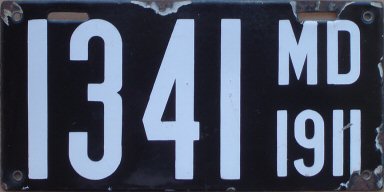
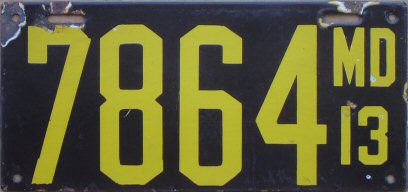
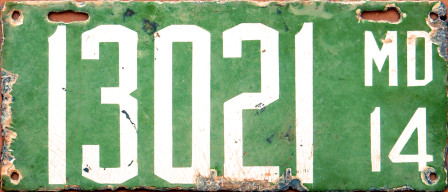
Apparently Maryland realized that the passenger car plates they issued in 1910 were of inferior quality, because in 1911 they switched to much more durable steel coated with porcelain. Passenger car plates were made of these materials through 1914. During these years, the serial numbers for passenger car plates could be four or five digits. To the right of the serial were the letters MD displayed horizontally, above the year which was also horizontal. In 1911 and 1912, the year included the century, and serials began at either 1000 or 1001; in 1913 and 1914, only the last two digits of the year were indicated, and serials began at 2000 or 2001. My four-digit 1911 plate measures 12 inches by 6 inches, the same size as modern plates. My four-digit 1913 plate measures 12 3/4 inches by 6 inches, and my five-digit 1914 plate is 14 inches by 6 inches. There were two varieties of the 1914 plate; numbers up to about 16000 had the "M" in the state abbreviation with the center point above the bottom of the two legs, while numbers higher than that had the "M" with the center point level with the bottom of the two legs.
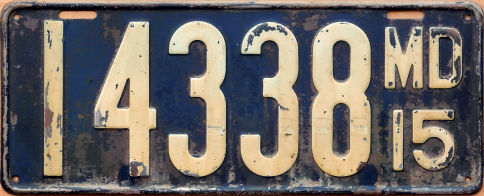
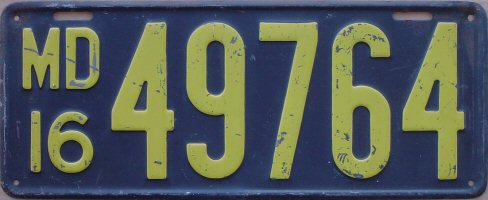
For 1915, Maryland again switched materials and maufacturing processes, this time to embossed heavy steel. The basic layout remained the same, with the letters MD over the two-digit year, to the right of the serial number. 1916 plates were similar to the 1915s, except that the state abbreviation and two-digit year were moved to the left of the serial. This was likely done because the colors of the 1916 plate were very close to those of the 1913 plate; the different location of the state abbreviation and year made the plates visually different. In 1915 and possibly 1916, passenger car serial numbers began at 4000 or 4001. Plate sizes during these years were approximately 15 inches by 6 inches, but the exact measurements of plates in my collection vary between 1/8 inch less than, to 1/4 inch more than these dimensions.
Unlike today, motorists who crossed state lines were often required to register their vehicles in each jurisdiction in which they drove. This was particularly evident in the Washington, D.C. area. D.C. is bordered by Maryland on three sides, and its residents often crossed into Maryland (and vice-versa). I've seen many vintage photos of passenger cars displaying both D.C. and Maryland plates. I mention this because other license plate historians have apparently determined that blocks of Maryland plate numbers were reserved for residents of Washington, D.C. who drove into Maryland. This is reported to have occurred from 1910 through 1923. The specific plate number ranges varied from year-to-year, and it's not completely clear what those were in any given year. The vintage photos aren't much help, because Maryland residents who drove into D.C. also displayed plates from both jurisdictions.
| 1910 – | black on yellow | – hand-embossed thin tin | – M / D / 1910 right |
|---|---|---|---|
| 1911 – | white on black | – porcelain | – MD / 1911 right |
| 1912 – | blue on white | – porcelain | – MD / 1912 right |
| 1913 – | yellow on black | – porcelain | – MD / 13 right |
| 1914 – | white on green | – porcelain | – MD / 14 right |
| 1915 – | white on blue | – embossed heavy steel | – MD / 15 right |
| 1916 – | yellow on black | – embossed heavy steel | – MD / 16 left |


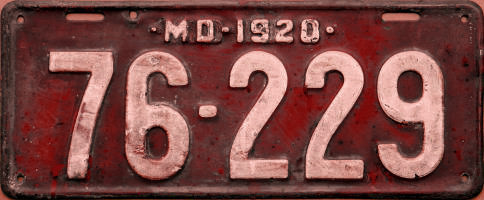 1918 plate restamped to 1920 |
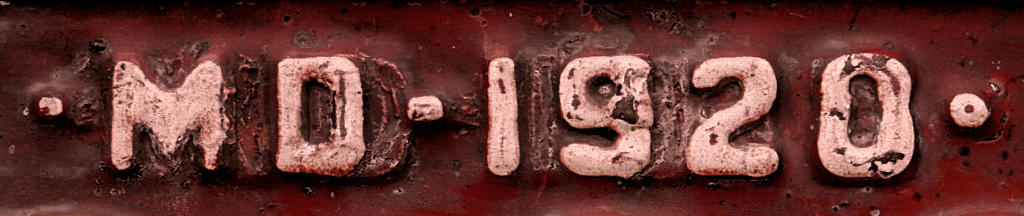 (click to enlarge) |
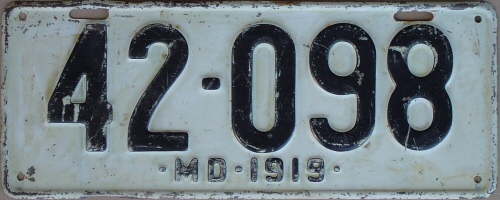
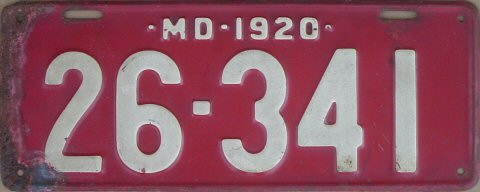
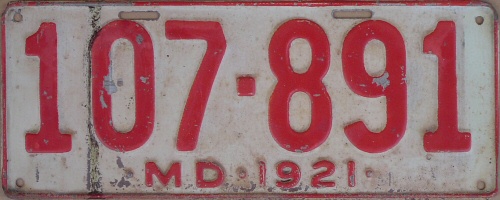
In 1917, Maryland plates changed significantly once again, but this time the style remained stable for five years. The state abbreviation and year were moved to the bottom edge of the plate in odd years, and to the top edge in even years. Three small dashes were also embossed among the state and year in the following pattern: -MD-19yy- A dash was also introduced into the serial number, between the hundreds and thousands digits. Serial numbers began at 20-000 or 20-001 from 1917 through 1920, and so from this point on, all passenger car plate numbers were at least five digits, and beginning in 1918 some were six digits. In 1921 the lowest passenger serial was raised to 30-000 or 30-001, and this remained the lowest passenger serial number through 1953. Plate sizes during these years were approximately 15 inches by 6 inches, but the exact measurements of plates in my collection vary between 1/8 inch less than, to 1/4 inch more than these dimensions.
Some leftover 1918 plates had the state abbreviation and year restamped to 1920 and were then issued in 1920; one of these is shown at right. You can best see the original stamping between the "D" and the dash. Similarly, some 1919 leftovers were restamped and used in 1921. Plates originally stamped in 1921 used new dies with a serif font.
Again, apparently blocks of Maryland plate numbers were reserved for residents of Washington, D.C. who drove into Maryland during these years, but I don't have good detailed information about which numbers those were.
| 1917 – | dark green on white | 1919 – | black on white | 1921 – | red on white | ||
|---|---|---|---|---|---|---|---|
| 1918 – | white on gray | 1920 – | white on red |
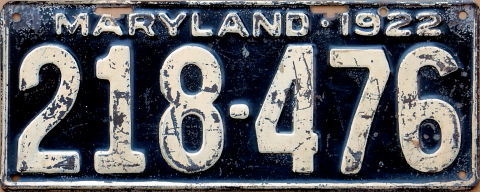
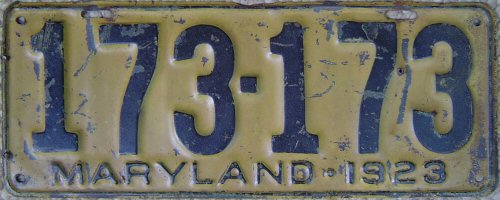
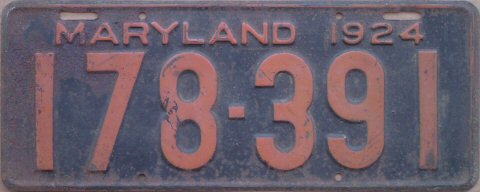
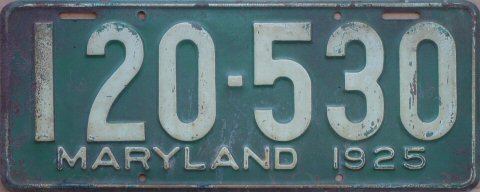
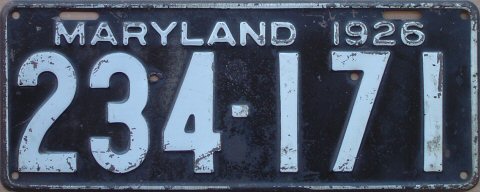
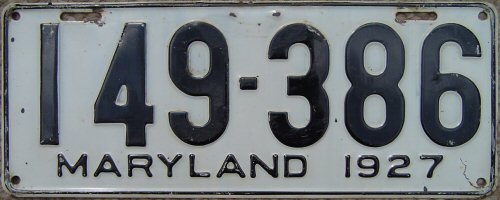
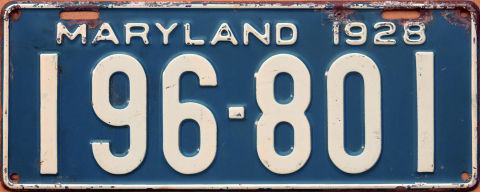
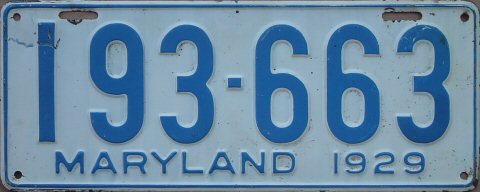
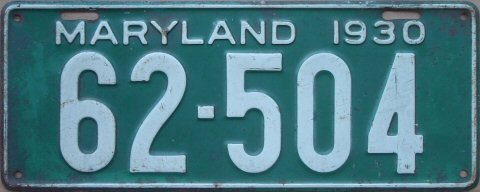
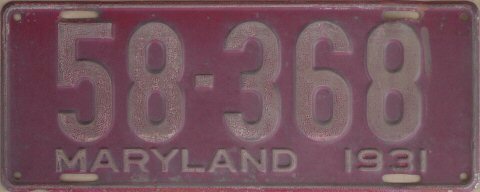
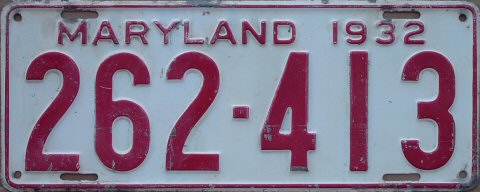
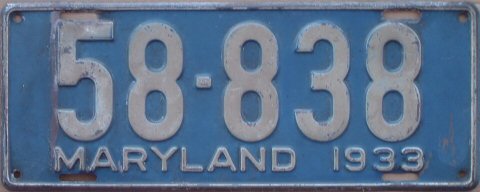

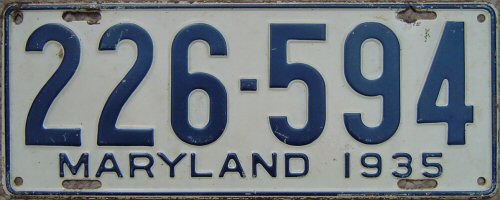
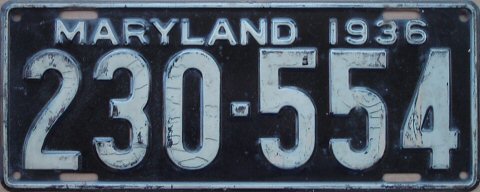
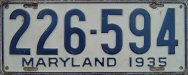
Starting with the 1922 plates, the full state name and four-digit year (without dashes) were embossed onto the edge of the plate, continuing the pattern of the top edge in even years, and the bottom edge during odd years. In mid-year 1923, the serial dies were changed to a thick-stroke, sans-serif font, similar but not identical to the dies used between 1917 and 1920. Lower bolt slots were added to the plates in approximately 1931. Plate dimensions continued to vary between 1/8 inch less than to 1/4 inch more than 15 inches by 6 inches until the mid-to-late 1920s, at which time the dimensions became precisely and consistently 15 inches by 6 inches.
Again, it's been reported that specific blocks of Maryland plate numbers were reserved for residents of Washington, D.C. who drove into Maryland. The blocks varied from year to year, and I don't have reliable information about what those were. However, I do have a Maryland motor vehicle registration card from 1923 that indicates that plate number 225-623 was issued to a D.C. resident. This practice ended after 1923, as a reciprocity agreement between Maryland and D.C. enabled residents of each to drive in the other using only the plates issued in their home jurisdiction.
It's also been reported by others that during most of this period, specific blocks of plate numbers were assigned to passenger cars registered to Baltimore residents, to passenger cars registered to members of various civic organizations, and to trucks registered statewide. Which groups had a number block, and what those number ranges were, apparently varied from year to year, and with few exceptions, I don't have good information about the specifics. Also during this period, very low numbers on what would seem to be passenger car plates were actually issued to buses.
The 1934 and some 1936 plates were distinctive from the other years in this group. The 1934 plate commemorated the 300th year since Maryland was first settled; the top of the plate read 1634 Maryland 1934 with very short characters, while the bottom edge of the plate contained the word Tercentenary using the same short-character font. It has been reported that not all 1934 plates contained the word "Tercentenary", but I've never seen one without it.
Most 1936 plates read Maryland 1936, which is consistent with other years. However, some 1936 plates that would seem to be passenger car plates were issued with one plate of each pair using a locking strip, which was intended to keep people from moving the plates from one vehicle to another. These plates had two holes cut out of the plate on the either side of Maryland; the locking strip was visible through the holes, and it was stamped with "19" visible through the left hole and "36" visible through the right hole. The other plate in each pair did not have holes or any locking strip, but nevertheless were stamped 19 Maryland 36 in order to match its mate. Thus, there were actually three styles of 1936 plates. The known number range of 1936 locking strip plates is approximately 150-000 to 199-999. That number range was what was assigned to not-for-hire trucks that year. I show photos of such plates on my Maryland truck plate history page.
| 1922 – | white on black | 1927 – | black on white | 1932 – | red on white | ||
|---|---|---|---|---|---|---|---|
| 1923 – | black on yellow | 1928 – | white on medium blue | 1933 – | white on dark blue | ||
| 1924 – | orange on black | 1929 – | bright blue on white | 1934 – | yellow on black | ||
| 1925 – | white on dark green | 1930 – | white on dark green | 1935 – | dark blue on white | ||
| 1926 – | white on black | 1931 – | white on dark red | 1936 – | white on black |
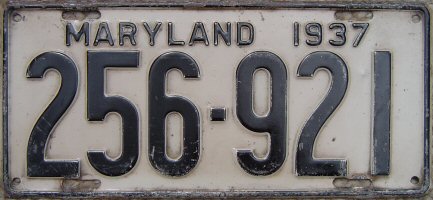
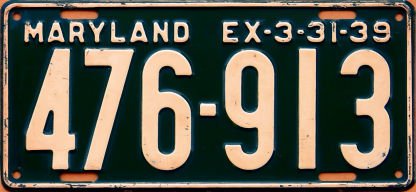
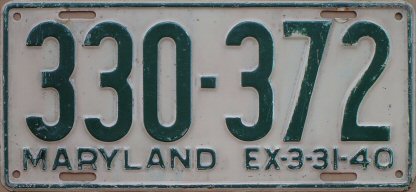
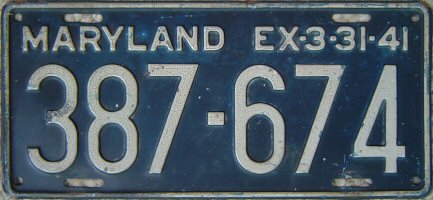
1937 to 1941 was a period of transition for Maryland license plates. For 1937, Maryland introduced smaller plates which were 13 inches long by 6 inches high; this size would then remain constant through 1956. The smaller-sized plates also necessitated the use of different dies in order for the serial numbers to still fit. For the 1941 expiration plates, the dies were changed again to more rounded chararacters with thinner strokes; however, these were used only for a single year.
At some point in the late 1930s, Maryland converted from calendar year registrations to registrations that expired annually on March 31. This was first indicated on the plates themselves in 1938. The plates issued at the beginning of the 1938-39 registration year only indicated the expiration date thus: Ex-3-31-39 There were no Maryland plates made with the year 1938 on them. All dated Maryland license plates, renewal tabs, and renewal stickers from this point forward always indicate the expiration year, rather than issue year. Annual, statewide March 31 passenger car plate expirations continued until 1986, when staggered registration periods were implemented.
Again, others have reported that during these years, specific blocks of plate numbers were assigned to passenger cars registered to Baltimore residents, to passenger cars registered to members of various civic organizations, and to trucks registered statewide. I don't have good information about the specifics. Also during this period, very low numbers on what would seem to be passenger car plates were actually issued to buses.
| 1937 – | black on white | 1939 – | white on dark green | 1941 – | white on dark blue | ||
|---|---|---|---|---|---|---|---|
| 1938 – | No dated 1938 plate | 1940 – | dark green on white |


 "3" restamped to "5" on 1946 plate |
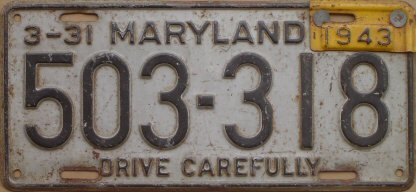
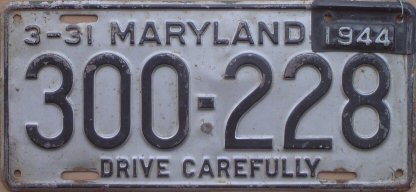
The 1942 plate had the expiration date moved to the upper corners, flanking the state name, with the month and date in the left corner and the four digit year in the right corner. The legend Drive Carefully was embossed along the bottom edge of the plate, and the colors were black characters on a silver background. Despite the silver color, the plates were painted steel, not unpainted aluminum. Like all previous Maryland plates, the 1942 plates were issued in pairs. The 1942 plate became the first Maryland multi-year base plate, as metal tabs dated 1943 and 1944 were issued to extend the expiration year stamped on the base plate. The 1943 tabs were also issued in pairs, but only a single 1944 tab was issued.
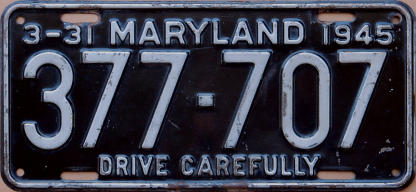
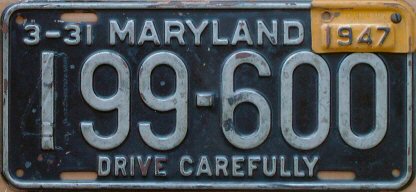
A new base plate was issued for 1945 expirations; it was identical in design to the 1942 base and differed only in that the colors were reversed to silver on black; however, only a single plate was issued on the 1945 base. Renewal tabs were again issued (obviously singly) to extend the life of the base plate to 1946 and 1947.
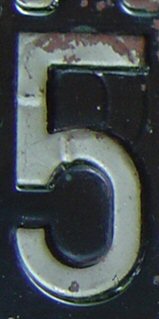
An interesting detail about the 1945 base is that many of them were stamped a second time to change a digit of the serial number. There does not appear to be a consistent pattern for this restamping. The 1946 expiration plate pictured above had its first digit changed from a "3" to a "5", as you can see from the close-up photo at right. The 1947 expiration plate shown above had its first digit changed from a "4" to a "1". I've seen photos of other restamped 1945 base plates, including one where the first digit was left unchanged as a "5", but the second digit was changed from a "2" to a "5".
Also, on my 1945 base plates, it looks like the last digit of the year was also restamped to change the expiration year from 1943 to 1945. This is difficult to see in person, and would be impossible to see in a photo. because of the size of the digit. I've seen a photo of a 1943 sample plate, but no real 1943 expiration plates were issued. It would seem that the state had intended to produce 1943 expiration plates and had already manufactured some, when, due to the metal shortage caused by World War II, they decided to hold on to the 1943 plates they already had and issue the 1943 renewal tabs instead. These unissued 1943 plates were made in pairs, but they issued 1945 plates as singles. Apparently, all of the 1943 expiration plates were restamped to have 1945 expirations, and one of each pair was restamped to a create a different plate number.
Again, others have reported that during these years, specific blocks of plate numbers were assigned to passenger cars registered to Baltimore residents, to passenger cars registered to members of various civic organizations, and to trucks registered statewide. I don't have good information about the specifics. Also during this period, very low numbers on what would seem to be passenger car plates were actually issued to buses.
| 1942 – | black on silver plate, no tab | – base plates issued in pairs |
|---|---|---|
| 1943 – | black on yellow tab | – tabs issued in pairs |
| 1944 – | silver on black tab | – single tab issued |
| 1945 – | silver on black plate, no tab | – single base plate issued |
|---|---|---|
| 1946 – | black on silver tab | – single tab issued |
| 1947 – | black on yellow tab | – single tab issued |
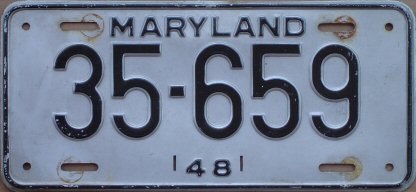
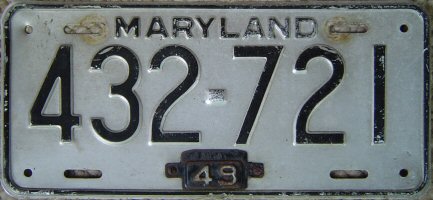
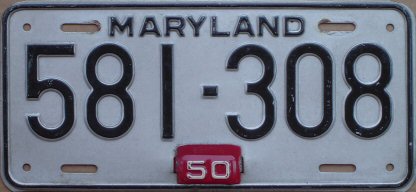

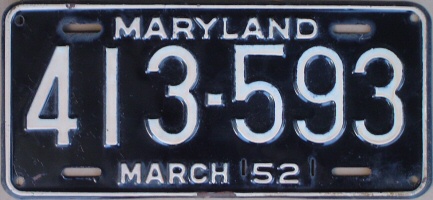
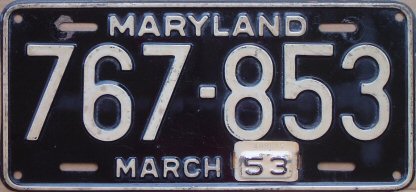
On the plate with the 1949 tab shown above, the motorist didn't follow the normal procedure and bend the flaps of the tab
and insert them into the tab slots on the plate; rather, he drilled holes into the tab flaps and the plate itself, and
bolted the tab flaps to the front of the plate.
The 1948 base plate design was a simplified version of the 1942 and 1945 bases. The "Drive Carefully" slogan was removed (perhaps the state thought everyone was now driving carefully enough), and the month, day, and century of the expiration date also vanished. The two-digit expiration year was moved to the bottom center and was flanked by tab slots. Most 1948 base plates were made of unpainted aluminum, although some steel plates are also known to exist. Renewal tabs were issued annully to extend the life of the plate to 1949, 1950, and 1951. This base plate and all of its renewal tabs were issued in pairs.
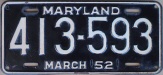
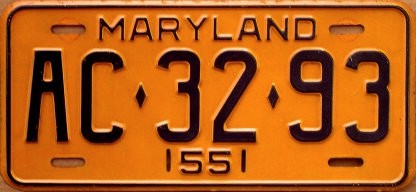
For 1952 expirations, a new base plate was issued. This plate was made of steel, but was otherwise similar in design to the 1948 base. The major difference was that the expiration month was reintroduced, this time spelled out in full. The tab slots remained on either side of the two-digit year. Thus, on passenger car plates, the bottom of the plate read March |52|, with the vertical lines indicating the location of the tab slots. The 1952 base plates and 1953 renewal tabs were both issued in pairs. After these plates expired in 1953, a new plate expiring in 1954 was issued.
Sometime between 1948 and 1952, most Maryland non-passenger registrations were shifted to expire annually each April 30, while passenger car and motorcycle registrations continued to expire annually on March 31. On the 1952 base, non-passenger plate types also had the expiration month embossed onto them, although of course the month was April.
Again, others have reported that during these years, specific blocks of plate numbers were assigned to passenger cars registered to Baltimore residents, to passenger cars registered to members of various civic organizations, and to trucks registered statewide. It's clear that the number range for trucks on the 1952 base was the 800-000 series, since those are all stamped with an April expiration month. Others have concluded that the range for trucks on the 1948 base included both the 800-000 and 900-000 series, but this doesn't make much sense to me, and so I just don't know what number range was used for trucks on the 1948 base. I elaborate on this a bit more on the Maryland truck plate history page. Also during this period, very low numbers on what would seem to be passenger car plates were actually issued to buses.
| 1948 – | black on silver plate, no tab |
|---|---|
| 1949 – | silver on black tab |
| 1950 – | white on red tab |
| 1951 – | white on black tab |
| 1952 – | white on black plate, no tab |
|---|---|
| 1953 – | black on white tab |
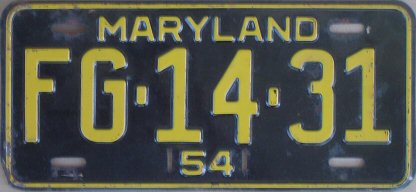
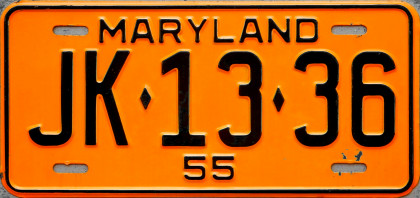

Two 1955 plates are shown, with and without year tab slots, respectively.
The Maryland plates issued in March 1953 and expiring in March 1954 had a number of differences from prior years. These dated 1954 plates were the first Maryland passenger car plates to have an alpha-numeric serial number format, rather than an all-numeric serial. Also for the first time, trucks and some other non-passenger vehicles were issued plates with a serial format distinct from those of passenger cars.
With the obvious exception of motorcycle plates, all Maryland license plates dated 1954 through 1956 were 13 inches wide by 6 inches high, and had an embossed border, long bolt slots, Maryland at the top, a two-digit expiration year centered at the bottom, embossed serial separator(s) whose shape varied from year to year, and distinctive serial dies not used before or since. All types of plates from a given year shared the same color scheme. All sequentially-issued passenger car plates, and most organizational member plates, were in the format xx-00-00, but the only letters used were A through L, excluding the letter I. Lead zeroes were not used, and so serial numbers began at 10-01 in each letter series.
The 1954 and 1955 plates were only issued as single plates. All 1954 and most 1955 plates had tab slots flanking the two-digit expiration year, allowing for the possibility that renewal tabs could be attached for subsequent years. However, these were never used, as new plates were issued each year. A small number of 1955 expiration plates were made without tab slots; these have high plate numbers and were issued late in the registration year.
The 1956 plates were issued in pairs, as have all Maryland passenger car plates since then. 1956 plates were made without tab slots.
| 1954 – | yellow on black | two vertical rectangle separators, | | tab slots | |
|---|---|---|---|
| 1955 – | black on school bus yellow | two diamond separators, | | tab slots | on most; no tab slots on late issues |
| 1956 – | dark red on white | two colon separators, | no tab slots |
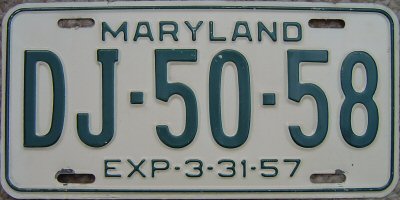
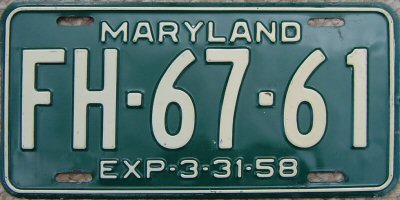
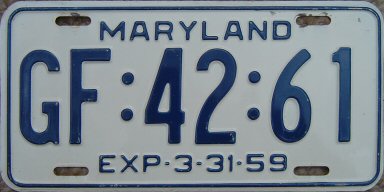
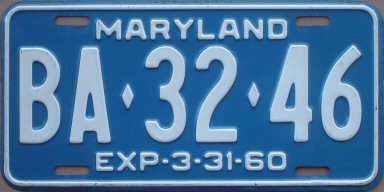
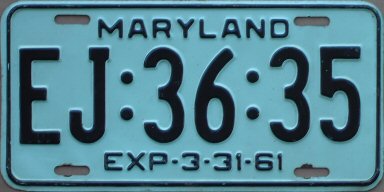
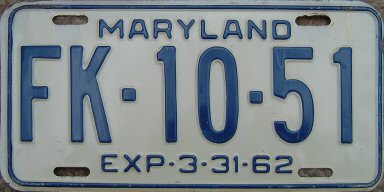

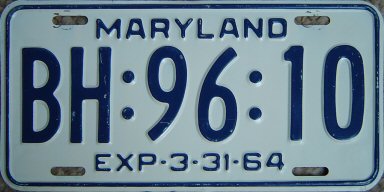
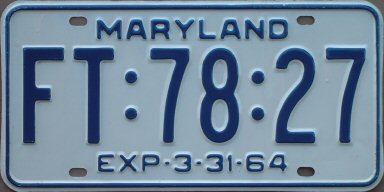
Two 1964 expiration plates are shown, with long and short bolt slots, respectively.
During the mid-1950s, the various motor vehicle departments throughout the U.S. and Canada all agreed to standardize the size of passenger car plates. This new standard called for plates to be 12 inches long and 6 inches high, and with 7 inches horizontally between the centers of the bolt holes. The 1957 expiration plates were the first Maryland plates to conform to these standards, although they were made with elongated bolt slots to accommodate older vehicles with attachment points that were other than 7 inches apart. The serial dies first seen on 1957 expiration plates were used continuously until mid-year 1974.
Virtually all Maryland license plates from this period had an embossed border, long bolt slots, Maryland at the top, Exp- followed by a specific expiration date at the bottom, and embossed separator(s) whose shape varied from year to year. All types of plates from a given year shared the same color scheme. All regular passenger car plates and samples, and most organizational member plates, were in serial format xx-00-00, and all of these have a March 31 expiration date. Lead zeroes were not used; each letter series began with plate number 10-01.
Again, the only serial letters used were between A and L, excluding I, through 1961 expirations. Beginning with the dated 1962 plate, any letter A to Z could be used, except for I, O, Q, or U. Because more letters were used in the second position, the first position letter never got past F or possibly G, except for organizational member reserved series, between 1962 and 1964.
It's been said that the black-on-light-green color scheme of the dated 1961 plates resulted in a lot of complaints from unhappy motorists, and that's why this color combination was never repeated. I was too young to remember these myself.
Late-issue 1964 expiration plates were made with the short bolt slots otherwise found on 1965-1970 expiration plates. This change began at approximately the FN series.
| 1957 – | dark green on cream | two square separators | 1961 – | black on light green | two colon separators | |
|---|---|---|---|---|---|---|
| 1958 – | cream on dark green | two square separators | 1962 – | dark blue on white | two square separators | |
| 1959 – | dark blue on white | two colon separators | 1963 – | white on blue | two diamond separators | |
| 1960 – | white on blue | two diamond separators | 1964 – | dark blue on white | two colon separators |
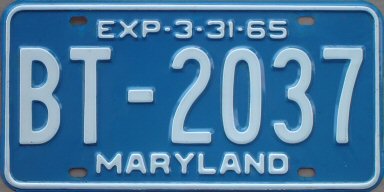

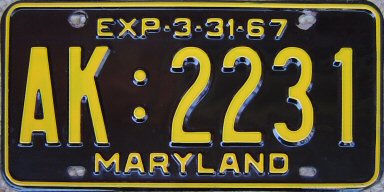
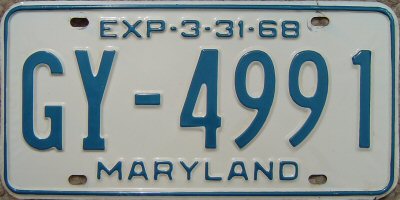
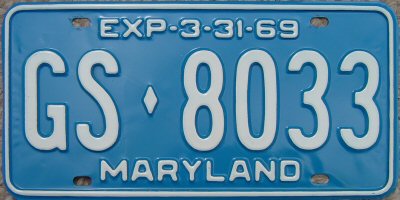
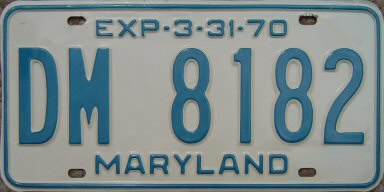
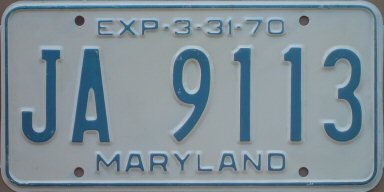
Two 1970 expiration plates are shown, with short bolt slots and round bolt holes, respectively.
The dated 1965-1970 plates differed from the dated 1957-1964 plates in several subtle ways. First, the state name and expiration date switched positions. Second, the separator between the second and third numeric digits disappeared. And third, the bolt slots were noticeably smaller. The highest first serial letter issued each year advanced from G to H to J during these years.
The embossed separator between the letters and numbers was replaced with a space separator on the 1970 expiration plates. Late-issue 1970 expiration plates were made with the round bolt holes used on all 1971 and subsequent base plates, beginning either in the late H series or at the start of the J series.
| 1965 – | white on blue | single dash separator | 1968 – | blue on white | single dash separator | |
|---|---|---|---|---|---|---|
| 1966 – | black on dark yellow | single diamond separator | 1969 – | white on blue | single diamond separator | |
| 1967 – | yellow on black | single colon separator | 1970 – | medium blue on white | single space separator |
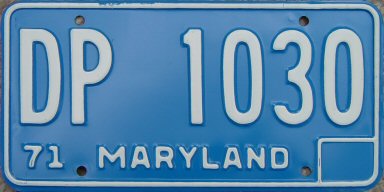


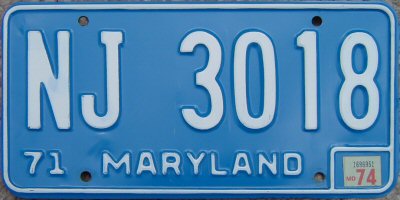
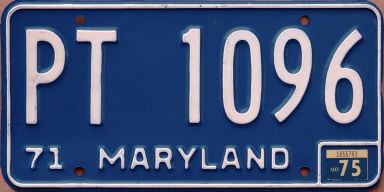
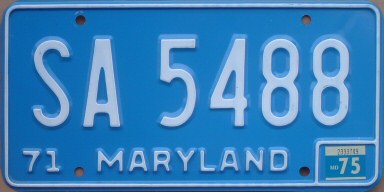
Two natural 1975 plates are shown, with old and new serial dies, respectively.
The dated 1971 base plate was used for five years, from March 1970 to March 1975 in the case of passenger car plates. The embossed 71 in the lower left corner indicated the initial expiration year. This base was then renewed annually with stickers on both the front and back plates, indicating the expiration years "72" through "75". Passenger car plate expiration dates continued to always be March 31 of the year indicated on the plate or sticker. During this five year span, all plates had the embossed 71 on them, regardless of when they were actually manufactured or issued.
Maryland license plates from this period were white on blue, and had an embossed border, bolt holes rather than slots, the embossed 71 in the lower left corner, Maryland at the bottom center, and an embossed sticker box in the lower right corner. All regular passenger plates, and most organizational member plates, used serial format xx 0000, with only a space separator. Lead zeroes were not used, and serials began at 1001 in each letter series.
During mid-year 1974, the serial number dies were changed in preparation for the new general replacement plates to be issued in March 1975. Therefore, some natural expiration 1975 plates were made with the old dies, and some with the new dies. The new characters were shorter, narrower, and more boxy-shaped than the previous characters. I have photographic evidence that the die change occurred in the midst of the RF series, and not at the start of the RF series as usually reported. Plate numbers at least as high as RF 2797 were made with the old dies, and were made with the new dies no later than RF 3226. These dies introduced in 1974 continue to be used through the present day.
| 1971 – | no sticker | Natural serial letter range approx. AA to JN. |
|---|---|---|
| 1972 – | red on white sticker | Natural serial letter range approx. JP to LE. |
| 1973 – | aqua on white sticker | Natural serial letter range approx. LF to MW. |
| 1974 – | red on white sticker | Natural serial letter range approx. MX to PK. |
| 1975 – | white on blue sticker | Natural serial letter range approx. PL to RF (old dies); RF to SE (new dies). |
Continue to History of Maryland passenger car plates, 1976 to present
Related pages on this site |
Elsewhere on the web |
Willard, Francis, and Ritterhoff plates are from the collections of John Willard, Jeff Francis, and Paul Rittehoff, respectively.
This page is W3C valid |
