 |
|
 |
|
|
|
|
This page provides a narrative history, with accompanying photos, of various types of trailer license plates issued by Pennsylvania from 1914 to the present day. Latest noteworthy updates to this page
|
|
From 1906 until 1979, Pennsylvania license plates displayed the year of issuance. Plates dated from 1941 through 1957 also showed the exact expiration date in addition to the year of issue.
Generally, Pennsylvania trailer plates followed the same color scheme and dimensions of passenger car plates. Because this information is covered in detail on the passenger plate pages, I'll just point out when there were deviations from passenger car plates.
My "Pictorial History" pages are intended to be a supplement to the information found in the ALPCA Archives. I am providing additional details and additional photos not found in the archives, and clarifying information when appropriate. When the ALPCA archives cover a subject in great detail, I do not repeat that detail here. I sincerely hope that you find this information useful.
If you find an error or have additional information, or can provide a plate or a photo of a plate that I'm missing, please send me an e-mail. There's a link to my e-mail address at the bottom of every page. Please note that all plates shown that are credited to another person are plates that I am still seeking for my own collection.
 (Eckenrode plate)  (Moore photo / plate) |
In Pennsylvania, trailers were first registered in 1914, and so there were two years of porcelain-coated trailer license plates issued before the state switched over to embossed plates. Trailer plates did not have the keystone attachment with the maker's number (today know as the VIN) on them like car and truck plates did. Instead, the state abbreviation Penna, the four-digit year, and the word Trailer were stacked on the left side of the plate. Trailer plate serial numbers had a "T" prefix, and probably started from T1. Beginning in 1916, trailer plates were embossed like all other Pennsylvania plate types, but the basic design of the plates were otherwise unchanged from the previous years' porcelain plates. In 1919, similar to other plate types, the state abbreviation, the year, and the Trailer plate type legend were relocated to the right side of the plate. |
(no picture available)
I've only seen one trailer plate from these years, and so I'm having to make some assumptions about the other years based on the one I have seen, plus various other 1920-1923 Pennsylvania non-passenger plates.
The one trailer plate I have seen was from 1922. It had the legend Penna Trailer 1922 along the bottom of the plate, again had a "T" prefix, followed by a two-digit number. Despite the low serial number, the plate was 16 inches long, necessary for the bottom text to fit on the plate. With no text at top, the plate was standard 6 inch height.
Likely the same plate layout was used in 1921 and 1923 as well. I'm a bit less certain about the 1920 trailer plates, because although some non-passenger types had this layout in 1920, others did not. The one 1920 truck plate I've seen had the vehicle type at the top edge of the plate, while the state abbreviation and year were at the bottom; therefore, the plate was taller than 6 inches, and less than 16 inches wide since it had only a five digit serial.
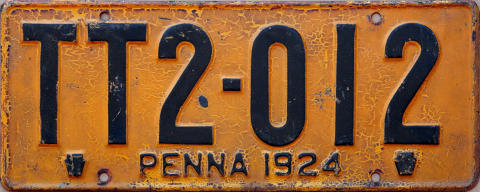 1924 trailer  1929 trailer (Moore photo / plate) |
During these years there was no legend to identify trailer plates, and beginning in 1924, truck plates began using a single "T" serial prefix, along with all the other letters from R to W, plus Y and Z. Therefore, trailer plates were now identified only with a double "TT" prefix. I've only seen a very few examples of trailer plates from these years, but it would seem that, like truck plates, serial letters were the same size as the numbers from 1924 through 1926, and then since 1927, always noticeably smaller than serial numbers. It also appears that in some years and with some numbers of serial characters, a dash separator was used between the third and fourth characters from the right, while in other situations no dash was used. This was also the case with other plate types from the 1920s, but again, I haven't seen enough trailer plates to really nail down when the dash was used and when it wasn't. |
 1931 trailer |
Pennsylvania plates again bore no legend identifying the plate type during these years, and therefore it's not entirely obvious exactly which serial format was used for what type of plate. Information about trailer plates for these years is scant and contraditory, and there is not a consensus among license plate historians which serial format was used on trailer plates. However, I've become convinced that trailer plates during these four years reverted back to the single "T" prefix that had identified trailer plates from 1914 to 1923. These plates could have from one to four numeric digits following the "T" prefix. To the casual observer, 1930 through 1933 Pennsylvania trailer plates would likely be mistaken for passenger car plates. However, passenger car plates never used a "T" in their serial numbers until the mid-1970s, except for a small number of late-issue 1956 plates. Even to someone familiar with the numbering schemes of old Pennsylvania license plates, these trailer plates might easily be mistaken for truck plates. The single "T" prefix, with no other letters in the serial, indicated a truck plate during the years 1924-1929, and also in 1932-1933 when followed by a five-digit number. A single "T" prefix was also used on truck plates in 1931 and from 1934 to 1967, but always with one or more additional letters in the serial. |
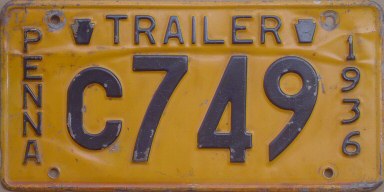
|
For 1934, and continuing to the present, trailer plates bore a legend that clearly identified them as such. During 1934 and 1935, they had the legend Trailer at the bottom edge, flanked by two embossed keystones, the four digit year running vertically down the left edge, and the state abbreviation Penna running vertically down the right. The serial was all numeric, with no prefix, and could be from one to four digits. The 1936 and 1937 plates were basically flip-flops of the 1934-1935 plates; they had the Trailer legend with the keystones along the top edge, and the positions of the year and state abbreviations were reversed. By 1936, if not sooner, over 9,999 trailers were registered, and in order to keep the serial number at four characters, a variable letter was introduced in serial position 1. I can't say whether these alpha-prefix trailer plates could have fewer than four serial characters or whether the letter could be followed by one or more zeroes. |
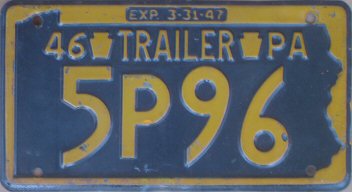 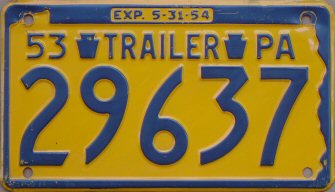   (Moore photo / plate) |
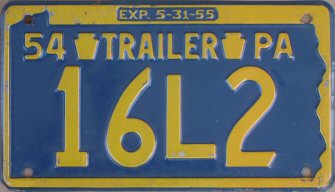
Starting in 1938, trailer plates bore the state map outline that was introduced on passenger plates in 1937. The legend was yy#Trailer#Pa with "#" indicating embossed keystones. During the years when passenger car plates came in two different sizes based on the number of serial digits, trailer plates apparently were all made in the longer size due to the length of the plate type legend. Serial number formats were now a minimum of four digits, and up to five digits, with lead zeros used on four character plates when necessary. It appears that formats were employed in this sequence: 0000, x000, 0x00, 00x0, 000x, 00000, although not all formats were used in the early years. The first year I've seen a five digit trailer plate is 1951, though of course this format might have made its debut earlier than that. For 1957, all trailer plates were given six digit, all numeric serials, apparently starting at 100001. These did not have any dash separator. It seems unimaginable to us now, but during all of these years, passenger car, motorcycle, trailer, and farm tractor plates all used at least some of the same serial formats, and therefore their serial numbers duplicated each other. For example, there would have been four different plates in use at any given time with plate number A101 – one for each vehicle type listed above. I suppose the thinking was that these vehicle types were different-looking enough that there should be no confusion. Like all other plate types, the registration period was changed from the calendar year to end on March 31 of the year following the year indicated on the plate, beginning with the 1941 plate. Starting with this plate, the actual expiration date was added in very small characters along the top edge of the plate. Along with truck plates, the expiration date of trailer plates was changed again effective with the 1953 plates to be May 31 of the year following the year indicated on the plate. Meanwhile, passenger car plates continued with March 31 expirations. |
|
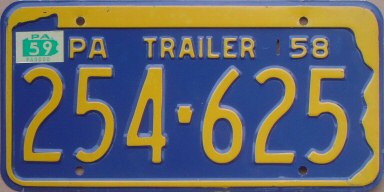
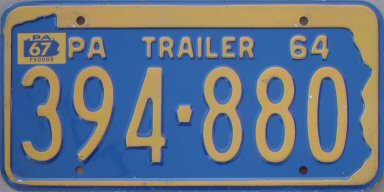
Like truck plates, multi-year trailer base plates were issued in 1958 and again in 1964. Both of these base plates were yellow on blue, causing the color scheme to be opposite that of passenger cars from 1965 thorough 1967. Continuing the serial format introduced in 1957, all trailer plates had a six digit, all numeric serial number, apparently starting at 100-001. A small keystone separator was introduced, located between the third and fourth serial characters. Once again, this format was the same as, and serial numbers overlapped with, both passenger car and farm tractor plates. Stamped along the top of these plates were Pa Trailer 58 and Pa Trailer 64, respectively. In years that base plates weren't issued, renewal stickers were applied in the upper left corner of the plate. From 1959 to 1963, trailer year stickers were the same colors as the following year's passenger car stickers. They were the same colors as truck stickers from 1965 to 1967. The exact expiration date was no longer indicated; I really don't know whether it continued to be May 31 of the year following the year of the plate or sticker, or was changed to a different date. |

|
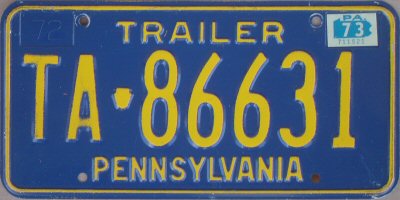
The multi-year trailer base plates issued from 1968 to 1971 were blue on yellow, matching the 1965-1970 passenger plate colors, and bore the legend Trailer along the top edge and the fully-spelled state name along the bottom edge. Like other non-passenger plate types, trailer plates again had a border in the shape of the state, sort of. The legend at the top necessitated redrawing the northern border of the state well into New York. These plates had a real sticker box with an embossed border in the lower left corner. Early issues of this base plate had a lightly debosssed "68" in the sticker box. The serial format was changed to Tx-00000, and this format was now unique to trailers. Well, almost; farm tractor plates got format TR-00000 starting in 1971, but trailer plates on the 1968 base never got anywhere close to the TR series. The small keystone separator continued to be used, now between the serial letters and numbers. The plate was used without stickers during 1968; stickers were applied to validate the plate for 1969-1971. Trailer sticker colors again were the same as truck stickers. I don't know what the annual regisrtation expiration date was during these years; it may have continued to be May 31 of the year following the year indicated on the plate or sticker. |
|
These plates were introduced one year after and continued to be issued one year after the corresponding Bicentennial passenger plates. 1972 to 1977 trailer plates were yellow on blue, again with Trailer at the top and the state at the bottom. The state map outline used continuously since 1938, which had become grotesquely distorted in 1968, was put out of its misery. Sticker wells were in both upper corners. Early issues had a lightly etched "72" in the left sticker well. Serial format Tx-00000 was again used, still with a small keystone serial separator. Again, format TR-00000 was used for farm tractors, but trailer plates on this base never got that high. The TK prefix is the highest that I've come across. This plate was used without stickers in 1972; stickers were applied to validate the plate for 1973-1977; sticker colors continued to be the same as those of truck plate stickers. Expiration dates may have continued to be May 31 of the following year, but I'm not certain. |
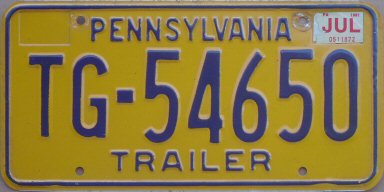 1981 trailer |
These blue-on-reflective-yellow plates were introduced about one year after the corresponding Keystone State passenger plates, starting in 1978 to about 1984 or so, or possibly even a year or two beyond 1984. These plates could then be renewed through 2000 expiration dates. The state name was now stamped at the top, between sticker wells located in the upper corners, and the Trailer legend was moved to the bottom. The trailer plate serial format was again Tx-00000, now with a dash separator rather than a keystone, and trailer plates again got up to the TK series on this base. There were now two other plate types with similar serial formats; tractor plates again had format TR-00000, but now taxi plates were introduced on this base; their format was TX-00000, with the second letter an actual "X". These trailer plates were undated and were used without stickers during the first year of issuance, likely through May 31, 1979. Red on white 1979 stickers were valid apparently through May 31, 1980, and then the state converted to staggered registration periods. As far as I know, trailer plates were converted to staggered registrations just like passenger car plates were. If so, then upon expiration of the 1979 sticker in March 1980, trailers were assiged a new month that fell in the range of September 1980 to August 1981. Single stickers bearing both the month and year of expiration have been used ever since. |
Yellow-on-blue Pennsylvania plates were issued from late 1983 to June 2000; however, not all plate types began at the same time, and I don't know exactly when yellow on blue trailer plates were first issued or the previous blue-on-yellow plates were last issued. The changeover to the new trailer base did occur sometime in the mid-1980s. Yellow-on-blue plates could be renewed through June 2002. These blue plates had a single sticker well in the lower left corner. Serial numbers continued in the same formats from the previous base. There were two types of trailer plates issued on this base, although the second wasn't introduced until a few years before the end of this base's life.
 1988 regular trailer, blue base version 1 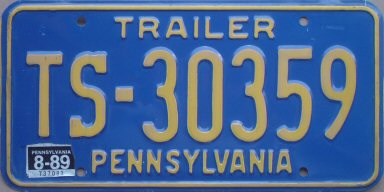 1989 regular trailer, blue base version 2a 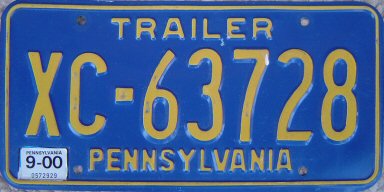 2000 regular trailer, blue base version 2b |
Regular trailersThe serial format continued to be Tx-00000, and picked up where the previous base left off, in the TL series. Early plates in the TL series continued with the previous base's placement of the state name and plate type, with Pennsylvania at the top and Trailer at the bottom. However, somewhere during the early TL series, the locations of these elements were switched to be consistent with other plate types on this base. Once the state name was moved to the bottom and Trailer to the top, these plates were strikingly similar in appearance to the 1972-1977 trailer plates. There are several ways to distinguish them, however, even if the plate does not have an expiration sticker. The 1970s trailer plates had two sticker wells in the upper corners, while the 1985-2002 trailer plates had a single sticker well in the lower left corner. The earlier plates had a keystone separator, while the later plates had a dash separator. And, I haven't come across a blue 1970s trailer plate past the TK series, while the blue 1980s trailer plates began at the TL series. Prefixes TR and TX were skipped for trailer plates, since they had been used for farm tractor and taxi plates, respectively. Plate TZ-99999 was issued sometime in the early 1990s, late 1993 according to one source, and the trailer serial format used since 1968 was exhausted. Then, a new serial format Xx-00000 was begun, with the first character always an "X" and the second letter variable. As far as I know, lead zeroes began to be used on these X-series trailer plates for the first time since 1956. Trailer plates got up into at least the XH series, possibly the XJ series, before this base was discontinued. |
 late 1990s permanent trailer |
Permanent trailersAccording to one source, this plate type was introduced in 1997. Serial format was PT-00000 on this base, and the legend Perm-Trailer was embossed at the top of the plate. The normal debossed sticker well was put in the lower left corner, but no stickers were used on these plates. Despite the "perm" designantion, these blue plates were apparently replaced with tri-color plates during the 2000-2002 general reissue. |
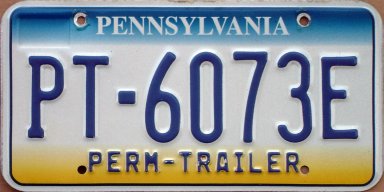
Tri-color plates with blue and yellow bands that fade to white were first introduced in 1999 with 2000 expirations. Tri-color plates with solid navy and yellow bands were introduced for regular trailers beginning in 2005 as existing stock of the earlier fade plates were used up. The original tri-color fade plate style continues to be used and renewed.
Both styles of tri-color plates are blue at the top, white in the middle, and yellow at the bottom, with embossed serial characters painted dark blue. The state name is screened on in the blue band in white captital letters. There's a single sticker well in the upper left corner.
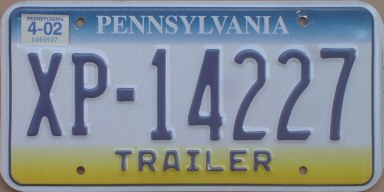 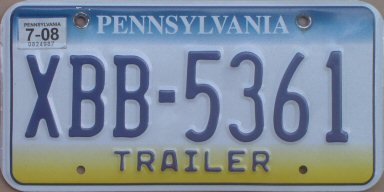 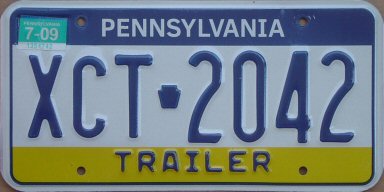 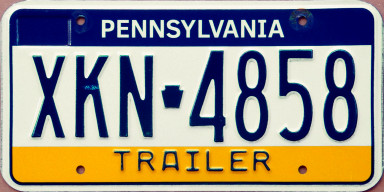 issued circa 2017 (plate in actual use) 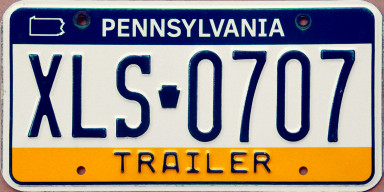 issued circa 2018 (plate in actual use) |
Regular trailersRegular trailers have the embossed legend Trailer along the bottom. Fade-style plates continued with the previous base's Xx-00000 serial format and picked up numerically where the previous plates ended, starting with the XK series. When serial XZ-99999 was reached in 2004, a new format Xxx-0000 was introduced, starting at XBA-0000. (Pennsylvania has tended to avoid vowels in the middle letter position in recent years.) Fade plates also had a dash separator between the letters and numbers. Solid band regular trailer plates were introduced in 2005 beginning with serial XCA-0000. These plates have a keystone separator. I don't know when this practice started, but non-permanent trailer registrations could be obtained for either one-year periods like other vehicle types, or for five-year periods. Expiration stickers were last issued at the end of 2016, so the latest possible stickers were five-year stickers renewal stickers expiring in early 2022. Trailer plates with the small outline of the state map in the upper left corner began being issued in early 2018 starting at plate number XKY-0000. |
 issued between 2000 and 2007 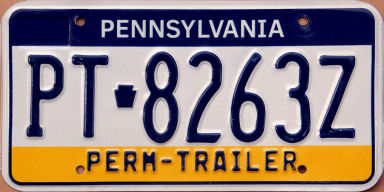 issued circa 2015 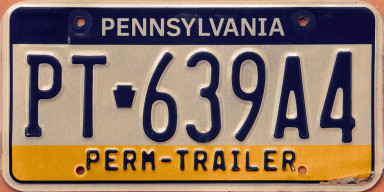 issued circa 2015  issued circa 2017 (plate in actual use) |
Permanent trailersPerm-Trailer is embossed at the bottom. These plates were always correctly used without a sticker indicating an expiration date, since they're, well, permanent. Those issued through sometime in 2017 do have the sticker well in the upper left corner nevertheless. Fade band plates use serial format PT-0000x, using a dash separator. Serial numbers advance before the suffix letter, which ranged from "A" to "K" on this base. Solid band plates first made their debut in approximately early 2007. Solid band plates use a keystone separator, and continued with suffix letters beginning with "L". In the spring of 2015, plate number PT-9999Z was issued, exhausting the format. At that point, a new format PT-000x0 was introduced. On this format, like the previous one, the variable letter advances last, after all the numeric digits. In mid-year 2017, in the midst of the PT-000D0 series, the never-used sticker well disappeared and was replaced with white outline of the state map. |
Related pages on this site |
Elsewhere on the web
|
Thanks to those who have directly contributed to the information on this page: Clayton Moore.
Moore photographs are presumed to be copyrighted by Clayton Moore, and are used with permission. Eckenrode plate is from the collection of Jake Eckenrode.
This page is W3C valid |

