|
|
 |
|
|
|
|
This page covers the history of various types of Maryland license plates issued for trailers, and also for special mobile equipment, both self-propelled and otherwise. Latest noteworthy updates to this page
|
|
From 1910 to 1937, Maryland license plates displayed the calendar year in which they were valid. Plates dated 1939 and later always indicate, on the plates themselves, or via metal tabs or stickers, the year in which they expire. Exceptions to this include undated, unstickered plates that expired in 1976 and 1981, and front plates issued since 1986, which are not dated and do not bear stickers. I consistently refer to plates by the year that is shown on the plate, regardless of when the plate was actually issued.
Maryland non-passenger plate types (meaning plate types for vehicles other than private passenger cars, and therefore including the passenger-carrying commerical plate types shown on this page) and their expiration stickers, with few exceptions, have closely resembled or been indistinguishable from their passenger car equivalents from the same time period. Because this information is covered in detail on the passenger plate pages and the general information page, I'll just point out when there were deviations from passenger car plates.
On the various Maryland non-passenger plate history pages, for plates dated 1953 and earlier, I've listed the specific years and plate numbers that I've seen firsthand or in photos. This will hopefully be useful in identifying patterns and figuring out the mysteries surrounding some of these plates.
Note that this page does not exhaustively cover all types of Maryland plates issued for trailers and mobile equipment. Plates for government-owned vehicles are covered on the History of Maryland Government Plates page. Trailer dealer plates are addressed on the History of Maryland Dealer Plates page.
My "Pictorial History" pages are intended to be a supplement to the information found in the ALPCA Archives. I am providing additional details and additional photos not found in the archives, and clarifying information when appropriate. When the ALPCA archives cover a subject in great detail, I do not repeat that detail here. I sincerely hope that you find this information useful.
If you find an error or have additional information, or can provide a plate or a photo of a plate that I'm missing, please send me an e-mail. There's a link to my e-mail address at the bottom of every page. Please note that all plates shown that are credited to another person are plates that I am still seeking for my own collection.
(no picture available)
Trailer plates were apparently introduced in either 1915 or 1916. Early examples through 1919 were flat, not embossed, and were noticeably different looking from passenger car plates. They had the word "Trailer" across the top of the plate, and the abbreviation MD stacked over a two-digit year on either the left or right side of the plate, depending on the year. I don't know if these were were porcelain-coated or not. In 1920, embossed trailer plates were used, and the word "Trailer" was moved to the bottom of the plate.
Plate numbers observed
|
 1925 trailer (Francis plate)  1926 - 2 ton trailer (Sallmen photo / plate) 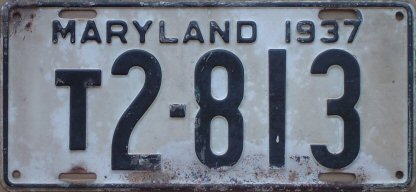 1937 regular trailer 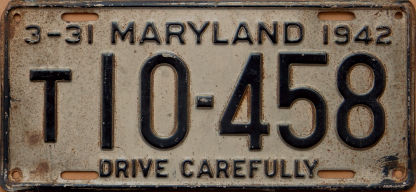 1942 regular trailer 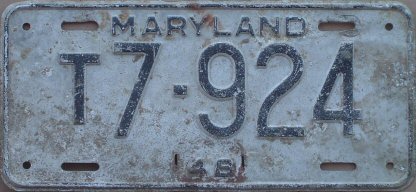 1948 regular trailer |
Regular trailersFrom 1921 forward, all the way to 1953, regular trailer plates were consistently identified with a "T" serial prefix or suffix. I don't know whether the "T" was small or full-sized during the first few years, but by the mid-1920s it was always smaller than the numeric digits. Although I've never seen any mention of this in any of my written sources, apparently from the 1926 through 1928 examples I've seen, trailer plates used the same riveted disks as did truck plates. Trucks that had a gross vehicle weight of 2 tons or greater had small disks riveted to their plates indicating the number of tons. The number on the disk could be 2 through 9, or "X", which apparently indicated 10 or more tons. Since the 1926 trailer plate at left has a "2" on the disk, it would seem to be for a two ton trailer. Trucks with lesser G.V.W.s did not get such disks, and so I assume that light trailers didn't, either. I'm sorry I don't know the exact years that these disks were used for either trucks or trailers.
| |
Shuttle relay trailersThis plate type was reportedly introduced on the 1942 base. 1942 and presumably 1945 bases had a small "T" prefix like regular trailers, with a stacked "S/R" suffix. Beginning on the 1948 base, the "S/R" and the "T" switched positions, so the "S/R" was on the left and the "T" was on the right. The meaning of the letters "S/R" has been variously reported as "shuttle relay", "special rate", and "state roads"; however, an article in The (Baltimore) Sunday Sun Magazine dated March 26, 1950, and reprinted in ALPCA's Plates Magazine dated December 2018, states that these plates are for "trailer[s] operated under shuttle relay system". I have not yet found a satisfactory explanation for what the shuttle relay system was or why it required distinctive license plates. Since similar shuttle relay plates were also issued to some truck tractors, it leads me to believe that shuttle relay trailer plates might only have been issued to some semi-trailers.
|
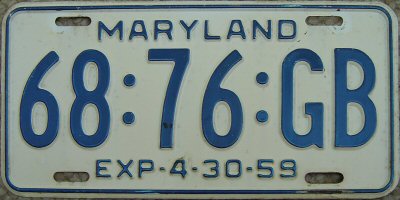 1959 regular trailer 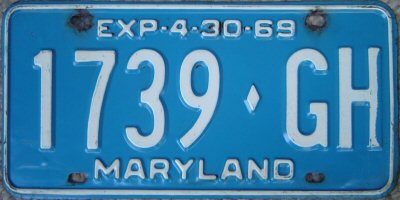 1969 regular trailer |
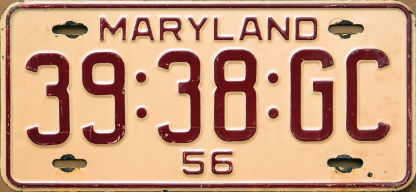
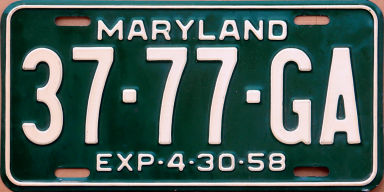
Regular trailersBy "regular", I mean trailers that are not issued any special type of trailer plate. Regular trailers were assigned the serial formats 00-00-Gx (1954-1964), 0000-Gx (1965-1969), and 0000 Gx (1970). Separators could be dashes, diamonds, or colons through 1969. For regular trailers, the first letter in the serial was always "G", indiciating the vehicle class. As with most non-passenger plate types, the expiration date (stamped on the plate 1957-1970) was April 30 rather than March 31 used for passenger vehicles.
| |
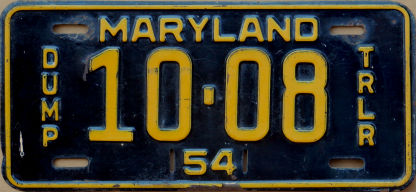 1954 dump trailer 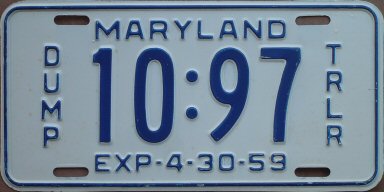 1959 dump trailer |
Dump trailersI'm not sure what year this plate type started, but by the 1954 expiration plate, specific plates for trailers with dumping mechanisms were being issued. This plate had the words Dump and Trlr running vertically down the left and right edges of the plate, respectively, with a four-digit serial number starting at 10-01. It's a safe bet that this same design continued until the 1970 expiration plate, except that the serial separator was omitted starting with the 1965 expiration plate. | |
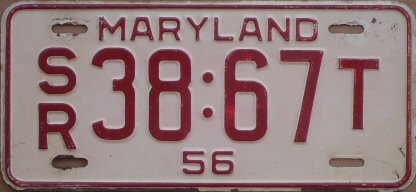 1956 shuttle relay trailer 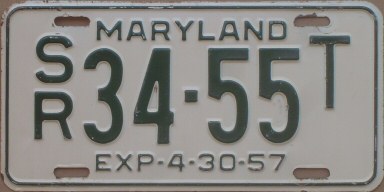 1957 shuttle relay trailer |
Shuttle relay trailersShuttle relay trailer plates were rather cryptic. The plate number consisted of a stacked S over R, followed by a four digit numeric serial, followed by the letter T, which is smaller than the numbers but larger than the stacked letters. Thus, the format was S/R00-00T. The meaning of the letters "S/R" has been variously reported as "shuttle relay", "special rate", and "state roads", but shuttle relay has been shown to be correct. I have not yet found a satisfactory explanation for what the shuttle relay system was or why it required distinctive license plates. Since similar shuttle relay plates were also issued to some truck tractors, it leads me to believe that shuttle relay trailer plates might only have been issued to some semi-trailers. In any event, the last of these had 1958 expirations. |
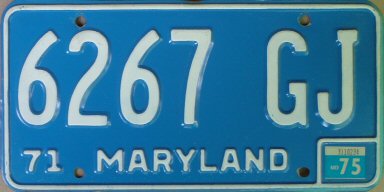 1975 regular trailer 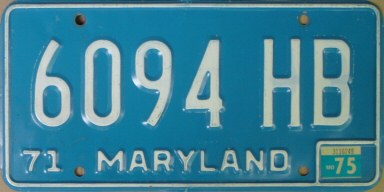 1975 regular trailer with 1976 serial dies |
Regular trailersRegular trailers again used the 0000 xx format, with the first letter "G", indicating the vehicle class for trailers. But late in the life of the 1971 base, trailer plates reached serial 9999 GZ, exhausting the format that had been used since the 1954 plates. Although during 1954-1970, format 0000 Hx had signified a truck for hire plate, this format with a letter H had not been used on the 1971 base. So, when the "G" series was exhausted, the MVA simply continued alphabetically and proceeded to issue "H" series plates to trailers. They didn't get too far into the H series before the 1971 base was retired. Plates started being made with serial dies from the upcoming red on white plates at the "HB" suffix. The highest trailer serial I've seen on this base had an "HD" suffix. |
Dump trailersI haven't seen a dump trailer plate on the 1971 base, but I have seen a document from the Maryland MVA that indicated that it had the legend Dump Trailer displayed horizontally with the words stacked one above the other on the left side of the plate, and a four-digit numeric serial occupying the center and right portions of the plate. |
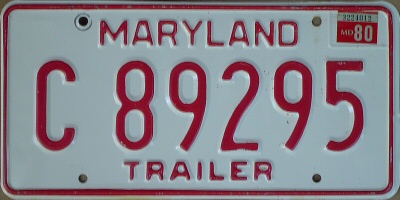 1980 regular trailer 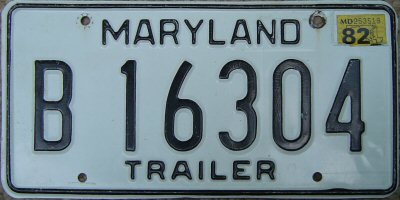 1982 regular trailer |
Regular trailersTrailers as well a number of other non-passenger classes were issued plates with serial format x 00000. The letters assigned to trailers were A, B, C, and E. (D was used for dealer plates.) These letters had no hidden meaning; the serials were simply assigned consecutively through this range of letters. The E series was only used on the 1981-1987 black and white base. The word Trailer was embossed on the bottom center of the plates. Trailers were not eligible to receive the optional Bicentennial or 350th Anniversary bases. Semi-trailers were issued standard trailer plates unless they fell into one of the categories below. | |
 1981 dump trailer (Childs plate) |
Dump trailersTrailers with dumping mechanisms were assigned plates with the serial format DT 000. The black-on-white 1981 base has the text Dump Trl. embossed at the bottom center, but I've seen a photo of a plate on the 1976 red-on-white base with the words Dump Trailer spelled out in full. I don't know when the change occurred. The 1981 base was the last for dump trailer plates; beginning on the 1986 base, dump trailers are now issued regular trailer plates. | |
 1979 farm trailer  1983 farm trailer |
Farm trailersDuring these years, trailers used for agricultural purposes received distinct plates. Serial format was TR 000, and the legend Farm Trl was embossed at the bottom center. The 1981 base was the last for farm trailer plates; beginning on the 1986 base, farm trailers are now issued regular trailer plates. | |
 1990 fleet trailer 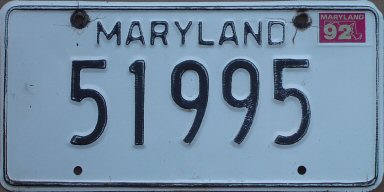 1992 fleet trailer 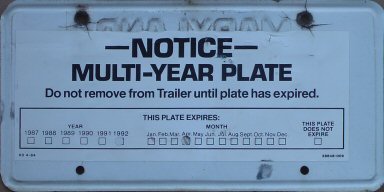 Back side of 1992 fleet trailer |
Fleet trailers, 1976-1993Beginning in 1976, owners of trailer fleets were able to register their trailers for up to eight years at a time. Trailers with long-term registrations were issued plates with the serial format 00000. I don't believe that long-term registrations were only available for specific types of trailers, but in practice, I observed fleet trailer plates in use exclusively on semi-trailers. On the red-and-white base, fleet trailer plates were embossed with the cryptic legend Trl Apr 84 at the bottom center, which meant "Trailer, April 1984", the expiration date. With the expiration date embossed, these plates did not use stickers, and they all expired in April 1984 regardless of the year of issuance.
On the black-on-white, all-embossed base, fleet trailer plates continued the serial format, but without an embossed expiration date; instead, a sticker was used to indicate the expiration. Apparently, with the introduction of an expiraiton sticker, these plates were allowed to expire eight years from initial registration, rather than all at the same time. The earliest year stickers were dated 1988, and the 1988 through 1993 expiration stickers used on this base, which would have been issued between 1980 and 1985, resembled the standard 1982 through 1986 year stickers with the state map outline that were issued during this same period. However, long-term trailer stickers were always white on red, and they did not contain a serial number. Month stickers were not used on this base but the expiration month was always April. Probably a disproportionate number of these had 1992 expirations, as they were issued in 1984 to replace the red-on-white plates with the embossed expiration date. Some of these black-on-white plates bore the legend Trailer while others had no legend; I have no idea why, or precisely when this change occurred. That big old "Notice – Multi-Year Plate" sticker covering most of the back of the 1992 fleet trailer plate was not placed there by the Maryland MVA. I've seen those same stickers on the backs of trailer plates from a number of different states. I've been told that U-Haul put those stickers on the backs of their trailer plates. In some cases, the information on the U-Haul sticker is redundant with the front of the plate, but in this instance, it clarifies exactly when the plate expires, in April 1992. |
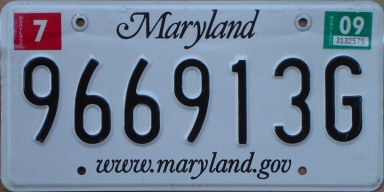 2009 regular trailer, version 2 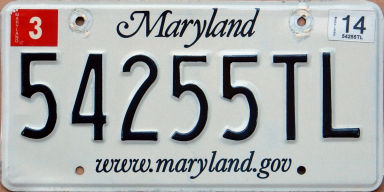 2014 regular trailer, version 3 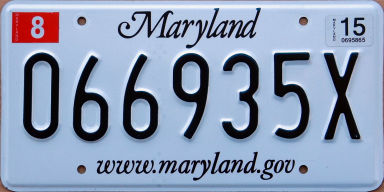 2015 regular trailer, version 4 |
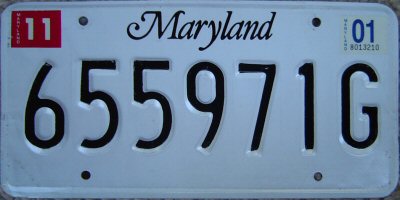
Regular trailersTrailers were assigned serial format 000000G on the standard base, with the letter G indicating the vehicle class code for trailers. With seven characters there was no room for a shield separator; there was also no longer an identifying legend at the bottom. Special trailer types (dump trailers, farm trailers, and fleet trailers) that previously received distinct plates were merged with regular trailers on this base. However, fleet trailer plates get distinct month and year stickers, and so are addressed separately, below. Beginning in 2005, at about serial number 854000G, the state's web site address was added along the bottom edge of the plate. After being issued for over 22 years, the 000000G format was exhausted in mid-2008. Rather than just move the vehicle class letter to the beginning of the serial, as had been done for multi-purpose vehicle plates in the late 1990s, instead, an unexpected new serial format 00000TL was begun. With only five variable digits rather than the previous six, this serial format only lasted three years before they again ran out of numbers. In the summer of 2011, serial format 000000X was introduced; the "X" doesn't stand for anything, but with six variable digits, this format will last a good long time.
| ||
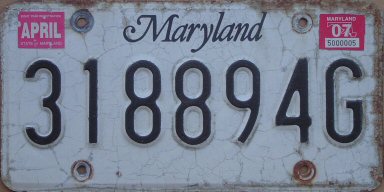 2007 fleet trailer, version 1 |
Fleet trailers
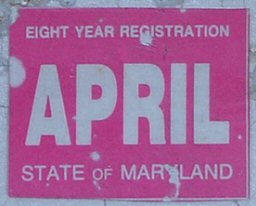
Since 1986, fleet trailers with eight year registrations have received regular trailer plates with distinct month and year stickers. The earliest issues of fleet registrations on this base were issued in 1986 and expired in 1994. For 1994 through 2016 expirations, the year stickers continued to always be colored white on red. It's been reported that fleet trailer year stickers first started having serial numbers printed on them on the 2007 sticker. Beginning with the 2017 expiration sticker, fleet trailer stickers have been colored black on white, but unlike normal year stickers, they continue to have the state name Maryland in full across the top of the sticker and the state map outline in the center. In any event, fleet trailer plates are easily identified because the month sticker is a hot pink color and it bears the alphabetic month name (always April) rather than the month number used for all other types of Maryland license plates. (For fleet trailers with expirations between 1988 and 1993, please see the previous section, as these were issued on the painted, all-embossed black-on-white base through early 1986.) | ||
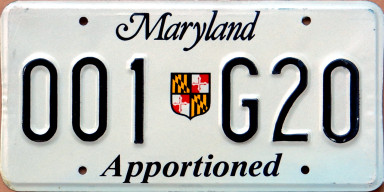 unissued, unstickered apportioned trailer |
Apportioned trailersWhen Maryland joined the International Registration Plan (IRP) in 1988, it began issuing plates with the legend Apportioned to trailers and various types of trucks and buses that participated in the plan. Apportioned trailer plates were assigned serials in the format 000*G00, where the letter G is constant and indicates the vehicle class. Other letters were used for other apportioned vehicle types. Apportioned trailer plates have been been discontinued for some time, but it's not clear exactly when this occurred. Not many were ever issued, and they're not seen in use any longer. Issued plates would have month and year stickers, but the one shown is an unissued leftover plate. Apportioned year stickers for 2005 were white on green rather than black on white used for most other plates, although it's uncertain whether apportioned trailer plates were still in use then. | ||
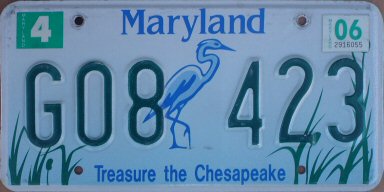 2006 first generation Chesapeake trailer  2015 Our Farms trailer (plate in actual use) 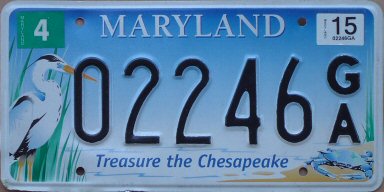 2015 second generation Chesapeake trailer |
Special interest trailer platesLight trailers could obtain the optional green-on-white first generation and black-on-blue second generation Treasure the Chesapeake plates. First-gen Chesapeake trailer plates were issued between 1991 and 2003 in the serial format of G00*000; the highest observed serial had been reported to be G08*297, but obviously, whoever was doing the observing didn't come across this one shown at left. Second-gen Chesapeake trailer plates were issued betwen 2004 and 2018 and used serial format 00000G/A. Though no longer issued, both of these versions remain valid with renewal stickers. Light trailers may now obtain the optional Our Farms, Our Future base and the third generation Protect the Chesapeake base. Trailers share the serial format A000000 with cars, taxis, trucks, and multi-purpose vehicles on the Our Farms base, but trailer serials are limited to the A900000 range. Third-gen Chesapeake trailer plate numbers continue uninterrupted from the previous base using serial format 00000G/A. |
These plates are issued to motor vehicles and trailers using public roads that really could be considered more tools than transportation, such as cranes, mobile compressors, wood chippers used by tree removal businesses, and the like. Probably this plate category did not exist prior to the 1976 base. Mobile equipment would likely have been issued either truck or trailer plates, depending on whether the equipment was self-propelled.
Off-road farm equipment such as tractors and combines are not required to be registered with the state, even when operated on public roads. Same thing with off-road construction equipment such as graders, backhoes, and front-loaders. As far as I know, this has always been the case. Maryland plates with the legends Trac or Tractor were issued to non-farm truck tractors. (A truck tractor is the front part of a tractor-trailer combination.) Maryland plates with the legend Farm Tractor do exist, but these were issued to farm-use truck tractors, not to actual farm tractors as most people understand the term.

|
On both the 1976 and 1981 bases, serial format was 00000 and the plates bore the embossed legend Spec Equip, which stood for "Special Equipment", or perhaps even "Special Mobile Equipment". |
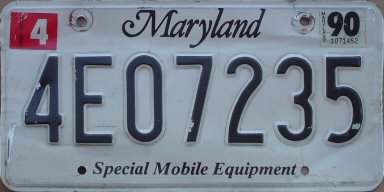  (plate in actual use) |
Mobile equipment plates on the screened Maryland base follow the format of dealer and automotive business plates. These plates have serial format 4E00000 and the screened legend Special Mobile Equipment at the bottom. The word "special" in the legend seems rather unnecessary, since there is no regular, non-special mobile equipment plate category. Like many, if not all, plates where the plate type is indicated at the bottom, the plate type description was made larger a few years after this base was introduced. Only single plates are issued. Like dealer plates, they're not registered to specific vehicles, and can be freely moved from one piece of equipment to another, owned by the same business. Thus, a business that had 20 pieces of mobile equipment, but only five drivers, might only need to obtain five license plates for their equipment. |
Related pages on this site |
Elsewhere on the web |
Thanks to those who have directly contributed to the information on this page: "Tiger" Joe Sallmen and Ed Burr.
Sallmen photograph is presumed to be copyrighted by "Tiger" Joe Sallmen, and is used with permission. Francis and Childs plates are from the collections of Jeff Francis and Jim Childs, respectively.
This page is W3C valid |