|
|
 |
|
|
|
|
On this page I display my collection of U.S. passenger car plates from the year 1959. All fifty states, plus Washington, D.C. and three of five U.S. territories are represented thus far. Latest noteworthy updates to this page
| |
Like many other license plate collectors, I'm working on a "birth year set", which is a collection of license plates from every state from the year I was born. Now, which plate do you think is best suited for a 1959 set – one that was issued in 1958 and expired in 1959, or one that was issued in 1959 and expired in 1960? My answer: I think the most appropriate plates are those that actually have the year 1959 on them, regardless of when they were issued or expired. But for states that had staggered registrations or indicated on their plates that they expired mid-year, I'm including both the 1958-1959 and the 1959-1960 versions in my set. Where there were mid-year die changes or other design differences, I want an example of each version as well.
Everyone seems to display their birth year sets in alphabetical order by state name. For no particular reason, I decided to be different and put my display in chronological order based on the date each state was admitted to the Union. This is the same sequence in which U.S. state quarters were issued, 1999-2008.
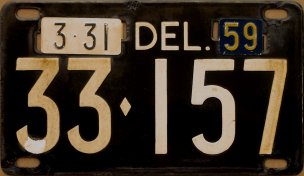 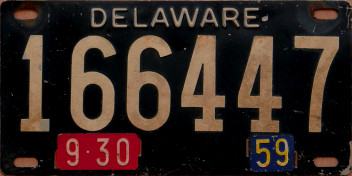 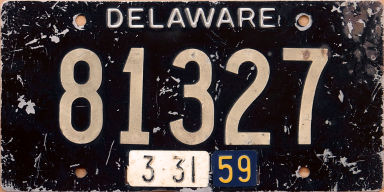 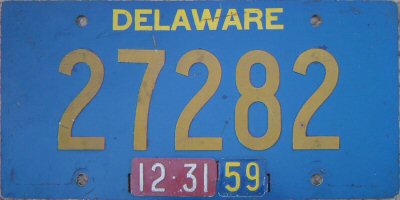  |
Delaware – 1st state; ratified the Constitution 1787There's a reason why Delaware is called The First State, although that slogan didn't make it onto Delaware license plates until 1963. (If you don't know what I'm talking about, read the line immediately above.) All Delaware plates issued since the spring of 1941 remain valid for use even today. Plates issued from then until 1947 were porcelain-coated. The top plate shown is one of these, and I believe it was issued in 1942. Black stainless steel plates were introduced in 1947; there are two versions of these, both shown, one with oval bolt holes in the far corners, issued 1947-1958, and one with round bolt holes in standard positions, issued only for a few months in 1958. Blue stainless steel plates, with slots to insert tab flaps, were issued 1958-62; two of these are shown, with 1959 and 1960 expiration dates. On all of these plates, metal tabs were attached to indicate the expiration date, which was always the last day of a calendar quarter. The first registration period did not exceed one year. So, for example, the first blue plate (fourth plate from the top) was apparently issued during the first quarter of 1959, with tabs indicating a December 31, 1959 expiration date; the second blue plate at bottom left would seem to have been issued during the second quarter of 1959, indicating a March 31, 1960 expiration. Delaware made new plates with old numbers when the old plate was damaged or lost, and they periodically issued new plates with dormant numbers, so the plate numbers on these four plates appear to be in no logical sequence. |
||
  |
Pennsylvania – 2nd state; ratified the Constitution 1787
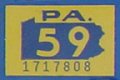
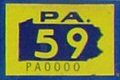
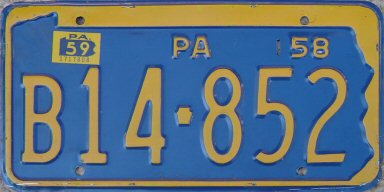
The dated '58 base was issued 1958-1964. Pennsylvania left its options open by issuing these plates with a tab slot, but they ultimately went with renewal stickers instead. The two plates shown at left may look identical, but they have different stickers. Plate B14-852 was issued in 1958 and renewed for 1959; its sticker has a "real" serial number, which indicates a renewal. Plate S95-820 was issued in 1959; its sticker has serial number PA0000, which indicates a new registration. This unusual sticker numbering system was used from 1959 through about 1974. |
||
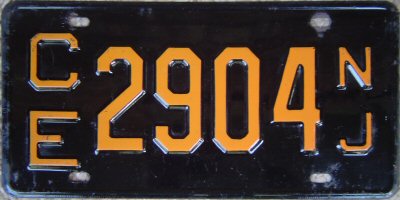 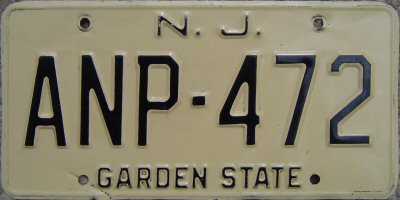 |
New Jersey – 3rd state; ratified the Constitution 1787From April 1956 to May 1959, New Jersey issued these undated orange-on-black plates with serial format x/x0000. The first letter in the serial indicated the county; serial prefixes beginning with "C" were issued in Camden County. These and other black plates dating back from 1952 were phased out between June 1959 and sometime in 1960 or 1961. The undated straw-colored plates were issued with serial format xxx-000 from June 1959 to 1973; these plates were issued sequentially, rather than coded by county. This example was probably issued in the late summer or early fall of 1959. For both of these bases, windshield stickers were used to show that the registration was current. |
||
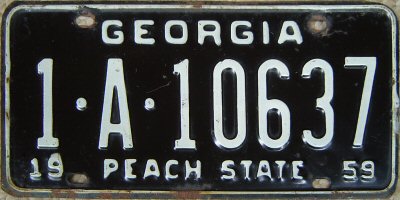 |
Georgia – 4th state; ratified the Constitution 1788Georgia, as well as its neighbors Florida and Tennessee, used both county codes and weight class codes on the same plate. The "1" stands for Fulton County; the "A" indicates a car weighing over 4,000 pounds. |
||
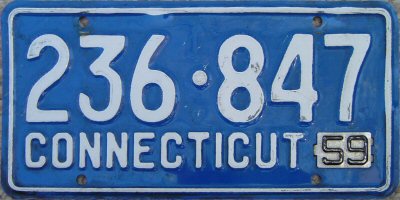 |
Connecticut – 5th state; ratified the Constitution 1788This undated base was issued 1957-1969 with several different serial formats. Metal year tabs were used even in 1957, the first year this design was on the street. I haven't been able to determine definitively when this specific plate was issued, but I believe it was a new registration sometime between late 1957 and early 1959. |
||
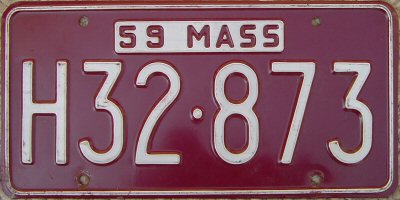 |
Massachusetts – 6th state; ratified the Constitution 1788Dated '59 plates were issued in both 1959 and 1960; based on the plate number, this specific example was issued in 1959. 1960 registrations were indicated with a windshield sticker. |
||
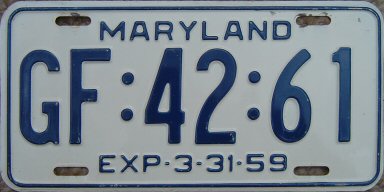 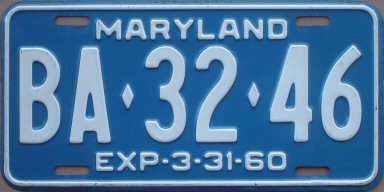 |
Maryland – 7th state; ratified the Constitution 1788Maryland passenger car plates all expired on March 31 of each year. The dated '59 passenger car plates were issued March 1958 through February 1959 and expired March 31, 1959; likewise, the dated '60 passenger car plates were issued between March 1959 and February 1960, and expired March 31, 1960. See my collection of various types of 1959 Maryland license plates. |
||
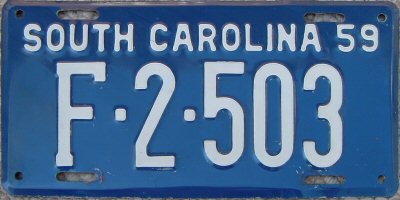 |
South Carolina – 8th state; ratified the Constitution 1788The letter prefix on South Carolina plates of this era was a vehicle weight class; "F" was used for passenger cars weighing 4,000 to 4,500 pounds. |
||
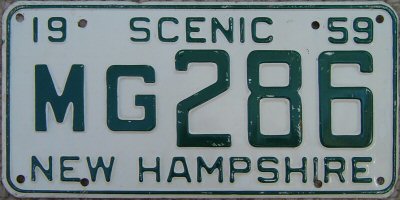 |
New Hampshire – 9th state; ratified the Constitution 1788Plates with serial numbers beginning with "M" were issued in Merrimack County. |
||
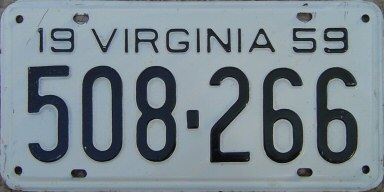 |
Virginia – 10th state; ratified the Constitution 1788Virginia passenger car plates of this era could be all numeric, or could have an "A" prefix. |
||
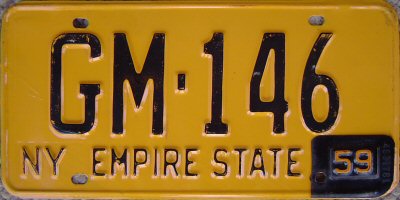 |
New York – 11th state; ratified the Constitution 1788This dated '58 base was validated for 1959 with a metal tab that was attached to the rear plate only. Unlike many New York alpha prefixes and suffixes, "GM" apparently was not assigned to any particular county. |
||
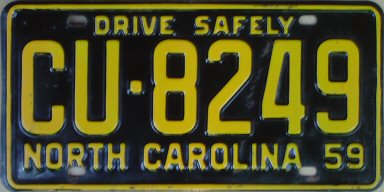 |
North Carolina – 12th state; ratified the Constitution 1789Safety slogans like this Drive Safely imperative were fairly common in decades past. |
||
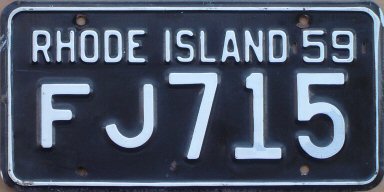 |
Rhode Island – 13th state; ratified the Constitution 1790Dated '59 bases were issued in 1959 and 1960; 1960 registrations were indicated with a metal "60" tab placed over the "59" on the base. |
||
 |
Vermont – 14th state; admitted to the Union 1791Tourism slogans were common on license plates in 1959, just as they are today. This one, See, has to take the prize for being the must concise. |
||
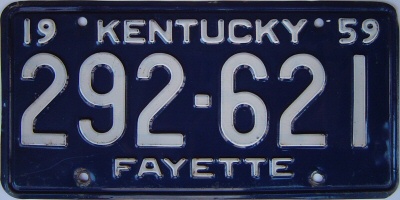 |
Kentucky – 15th state; admitted to the Union 1792Many states had ways to identify the county on their plates, but in 1959 only Kentucky and Mississippi put the actual county names on their plates. |
||
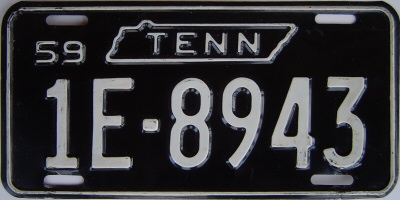 |
Tennessee – 16th state; admitted to the Union 1796Tennessee was among a few southern states that used both county codes and weight codes on their plates. The "1" indicated Davidson County; as near as I can tell, "E" was one of several letters used for a passenger car weighing 3,600 pounds or less. |
||
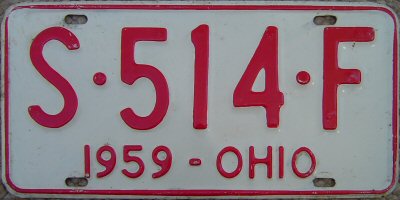 |
Ohio – 17th state; admitted to the Union 1803Various serial formats were used in different areas of the state; the x-000-x format indicates this plate was issued to someone living roughly in the southeastern part of the state. |
||
 |
Louisiana – 18th state; admitted to the Union 1812If you can't tell, that thing in the middle of the plate is an embossed image of a pelican. |
||
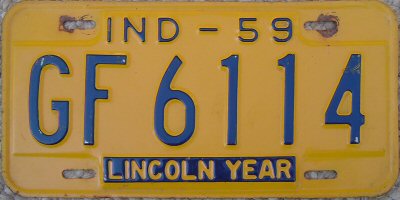 |
Indiana – 19th state; admitted to the Union 1816During this time, each combination of alpha characters in the serial was assigned to a specific county. "GF" was used for residents of Jasper County. The legend Lincoln Year commemorates 1959 as the 150th anniversary of the birth of Abraham Lincoln, who lived in Indiana from age 7 to age 21. |
||
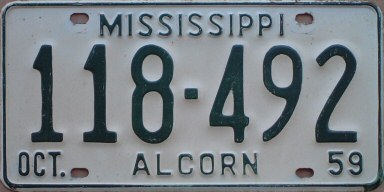 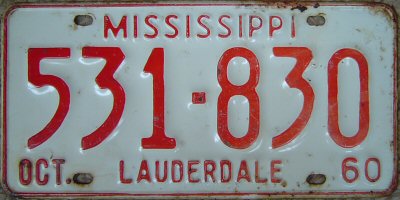 |
Mississippi – 20th state; admitted to the Union 1817All Mississippi license plates expired each October during this period. County names were shown at the bottom of passenger car plates. Successive blocks of plate numbers were assigned to each county in alphabetical order. |
||
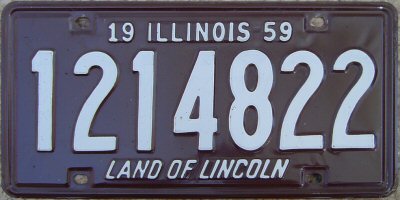 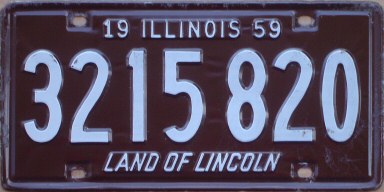 |
Illinois – 21st state; admitted to the Union 1818Well as we now know, as much as Illinois likes to call itself the Land of Lincoln, this is a somewhat dubious claim, as he did not actually live there until he was 21 years old. Even in the 1950s, brown was a rather unusual color for a license plate. Seven-digit registration numbers were also uncommon. Starting at about plate number 3200 000, different, slightly smaller dies were used to stamp the plate number, allowing for a half-space between the fourth and fifth serial digits. These new dies were then used on all 1960 Illinois plates. |
||
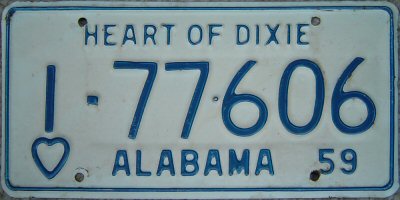 |
Alabama – 22nd state; admitted to the Union 1819The "1" prefix was a county code used for residents of Jefferson County, the most populous in the state. |
||
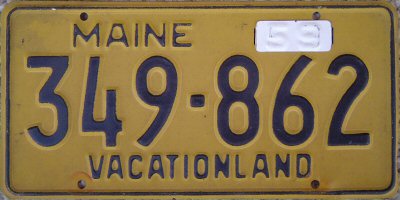 |
Maine – 23rd state; split from Massachusetts and admitted to the Union 1820This base plate was used between 1956 and 1961. Earlier versions had an embossed "56" that was then covered by a year tab in subsequent years; later versions issued after 1956, including this example, were undated and required a year tab to be valid. The year tabs were unusual in that they were entirely one color, making the embossed year difficult to read. |
||
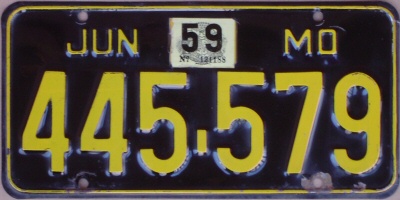 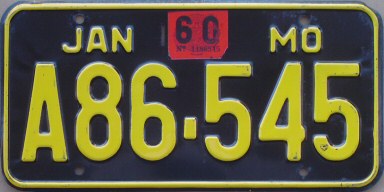 |
Missouri – 24th state; admitted to the Union 1821Missouri first issued this base plate in 1955 with 1956 expirations, and used it through 1961. Missouri was an early adopter of staggered expirations, and was the first state to issue plates with year stickers. The plate itself was undated, but was issued with a '56 sticker already attached between two tab slots (which were never used) at the top center. In subsequent years, the year stickers were larger and covered one or both tab slots. Earlier issues of this base were all numeric; later issues had a alpha prefix. |
||
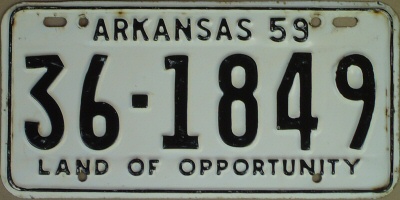 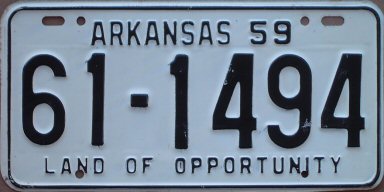 |
Arkansas – 25th state; admitted to the Union 1836Arkansas was the last of the 50 states I needed for this U.S. 1959 set. I acquired the version 1 plate shown at top left in April 2006; it's not a rare plate or anything, but some state had to be last. County number 36 is Lawrence County. The version 2 plate at bottom left is rather rare, however. I've only ever seen a few of these. The dies used to stamp the plate number on this plate appear to be the same ones used to make 1957 as well as 1960-1962 Arkansas plates. However, the dies used to stamp the state name, year, and the Land of Opportunity legend appear to be the same as was used only for 1957 Arkansas plates. In any case, I believe it to be a late-issue variation, probably made concurrently with 1960 plates. County number 61 is Searcy County. |
||
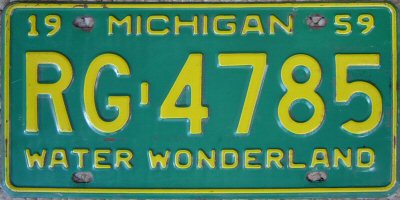 |
Michigan – 26th state; admitted to the Union 1837The dated 1959 base plate was renewed for 1960 and 1961 with metal tabs that attached to the upper right bolt hole and covered the "59". The "RG" serial prefix identifies this plate as having come from Muskegon County. |
||
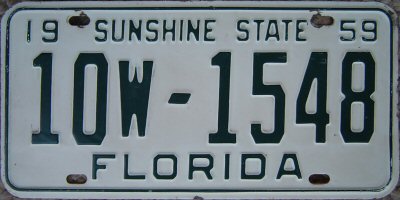 |
Florida – 27th state; admitted to the Union 1845Florida was another southern state that used both county codes and weight class codes on the same plate. The "10" means this vehicle was registered in Broward County; the "W" means that it was a passenger car weighing between 3,500 and 4,500 pounds. |
||
 |
Texas – 28th state; admitted to the Union 1845The tab slots on this plate were never put to use; instead, a new plate was issued for 1960. |
||
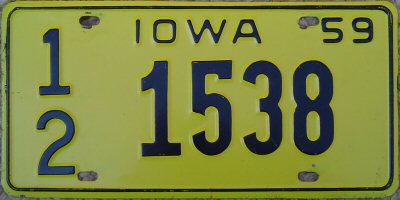 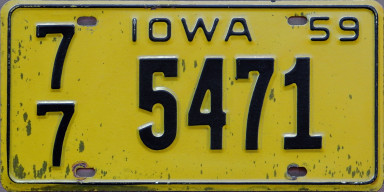 |
Iowa – 29th state; admitted to the Union 1846The stacked "12" on the top plate indicated that the motorist lived in Butler County, while the "77" on the bottom plate indicates Polk County, which is where Des Moines, the state capital, is located. Note the completely different dies used for the county number versus the serial number. Anyway, Iowa conducted an experiment with reflective-background plates in 1959 by issuing them to Polk County motorists, while continuing to use painted, non-reflective plates to rest of the state. Apparently the experiment was a failure, because nearly every reflective 1959 Iowa plate I've seen has these dark spots. As far as I know, Iowa didn't issue reflective-background plates again until 1967. |
||
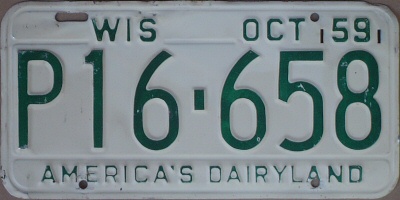 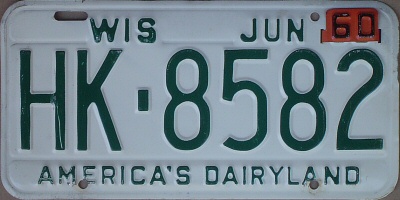 |
Wisconsin – 30th state; admitted to the Union 1848The dated '59 base was issued in 1958 and 1959 with staggered expiration dates; a metal "60" tab was applied for 1960 expirations. Each month had a specific serial prefix letter assigned; after plate x99-999 was issued in a given month, they went to two-letter prefixes using the same first letter, with the second letter variable but starting at "K". |
||
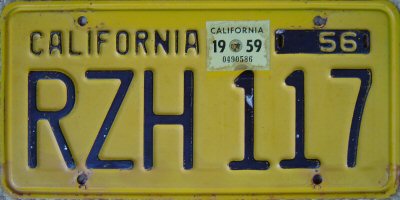 |
California – 31st state; admitted to the Union 1850Similar to Pennsylvania in 1958, California initially issued dated '56 plates with a tab slot, but then the following year used a sticker to show that the registration was current. Plates were issued in pairs, but the sticker was applied to the rear plate only. The dated 1956 base plate was used through 1962. This particular plate was issued in early 1959, based on the registration number. In 1960, newly issued plates no longer came with a tab slot. |
||
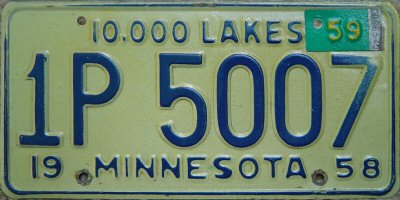  |
Minnesota – 32nd state; admitted to the Union 1858The dated 1958 base was issued in 1958 and renewed with a '59 metal tab. Base plates issued for new registrations in 1959 looked similar, but were undated; these also used the '59 tab. Both were replaced in 1960 with a new base. The first and second serial characters identified the U.S. congressional district and the issuing state vehicle registration office within that district, respectively. The dated 1958 base plate was issued from the office located in the town of Waseca. I haven't determined where the undated base was issued. |
||
  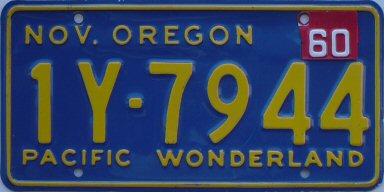 |
Oregon – 33rd state; admitted to the Union 1859The base with no slogan was originally issued in 1955 with staggered expiration months and an embossed '56 expiration year. At some point after 1955, the expiration year was no longer stamped on the plate; the two plates at top left and middle left are those later models. In about November 1959, a new base with the slogan Pacific Wonderland began to be issued with late 1960 expiration dates to new registrants, as shown at bottom left. These were issued through the mid-1960s. On all of these plates, the letter in the plate number corresponds to the stamped expiration month. First, letters A through M, excluding I, were used for expiration months January through December, respectively. Then, as those letters were used up, letters N through Z, excluding O, were pressed into service. Thus, a January expiration plate may have either letter A or N in the serial number. |
||
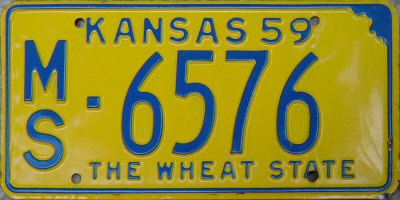 |
Kansas – 34th state; admitted to the Union 1861The stacked "MS" is the county code for Marshall County. |
||
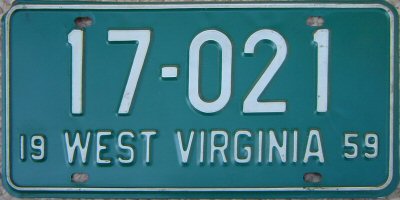 |
West Virginia – 35th state; split from Virginia and admitted to the Union 1863There's nothing special about the "17" prefix; West Virginia plates were issued sequentially. |
||
 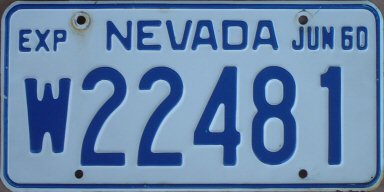 |
Nevada – 36th state; admitted to the Union 1864All Nevada passenger car plates of this era expired annually each June 30, and had a one- or two-letter serial prefix, smaller than the numbers, that identified the county where the vehicle was registered. The 1959 expiration plate is from Clark County, home of Las Vegas, while the 1960 expiration plate is from Washoe County, where Reno is located. The low-contrast color scheme on the 1959 plate (silver on light blue) would never pass muster today. |
||
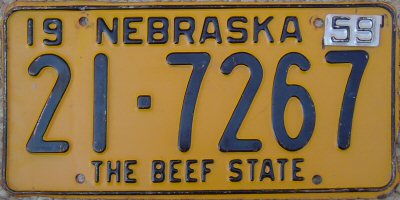 |
Nebraska – 37th state; admitted to the Union 1867The dated 1958 base was issued in 1958 as well as 1959; 1959 registrations also used a metal '59 tab. The "21" prefix is the county code for Scott's Bluff County. |
||
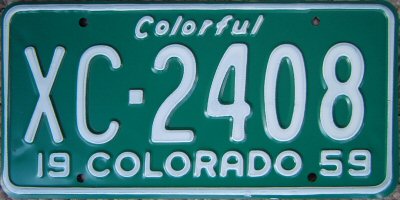 |
Colorado – 38th state; admitted to the Union 1876The "XC" prefix identifies this plate as having been issued in Bent County, one of the less populated counties in the state. |
||
 |
North Dakota – 39th state (tie); admitted to the Union 1889The dated '58 base was issued 1958 through 1961; a metal year tab indicated the registration year after 1958. |
||
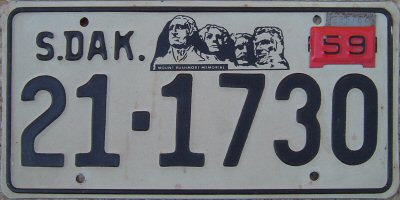 |
South Dakota – 39th state (tie); admitted to the Union 1889The dated '57 base was issued 1957 through 1959; metal year tabs were applied in 1958 and 1959. The Mt. Rushmore graphic is screened, which is remarkable for a 1950s plate. This "21" is also a county code; in South Dakota, "21" means Custer County. |
||
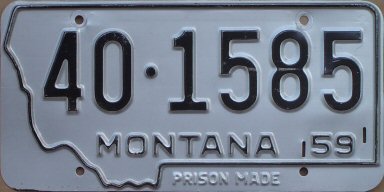 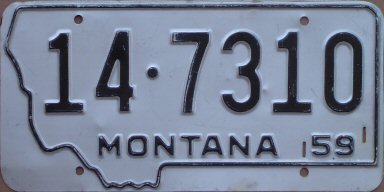 |
Montana – 41st state; admitted to the Union 1889The dated '59 base plate was made of unpainted aluminum. It was validated with a metal year tab for the years 1960 through 1962. There were two versions of the '59 base, both shown at left; the majority had the words Prison Made lightly embossed along the bottom edge, but some plates did not have this legend. I suspect that these latter plates may have actually been issued in 1962, and would have only been used with a '62 tab covering the embossed '59 on the plate. Whether they stopped making plates in prison, or just stopped thinking that they needed to be marked as such, I don't know. Most likely the latter, I'd say. County number 14 is Custer County, while county number 40 is Sweet Grass County. |
||
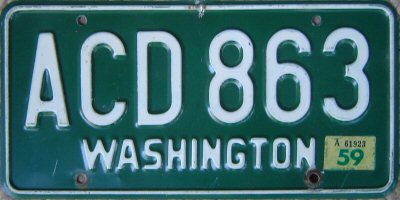 |
Washington – 42nd state; admitted to the Union 1889Washington 1958 base plates had no embossed year, but came with a '58 sticker already attached. They were then validated annually with stickers through 1962. Despite the seemingly generic serial format, these plates were county-coded; plate numbers beginning with "A", as well as stickers with an "A" prefixed serial number, were from King County. |
||
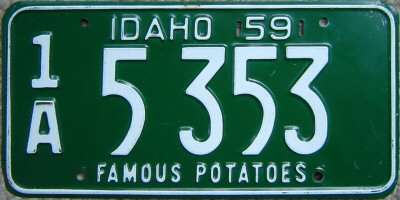 |
Idaho – 43rd state; admitted to the Union 1890The tab slots on the 1959 plate were never used; a new 1960 plate replaced this one. The stacked "1A" indicates the registrant lived in Ada County with Idaho's unique alphanumeric county coding system. |
||
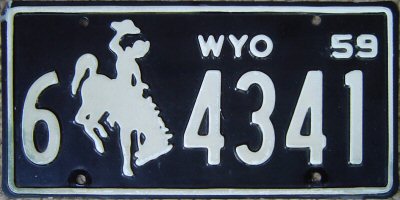 |
Wyoming – 44th state; admitted to the Union 1890The "6" to the left of the bronco identifies the plate as having been issued in Carbon County. The bucking bronco made its debut in 1936, and has been a fixture on Wyoming plates ever since. For details about the bronco, and how it came to be on Wyoming license plates, click here. |
||
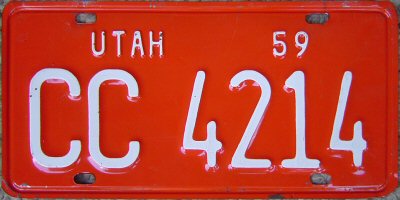 |
Utah – 45th state; admitted to the Union 1896In 1959, Utah introduced especially narrow and thin dies for the state name and year. These elements look like they would have been pretty hard to read by law enforcement, and in any event, were made larger on 1960 plates. |
||
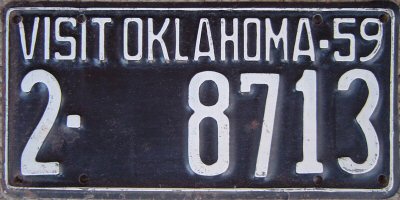 |
Oklahoma – 46th state; admitted to the Union 1907The embossing on Oklahoma plates through 1959 looked especially primitive. The dies were changed for 1960, and from that point forward, the embossing looked crisp and modern. The "2" is a county code for Tulsa County. |
||
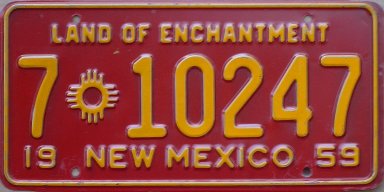 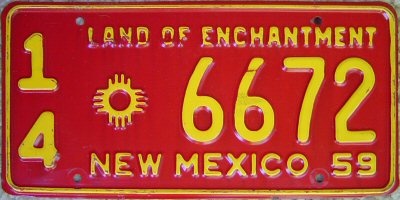 |
New Mexico – 47th state; admitted to the Union 1912County number 7 was Doña Ana County; county number 14 was Valencia County. Plates in single-digit counties had the legend Land of Enchantment centered, and had a small "19" (for the first two digits of the year) in the lower left corner. For two-digit counties, the legend was offset to the right and the century was omitted. This base was renewed in 1960 with a "60" sticker affixed to a metal tab, which attached to the lower right bolt hole and covered the "59" on the base. |
||
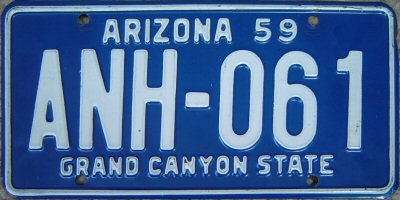 |
Arizona – 48th state; admitted to the Union 1912The dated '59 base was issued in both 1959 and 1960; the 1960 registration was indicated with a sticker placed in the upper right corner of the plate. |
||
 |
Alaska – 49th state; admitted to the Union January 3, 1959The dated '58 base was issued in 1958 and 1959; a metal tab was affixed for 1959 registrations. |
||
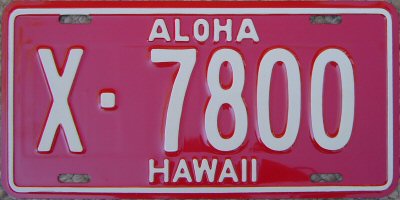 |
Hawaii – 50th state; admitted to the Union August 21, 1959This undated plate was issued 1957-1960. Windshield stickers were used to show that registration was current. Hawaii used an alphabetic county coding system; but most of the letters were assigned to Honolulu County, including the letter "X" found on this example. The letter "X" and the serial format also indicate that this plate was likely issued in 1959. |
||
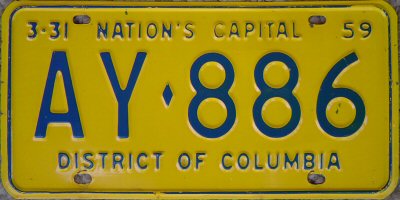 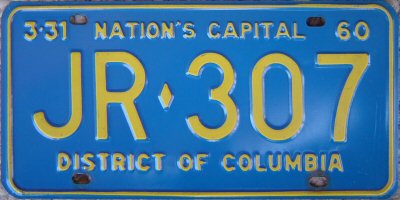 |
District of Columbia – established by Congress 1791 from land contributed by Maryland and Virginia; Virginia portion returned 1846Similar to neighboring Maryland, Washington, D.C. plates of this era were issued annually and bore the complete expiration date, which was always March 31. |
||
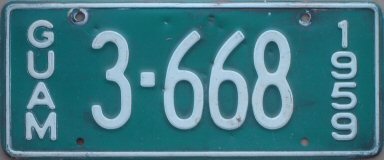 |
Guam – acquired from Spain 1898All U.S. states had conformed to the standard 12-inch by 6-inch plate dimensions by the mid-1950s; Guam didn't get around to doing so until 1960. Between 1948 and 1959, Guam plates measured 12 inches by 5 inches. |
||
 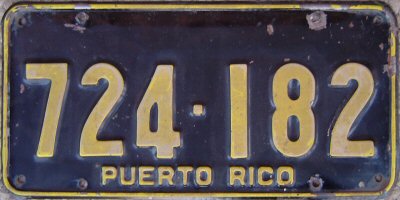 |
Puerto Rico – acquired from Spain 1898Until about 1990, Puerto Rican passenger car plates and/or stickers usually indicated both the issue year and expiration year. The last annually-issued plate was the blue plate dated "1958-59" shown above left. The undated black plate below it was issued from 1959 to 1963, and was used during the 1959-60 registration year without stickers. Renewal stickers were used for 1960-61 and subsequent registration years through 1965-66. |
||
 |
Canal Zone – acquired from Panama 1903; returned to Panama 1979The Canal Zone was a strip of land flanking the Panama Canal that was administered by the U.S. from 1903 to 1979, and which no longer exists as a jurisdiction. Canal Zone plates used this basic design, with alternating colors each year, between 1956 and 1960. Passenger car plates had all-numeric plate numbers. |
||
  |
U.S. Virgin Islands – acquired from Denmark 1917Virgin Island plates use a letter prefix to identify the island where the vehicle is registered. A "C" prefix indicates St. Croix and a "T" prefix was used for both St. Thomas and St. John until 1975, when St. John got its own "J" prefix. There's nothing particularly noteworthy about the red-on-white plate, except that they didn't make enough of them. Their solution was to make use of some leftover blue-on-yellow 1957 plates they still had on hand. They hammered flat the last digit of the embossed year, painted on a red "9" over top of it, and painted on a red "A" plate number suffix to avoid duplicating plate numbers already issued as red-on-white plates. |
Related pages on this site |
Elsewhere on the web |
Thanks to those who have directly contributed to the information on this page: Barrett Glasnapp.
This page is W3C valid |