 |
|
 |
|
|
|
|
On this page I display my collection of U.S. passenger car plates from the year 1977. Now up to 50 of 50 states, plus 6 of 6 non-state U.S. jurisdictions. Latest noteworthy updates to this page
| |
Many license plate collectors, myself included, either have or are working on a "birth year set", which is a collection of license plates from every state from the year they were born. I've never heard of anyone with a high school graduation year set, but I certainly don't mind being the first. Maybe this idea will catch on with other collectors, too. These plates are more significant to me than those in my birth year set, because I actually remember seeing them in use.
These are all "passenger plates", which are license plates of the type that would be issued to regular passenger cars. Both standard-issue plates, and optional plates where applicable, are shown. Since by 1977 most states had staggered expiration dates indicated with stickers, whenever possible I'm collecting plates that have the date "77" on the plate or the sticker, preferably naturals. In states that had multiple base plates in use in 1977, as a lower priority I will also also strive to obtain examples of older base plates that indicate registration in 1977. Maine is the first state where I'm able to show both an older base renewed with a 1977 sticker, and the then-current base with a natural 1977 sticker.
These plates are displayed in sequence based on an imaginary road trip around the country, starting in my home state of Maryland, and visiting Washington, D.C. and each of the contiguous 48 states once and only once. This trip necessarily ends in Maine, because Maine is bordered by only one other state. Therefore, the trip more or less takes you in a big clockwise circle around the country. The non-contiguous states and territories follow at the bottom of the page.
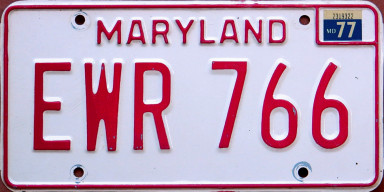 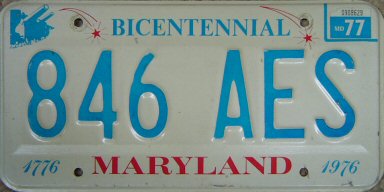 |
Marylandbordered by the District of Columbia, Virginia, West Virginia, Pennsylvania, and DelawareIn the 1970s, Maryland passenger car plates all expired on March 31 of the year indicated on the sticker. The red-on-white base was the standard issue; the graphic Bicentennial plate was an extra-cost optional issue. Both plates were first issued in 1975 and were valid through March 1980 with appropriate stickers. |
 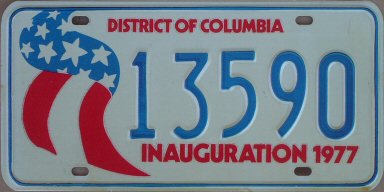 |
District of Columbiabordered by Maryland and VirginiaD.C. Bicentennial plates were standard issues first seen in March 1974. Low serial numbers up to 1250 were VIP plates assigned by the Mayor's office. Regular people were issued serials beginning at 100*001. From 1933 to 2001, D.C. issued special event plates for U.S. presidential inagurations. These were valid license plates that could be used on any vehicle in the U.S. for a period of a few months. President Jimmy Carter was inaugurated in 1977. |
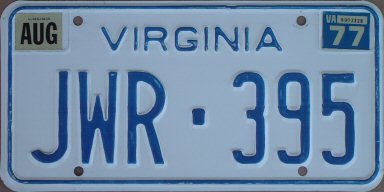  |
Virginiabordered by Maryland, the District of Columbia, West Virginia, Kentucky, Tennessee, and North CarolinaLike Maryland, Virginia offered a plain standard passenger car plate as well as an extra-cost graphic Bicentennial plate. Notice the completely different dies used to embosss the serial numbers on these two bases. The standard plate was issued from about 1973 to 1980 and was used for several years beyond that. The Bicentennial plate was introduced in 1975 and can still be renewed even today. |
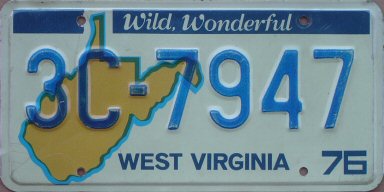 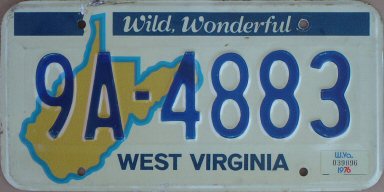 |
West Virginiabordered by Maryland, Virginia, Kentucky, Ohio, and PennsylvaniaWest Virginia passenger car plates from the mid-to-late 1970s are confusing. I'll spare you all the details, but there were no plates or stickers indicating the year 1977. Two versions of the 1976 "map" graphic plate expired in 1977 – the short serial die version with first character 1 through 7, a screened "76" in the lower right corner, and no year stickers; and also the tall serial die version with first character 8, 9, O, N, or D, with a "1976" sticker covering the screened "76" on the plate, as shown at left. You can especially see the difference between the dies by comparing the "9" digit on these two plates. The first serial character indicates the expiration month, March and September, respectively, on these plates. |
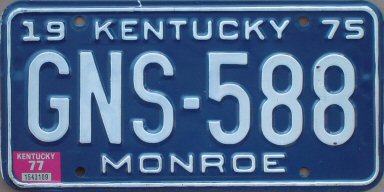 |
Kentuckybordered by Virginia, West Virginia, Tennessee, Missouri, Illinois, Indiana, and OhioThis 1975 base plate was valid for three years with appropriate renewals stickers. The stickers themselves were rounded at one corner so they'd fit snugly against the embossed border in the proper corner of the plate. The motorist's county of residence is indicated at the bottom center. |
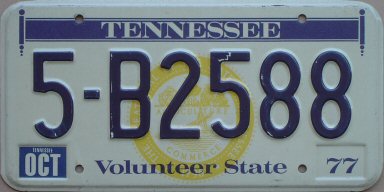 |
Tennesseebordered by Virginia, Kentucky, North Carolina, Georgia, Alabama, Mississippi, Arkansas, and MissouriWhen 1976 annual registrations expired statewide in February 1977, Tennessee simultaneously introduced their first graphic plate and converted to staggered registrations. The earliest staggered expiration date was September 1977. 1977 expirations were indicated on this base with a month sticker in the lower left corner and the screened "'77" in the lower right corner. The number "5" to the left of the dash in the serial number indicates that this motorist resided in Sullivan County. |
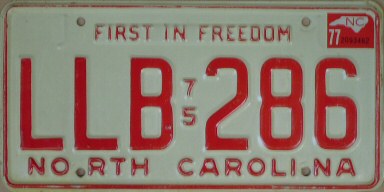 |
North Carolinabordered by Virginia, Tennessee, South Carolina, and GeorgiaIt's hard to believe that a state where slavery was legal until the 1860s would promote themselves as First in Freedom, but that's exactly what North Carolina did on this 1975 base plate. The controversial slogan was absent from newly issued plates starting in about 1979, but these 1975 plates continued to be renewed and used until about 1985. |
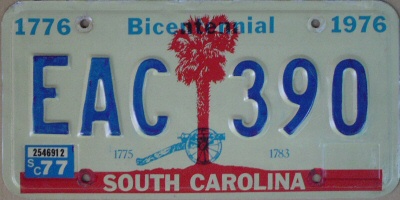 |
South Carolinabordered by North Carolina and GeorgiaThis was South Carolina's first graphic plate, and their first multi-year base plate since World War II. It was valid through November 1976 without stickers, and was used through 1980 with the appropriate expiraiton stickers. That red thing in the middle of the plate is supposed to be a palmetto, the state tree. |
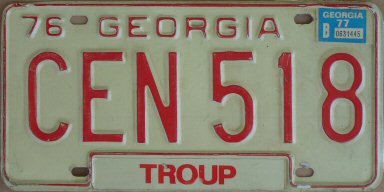 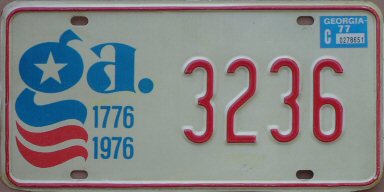 |
Georgiabordered by Tennessee, North Carolina, South Carolina, Florida, and AlabamaGeorgia used this standard red-on-white base plate from 1976 to 1982 with appropriate validation stickers. Despite the seemingly generic numbering format, the first serial letter was actually a weight class code. "C" was one of the letters used for the lightest weight class, which was for cars weighing only 1,000 to 3,000 pounds. The motorist's county is identified with a sticker applied at the lower edge of the plate. Georgia also offered an an extra-cost graphic Bicentennial plate, but it was not a popular choice among Georgia motorists. This plate was also introduced in 1976; I'm not sure how long it was issued, but by one account it could be used through 1989. These were not normally used with a county sticker. |
  |
Floridabordered by Georgia and Alabama1977 was a transition year for Florida license plates. A new green-on-white plate began being issued to new registrants in July, and these new plates abandoned the long practice of using county codes and weight codes. These plates had a place along the bottom for a county name sticker to go, but early issues on this base were issued without county stickers. Shown at top left is an outgoing, old-school plate; the "12" indicates Lake County, and the lack of a letter indicates a passenger car weighing between 2,501 and 3,500 pounds. At bottom left is the new plate introduced in July 1977; the November 1977 expiration is possible because Florida assigns expiration dates based on the vehicle owner's birthdate. |
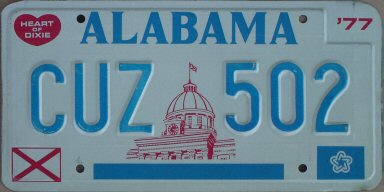 |
Alabamabordered by Tennessee, Georgia, Florida, and MississippiThis graphic Alabama plate is considered to be a U.S. Bicentennial plate due to the logo in the lower right corner, but was introduced in September 1976, two months after the date of the actual event. The plate was valid without stickers through September 1977. Most of these plates had a county name sticker covering the blue bar at the bottom; I don't know why this one doesn't. |
 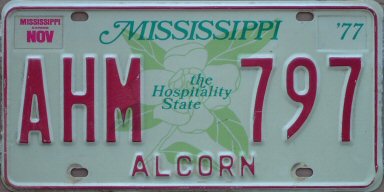 |
Mississippibordered by Tennessee, Alabama, Louisiana, and ArkansasIntroduced in October 1976, this was Mississippi's first graphic plate, and its first multi-year base plate in the modern era. At that time, the previous license plates were all expiring on October 31, as they had done each year for decades. All motorists renewing their registrations were issued this plate, with a screened '77 expiration year in the sticker well but without expiration stickers, as shown at upper left. Unstickered plates such as this were valid through October 1977. However, at the same time, Mississippi began issuing new plates with an initial registration period ending on the last day of the same month in the following year. Therefore, motorists who newly registered vehicles in November or December 1976 were issued the 1977 plate along with a corresponding pink-on-white month sticker to show that the plate was valid beyond October 1977, as shown at bottom left. I've also seen pink-on-white October month stickers affixed to plates with no year sticker, which strikes me as being redundant. I can only guess that October stickers were affixed to plates issued to vehicles being newly registered during October 1976. In any case, pink-on-white month stickers were issued only during that three-month period. For both new and renewed registrations expiring in 1978 through 1980, the state issued new month stickers each year with colors that matched the year stickers. |
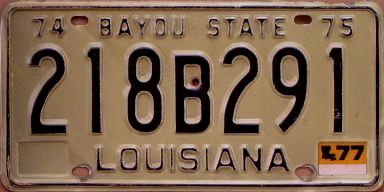 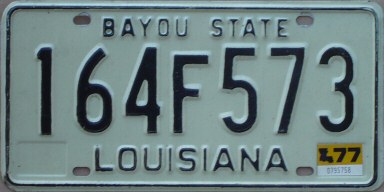 |
Louisianabordered by Mississippi, Arkansas, and TexasLouisiana passenger car plates issued between 1964 and 1993 had a letter code in the middle of the plate number that identified the state police district in which the motorist resided. District B was in the southeastern part of the state including New Orleans. District F covered the north central part of the state, around Monroe. There were two different base plates in use in 1977 – one with the years 74 and 75 embossed in the upper corners, respectively, and this undated plate that was introduced in either 1976 or 1977. For reasons unknown, some 1977 stickers had serial numbers and others did not. |
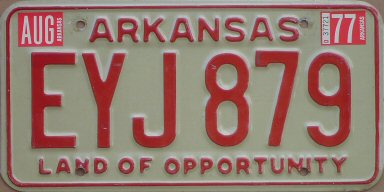 |
Arkansasbordered by Tennessee, Mississippi, Louisiana, Oklahoma, Texas, and MissouriArkansas introduced a plain, red-on-white base plate in 1968, but by 1975 had added the legend Land of Opportunity to newly issued plates. A graphic plate was introduced in late 1977, while both all-embossed versions continued to be renewed through 1982. During this era, Arkansas, like Mississippi, issued a new month sticker each year that matched the colors of the year sticker. |
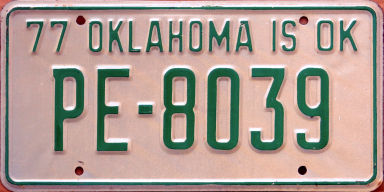 |
Oklahomabordered by Arkansas, Texas, New Mexico, Colorado, Kansas, and MissouriOklahoma was one of only four states in 1977 still issuing new plates every year. The slogan Oklahoma is OK was first used in 1967; it seems rather lame today. The prefix letters "PE" indicate the plate was issued to someone living in Pottawatomie County. |
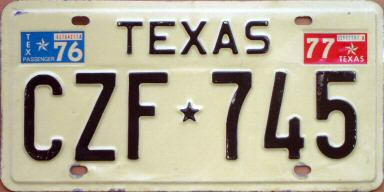 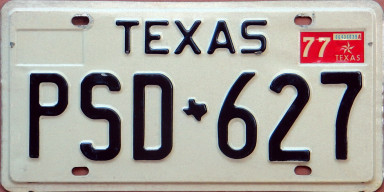 |
Texasbordered by Louisiana, Arkansas, Oklahoma, and New Mexico (and Mexico)This base plate was introduced in 1975. Early versions had a star for a separator; in late 1975 or early 1976, the separator was changed to the state map. |
 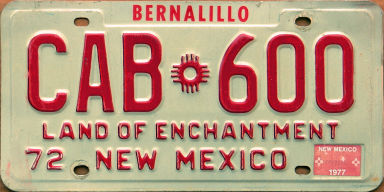 |
New Mexicobordered by Oklahoma, Texas, Arizona, and Colorado (and Mexico). Shares a corner with Utah.New Mexico had six base plates in use in 1977. The first five were colored red on white, one with an embossed year 74 in the lower left corner, and the other four with an embossed 72, which were issued both before and after the "74" plates. Pictured are the fourth and fifth of the five red-on-white base plates used in 1977. These plates continued to be renewed until at least the early 1980s. A sixth base was colored red on yellow, and otherwise looked like the bottom plate shown at left, except that it had no embossed year. |
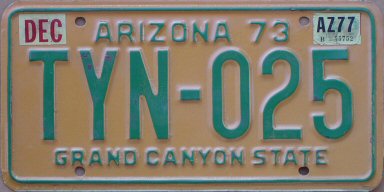 |
Arizonabordered by New Mexico, Utah, Nevada, and California (and Mexico). Shares a corner with Colorado.Arizona issued this dated 1973 base plate through 1980, validating it with stickers beginning in 1974. It continued to be used through 1990. I think the colors were quite appropriate for a desert state. |
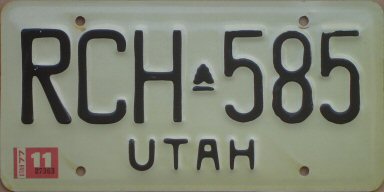 |
Utahbordered by Arizona, Nevada, Idaho, Wyoming, and Colorado. Shares a corner with New Mexico.Utah issued a number of plain, black-on-white base plates between 1973 and 1985, with minor differences between them. All of these may continue to be renewed today. That triangle-shaped thing in the middle of the plate is supposed to be a beehive, which is the state symbol. Beehive plates were issued to new registrants between about 1975 and 1978. |
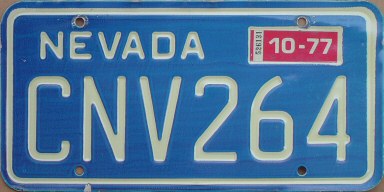 |
Nevadabordered by Arizona, Utah, California, Oregon, and IdahoNevada had three different white-on-blue base plates in use in 1977, and a few more were issued in subsequent years. All of these were debossed, with the white characters lower than the surrounding blue background. The first of these debuted in 1969; shown at left is the third version introduced around 1974 or 1975. The plate serial letters were coded to indicate the motorist's county; most of the C-series plates, including this one, were issued to Clark County residents. |
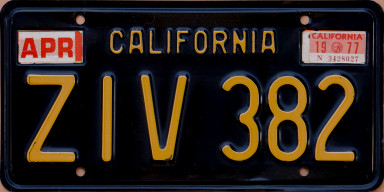 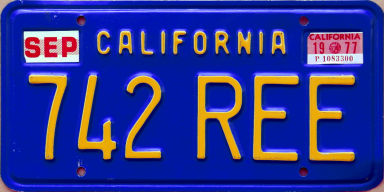 |
Californiabordered by Arizona, Nevada, and Oregon (and Mexico)These familiar plates were seen in many of the TV shows and movies of my youth. The black-background plates were issued between 1963 and 1969. When the numbers in the three-letter, three-number format were exhausted in late 1969, the letters and numbers switched places and the background color was changed to blue. The three-number, three-letter format was used on blue-background plates until it was exhausted in about 1979. The blue plates then continued to be issued in a seven-character format until about 1986. Both of these plate designs remain in use today. |
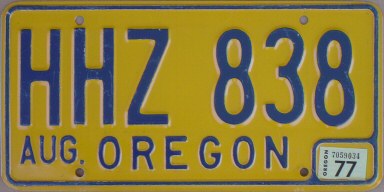 |
Oregonbordered by Nevada, California, Washington, and IdahoThese orange plates were issued to new registrants in the 1970s and 1980s, and like all Oregon passenger car plates issued since 1955, can still be used today if continuously registered. |
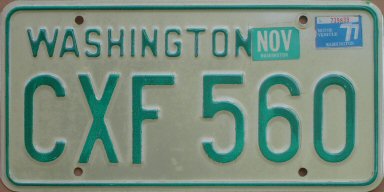 |
Washingtonbordered by Oregon and Idaho (and Canada)Washington converted to staggered expiration dates in 1977, and as a result, virtually no plates were issued with natural (first-time) 1977 expirations. New registrations during 1976 got 1976 stickers, and new registrations during 1977 got 1978 expiration stickers. Plates registred during 1976 and renewed were assigned new expiration dates between July 1977 and June 1978. Pictured at left is such a plate with a 1977 expiration. |
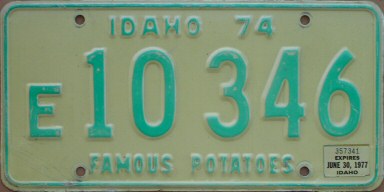 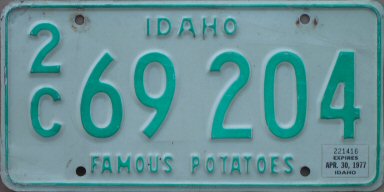 |
Idahobordered by Utah, Oregon, Washington, Montana, and Wyoming (and Canada)Idaho issued all-embossed green-on-white base plates between 1974 and 1982; originally these had an embossed "74" after the state name, but later issues were undated. You can see that the older plate has yellowed pretty badly – this was fairly common problem with the reflective sheeting used at that time. As is also done in Massachusetts, the last digit of the plate number corresponded with the expiration month. The stacked characters "2/C" indicate that the motorist issued this plate lived in Canyon County, while the "E" prefix identifies the motorist as hailing from Elmore County. |
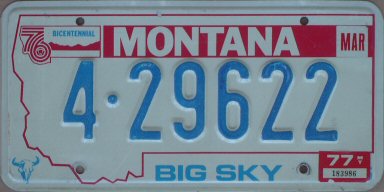 |
Montanabordered by Idaho, Wyoming, South Dakota, and North Dakota (and Canada)This base plate was issued from 1976 to 1990, with the last registration period expiring in 1991. The "4" serial prefix identifies this plate as having been issued in Missoula County. |
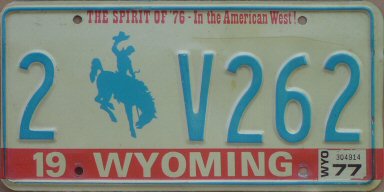 |
Wyomingbordered by Utah, Idaho, Montana, Colorado, Nebraska, and South DakotaThis was Wyoming's first multi-year base, issued in 1975 and renewed in 1976 and 1977 with stickers. The "2" to the left of the bucking bronco graphic indicates this plate was issued in Laramie County. |
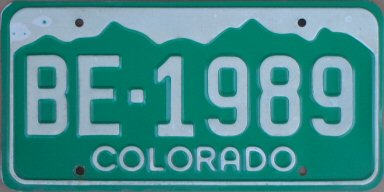 |
Coloradobordered by Oklahoma, New Mexico, Utah, Wyoming, Kansas, and Nebraska. Shares a corner with Arizona.Colorado introduced its long-running white on green mountain base plate in 1977, and it was valid without stickers during its first year. In 1978 and subsequent years, these plates were validated with stickers applied to the rear plate only. The "BE" serial prefix identifies the plate as having been issued to a Denver County motorist. The xx-0000 serial format was issued during the first few years; as each county's allotment of prefix letters were used up, they then switched to other formats. |
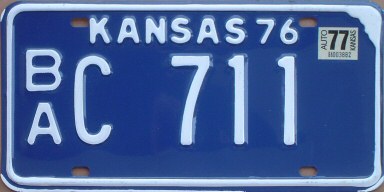 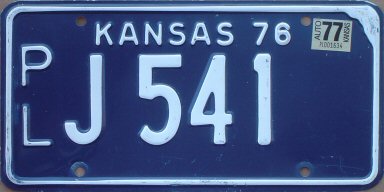 |
Kansasbordered by Oklahoma, Colorado, Nebraska, and MissouriThe 1976 Kansas base plate was issued and used through 1980, and was validated with stickers each year after 1976. The 1976 base plate was manufactured by two separate entities, and the plates they each made had several small but noticeable differences from each other. Perhaps the most obvious of these differences is the shape of the number "6" in the embossed year. The two stacked letters on these plates are county codes; "B/A" indicates Barber County, while "P/L" is for Phillips County. The full-sized letter was a code indicating the month of expiration, but these codes were not intuitively obvious. "C" denoted an April expiration date, and "J" denoted a July expiration. (Just trust me on this, okay?) |
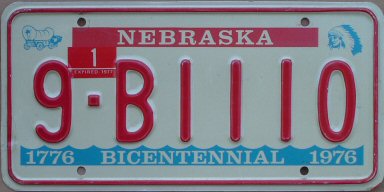 |
Nebraskabordered by Wyoming, Colorado, Kansas, South Dakota, Iowa, and MissouriWhen Nebraska created this rather busy design, they forgot to leave a space for the expiration sticker. They apparently didn't instruct people where to place them, either, because Nebraska motorists applied their stickers in just about every conceivable location on their plates. The "1" sticker indicates a January 1977 expiration; the odd text Expired 1977 is printed at the bottom. The "9" prefix in the plate number identifies the plate as having been issued in Buffalo County. |
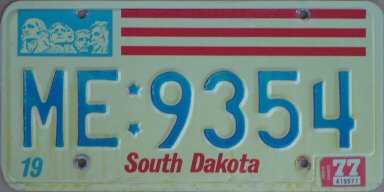 |
South Dakotabordered by Montana, Wyoming, Nebraska, North Dakota, Minnesota, and IowaSouth Dakota pioneered the use of screened graphics in the 1950s, and by the mid-1970s had gotten pretty sophisticated with them. This base plate was issued and used in 1976 without stickers, and was kept current with renewal stickers through 1981. The "ME" serial prefix identifies this plate as being from Minnehaha County. |
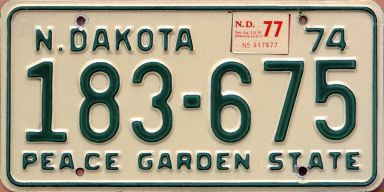  |
North Dakotabordered by Montana, South Dakota, and Minnesota (and Canada)There were at least two versions of this baseplate, which was used between 1974 and 1979. The two versions used distinctly different dies for the plate numbers. The earlier version, shown at top left, had shorter, rounder numbers than did the later version, shown at bottom left. The later version is a natural 1977 registration. The small print on the "77" stickers reads: "Pass. Exp. 3-31-78 / Others Exp. 12-31-77". |
 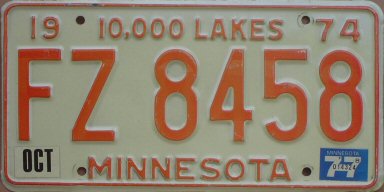 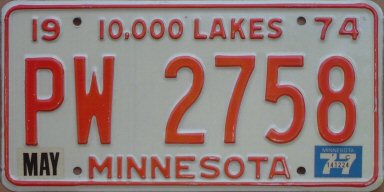 |
Minnesotabordered by South Dakota, North Dakota, Wisconsin, and Iowa (and Canada)Minnesota used the dated 1974 base through 1977; staggered expiration months were introduced in 1975. The orange paint tended to fade pretty readily on these. There were three different die sets used for serial numbers during the life of this base, as shown at left. |
 |
Wisconsinbordered by Minnesota, Iowa, Illinois, and MichiganHello, Wisconsin! This is the type of plate that would have been used on Eric Forman's Vista Cruiser or one of the other classic cars featured on That 70's Show. The letters at the bottom left corner actually read "APR", indicating an April expiration. The bolt hole clobbered most of the right leg of the letter "R". |
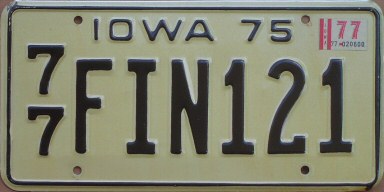 |
Iowabordered by Nebraska, South Dakota, Minnesota, Wisconsin, Missouri, and IllinoisOn the 1975 base plates, Iowa went to an alphanumeric serial format, with each six-character serial only used once statewide. Despite that, they also retained their county number codes, resulting in a bizarre 0/0xxx000 serial format. The embossed "77" on the left side of the plate is the number code for Polk County. This base plate was renewed with stickers through 1978. |
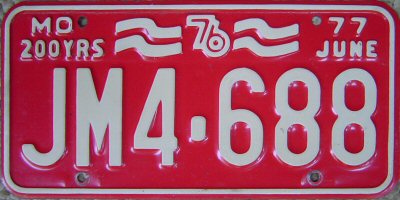 |
Missouribordered by Kentucky, Tennessee, Arkansas, Oklahoma, Kansas, Nebraska, Iowa, and IllinoisOnly people whose registrations expired during the first half of year actually had these spiffy 1977 expiration Bicentennial plates on their cars on the date of the actual anniversary. Everyone else still had the completely ordinary 1976 expiration plates, and only got their Bicentennial plates after the event was already over. |
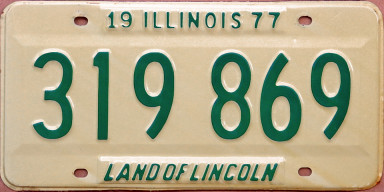 |
Illinoisbordered by Kentucky, Wisconsin, Iowa, Missouri, and IndianaIllinois quickly ditched their graphic 1976 Bicentennial plates, reverting back to the same plain design they had been using since the 1950s. In 1977, Illinois was only one of four states that were still replacing their plates every year. Passenger car serial formats could be all-numeric, as shown here, or using a two-letter prefix. |
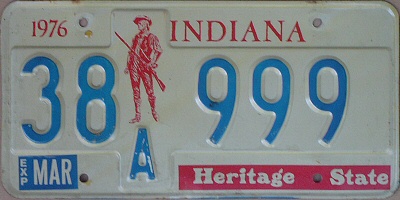 |
Indianabordered by Kentucky, Illinois, Michigan, and OhioThis plate would seem to have expired in March 1976, but really it was March 1977. During the 1970s, Indiana still annually issued new plates to all registrants. Once staggered expirations were begun, the expiration year was normally shown on the plate; Indiana plates actually expiring in 1976 had the 1976 date on the plate and were non-graphic. Indiana jumped on the Bicentennial bandwagon at the last minute, with these plates that were issued in 1976 and expired in 1977. Plates issued in 1977 and expiring in 1978 once again bore the expiration year. The number(s) to the left of the minuteman graphic identify the county; "38" is for Jay County. |
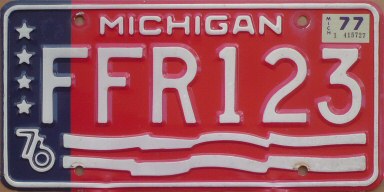 |
Michiganbordered by Wisconsin, Indiana, and Ohio (and Canada)In my book, this plate wins the prize for "Plate of the Decade" for the entire 1970s. It's patriotic, and very colorful – like a loud, plaid sport jacket with extra-wide 1970s lapels. This base was valid for use during 1976 without stickers; a single renewal sticker was applied to the rear plate for 1977 and 1978. |
|
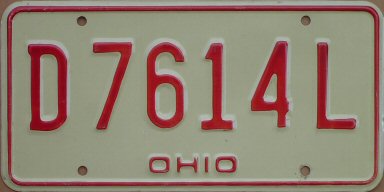
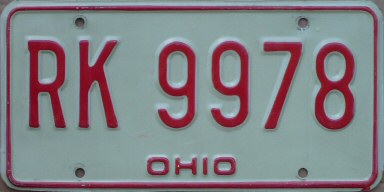
Ohiobordered by West Virginia, Kentucky, Indiana, Michigan, and PennsylvaniaIn contrast to the Michigan plate, they don't get much more boring-looking than these from neighboring Ohio. Ohio used a variety of numbering formats to identify the region of the state the plates was issued; the format with both prefix and suffix letters is from the eastern and southeastern portions of the state, including Akron and Youngstown and points south, while the format with two prefix letters is from the northeastern portion of the state, in and around Cleveland. This base plate was introduced in April 1976 and was valid through May 1977 without stickers. Stickers indicating the expiration month and year were then used to validate this plate through 1980. |
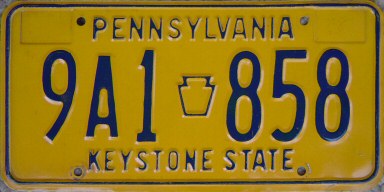 |
Pennsylvaniabordered by Maryland, West Virginia, Ohio, Delaware, New Jersey, and New YorkPennsylvania was the first state to issue Bicentennial plates in March 1971, and was also among the first to replace them in March 1977. These plates were valid without stickers in 1977 and were on the road through 1999. Serial formats in 1977 were all-numeric or had a single letter in positions 1, 6, or 2. |
 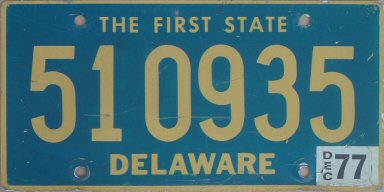 |
Delawarebordered by Maryland, Pennsylvania, and New JerseyBetween 1947 and 1970, Delaware made all of its license plates by riveting the indivdual plate number digits onto a blank plate with pre-drilled holes for the rivets. Beginning in about 1970, the company that produced Delaware plates pioneered the manufacture of completely flat plates with screened registration numbers; Delaware plates have remained essentially unchanged since then. Even after 1970, Delaware still rivted numbers onto plates when making up replacements (with the same number) for lost or stolen plates. The top plate shown at left has riveted-on numbers and only the 1977 expiration sticker, so this is undoubtedly such a replacement plate. The bottom plate at left is an ordinary flat plate. |
|
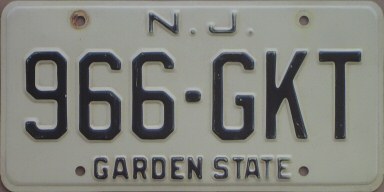
New Jerseybordered by Pennsylvania, Delaware, and New YorkNew Jersey made plates in this same style from 1959 until mid-1977, with the only real change during that time being the serial format switch from letters at the front to letters at the end. Evidence of current registration was provided by means of a windshield sticker. During 1977, for the first time ever, New Jersey began issuing plates with the state name spelled in full. |
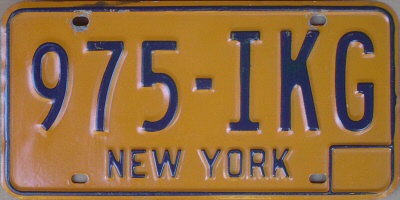 |
New Yorkbordered by Pennsylvania, New Jersey, Connecticut, Massachusetts, and Vermont (and Canada)New York used these obnoxious blue-on-orange plates from 1973 to 1986. Six-character serials were issued until 1980, and some letter suffixes were loosely assigned by county, although apparently IKG was not among these. The sticker box was never used; current registrations were indicated with windshield stickers. Because of this, and since serials weren't issued sequentially, there's usually no way to precisely identify when a particular plate was issued. |
 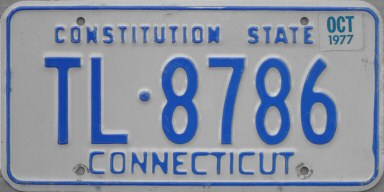 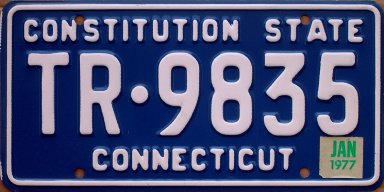 |
Connecticutbordered by New York, Rhode Island, and MassachusettsThe blue-background base with no slogan was issued 1957-1974 with several different numbering formats. I believe the one shown at top left was issued in 1972. Two other bases also in use in 1977 were the white-background base, introduced in 1974, and the blue-background Constitution State plate, introduced in 1976. The white-background plates were issued in the entire P and S series, and the T series from the TA prefix to partway through the TP prefix. They were replaced in 1991, while the blue-background versions stayed on the road until 2002. |
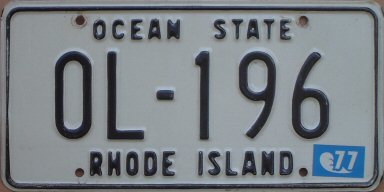 |
Rhode Islandbordered by Connecticut and MassachusettsThe black-on-white Ocean State base was issued and used from the early 1970s (my sources seem to disagree whether it was 1971, 1972, or 1973) through 1979. The most common serial format was xx-000, so the first character on the plate at left is the letter "O", not a zero. |
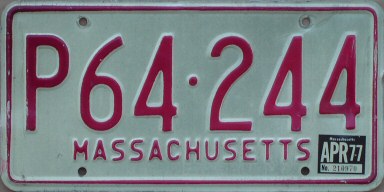 |
Massachusettsbordered by New York, Connecticut, Rhode Island, Vermont, and New HampshireThis red-on-white base was issued between 1972 and 1978 and could be renewed through 1983. Massachusetts began using two-year registration periods in 1969, and so a plate with a natural 1977 expiration would have normally been issued in 1975. The last numeric digit of the plate number corresponds to the expiration month, a method still used today. But back then, plates ending with letters X or Y would get November or December expiration months, regardless of the last numeric digit. Two different die sets, and serveral serial formats with either all numbers or a single letter, were used for this base. |
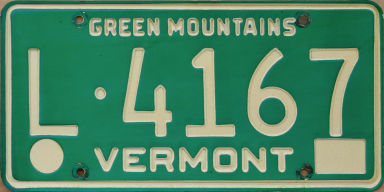 |
Vermontbordered by New York, Massachusetts, and New Hampshire (and Canada)Although not the last 1977 plate I needed for this set, this was probably the toughest among the 50 states to find. This is partly due to Vermont being a low-population state, and partly because this base plate was introduced and used without stickers in 1977, then renewed in subsequent years with stickers affixed in the lower right corner. Finding an unstickered plate used only in 1977 was a challenge. Anyway, plate numbers issued in 1977 could be all-numeric, or could have a single letter prefix or suffix. Later in the life of this base, two-letter prefixes and suffixes were issued. The round sticker well in the lower left corner was distinctive, but was never actually used for anything. |
 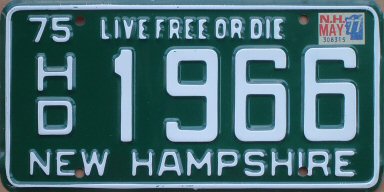 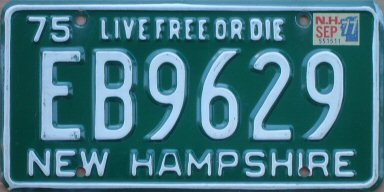 |
New Hampshirebordered by Massachusetts, Vermont, and Maine (and Canada)New Hampshire issued the 1975 base between 1975 and 1977, and it could be renewed through 1980. It came in four varieties of serial formats and dies. One variety had all-numeric serials of up to four digits. The others had two prefix letters coded to indicate the motorist's county. These three letter-prefix varieties included horizontal letters with up to three numeric digits and squared dies, issued mostly in 1975; vertical letters with four numeric digits, issued mostly in 1976; and horizontal letters with up to four numeric digits and rounded dies, issued mostly in 1977. Plates starting with the letter C were issued in Carroll County, those starting with the letter E were issued in Cheshire County, and those starting with the letter H were issued in Hillsboro County. |
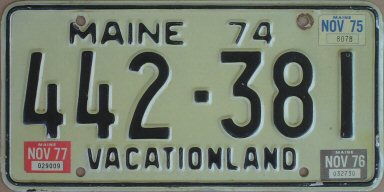  |
Mainebordered by New Hampshire (and Canada)The 1974 base plate shown at top left was obviously renewed several times. At the time, Maine instructed motorists to apply subsequent year stickers in each successive corner in a clockwise direction. The embossed year was absent from newly-issued Maine plates beginning in 1975. The undated base at bottom left is one of these; this one has a natural 1977 expiration. You'd think that the sticker should have been placed in either the upper right or lower left corners, but you'd be wrong. The state of Maine, in their wisdom, decreed that October 1975 through September 1976 stickers went in the upper right corner, October 1976 through September 1977 stickers went in the lower right, Octuber 1977 through September 1978 stickers went in the lower left, and so on. |
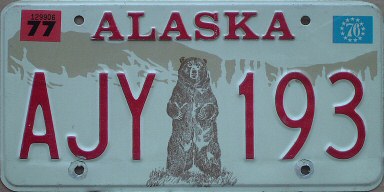 |
Alaska(bordered by Canada)This attractive graphic plate, featuring a standing bear, was introduced for the 1976 registration year and used through the early 1980s. It was quite different from any other Alaska plates before or since, at least until 2015 when the state came out with a similar but more colorful plate design. Otherwise, Alaska plates have pretty much always used the color blue along with yellow and/or white, and have usually featured the state flag. |
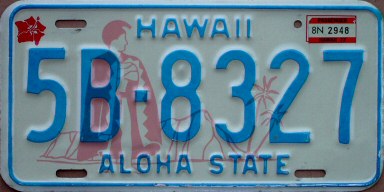 |
Hawaii(Pacific islands)This base plate was Hawaii's first graphic plate. I believe the pink background image is supposed to be of King Kamehameha. This design was introduced and used in 1976 without stickers, and was kept current with renewal stickers through 1980. This specific plate, like most Hawaii plates, is from Honolulu County. |
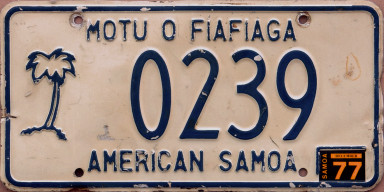  |
American Samoa(Pacific island)My understanding is that all American Samoa plates were replaced for 1977, and that they all had an etched "77" in the sticker box. However, I'm unclear about the use of 1977 registration stickers, which seem redundant. It's hard to get good information about plate usage over 45 years ago from such a remote plate. Nearly all 1977 American Samoa plates I've seen have been without stickers, yet here's one that does have such a sticker. While the unstickered plate was apparently never used, which could explain the lack of a sticker, I also have an obvioiusly used American Samoa taxi plate with the same etched "77" and no sticker. Maybe the stickers were applied only to rear plates, but if that's true, I would think there would be more of them out there. I've seen reports that the first digit of American Samoa passenger car plate numbers indicates the expiration month, but I've recently determined that that practice actually began on the 1980 base. Apparently plate numbers on the 1977 base never got as high as 4000. That would probably make this fairly high-numbered unstickered plate an unissued leftover, and would make the stickered plate an early issue. The 1977 sticker has the month December printed on it, but I don't know if they all expired in December or in various months. I assume they all expired in December since the 1978 and 1979 stickers don't have months printed on them. In any case, my current theory is that 1977 stickers were briefly issued for use on the dated 1977 plates, but this practice was discontinued partway through the year, because, assuming all registrations expired at the end of year, the stickers served no purpose since the year was also etched onto the plates themselves. But I don't have a lot of confidence in this theory. I believe the paint spatters on the unissued, unstickered passenger car plate are a manufacturing defect; the paint color appears to match that applied to the embossed characters. |
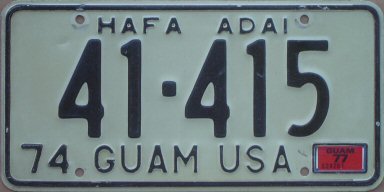 |
Guam(Pacific island)The island of Guam issued a dated 1974 base plate during the years 1974 to 1980, validating it with appropriate year stickers after 1974. Hafa Adai means "Hello" in Chamorro, the native language of the Mariana islands, of which Guam is a part. |
 |
Canal Zone(bordered by Panama)The Canal Zone was a strip of land flanking the Panama Canal that was administered by the U.S. from 1903 to 1979. A 1977 treaty between the U.S. and Panama returned jurisdiciton of the Canal Zone to Panama in 1979, and turned over operation of the canal itself in 1999. Note that the legend on the plate is written in English, rather than Spanish, the language of Panama. |
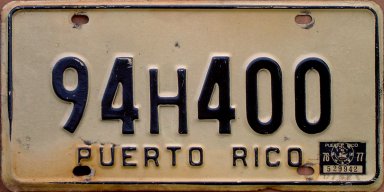 |
Puerto Rico(Carribean island)Until about 1990, Puerto Rican passenger car plates had annual registration periods that expired mid-year, and the plates and/or stickers usually indicated both the issue year and expiration year. This plain black-on-white base was introduced in 1973, and I believe issued through about 1979 and used until about the mid-1980s. This particular plate displays a 1976-77 validation sticker. |
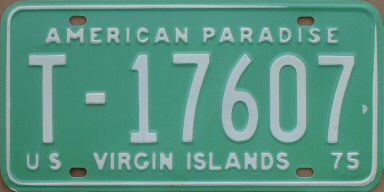 |
U.S. Virgin Islands(Carribean islands)Yes, I realize that this is a 1975 plate. However, the U.S. Virgin Islands used their dated 1975 plates for two additional years; proof of current registration for 1976 and 1977 was indicated via windsheild stickers. Single-letter serial prefixes were used for passenger car plates; the letters could be either C, J, or T, corresponding to the islands of St. Croix, St. John, and St. Thomas, respectively. That white smudge on the right side is a dab of paint with a fingerprint in it, no doubt from the manufacturing process. |
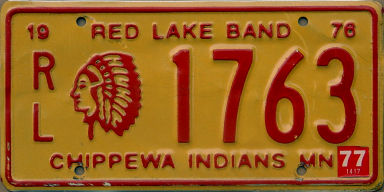 |
Red Lake Band of Chippewa IndiansMinnesotaAlthough this plate bears the abbreviation for the state of Minnesota, it was not made by or issued by the state, and looks nothing like a Minnesota state-issued plate. The reference to Minnesota merely identifies the location of the Red Lake Band reservation. As best as I can determine, the Red Lake Band was the first native American tribe to issue its own license plates, starting in 1974, and still the only tribe issuing plates in 1977. (Yes, the Seminole tribe of Florida had distinct plates much earlier than that, but they were made by the state of Florida and looked like other Florida plates.) The 1976 base was validated for one additional year with a 77 sticker. |
 |
U.S. Forces in Germany(West Germany)And finally this one, which, despite having USA stamped on it, was used outside of U.S. territory. It's debatable whether it even belongs on this page, but I chose to include it because, well, it certainly does look American, and it's the only plate from outside U.S. or Canadian territory shown on a color pictorial pamphlet put out by the U.S. Federal Highway Administration titled License Plates 1977. Anyway, these USA plates were once issued to members of the U.S. military for use on their personal vehicles while stationed in Germany. I suppose the German police did not want to have to keep track of license plates from 50+ different U.S. jurisdictions. These plates have extra-long bolt slots so that they can better accommodate either U.S.-spec or European-spec license plate brackets without having to drill holes in the plates. The black-on-green design was used between 1973 and 1983 and was validated annually with an expiration sticker as shown. The small text at the top of the sticker reads Expires (Verfaellt). I assume "verfaellt" is the German translation of the word "expires". |
Related pages on this site |
Elsewhere on the web |
Thanks to those who have directly contributed to the information on this page: Jeff Ellis.
This page is W3C valid |
